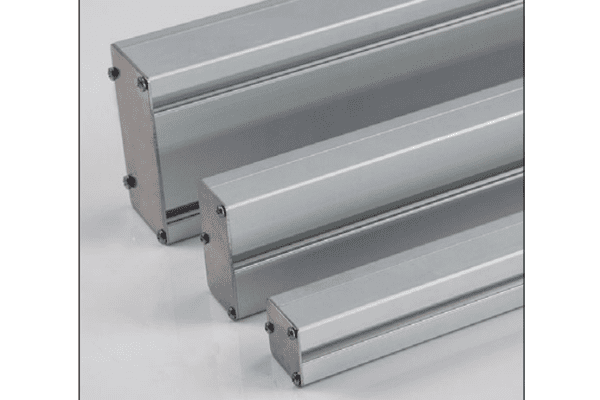
Aluminium Conduit End Cap
Snap-fit or screw-fixed end caps for aluminium conduit profiles from 40x40 to 80x200 mm, in PA6 or ABS, with blank, single or multi cable entry sized to standard glands.
| Material | PA6 nylon / ABS |
|---|---|
| Alloy Grade | Not applicable (polymer accessory) |
| Temper | custom |
| Section Size | 40x40 to 80x200 mm profile sections |
| Slot | Fits the open end face of conduit profiles |
| Length | Cap height 8-14 mm depending on section |
| Tolerance | ±0.3 mm on mating dimensions |
| Surface | Moulded, UV stabilised |
| MOQ | 500 |
| Lead Time | 15-25 days after deposit |
| Loading Port | Shanghai / Ningbo |
| Supply Ability | 300,000 pcs per month |
| Payment Terms | T/T 30% deposit + 70% before shipment | L/C at sight |
| Trade Terms | FOB | CIF | EXW |
| Certifications | ISO 9001:2015 | RoHS | REACH |
Profile accessories · Cable management
A conduit end cap closes the open end face of a hollow conduit profile. Its job is not decoration: it stops dust and swarf entering the internal cable channel, it removes the sharp extruded edge from the finished structure, and on the variants with a cable entry it becomes the strain-relief point where a cable leaves the profile and runs to the device.
Caps are supplied for the six conduit sections we hold — 40×40, 40×80, 60×120, 80×80, 80×160 and 80×200 mm — in PA6 nylon or ABS, in black, grey or a colour matched to the profile anodising. Snap-fit is standard; a screw-fixed version is available where the cap has to survive repeated removal or a pull on the cable.
What a conduit end cap actually has to do
Three requirements pull in different directions, and the compromise between them is what separates a cap that lasts from one that falls out in the first week.
The cap has to retain itself against vibration and against the weight of a cable hanging from it. It has to seal well enough to keep out the dust and coolant mist that are normal in a machine shop. And it has to look like part of the structure, because on a workstation or a display frame the profile end is visible at eye level.
A snap-fit cap with two moulded detent ribs satisfies the first two requirements on a clean, dry frame. Where the frame is washed down, or where the cable is pulled, the screw-fixed version is the one to specify.
| Profile section | Cap size | Cable entry | Typical use |
|---|---|---|---|
| 40 × 40 mm | 40 × 40 mm | 1 × Ø16 mm or blank | Sensor rails and light-duty cable runs |
| 40 × 80 mm | 40 × 80 mm | 1–2 × Ø16 mm or blank | Machine frame legs carrying control cable |
| 60 × 120 mm | 60 × 120 mm | 2 × Ø20 mm or blank | Main uprights with power and signal cable |
| 80 × 80 mm | 80 × 80 mm | 1 × Ø20 mm or blank | Heavy legs and gantry posts |
| 80 × 160 mm | 80 × 160 mm | 2–3 × Ø20 mm or blank | Central columns of large machine frames |
| 80 × 200 mm | 80 × 200 mm | 3 × Ø20 mm or blank | Structural columns with high cable count |
The cable entry is the detail that decides the cap
A blank cap is the cheapest and, in many frames, the right answer — the cable exits through a drilled hole in the profile side rather than the end. But where the cable has to leave the frame at the top of a leg, the entry in the cap is what stops the cable chafing on the extruded edge.
We mould the entry with a radiused lip rather than a sharp hole, and the entry can be sized to the cable gland the customer already uses. That matters more than it sounds: a Ø16 mm entry that matches an existing M16 gland removes a separate grommet from the bill of materials.
PA6 or ABS: which material belongs on which frame
- PA6 nylon is the default. It has enough flexibility for the detent ribs to snap over the extruded edge without cracking, and it resists oils, coolants and most workshop solvents.
- ABS is used where a very tight colour match to an anodised profile matters, because it takes pigment more uniformly. It is more brittle than PA6, so the detent is usually a little deeper to compensate.
- Both are supplied in a UV-stabilised grade for frames that stand near a window or outdoors, where an unstabilised cap will chalk within a season.
Fitting, and the two mistakes that show up later
- Deburr the profile end first A cap pushed onto a burred end sits proud on one side and leaves a visible gap. The cut ends we supply are already deburred, but site-cut members are not.
- Seat the cap square Push it in by hand until both detents engage, then check the gap line. A cap seated with a mallet can crack the rib.
- Fit the cable before the cap Route and dress the cable with the cap off, then fit the cap over it. Pulling the cable through a fitted cap is the single most common cause of a broken entry lip.
- Leave a service loop Where the cap is screw-fixed, leave 50 mm of slack inside the profile so the cap can be removed later without disconnecting the cable.
Practical point: if you are ordering profiles cut to a cut list for an OEM programme, tell us which members are visible and which carry cable. We will bag the caps with the matching members so the kit assembles without sorting.
Frequently asked questions
Will the cap fit a profile from another supplier?
Only if the outside dimensions and the internal wall thickness match. Caps are moulded to the specific section, so a 40×40 cap from one range will not seat on a 40×40 profile with a different wall thickness. Send us the section drawing and we will confirm the fit.
Can the cap be supplied in a colour to match the profile?
Yes. Black and grey are held as standard, and a colour matched to a specific anodising shade is available on moulded parts from around 2,000 pieces.
Is the cap strong enough to take a cable gland?
The screw-fixed version is. A gland tightened into a snap-fit cap can pull the cap off the profile, so where a gland or conduit connector is used we supply the cap with two fixing screws.
Do the caps have to be removed to run cable?
No, but it is much easier. Route and dress the cable with the cap off, then fit the cap over it, rather than pulling the cable through a fitted entry.
What temperature will the caps withstand?
PA6 is rated to about 90 °C continuous and ABS to about 70 °C. Both are well inside the range of a normal machine frame, but a cap next to a heat source should be specified in PA6.
Send the section drawing and we will match the cap
Tell us the conduit section, whether the cable exits through the end, and the gland you use. We will confirm the cap, the entry size and FOB pricing within one working day.
Request a QuoteRelated Products
 Aluminium Profile End Cap
Push-fit end caps for T-slot framing profiles from 15 to 60 series, sized to…
 T-Slot Reducing Profile
Reducing insert that narrows a wide T-slot to accept standard nuts and accessories from…
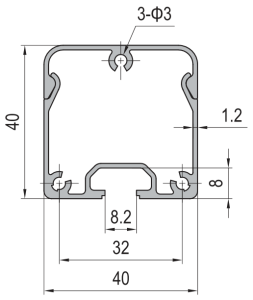 Aluminium Conduit Profile 40×40 mm Cable Duct T-Slot Enclosure
40 x 40 mm aluminium conduit profile in 6063-T5 with a 32 x 8.2…
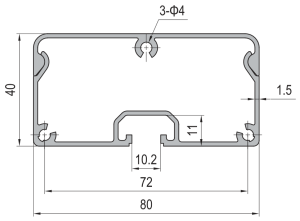 Aluminium Conduit Profile 40×80 mm Large Cable Duct Enclosure
40 x 80 mm aluminium conduit profile in 6063-T5 with a 66 x 11…
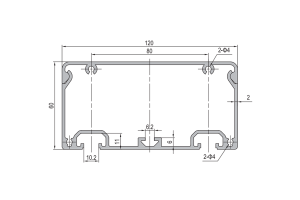 Aluminium Conduit Profile 120×60 mm Cable Duct Extrusion 2 mm Wall for Machine Wiring
120 x 60 mm aluminium conduit profile duct in 6063-T5 with a 2 mm…
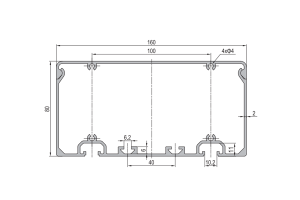 Aluminium Conduit Profile 160×80 mm Cable Duct Extrusion with Two Sided Mounting for Machine Frames
160 x 80 mm aluminium conduit profile duct in 6063-T5 with a 2 mm…
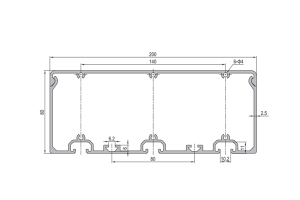 Aluminium Conduit Profile 200×80 mm Cable Duct Extrusion 2.5 mm Wall for Long Production Line Runs
200 x 80 mm aluminium conduit profile duct in 6063-T5 with a 2.5 mm…
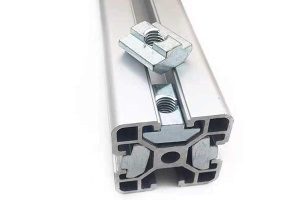 T-Nut and Bolt Set Aluminium Profile Fastener Kit M5 M6 M8 20-40 mm T-Slot Hardware
Matched T-nut, bolt and washer set for aluminium profile frames in M5, M6 and…
