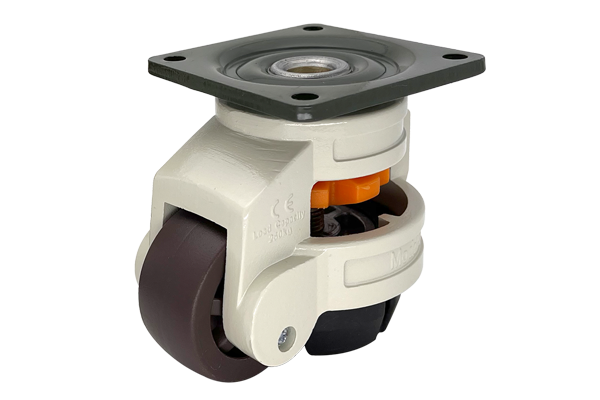
Levelling Castor
Combined castor and levelling foot: move the frame on the wheel, then wind the pad down to lift the wheel clear and stand the frame level on fixed pads.
| Material | Zinc-plated steel bracket; polyurethane or nylon wheel; nylon or rubber pad |
|---|---|
| Alloy Grade | Aluminium core on heavy-duty wheels |
| Temper | custom |
| Section Size | Wheel Ø50-125 mm |
| Slot | Plate 60x60 / 100x100 mm or thread stem M12 / M16 |
| Length | Overall height 85-160 mm; pad travel 12-20 mm |
| Tolerance | ±0.5 mm on plate hole pattern |
| Surface | Zinc plated; stainless option |
| MOQ | 100 |
| Lead Time | 20-30 days after deposit |
| Loading Port | Shanghai / Ningbo |
| Supply Ability | 30,000 pcs per month |
| Payment Terms | T/T 30% deposit + 70% before shipment | L/C at sight |
| Trade Terms | FOB | CIF | EXW |
| Certifications | ISO 9001:2015 | ISO 14001 | RoHS | REACH |
Floor elements · Move and level
A levelling castor combines a wheel and a levelling foot in one unit. The frame is moved on the wheel; once it is in position, a threaded pad is wound down until it takes the load and lifts the wheel clear of the floor. The frame is then standing on four fixed pads — level, and no longer able to roll.
This solves the problem that a plain castor creates: a frame on castors is never really still. It rolls, it needs brakes on every wheel, and even braked it sits on resilient wheels that let it move under a sideways push. Winding the pad down takes the load off the wheels entirely, so the frame behaves as if it were on fixed feet while keeping the ability to be moved again.
The trade a levelling castor makes
Nothing is free, and the trade here is height and cost. A levelling castor is taller than either a castor or a foot alone, because it has to contain the wheel, the swivel, and the threaded pad and its adjustment travel. It is also more expensive than a castor plus a separate foot.
What it buys is a frame that is genuinely stable when it is parked and genuinely mobile when it is not, without a separate set of feet that have to be wound down by hand and stored. On a machine that is repositioned between jobs, or on a workstation that is moved for cleaning, that is usually worth both the height and the cost.
| Wheel Ø | Pad travel | Load per unit | Overall height | Typical use |
|---|---|---|---|---|
| 50 mm | 12 mm | 300 kg | 85 mm | Light workstations and benches |
| 75 mm | 15 mm | 500 kg | 110 mm | Assembly benches and kit carts |
| 100 mm | 18 mm | 700 kg | 135 mm | Machine frames and heavy benches |
| 125 mm | 20 mm | 1,000 kg | 160 mm | Heavy machinery and gantries |
How the changeover works
- Move. The pad is wound up, clear of the floor, and the frame runs on the wheels. The wheels swivel, so the frame can be steered in any direction.
- Position. Push the frame to where it is wanted. Because the frame is still on wheels, small adjustments are easy at this stage.
- Wind down. Turn the adjustment nut on each unit until the pad contacts the floor and the wheel lifts clear. Do this corner by corner, checking the level as you go.
- Level. Once all four pads are down, fine-tune the adjustment to bring the frame level. The wheels are now off the floor and the frame is on four fixed pads.
- Reverse to move again. Wind the pads up, and the wheels take the load. No tools are needed, and the pads stay with the frame.
Choosing the wheel and the pad
Practical point: a levelling castor adds about 35 mm to the frame height compared with a plain castor of the same wheel size. If the frame height is fixed, that has to be taken off the leg length at the design stage — it is much easier than discovering it when the frame is built.
Frequently asked questions
How much weight can a levelling castor take?
Up to about 1,000 kg per unit on the largest size, static and with the pad wound down. While the frame is being moved, the load is on the wheel, and the wheel rating applies instead.
Do I still need brakes?
Not for parking, because the pads take the load and the frame cannot roll. Brakes are still useful while the frame is being moved and positioned.
Can the frame be moved while the pads are down?
No. The pads have to be wound up first, which is deliberate — it prevents the frame being dragged on its pads and damaging them.
Does the pad mark the floor?
A nylon or rubber pad does not mark epoxy, vinyl or painted floors. On a very smooth floor, a rubber pad grips better than nylon.
How much height does it add?
About 35 mm over a plain castor of the same wheel diameter, because the unit has to contain both the wheel and the threaded pad.
Tell us the frame height and how often it moves
Send the frame height budget, the loaded weight and how often the frame is moved. We will return the unit, the height it adds and FOB pricing within one working day.
Request a QuoteRelated Products
 Foot Mounting Plate
Adapter plate bolted to the end of a profile leg that presents a standard…
 Foot and Castor Components
Spare and replacement components for foot and castor installations — pads, stems, locking nuts,…
 Aluminium Profile Castors
Castors for aluminium profile frames in seven configurations — plate fixed, swivel, braked and…
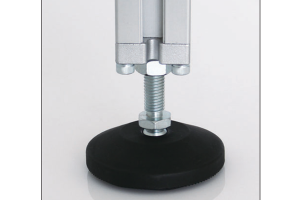 Swivel Ball Foot
Self-aligning levelling foot with a ball-and-socket joint between stem and pad, keeping the pad…
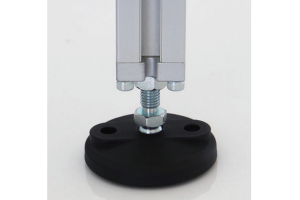 Swivel Foot with Mounting Holes
Levelling foot with a drilled base pad so the frame can be anchored to…
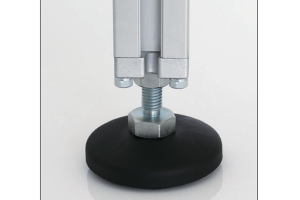 Nylon Pivot Foot
Levelling foot with a moulded PA6 nylon pivot joint and base, selected for vibration…
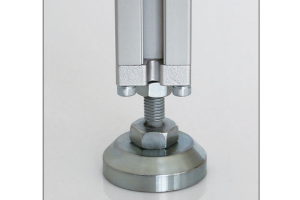 Metal Pivot Foot
Heavy-duty levelling foot with a steel or stainless pivot joint and base, for frames…
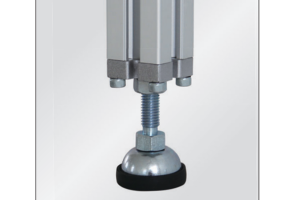 Cup Pivot Foot
Levelling foot moulded as a shallow cup that the profile end seats into, giving…
