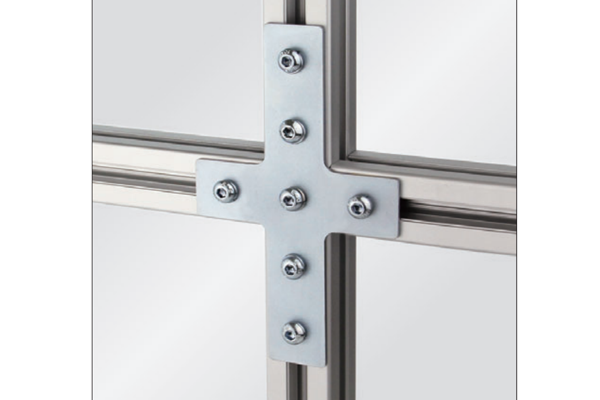
Joining Plate PG40-4040
Joining plate sized for two 40 × 40 mm profiles meeting at 90°, the standard corner joint in aluminium framing, normally fitted as a pair on the two visible faces.
| Material | Die-cast aluminium ADC12 or machined 6063-T5 |
|---|---|
| Alloy Grade | ADC12 die-cast or 6063-T5 |
| Temper | custom |
| Section Size | 40 x 40 mm profiles at 90 degrees |
| Slot | 8 mm slot; 2 + 2 M8 T-nuts (3 + 3 heavy) |
| Length | Plate 80 x 80 x 40 mm |
| Tolerance | ±0.25 mm on bolt slot positions |
| Surface | Anodised or powder coated |
| MOQ | 500 |
| Lead Time | 15-25 days after deposit |
| Loading Port | Shanghai / Ningbo |
| Supply Ability | 400,000 pcs per month |
| Payment Terms | T/T 30% deposit + 70% before shipment | L/C at sight |
| Trade Terms | FOB | CIF | EXW |
| Certifications | ISO 9001:2015 | ISO 14001 | RoHS | REACH |
Joining plates · 40 × 40 corner
This plate joins two 40 × 40 mm profiles at 90°, and it is the single most common joint in an aluminium frame. Every leg-to-rail connection in a typical 40 series frame is this joint, which is why the plate is made in the largest quantity and why getting it right matters more than any other joint in the frame.
The plate is normally supplied and fitted as a pair: one on each of the two visible faces of the corner. A single plate holds the joint together and locates it, but it resists rotation about the line of the bolts only weakly. Two plates, one on each face, put the corner in double shear and make it stiff in both directions.
What happens inside a 40 × 40 corner joint under load
- The bolts clamp, the plate bears. Tightening the M8 bolts draws the T-nuts against the inside of the slot and clamps the plate to the profile face. The joint is held by friction, and the plate spreads the load over the face so the profile is not crushed locally.
- A moment tries to rotate the corner. Any load that is offset from the corner — a shelf, a cantilever, a machine pushing sideways — puts a moment into the joint. With one plate, that moment is resisted by the bolts and by the plate bearing on the face; the corner rotates slightly.
- A second plate doubles the resistance. With a plate on each face, the moment is carried by the two plates in opposing tension and compression, which is a much stiffer arrangement than one plate alone.
- Shear goes through the bolts. A vertical load on the rail is carried in shear by the bolts in the slot. Two bolts per leg is the minimum; three is used where the joint is loaded.
- Cut both members square A plate cannot correct an out-of-square cut. Cut the 40 × 40 members square to within 0.2 mm.
- Set four T-nuts Two M8 T-nuts in the slot of each member, slid to the plate bolt positions. On a corner joint, the T-nuts go in the slot that faces the plate.
- Fit the first plate and check square Bolt the first plate to one member finger-tight, offer the second member up, and check the corner with a square before tightening.
- Fit the second plate Fit the second plate on the other visible face. This is the step that turns a locating joint into a stiff one.
- Torque in two diagonal passes Tighten all bolts to around 20 Nm in two passes, diagonally, alternating between the two plates so the corner is not pulled out of square.
| Joint condition | Plates | Bolts per plate | Comment |
|---|---|---|---|
| Unloaded corner, light frame | 1 | 2 + 2 | Locating and holding only |
| General machine frame corner | 2 | 2 + 2 | The normal specification |
| Loaded or vibrating corner | 2 | 3 + 3 | Heavy plate variant |
| Corner with a cantilever | 2 + brace | 3 + 3 | Add a diagonal brace |
| Base corner of a tall frame | 2 + brace | 3 + 3 | Brace the base corners first |
Why a pair, and when one is enough
A single plate on one face of a 40 × 40 corner is a hinge: it holds the two members together and stops them separating, but it lets the corner rotate about the line of its bolts. On a frame that is only carrying its own weight, that rotation is negligible. On a frame that is pushed, or that carries a machine, it is the difference between a rigid frame and one that flexes at every corner.
The rule we use is that a structural corner gets a plate on each face. A corner that is only locating a cover or a panel can have one. If in doubt, two plates cost very little and they are fitted with the same bolts and the same tool.
Practical point: order the plates with the frame, not after it. The plate count for a frame is easy to get wrong from a drawing, and running short on a two-plate-per-corner specification stops the build. We will count the joints from your drawing and quote the exact plate and bolt quantity.
Frequently asked questions
Do I need one plate or two at each corner?
For a structural corner, two — one on each visible face. A single plate locates the joint but lets the corner rotate about the bolt line, which shows up as a flexible frame.
How many bolts per plate?
Two M8 bolts per leg as standard, three per leg on the heavy variant used for loaded or vibrating corners.
What torque should the bolts be?
Around 20 Nm for an M8 T-nut in a 40 series slot. Tighten in two diagonal passes so the corner stays square.
Will the plate work on a 40 × 80 profile?
The 4040 plate is sized for the 40 × 40 section. A 40 × 80 leg takes the 4080 plate, which has a longer leg to suit the wider member.
Can the plates be powder coated to match the frame?
Yes. Standard finishes are natural anodised, black and grey, and a colour to match a powder-coated frame is available from around 2,000 pieces.
Send the frame drawing and we will count the corners
Send the frame drawing or the joint list. We will count the 40 × 40 corners, tell you where a pair is needed and where a brace is needed, and return FOB pricing within one working day.
Request a QuoteRelated Products
 Joining Plate PG40-4080
Transition joining plate that joins a 40 mm member to an 80 mm member…
 Joining Plate PG40-8080
Heavy joining plate for two 80 mm profiles at 90°, a structural corner joint…
 Joining Plate PG45-4545
Joining plate for two 45 × 45 mm profiles at 90°, sized to the…
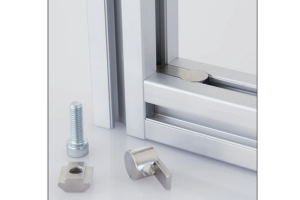 Butt Connector
Connector that joins two profiles end to end in a straight line, transmitting bending…
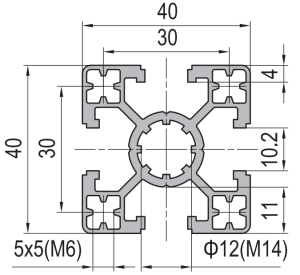 Strut Aluminium Profile 40×40 mm 4-Slot T-Slot Extrusion Machine Frame
40 x 40 mm four-slot T-slot strut aluminium profile in 6063-T5 with M6 slots…
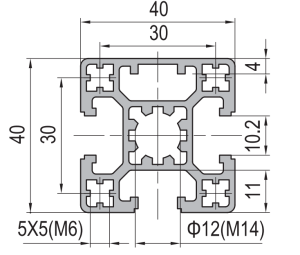 Strut Aluminium Profile 40×40 mm 3-Slot T-Slot Extrusion Closed Face
40 x 40 mm three-slot T-slot strut aluminium profile in 6063-T5 with one solid…
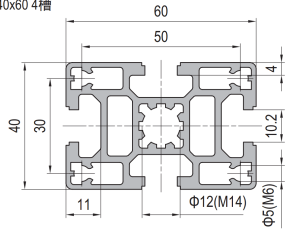 Strut Aluminium Profile 40×60 mm 4-Slot Rectangular T-Slot Extrusion
40 x 60 mm four-slot rectangular T-slot strut aluminium profile in 6063-T5 with M6…
 Aluminium Angle Profile 40x40x5 mm 6061 T6 Extruded Structural Angle
40 x 40 x 5 mm equal leg extruded structural aluminium angle in 6061-T6,…
