Strut Aluminium Profile 30×120 mm 3-Slot Wide Beam T-Slot Extrusion
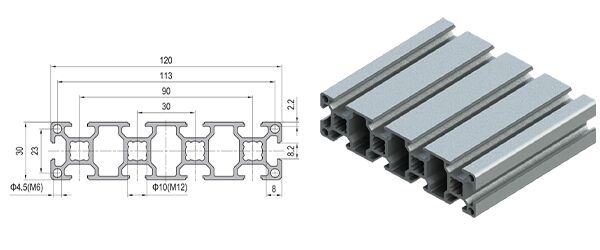
30 x 120 mm three-slot wide-beam T-slot strut aluminium profile in 6063-T5 with three M5 slots on a 30 mm pitch and a O 10 mm centre bore tapped M12. A flat cross member for bench top supports, shelf rails and wide mounting faces.
| Material | Aluminium |
|---|---|
| Alloy Grade | 6063-T5 |
| Temper | T5 |
| Section Size | 120 x 30 mm |
| Slot | M5 groove, 4.5 x 4.5 mm, 3 slots, 30 mm pitch |
| Length | 6 m stock, cut to drawing to plus or minus 0.5 mm |
| Tolerance | EN 755-9 / GB/T 6892, wall plus or minus 0.15 mm |
| Surface | Mill finish / clear anodised / black anodised |
| MOQ | 300 |
| Lead Time | 22-35 days after deposit for mill finish |
| Loading Port | Shanghai |
| Supply Ability | 300 t per month |
| Payment Terms | T/T 30% deposit + 70% before shipment | L/C at sight |
| Trade Terms | FOB | CIF | EXW |
| Certifications | ISO 9001:2015 | EN 755-9 | RoHS | REACH |
Wide beam · 30 series
A 30 x 120 three-slot strut profile is a wide, shallow T-slot aluminium extrusion measuring 120 mm across the face and 30 mm deep, with three M5 slots side by side on a 30 mm pitch and a O 10 mm centre bore tapped M12. It weighs about 3.10 kg/m. It is a cross member rather than a frame member: the section is used as a bench top support, a shelf rail, a table cross beam or a wide mounting plane, wherever a member has to offer several fixing lines across its width and take almost no height out of the assembly.
The width is the point. Three slots on a 30 mm pitch give three independent fixing lines across 120 mm, so a bench top, a panel or a sub-frame can be fastened at three places along the same member instead of being bracketed from the edges. What the section does not offer is stiffness per kilogram: laid flat it works at a depth of only 30 mm, so a 40 x 60 four-slot turned on edge is about twice as stiff for about 18 per cent less weight. Buy the 30 x 120 for its width and its flat profile, and use a deeper section when the job is bending.
A beam, not a column
Most T-slot sections are square because a square section is a compromise: it behaves acceptably as a column, as a beam and as a frame member, and it is easy to join on any face. A 30 x 120 gives that compromise up deliberately. It is ten times stiffer about one axis than the other, which makes it excellent in one role and poor in another, and the whole selection decision is about knowing which one the drawing needs.
The table below puts the section next to the alternatives at similar weight. The comparison is deliberately unflattering, because the reason to specify a 30 x 120 is not the number in the stiffness column.
| Section | Depth against the load | Moment of inertia | Weight | Where it belongs |
|---|---|---|---|---|
| 30 x 30 four slot | 30 mm | approx. 3.0 cm4 | approx. 1.15 kg/m | Small frame member |
| 30 x 120 three slot, flat | 30 mm | approx. 12 cm4 | approx. 3.10 kg/m | Bench top support, cross rail |
| 30 x 120 three slot, in plane | 120 mm | approx. 115 cm4 | approx. 3.10 kg/m | Horizontal rail pushed sideways |
| 40 x 60 four slot, on edge | 60 mm | approx. 24 cm4 | approx. 2.55 kg/m | Beam on a small footprint |
| 60 x 60 four slot | 60 mm | approx. 42 cm4 | approx. 3.60 kg/m | Column and general beam |
Read the table this way: loaded flat, the 30 x 120 gives about 12 cm4 for 3.10 kg/m. A 40 x 60 on edge gives about twice that for 2.55 kg/m. If the only requirement is bending stiffness, the 30 x 120 is the wrong purchase. If the requirement is three fixing lines across a 120 mm face in a member only 30 mm tall, nothing else in the range does it.
Three slots side by side: what the width is for
Why it is not a column
- Buckling comes first. A column loaded in compression fails by buckling about its weaker axis, and this section is nearly ten times weaker about one axis than the other. It would bow sideways long before the aluminium reached its compressive strength, so the load it can carry as a column is far below what its cross-sectional area suggests.
- The 30 mm faces have no slot. A column has to accept beams and brackets on several faces. The two 30 mm edges of this section are plain, so connections are limited to the wide face and the two ends, which is exactly the wrong distribution for a column.
- Height. A column sets the height of the frame. A 30 mm tall column would put the structure almost on the floor and leave no room for feet, cross bracing or a base plate.
- The right split. Use a square section for the columns, 60 x 60 or 40 x 40, and use the 30 x 120 as the cross member that ties the tops together and carries the bench surface. That is the arrangement the section was drawn for.
Specifying a wide beam
- Say which way the load comes in The same section gives 12 cm4 or 115 cm4 depending on orientation, so a drawing that shows the profile without showing the load direction is not enough to quote from. Mark the load direction and the support points on the layout.
- Fix the support spacing, not just the span A flat 30 x 120 under a bench top is usually supported at both ends and loaded along its length. Give the support positions and the distributed load, and we will confirm the deflection rather than quoting a section that looks right.
- Give the fixing positions on the face With three slots on a 30 mm pitch there is a choice about which slot each fixing goes into. Put the fixing positions on the drawing so the tapped ends and the counterbores land in the right slot.
- Plan for the weight At about 3.10 kg/m a 6 m length is roughly 18.6 kg and a bundle is a two-person lift. Tell us the longest piece in the cut list and we will bundle and label it so it can be handled on site.
- State the finish Mill finish is standard. A wide visible face is often the reason for this section, so where the beam is on show, anodise the whole order in one batch to keep the colour consistent between lengths.
Fixing and finishing a wide beam
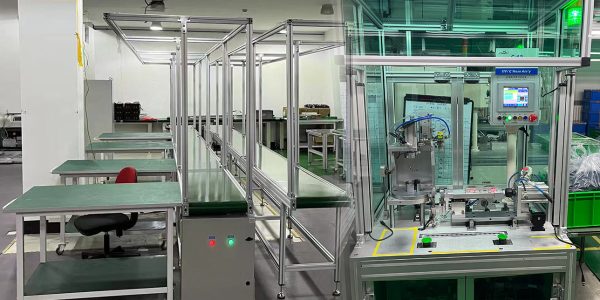
The three M5 slots take standard T-slot nuts. Where the beam meets a column, a joining plate or a heavy angle bracket spreads the load across the wide face rather than concentrating it in one slot. The M12 centre bore takes a long through-bolt where the beam has to be pulled hard against an end plate, and it can also be used as a threaded anchor for a rod or a foot.
Bench surfaces are usually fixed straight into the slots with panel mounting blocks, and the open slots closed with cover strip where the beam is visible. Where the beam carries a guard or an enclosure, a panel installation element keeps the panel off the anodised face and avoids drilling it.
Frequently asked questions
Is a 30 x 120 profile strong enough to use as a beam?
Yes, provided it is loaded in the right direction and the span is short. Laid flat it works at a depth of 30 mm and gives about 12 cm4, so it suits bench top supports and short cross rails rather than long spans. For pure bending, a deeper section is more efficient per kilogram.
Can I use it as a column or a leg?
No. It is nearly ten times weaker about one axis, so it buckles sideways long before it reaches its compressive strength, and its 30 mm faces have no slot for beam connections. Use a square section for columns and this section for the cross members.
How many fixing lines do the three slots give me?
Three lines across the 120 mm face on a 30 mm pitch, plus the two ends and the M12 centre bore. That is the main reason to choose it over a square section of similar weight.
What lengths and cut tolerance do you supply?
6 m stock, cut to drawing to plus or minus 0.5 mm and deburred. At about 3.10 kg/m a 6 m length is roughly 18.6 kg, so we bundle and label long pieces for safe handling.
Do you machine the ends and tap the centre bore?
Yes. We tap the M12 centre bore and slot ends, drill and counterbore for brackets and plates, and machine mitres and notches on CNC centres. Send DWG, DXF, STEP or PDF and we quote from the drawing.
Send the layout, get an orientation check and a price
Tell us the load direction, the support spacing and the fixing positions on the wide face. We will confirm that the section works in that orientation or suggest a deeper member, then quote the cut list, the machining and FOB pricing with the beams cut and labelled.
Request a QuoteRelated Products
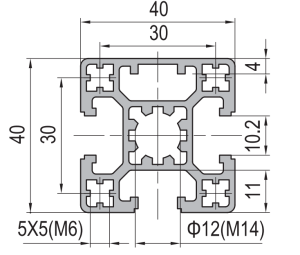 Strut Aluminium Profile 40×40 mm 3-Slot T-Slot Extrusion Closed Face
40 x 40 mm three-slot T-slot strut aluminium profile in 6063-T5 with one solid…
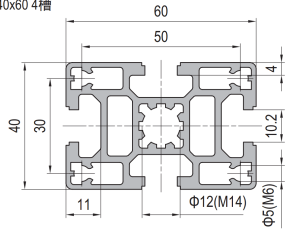 Strut Aluminium Profile 40×60 mm 4-Slot Rectangular T-Slot Extrusion
40 x 60 mm four-slot rectangular T-slot strut aluminium profile in 6063-T5 with M6…
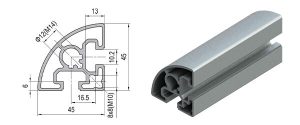 Radius Corner Aluminium Profile 45×45 mm Quarter Round Trim Section
45 x 45 mm quarter-round radius corner aluminium trim section in 6063-T5 with an…
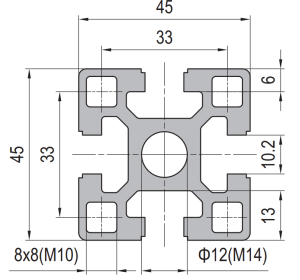 Strut Aluminium Profile 45×45 mm 4-Slot Heavy Duty T-Slot Extrusion
45 x 45 mm heavy duty four-slot T-slot strut aluminium profile in 6063-T5 with…
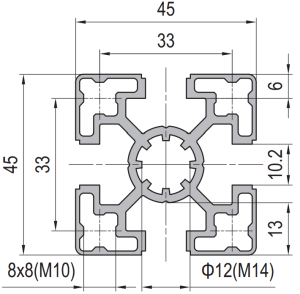 Strut Aluminium Profile 45×45 mm 4-Slot Light T-Slot Extrusion
45 x 45 mm light wall four-slot T-slot strut aluminium profile in 6063-T5 with…
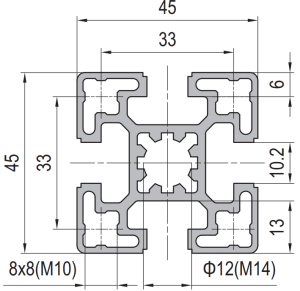 Strut Aluminium Profile 45×45 mm 4-Slot Standard T-Slot Extrusion
45 x 45 mm four-slot standard T-slot strut aluminium profile in 6063-T5 with walls…
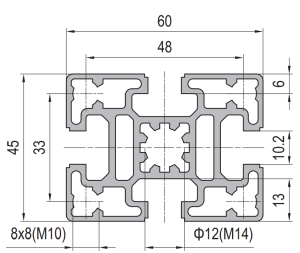 Strut Aluminium Profile 45×60 mm 4-Slot Column T-Slot Extrusion
45 x 60 mm four-slot rectangular T-slot strut aluminium profile in 6063-T5, about 3.3…
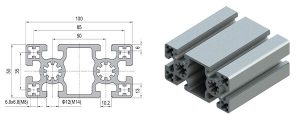 Strut Aluminium Profile 50×100 mm 2-Slot Heavy T-Slot Beam Extrusion
50 x 100 mm heavy two-slot T-slot strut aluminium beam in 6063-T5, about 6.2…
