Strut Aluminium Profile 40×40 mm 3-Slot T-Slot Extrusion Closed Face
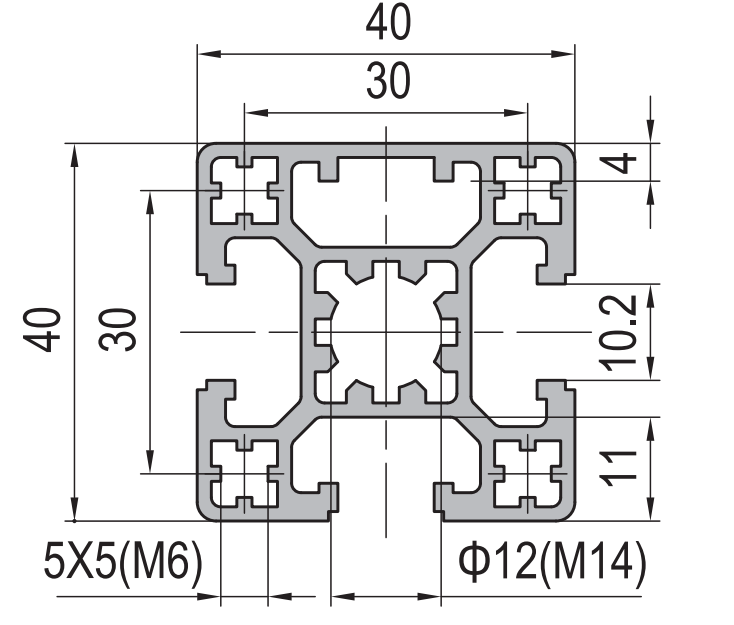
40 x 40 mm three-slot T-slot strut aluminium profile in 6063-T5 with one solid closed face, M6 slots on the other three faces and an M14 centre bore. For sealed, wipeable or labelled outward faces on guards and enclosures.
| Material | Aluminium |
|---|---|
| Alloy Grade | 6063-T5 |
| Temper | T5 |
| Section Size | 40 x 40 mm |
| Slot | M6 slot, 8 mm mouth, 3 slots, 30 mm pitch, one closed face |
| Length | 6 m stock, cut to drawing to plus or minus 0.5 mm |
| Tolerance | EN 755-9 / GB/T 6892, wall plus or minus 0.15 mm |
| Surface | Mill finish / clear anodised / black anodised |
| MOQ | 500 |
| Lead Time | 15-25 days after deposit for mill finish |
| Loading Port | Shanghai / Ningbo |
| Supply Ability | 620 t per month |
| Payment Terms | T/T 30% deposit + 70% before shipment | L/C at sight |
| Trade Terms | FOB | CIF | EXW |
| Certifications | ISO 9001:2015 | EN 755-9 | RoHS | REACH |
Closed face · 40 series
A 40 x 40 three-slot strut profile is a 40 mm square T-slot extrusion with slots on three faces and one solid, closed face. It carries the same M6 slot geometry and the same O 12 mm centre bore tapped M14 as the four-slot version, and weighs about 1.70 kg/m. It is specified when one side of the member has to be a continuous flat surface rather than an open groove: a face for a gasket, a face that can be wiped clean, a face for a label or a logo, or a face that acts as an assembly reference.
The closed face is a feature, not a shortage. A bolt cannot enter from it, and that is the whole point: nothing can enter from it, including dust, wash water and the operator’s fingers. The cost is one fixing line and one direction of accessory access, plus a section that is no longer symmetrical, so the drawing has to say which face is closed and the assembly has to keep it consistent. Where none of that matters, the four-slot 40 x 40 is the more flexible member.
What a closed face is actually for
On a four-slot section every face is a groove, and a groove is a dirt trap and a leak path. That is fine on a machine base, where nobody looks and nothing is washed. It is not fine on an enclosure that has to be sealed, a piece of equipment that is hosed down, or a frame that a customer sees every day. The closed face solves four different problems with the same piece of geometry.
What you give up
Three slots instead of four is a real reduction in flexibility, and it is worth being explicit about it rather than discovering it during assembly.
- One fixing line per corner. A four-slot corner can be pulled from all four directions. A three-slot corner has one side that can only be fixed from the member it meets, so the joint detail has to be designed around the closed face rather than adapted to it on site.
- Accessory access from three sides only. A T-slot nut is either slid in from the end of the member or dropped in at a slot opening. With one face closed there is one fewer direction for that, and on a long frame where the member is already fixed, it is the difference between dropping a nut in and dismantling the joint.
- No cable exit through that face. Cable run inside the section can leave through an open slot or a machined hole. Through the closed face it has to be drilled, which breaks the anodising and, on a sealed enclosure, the seal.
- A section that has a right way round. The closed wall is thicker than a slotted wall, so the section is slightly asymmetric: about 8.6 cm4 about the axis through the closed face against about 9.4 cm4 about the perpendicular axis. More visibly, a frame built with one member turned the wrong way will show a slot where the rest of the frame shows a flat face.
| Property | 40 x 40 three slot | 40 x 40 four slot |
|---|---|---|
| Slots | 3 | 4 |
| Closed faces | 1 | none |
| Slot | M6, 8 mm mouth | M6, 8 mm mouth |
| Slot pitch | 30 mm | 30 mm |
| Centre bore | O 12 mm, tapped M14 | O 12 mm, tapped M14 |
| Moment of inertia, closed-face axis | approx. 8.6 cm4 | approx. 9.2 cm4 |
| Moment of inertia, other axis | approx. 9.4 cm4 | approx. 9.2 cm4 |
| Weight | approx. 1.70 kg/m | approx. 1.75 kg/m |
| Sealable face | one, end to end | none without cover strip |
Orientation: the closed face has to be planned
- Decide which face is outward and say so on the drawing Mark the closed face on the section view and on the layout. A supplier who is not told will treat the section as symmetrical, and a machinist who is not told will drill the closed face because it is the flat one.
- Keep it consistent within a frame A frame has two sides and a customer can see both. If the closed faces are not kept on the same plane, the frame looks wrong from one end and the mistake cannot be corrected without rebuilding it.
- Use the closed face for the seal, the slots for the structure The usual detail is the closed face outboard and carrying the gasket, with all the structural connections made on the three slotted faces inside the frame. That keeps the seal line continuous and the fasteners hidden.
- Drill the closed face before anodising, or mask it Any hole through the closed face is a break in the anodising and, on a sealed enclosure, in the seal. Put those holes in the machining drawing so they are cut with the rest of the work and the area can be masked or the cut edges sealed.
- Order cover strip for the three open slots If the frame is visible and the closed face is the reason for the choice, the three open slots should be closed with cover strip so the whole frame reads as flat faces. Mixing one flat face with three open grooves defeats the purpose.
Quick test: if the answer to “does anything have to be sealed, wiped, labelled or measured against this face?” is yes, specify the three-slot section and plan the orientation. If the answer is no, the four-slot section costs almost the same and is easier to build with.
Fixing and finishing the three-slot section
The three M6 slots take standard T-slot nuts, and corners are normally made with an angle bracket or a joining plate on the slotted faces. The closed face is not part of the joint, which is an advantage in a sealed assembly: the fasteners stay inside the enclosure and the outside stays a smooth, wipeable plane.
Feet and floor connections use a base plate or a levelling foot on the slotted faces. Panels are held with panel mounting elements where the panel is structural, and with a gasket against the closed face where the panel has to seal. Anodising is where the closed face earns its money: a 40 mm flat plane anodised in one batch gives a uniform, scratch-resistant outer surface that a slotted face cannot match.

Frequently asked questions
Can I still bolt through the closed face of a three-slot profile?
You can drill and machine it, and we do that to drawing, but there is no slot and no T-slot nut access, so the connection has to be a through-bolt or a tapped hole rather than a slot fixing. If the joint needs slot adjustment, make it on one of the three slotted faces.
What is a closed face actually used for?
A continuous flat surface for a gasket or sealant bead, a wipeable outer face for food, pharmaceutical and cleanroom equipment, a flat area for labels and screen-printed graphics, and a positive datum for squaring the frame during assembly.
Is the three-slot section weaker than the four-slot version?
No. It weighs about 1.70 kg/m against 1.75 kg/m and its stiffness is comparable: about 8.6 cm4 about the axis through the closed face and about 9.4 cm4 about the other, against about 9.2 cm4 both ways for the four-slot section.
Does the closed face change how the accessories fit?
The three slotted faces take the same 40-series T-slot nuts, brackets, feet and panel fixings as the four-slot section. The only difference is that one direction of access is closed, so accessories have to be loaded from the end of the member or through an open slot.
Can you supply it cut, tapped, drilled and anodised?
Yes. We cut to plus or minus 0.5 mm, deburr, tap the M14 centre bore and slot ends, drill and counterbore to drawing, and supply mill, clear anodised or black anodised. Send DWG, DXF, STEP or PDF.
Send the section drawing with the closed face marked
Tell us which face has to be solid and what it has to do, whether that is sealing, wiping or carrying a label. We will confirm the section, plan the orientation with you and quote the cut list, the machining and FOB pricing, with the closed faces protected in transit.
Request a QuoteRelated Products
 Strut Aluminium Profile 40×60 mm 4-Slot Rectangular T-Slot Extrusion
40 x 60 mm four-slot rectangular T-slot strut aluminium profile in 6063-T5 with M6…
 Radius Corner Aluminium Profile 45×45 mm Quarter Round Trim Section
45 x 45 mm quarter-round radius corner aluminium trim section in 6063-T5 with an…
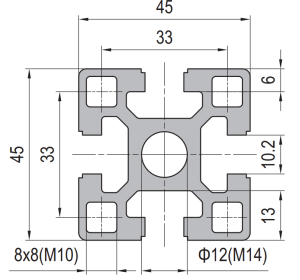 Strut Aluminium Profile 45×45 mm 4-Slot Heavy Duty T-Slot Extrusion
45 x 45 mm heavy duty four-slot T-slot strut aluminium profile in 6063-T5 with…
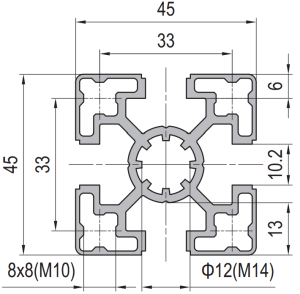 Strut Aluminium Profile 45×45 mm 4-Slot Light T-Slot Extrusion
45 x 45 mm light wall four-slot T-slot strut aluminium profile in 6063-T5 with…
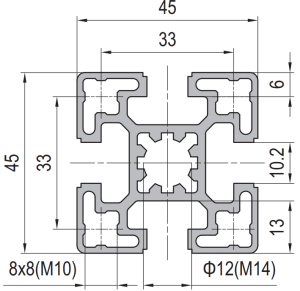 Strut Aluminium Profile 45×45 mm 4-Slot Standard T-Slot Extrusion
45 x 45 mm four-slot standard T-slot strut aluminium profile in 6063-T5 with walls…
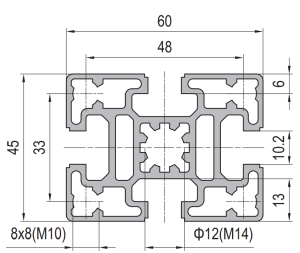 Strut Aluminium Profile 45×60 mm 4-Slot Column T-Slot Extrusion
45 x 60 mm four-slot rectangular T-slot strut aluminium profile in 6063-T5, about 3.3…
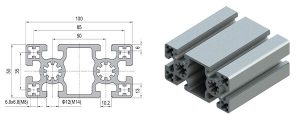 Strut Aluminium Profile 50×100 mm 2-Slot Heavy T-Slot Beam Extrusion
50 x 100 mm heavy two-slot T-slot strut aluminium beam in 6063-T5, about 6.2…
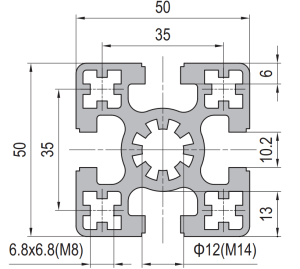 50 x 50 mm Four Slot Aluminium Strut Profile Heavy Frame Cross Member
50 x 50 mm four slot T-slot strut aluminium profile in 6063-T5, about 3.1…
