PG15 Strut Aluminium Profile 15×15 mm Light T-Slot Extrusion
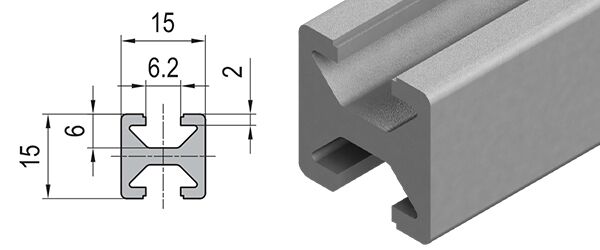
PG15 15 x 15 mm single-slot T-slot strut aluminium profile in 6063-T5, about 0.48 kg/m, with a 6.2 mm slot mouth over a 6 mm groove and walls about 1.2 mm. The lightest member in the range, for sensor brackets, small fixtures, light display frames and instrument rigs.
| Material | Aluminium |
|---|---|
| Alloy Grade | 6063-T5 |
| Temper | T5 |
| Section Size | 15 x 15 mm |
| Slot | 6.2 mm mouth, 6 mm groove, M4/M5 slot nuts, single slot |
| Length | 6 m stock, cut to drawing to +/-0.5 mm |
| Tolerance | EN 755-9 / GB/T 6892, wall +/-0.10 mm |
| Surface | Mill finish / clear anodised / black anodised |
| MOQ | 1000 |
| Lead Time | 12-20 days after deposit for mill finish |
| Loading Port | Ningbo / Shanghai |
| Supply Ability | 800 t per month |
| Payment Terms | T/T 30% deposit + 70% before shipment | L/C at sight |
| Trade Terms | FOB | CIF | EXW |
| Certifications | ISO 9001:2015 | EN 755-9 | RoHS | REACH |
Light system · 15 series
PG15 is a 15 x 15 mm single-slot aluminium extrusion in 6063-T5 with a 6.2 mm slot mouth over a 6 mm groove, about 1.2 mm of wall and a weight of about 0.48 kg/m. It takes M4 and M5 slot nuts and a small range of corner connectors, and it is supplied in 6 m stock, cut to length. It is the lightest member in the T-slot range and it is built for things that are small and light: sensor and camera brackets, small fixtures and jigs, instrument enclosures, light display and signage frames, and laboratory rigs.
The section’s defining feature is that there is almost no material in it. About 1.2 mm of wall cannot hold a thread, so on a PG15 joint the thread always lives somewhere else: in the slot nut, in a through-bolt and nut, or in an end-tapped hole in the 15 mm end face. That single fact explains most of the design rules for the system, and it is also the reason the boundary with 20 series is decided by the fastener rather than by the load.
What the PG15 system is good at
Light framing is a different job from structural framing, and judging a 15 mm section against a 40 mm one misses the point. What a PG15 frame has to do is hold something small in a precise position, be easy to adjust, and be light enough that the thing it is holding does not notice it. On those three counts it wins comfortably, because a 15 mm member is about a quarter of the weight of a 30 mm member and a fraction of the cost.
The system is at its best where the frame is a fixture rather than a structure. A sensor bracket on a conveyor does not span anything; it holds a photoelectric head at a fixed height and angle, and needs to be re-positioned in two axes without re-machining. A PG15 frame does that with two members and two corner connectors, and the whole assembly can be moved by hand.
PG15 in numbers, against the next size up
The comparison that decides a PG15 design is the one against 20 series, because that is the next size up and the point at which the accessory range widens considerably. The numbers below are planning figures for the same wall class in each series and are meant for comparison rather than as a design certificate.
| Property | PG15 15 x 15 | 20 x 20 light |
|---|---|---|
| Envelope | 15 x 15 mm | 20 x 20 mm |
| Slot mouth | 6.2 mm | 6 mm |
| Slot groove | 6 mm | 8 mm |
| Slot nuts | M4 / M5 | M5 / M6 |
| Wall thickness | approx. 1.2 mm | approx. 1.3 mm |
| Second moment of area | approx. 0.21 cm4 | approx. 0.68 cm4 |
| Weight | approx. 0.48 kg/m | approx. 0.85 kg/m |
| Deflection, 50 N over 500 mm | approx. 0.9 mm | approx. 0.3 mm |
| Working span, light load | up to approx. 400 mm | up to approx. 700 mm |
Read the deflection row twice. The section is only about three times stiffer in second moment of area, but deflection scales with the cube of span, so the gap between 15 mm and 20 mm opens up fast. At 500 mm and 50 N the difference is roughly 0.9 mm against 0.3 mm; at 800 mm the same load puts the 15 mm member past 3 mm, which is visible on a sensor bracket.
Where 15 mm stops being enough
There are four boundaries, and any one of them is enough to move the design to 20 series. They arrive in roughly this order as a design grows.
- Span: past about 400 mm with any real load, a 15 mm member sags enough to see. The fix is a shorter span or a mid support rather than a heavier wall, because the 15 mm envelope does not have a heavy wall option that changes the answer.
- Thread: about 1.2 mm of wall cannot be tapped at all, so every thread in a PG15 joint sits in a slot nut, a nut behind the joint, or an end-tapped hole in the 15 mm end face. If the design needs a thread in the side of the member, the design has outgrown the section.
- Fastener size: the mouth takes M4 and M5 slot nuts and no more. Any joint that needs an M6 or M8 fixing, a standard 30 mm hinge, or a bracket designed for a 20-series groove simply will not fit, whatever the load is.
- Panel rigidity: a PG15 frame will not hold a 5 mm polycarbonate guard or a glass panel flat. The frame deflects before the panel does, so the panel ends up carrying the frame rather than the other way round.
Building a PG15 frame that goes together first time
- Keep the layout on the slot module A 15 x 15 has one slot per face, and the 15 x 30 two-slot version puts its two slots at 15 mm centres. Keep the frame grid on that module so brackets land on slots rather than on drilled holes.
- Use corner connectors rather than drilled joints The connecting element range for 15 series is small but it covers the common corners, and a connector needs no hole in the extrusion. Drilling a 15 mm member removes a large share of its section, so avoid it where a connector exists.
- Work out the bolt length from the groove depth A slot nut sits about 6 mm below the surface on PG15. Through a 3 mm bracket that means an M5 x 10 reaches the nut and an M5 x 8 does not, so M5 x 10 and M5 x 12 are the two lengths worth keeping in stock.
- Cap the torque The slot lips on a 1.2 mm wall are thin. Keep M4 fixings to about 2 to 3 Nm and M5 fixings to about 4 to 5 Nm. Beyond that the lips deform, the nut loses its bearing area, and the joint is looser after tightening than before.
- Cut with a fine-tooth blade and deburr A thin wall burrs badly, and a burr left in the slot mouth will stop a slot nut sliding in. Deburr both the cut face and the slot mouth, and blow the groove out before assembly.
Finishing and cutting a light section
Mill finish is the normal supply for PG15, and it is usually the right one: on a small frame the extrusion is often hidden inside a cover or behind the panel it carries. Where the frame is visible, clear anodising gives a clean bright finish and black anodising makes the frame disappear against a dark background, which is what a display or a vision fixture usually wants.
Cutting is where a light section is easiest to get wrong. A 15 mm member cut on a coarse blade tears the thin wall, and a cut that is 1 mm out of square shows up immediately as a corner that will not close. We cut to plus or minus 0.5 mm, deburr and bag by assembly, and for a frame with more than a handful of members that is usually cheaper than cutting on site.

Frequently asked questions
Can I tap a thread into a PG15 profile?
Not into the wall, which is only about 1.2 mm thick. You can tap the end face of a member, where the full 15 mm section is available, and that is normally used for an M5 end connection. Every other thread in a PG15 joint lives in a slot nut or in a nut behind the joint.
What is the maximum span for a 15 x 15 member?
Keep a lightly loaded member under about 400 mm. At 500 mm with a 50 N load the deflection is roughly 0.9 mm, and deflection grows with the cube of span, so at 800 mm the same load is past 3 mm. Add a mid support or move to 20 series.
When should I use 20 series instead of PG15?
When the span passes about 400 mm, when the joint needs a fastener bigger than M5, when a thread is needed in the side of the member, or when the frame has to hold a panel flat. If none of those applies, PG15 is the lighter and cheaper answer.
What torque should I use on a PG15 joint?
About 2 to 3 Nm for an M4 fixing and about 4 to 5 Nm for an M5 fixing. The slot lips are thin, and over-torquing deforms them so that the nut loses bearing area and the joint ends up looser than it would have been at the correct torque.
Can you supply 15 x 15 cut and machined to a drawing?
Yes. We cut to plus or minus 0.5 mm, deburr the cut face and the slot mouth, tap end faces to drawing, drill small mounting holes, and supply mill finish, clear anodised or black anodised, bagged by assembly.
Send the bracket layout, get a cut list and a kit price
Tell us what the frame has to hold, the span and the fastener size, and we will confirm whether PG15 is the right section or whether the design has crossed into 20 series. We then quote the members, the 15-series connectors, the cutting and the finish, with everything cut, deburred and bagged by assembly and FOB pricing on the same sheet.
Request a QuoteRelated Products
 Aluminium Conduit Profile 40×40 mm Cable Duct T-Slot Enclosure
40 x 40 mm aluminium conduit profile in 6063-T5 with a 32 x 8.2…
 Aluminium Conduit Profile 40×80 mm Large Cable Duct Enclosure
40 x 80 mm aluminium conduit profile in 6063-T5 with a 66 x 11…
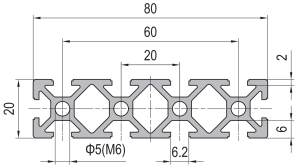 PG20 80×20 mm Ten Slot Aluminium Strut Profile Wide Flat Beam for Cable Tray and Panel Support
80 x 20 mm ten slot PG20 aluminium strut profile in 6063-T5 with a…
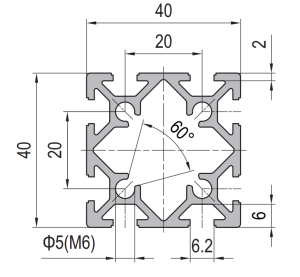 PG20 40×40 mm Eight Slot Aluminium Strut Profile 20 mm Pitch T-Slot Extrusion for Dense Fixtures
40 x 40 mm eight slot PG20 aluminium strut profile in 6063-T5 with two…
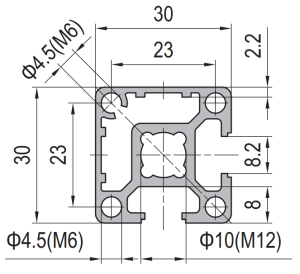 PG30 30×30 mm Two Slot Type A Aluminium Strut Profile Closed Face T-Slot Extrusion
30 x 30 mm Type A two slot PG30 aluminium strut profile in 6063-T5…
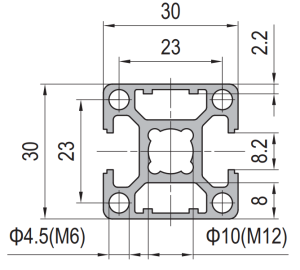 PG30 30×30 mm Two Slot Type B Aluminium Strut Profile Symmetric T-Slot Extrusion for Corner Posts
30 x 30 mm Type B two slot PG30 aluminium strut profile in 6063-T5…
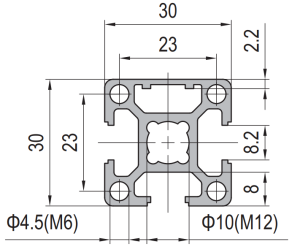 PG30 30×30 mm Three Slot Aluminium Strut Profile Light Frame Column
30 x 30 mm aluminium strut profile with three 8.2 mm T-slots and one…
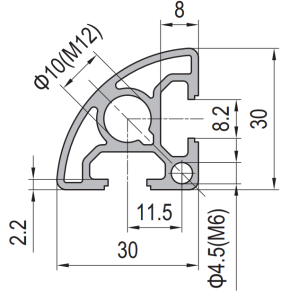 PG30 30×30 mm R90 Two Slot Aluminium Strut Profile Rounded Corner Rail
30 x 30 mm quarter round aluminium profile with one 8.2 mm T-slot on…
