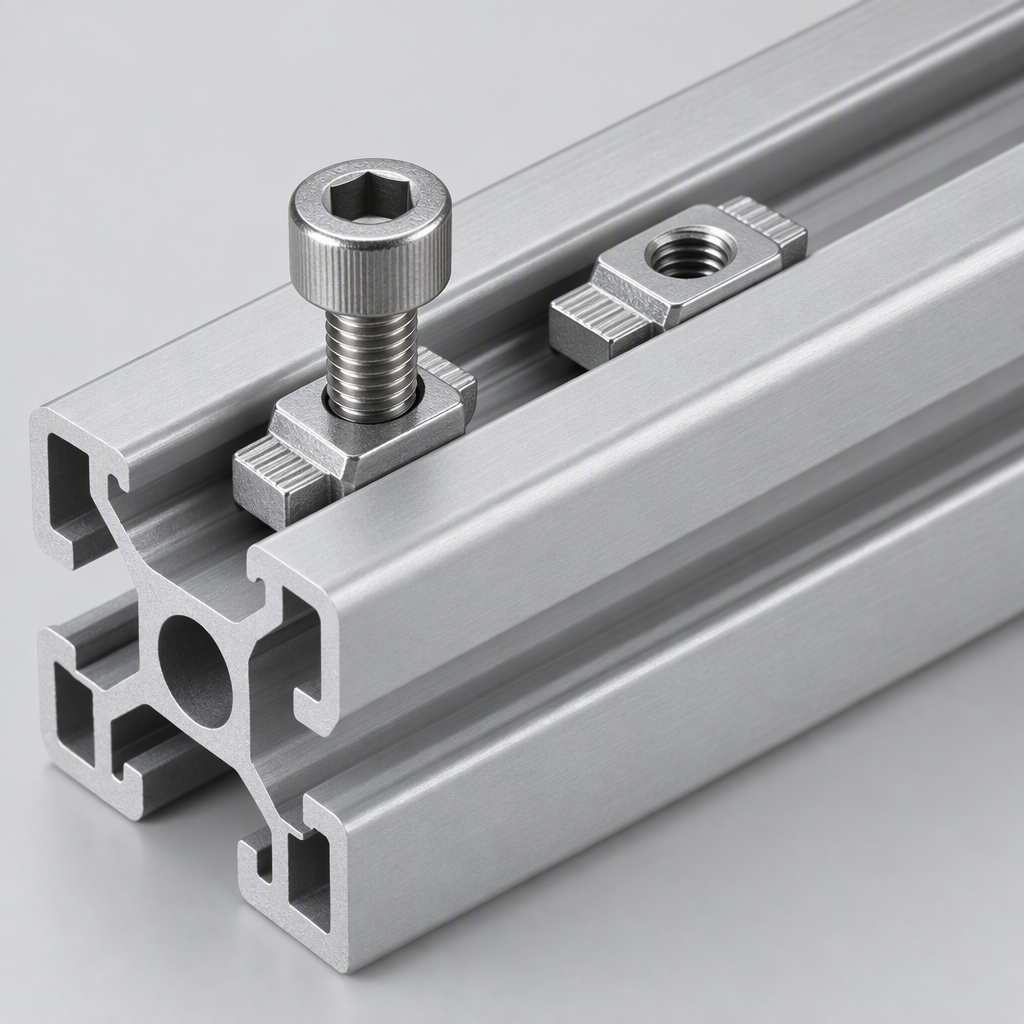
T-Nut for 10 mm Aluminium Profiles M4 M5 M6 M8 M10
Full range of T-slot nuts from M4 to M10 for 15 to 60 series aluminium profiles. Pre-set, subsequent, square and anti-torsion types. Carbon steel or stainless. Master selection guide for nut, thread and series.
| Material | Carbon steel |
|---|---|
| Alloy Grade | Carbon steel C1035, spring steel 65Mn, stainless A2 / A4 |
| Temper | custom |
| Section Size | n/a (piece part) |
| Slot | Fits 6 mm, 8 mm and 10 mm groove widths (15-60 series) |
| Length | n/a (piece part, sold per nut) |
| Tolerance | Thread 6H, body width +/-0.1 mm, body height +/-0.1 mm |
| Surface | Zinc plated / stainless steel A2 or A4 |
| MOQ | No MOQ for stock sizes; 500 pieces for custom configurations |
| Lead Time | Stocked sizes ship in 2 to 3 days; custom and stainless about 2 weeks |
| Loading Port | Shanghai, Ningbo, Qingdao |
| Supply Ability | Full range stocked in carbon steel; stainless and custom types produced to order |
| Payment Terms | T/T 30 per cent deposit, balance against copy of B/L; L/C at sight for larger orders |
| Trade Terms | FOB, CIF, CFR, EXW |
| Certifications | RoHS, REACH, material certificate for stainless steel, vibration test report for anti-torsion |
01What is a T-nut for aluminium profiles?
What does a T-nut do in a T-slot profile?
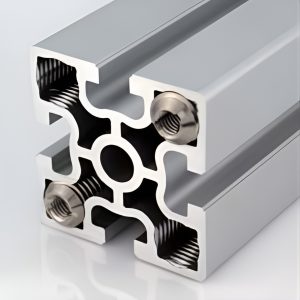
A T-nut sits inside the T-slot groove with its body behind the slot lip and its threaded hole facing outward. A bolt passes through the bracket or fitting from outside and threads into the nut. The nut body bears against the back of the groove lip and resists the clamping force. It is the primary fastening method for all T-slot aluminium profile systems.
How many types of T-nut are there?
Four main types, distinguished by how they enter the groove and whether they prevent rotation: pre-set (placed before assembly, anti-drop tab), subsequent (slid in from end face after assembly), square (flat sides prevent rotation), and anti-torsion (twin wings grip groove walls for vibration resistance). Each type has a specific use case — see Section 06 for the selection logic.
What is the full thread range available?
M4, M5, M6, M8 and M10. The thread size is matched to the profile series: M4 for 15 series, M5 for 20 series, M6 for 30 series, M8 for 40 series, and M10 for 45 and 60 series. Reducer configurations (smaller thread in larger groove) are also available — see Section 04.
02The master selection chain: series to nut to bolt
The selection of a T-nut follows a chain: the profile series determines the groove width, the groove width determines the nut body width, the nut body determines the thread size, and the thread size determines the bolt. This chain must be followed in order — you cannot start with a bolt size and work backwards, because the groove width constrains everything downstream.
| Series | Groove width | Slot mouth | Nut thread | Bolt | Weight per nut |
|---|---|---|---|---|---|
| 15 series | 5 mm | 4 mm | M4 | M4 x 6/8/10 | 0.9 g |
| 20 series | 6 mm | 4.5 mm | M5 | M5 x 8/10/12 | 1.5 g |
| 30 series | 8 mm | 5.5 mm | M6 | M6 x 10/12/16 | 3.2 g |
| 40 series | 10 mm | 8 mm | M8 | M8 x 12/16/20 | 6.8 g |
| 45 series | 10 mm | 8 mm | M8 | M8 x 12/16/20 | 7.5 g |
| 60 series | 10 mm | 8 mm | M10 | M10 x 16/20/25 | 18.0 g |
The 45 and 60 series both use a 10 mm groove, so the same M8 nut body fits both. The difference is that the 60 series groove wall is thicker, allowing an M10 thread in the same body width. The 45 series uses M8 as standard; M10 is available as an option.
03Nut types and their characteristics
The four nut types differ in how they enter the groove and whether they resist rotation. The choice of type is independent of the thread size — each type is available in every thread from M4 to M10 (with the exception of anti-torsion, which is not made for M4 or 15 series).
| Type | Entry method | Anti-drop | Anti-rotation | Typical use |
|---|---|---|---|---|
| Pre-set | from slot mouth, before assembly | yes (spring tab) | no (round body) | production frames |
| Subsequent | from end face, after assembly | no | no (round body) | retrofit, prototype |
| Square | from end face, after assembly | no | yes (flat sides) | precision mounting |
| Anti-torsion | from end face, after assembly | no | yes (twin wings) | vibration resistance |
The pre-set and square types can be combined: a pre-set square nut has both a spring tab and flat sides. This is a custom configuration available on request for production jigs that need both anti-drop and anti-rotation.
04Reducer configurations: smaller thread in larger groove
Sometimes the fitting you need to mount has a smaller thread than the series default. For example, a sensor mount with an M5 thread on a 30 series profile (which normally takes M6). In this case, a reducer nut is used: the body fits the 30 series groove (8 mm) but the thread is M5 instead of M6.
| Profile series | Groove | Default thread | Reducer thread | Use case |
|---|---|---|---|---|
| 30 series | 8 mm | M6 | M5 | M5 sensor mount on 30 series |
| 40 series | 10 mm | M8 | M6 | M6 fitting on 40 series |
| 40 series | 10 mm | M8 | M5 | M5 fitting on 40 series |
| 45 series | 10 mm | M8 | M6 | M6 fitting on 45 series |
| 60 series | 10 mm | M10 | M8 | M8 fitting on 60 series |
Reducer nuts are available in all four types (pre-set, subsequent, square, anti-torsion). Specify both the series and the thread when ordering a reducer nut.
05Sliding resistance in the groove
The force required to slide a T-nut along the groove depends on the nut type, the groove finish and the nut body clearance. We measured the sliding force for each nut type in a clean, mill finish 40 series groove (10 mm) with an M8 thread, with no bolt installed.
| Nut type | Sliding force (N) | Resistance note |
|---|---|---|
| Pre-set (with tab engaged) | 2 to 5 | tab adds friction |
| Subsequent (round body) | 0.5 to 1.5 | lowest friction, slides freely |
| Square (flat sides) | 1.5 to 3.0 | flat side contact adds drag |
| Anti-torsion (wings) | 4 to 8 | wing serrations drag on groove |
| Subsequent (hard-anodised groove) | 3 to 6 | anodising roughness increases drag |
Sliding force is measured without a bolt installed. Once the bolt is tightened, the nut is locked in position by the clamping force and does not slide. The sliding force only matters during positioning, before the bolt is inserted.
06Selection logic: which nut type for which application
Choose pre-set nuts
- Production runs where nut positions are known upfront
- Frames with many fittings per profile (8+ per metre)
- Automated or jig-guided assembly where speed matters
- Frames where profile ends will be capped — no end access
Choose subsequent nuts
- Prototypes where fitting positions may change
- Retrofit or modification of existing frames
- Low fitting count per profile (1 to 3)
- Frames where profile ends are accessible for sliding
Within each entry method, the choice of body shape — round, square, or winged — depends on the precision and vibration requirements:
- Round body (standard): lowest cost, lowest friction, sufficient for non-critical mounts. Positioning accuracy +/-1.0 mm.
- Square body: flat sides prevent rotation, positioning accuracy +/-0.2 mm. For precision mounting: sensors, jigs, hinges.
- Winged body (anti-torsion): twin wings with serrations grip the groove. For vibration environments: spindles, actuators, conveyors. 95 per cent torque retention under vibration.
07Pull-out force by thread size
The pull-out force is the axial load required to pull the nut out of the groove. It is determined by the nut body engagement with the groove lip (not by the thread size) and by the groove wall strength. Larger nuts have wider bodies and more engagement, so they have higher pull-out ratings.
| Thread | Series | Body width | Engagement area | Pull-out force |
|---|---|---|---|---|
| M4 | 15 series | 4.5 mm | 15 sq mm | 0.5 kN |
| M5 | 20 series | 5.5 mm | 25 sq mm | 0.8 kN |
| M6 | 30 series | 7.5 mm | 45 sq mm | 1.5 kN |
| M8 | 40 series | 9.5 mm | 70 sq mm | 2.5 kN |
| M10 | 60 series | 9.5 mm | 80 sq mm | 3.5 kN |
Pull-out force is approximate and assumes a new, mill finish groove with no damage. In a worn or corroded groove, the pull-out may drop by 30 per cent. For structural joints that must not pull out, use the centre bore through-bolt instead of the T-slot.
08What to specify when ordering
Procurement checklist for T-nuts
- Confirm the profile series (15, 20, 30, 40, 45 or 60) — this determines the groove width and the nut body size.
- Confirm the thread size (M4, M5, M6, M8 or M10). If using a reducer, specify both the series and the smaller thread.
- Confirm the nut type: pre-set (with tab), subsequent (slide from end), square (anti-rotation), or anti-torsion (vibration).
- Confirm the material: carbon steel zinc plated, or stainless steel A2 / A4.
- Confirm the quantity per type and size. Price breaks apply at 100, 500 and 1000 pieces per line item.
- Whether you need matching bolts and at what lengths. Bolts are available in the same threads and materials.
09Terms used on this page
- T-nut
- A nut that sits inside a T-slot groove with its body behind the slot lip and a threaded hole facing outward. The primary fastening method for T-slot profiles.
- Pre-set nut
- A T-nut placed into the groove before the profiles are assembled, with an anti-drop spring tab.
- Subsequent nut
- A T-nut slid into the groove from the end face after the frame is assembled.
- Square nut
- A T-nut with a square body whose flat sides prevent rotation under torque.
- Anti-torsion nut
- A T-nut with twin wings that grip the groove walls to prevent rotation under vibration.
- Reducer nut
- A T-nut whose body fits one series groove but whose thread is smaller than the series default.
10Questions buyers ask
What thread sizes are available?
M4, M5, M6, M8 and M10. Each thread is matched to a profile series: M4 for 15 series, M5 for 20 series, M6 for 30 series, M8 for 40 and 45 series, and M10 for 60 series.
Can I use a different thread than the series default?
Yes, with a reducer nut. The body fits the larger groove but the thread is smaller. For example, an M5 thread in a 30 series (8 mm) groove, or an M6 in a 40 series (10 mm) groove.
What is the difference between pre-set and subsequent?
Pre-set nuts are placed before assembly (from the slot mouth) and have an anti-drop tab. Subsequent nuts slide in from the end face after assembly. Both carry the same load once bolted.
Which type should I use for a vibrating application?
Anti-torsion nuts with twin wings. They grip the groove walls and retain 95 per cent of bolt torque under vibration. Available for 30 and 40 series, M6 and M8.
Do you supply matching bolts?
Yes. We supply T-slot bolts in M4 to M10, in lengths from 6 mm to 50 mm, in carbon steel and stainless steel. Specify the thread, length and material when ordering.
What is the minimum order quantity?
No MOQ for stock sizes. Price breaks apply at 100, 500 and 1000 pieces. For custom configurations (stainless, precision tolerance, pre-set square), the MOQ is 500 pieces.
What we need to quote T-nuts
- The profile series (15, 20, 30, 40, 45 or 60) for each joint location.
- The thread size: M4, M5, M6, M8 or M10. Call out reducer configurations explicitly.
- The nut type: pre-set, subsequent, square, or anti-torsion.
- The material: carbon steel zinc plated, or stainless steel.
- The quantity per type and size, with the total across all lines.
- Whether you need matching bolts and at what lengths.
Send those six items and the quotation comes back with the unit price at each quantity break, the material surcharge for stainless if applicable, and the lead time for stocked and non-stocked sizes. Browse the full connecting elements range for related fasteners.
Need T-nuts quoted across multiple series?
Send the series, thread, type, material and quantity for each line item. We quote the full range with matching bolts available.
Request a quotationRelated Products
 Aluminium Angle Profile Bracket 80x80x9 mm 45 Degree Corner Gusset for Angled Bracing
45 degree corner gusset 80 x 80 x 9 mm machined from 6061-T6 plate,…
 Aluminium Angle Profile Bracket 70x70x9 mm 135 Degree Corner Gusset for Obtuse Joints
Obtuse corner gusset 70 x 70 x 9 mm at 135 degrees, machined from…
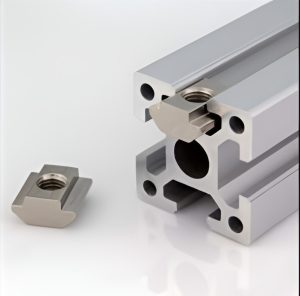 Pre-set T-Slot Nut for 8 mm Aluminium Profiles M5 M6 M8
Pre-set T-slot nut with anti-drop spring tab for 20, 30 and 40 series aluminium…
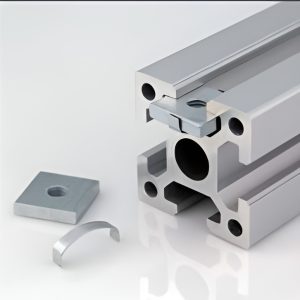 Square Nut for 8 mm T-Slot Aluminium Profiles M5 M6 M8
Square T-slot nut with four flat sides for 30 and 40 series aluminium profiles.…
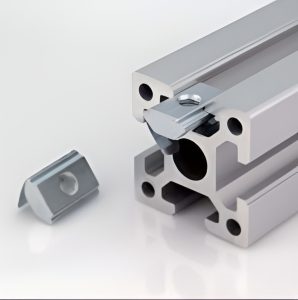 Subsequent Nut for 8 mm T-Slot Aluminium Profiles M5 M6 M8
Subsequent T-slot nut for 30 and 40 series aluminium profiles. M5, M6 and M8…
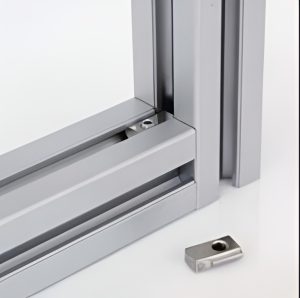 Anti-torsion Subsequent Nut for 8 mm T-Slot Aluminium Profiles
Anti-torsion subsequent T-slot nut with twin wings for 30 and 40 series aluminium profiles.…
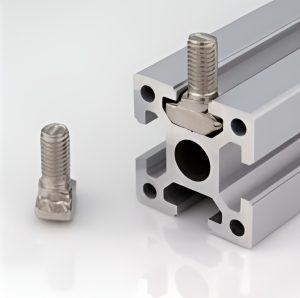 T-Bolt for 8 mm T-Slot Aluminium Profiles M6 M8 M10
T-bolt with integral T-head for 20, 30 and 40 series aluminium profiles. M5, M6,…
 Hole Reducer Bolt for 8 mm T-Slot Aluminium Profiles
Hole reducer bolt with stepped M8 to M6 thread for 30 and 40 series…
