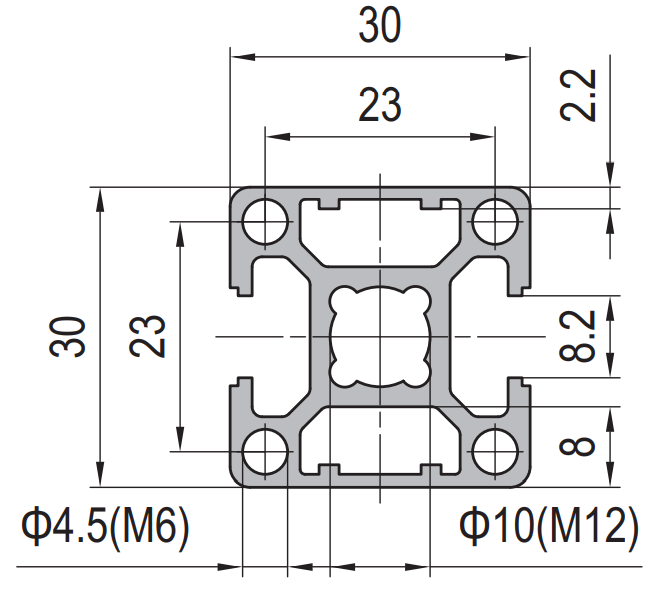
PG30 30×30 mm Two Slot Type B Aluminium Strut Profile Symmetric T-Slot Extrusion for Corner Posts
30 x 30 mm Type B two slot PG30 aluminium strut profile in 6063-T5 with 8.2 mm grooves on opposite faces. A symmetric section with the centroid on the geometric centre, for corner posts and uprights.
| Material | Aluminium |
|---|---|
| Alloy Grade | 6063-T5 |
| Temper | T5 |
| Section Size | 30 x 30 mm |
| Slot | 2 x 8.2 mm groove, 6 mm mouth, opposite faces, 23 mm pitch, M8 |
| Length | 6 m stock, cut to drawing to +/-0.5 mm |
| Tolerance | EN 755-9 / GB/T 6892, wall +/-0.15 mm |
| Surface | Mill finish / clear anodised / black anodised |
| MOQ | 500 |
| Lead Time | 15-25 days after deposit for mill finish |
| Loading Port | Shanghai / Ningbo |
| Supply Ability | 600 t per month |
| Payment Terms | T/T 30% deposit + 70% before shipment | L/C at sight |
| Trade Terms | FOB | CIF | EXW |
| Certifications | ISO 9001:2015 | EN 755-9 | RoHS | REACH |
Structural framing · PG30 Type B
A 30 x 30 mm Type B two-slot strut profile is a square aluminium extrusion with a T-slot on two of its four faces, arranged so that the two slots face each other. That single detail — opposite rather than adjacent — makes the section symmetric about both face centrelines, and it is the whole reason to specify Type B. The groove is 8.2 mm with a 6 mm mouth on a 23 mm pitch, so it takes 30-series M8 hardware. The centre bore is Ø10 mm tapped M12, the corner holes are Ø4.5 mm tapped M6, and the wall is 2.2 mm at the flange and 8 mm through the web. We extrude it in 6063-T5 and supply it cut, drilled, tapped or machined.
Symmetry sounds like a cosmetic property until the member is used as an upright. A column loaded in compression fails by buckling, and buckling is governed by where the load sits relative to the centroid of the section. On a symmetric section the centroid is on the geometric centre, so a load applied at the centre of the end face goes straight down the axis and nothing bends. On an asymmetric section the centroid is offset, the same load is eccentric, and the member picks up a bending moment it was never designed for. That difference is worth roughly a third of the buckling capacity, and it costs nothing to get right.
Why symmetry is a structural property, not a detail
Every section has a centroid, and every load has a line of action. If the two coincide the member is in pure compression and behaves predictably. If they do not, the offset multiplied by the load becomes a bending moment, and the member has to resist bending as well as compression. That is how a column that looked fine on paper fails at two thirds of the load it was supposed to carry.
Type B is symmetric about both face centrelines, so its centroid is exactly on the geometric centre. A load applied at the centre of the end face is concentric. The section is also equally stiff in both directions, so it does not matter which way round the upright is installed — an advantage on site, where the person assembling the frame is rarely the person who drew it.
| Property | Type B (this section) | Type A |
|---|---|---|
| Slot positions | Two opposite faces | Two adjacent faces |
| Centroid | On the geometric centre | Offset towards the closed corner |
| Stiffness, both axes | Equal | Not equal |
| Concentric axial load | Yes, at the end face centre | No, unless offset |
| Buckling capacity | Predictable, symmetric | Reduced by eccentricity |
| Best as | Corner post, upright, leg | Edge rail, seal carrier |
| Slot groove | 8.2 mm, 6 mm mouth | 8.2 mm, 6 mm mouth |
| Weight | approx. 0.86 kg/m | approx. 0.86 kg/m |
The eccentricity trap: if a Type A member is used as an upright and loaded at the geometric centre of its end face, the load is eccentric by a few tenths of a millimetre. That is small, but on a 2 m column it is the difference between a straight post and one that bows under load. If a two-slot upright has to carry compression, specify Type B.
Assembling a post that takes parts on two sides
The obvious use of a Type B upright is a post that has something bolted to it on two opposite sides — a panel on one face and a shelf bracket on the other, or two panels back to back. Because the slots are directly opposed, a fixing on one side can be reached from the other, which makes assembly and later adjustment far easier than on an asymmetric section. The order of assembly still matters.
- Pre-load the nuts before the frame goes up With the slots opposed, you can slide a nut into each slot from the end while the member is still on the bench, then stand the post up. Trying to feed nuts into a vertical member after the frame is built is the slowest part of the job.
- Fix the more heavily loaded side first Tighten the panel side before the bracket side. Once the first side is tight the member cannot rotate, so the second side can be set without the post turning away from the driver.
- Check square before final torque A symmetric post is easy to get plumb but hard to twist back afterwards. Set the frame square with the fixings just nipped, then torque to the specified figure.
- Leave one slot clear on long posts On a post over 1.5 m, keep one of the two slots free for a mid-height tie or a levelling adjustment. Filling both slots at the top and bottom leaves nothing to correct with later.
The alignment trap when Type A and Type B are used together
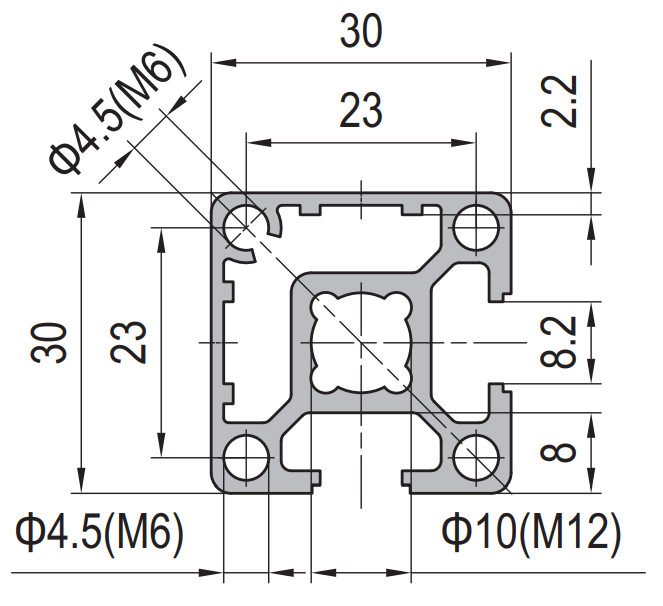
Frames often need both an edge rail (Type A, for its closed face) and an upright (Type B, for its symmetry). The two sections have identical outside dimensions, identical grooves and identical weight, so a mixed delivery looks perfectly consistent — and that is exactly why the error goes unnoticed. The slots do not line up. On a Type B member the slots are on opposite faces; on a Type A member they are on adjacent faces. Where the two meet, one member’s slot faces a closed face on the other, and a fixing that was meant to pass through both cannot be made.
The rule is simple: make the change of section at a joint, never mid-member, and always through a bracket, a connector or a plate that is dimensioned for both. Never assume that a 30 x 30 bracket will line up two 30 x 30 members without checking which type each one is.
Frequently asked questions
How is Type B different from Type A?
Only in the arrangement of the two slots. Type B has them on opposite faces and is symmetric about both face centrelines; Type A has them on adjacent faces and leaves a closed corner. Outside dimensions, groove, pitch and weight are identical.
Is Type B always better than Type A?
No. Type B is better where the member carries compression or has to behave the same way in both directions, which is why it suits uprights. Type A is better where a closed face is needed for a seal, a datum or a dowel, which is why it suits edge rails.
Can I use it as a beam rather than a post?
Yes, and it is the better choice for a beam where the load direction is not yet known, because it is equally stiff in both axes. For a beam with a known load direction a section with more material further from the neutral axis will be lighter for the same stiffness.
Does the 8.2 mm groove take M6 as well as M8?
The groove takes 30-series M8 nuts and hammer-head bolts. M6 is used on the Ø4.5 mm corner holes, not in the slot. Using an undersized nut in the slot lets the nut rotate and the joint will not stay tight.
What length and tolerance do you supply?
Standard stock is 6 m, cut to the drawing at +/-0.5 mm per piece, deburred and bagged by assembly. Where a frame has to assemble square, give us a cut list rather than a total length.
Send the post height and the load, get a section check
Tell us the upright height, the compression load and what hangs off each side. We will confirm the section and the buckling margin, then quote cut lengths, machining and FOB pricing.
Request a QuoteRelated Products
 PG30 30×30 mm Three Slot Aluminium Strut Profile Light Frame Column
30 x 30 mm aluminium strut profile with three 8.2 mm T-slots and one…
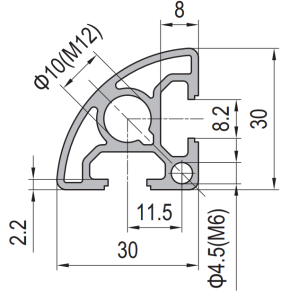 PG30 30×30 mm R90 Two Slot Aluminium Strut Profile Rounded Corner Rail
30 x 30 mm quarter round aluminium profile with one 8.2 mm T-slot on…
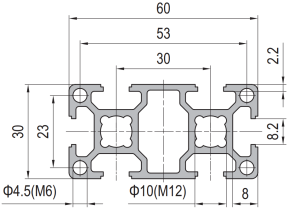 PG30 60×30 mm Six Slot Aluminium Strut Profile Rectangular T-Slot Extrusion for Cabinet Uprights
60 x 30 mm six slot PG30 rectangular aluminium strut profile in 6063-T5 with…
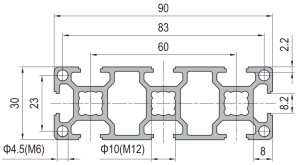 PG30 90×30 mm Eight Slot Aluminium Strut Profile Wide Beam T-Slot Extrusion for Door Frames
90 x 30 mm eight slot PG30 wide beam aluminium strut profile in 6063-T5…
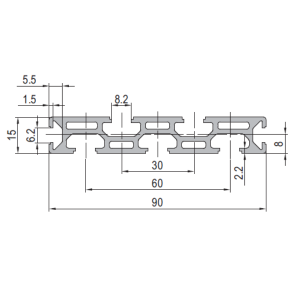 PG30 90 x 15 mm Seven Slot Aluminium Strut Profile Narrow Multi Slot Rail
90 x 15 mm seven-slot aluminium strut profile with 8.2 mm grooves on a…
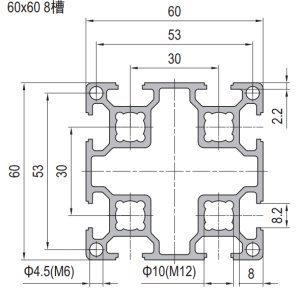 PG30 60×60 mm Eight Slot Aluminium Strut Profile Heavy Duty T-Slot Extrusion for Robot Pedestals
60 x 60 mm eight slot PG30 heavy duty aluminium strut profile in 6063-T5…
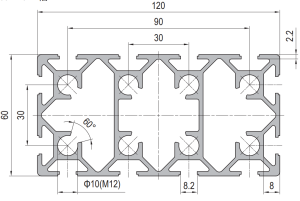 PG30 120 x 60 mm Twelve Slot Aluminium Strut Profile Heavy Frame Beam
A 120 x 60 mm twelve slot PG30 aluminium strut profile at about 5.20…
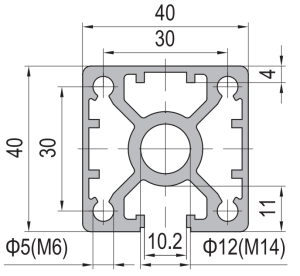 PG40 40 x 40 mm Single Slot Aluminium Strut Profile Guide Rail Base
40 x 40 mm single-slot aluminium strut profile with one 10.2 mm groove on…
