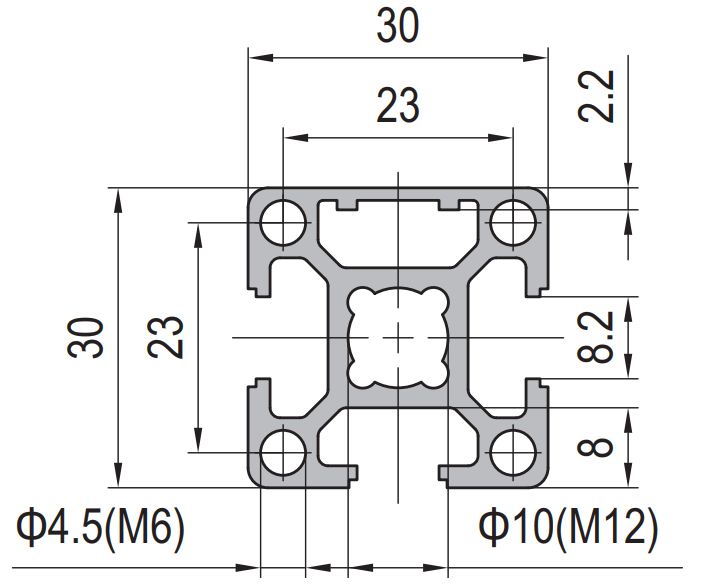
PG30 30×30 mm Three Slot Aluminium Strut Profile Light Frame Column
30 x 30 mm aluminium strut profile with three 8.2 mm T-slots and one closed face. The closed wall is tapped M8 to full depth, giving roughly eight threads of engagement for end joints and feet.
| Material | Aluminium |
|---|---|
| Alloy Grade | 6063-T5 |
| Temper | T5 |
| Section Size | 30 x 30 mm |
| Slot | 3 x 8.2 mm groove, 6 mm mouth, 23 mm pitch, M8, one closed face |
| Length | 6 m stock, cut to drawing to +/-0.5 mm |
| Tolerance | EN 755-9 / GB/T 6892, wall +/-0.15 mm |
| Surface | Mill finish / clear anodised / black anodised |
| MOQ | Made to order; trial lengths available |
| Lead Time | Typically 2 to 3 weeks for mill finish, about a week longer for anodising |
| Loading Port | Shanghai, Ningbo, Qingdao |
| Supply Ability | Extrusion, cutting, tapping and anodising in house |
| Payment Terms | T/T 30 per cent deposit, balance against copy of bill of lading; L/C at sight for larger orders |
| Trade Terms | FOB, CIF, CFR, EXW |
| Certifications | Mill certificate to EN 10204 3.1 on request, RoHS and REACH declarations |
01What is the 30 x 30 mm three slot profile?
Why does this section have three slots instead of four?
Because the fourth face is worth more as solid metal than as a slot. A 30 mm envelope with a 2 mm wall leaves very little material around a slot. Taking that fourth slot out leaves one face with a continuous wall you can tap to full depth, which is how the section gets its end connections and its levelling feet. Four slots would look more flexible and would actually connect less securely.
How much thread do I actually get?
In the closed wall, an M8 tapped hole runs the full 8 mm of the wall section, so the bolt engages roughly eight full threads. Put the same M8 into the 6 mm slot mouth of a four slot section and the effective engagement drops to around five threads. Eight threads against five is the difference between a joint that holds torque and one that strips when it is re-tightened.
What is it normally used for?
Light machine frames, guard posts, workbench underframes, trolley and cart frames, signage and display stands, and any frame that is built from a cut list and bolted together on site. It is the smallest section in the range that still takes M8.
02Section data
| Item | Value | Note |
|---|---|---|
| Envelope | 30 x 30 mm | square, sharp corners |
| Slots | 3 | 8.2 mm groove, 6 mm mouth |
| Slot pitch | 23 mm | between centres |
| Closed face | 1 | plain wall, no slot |
| Thread in wall | M8 | full depth, about eight threads |
| Thread in slot | M6 | standard 30 series slot nut |
| Wall | 1.6 to 2.0 mm | varies by face |
| Weight | approx. 0.95 kg/m | as published |
| Alloy | 6063-T5 | EN AW-6063 |
| Standard | EN 755-9 / GB/T 6892 | wall tolerance +/-0.15 mm |
| Length | 6 m stock | cut to drawing to +/-0.5 mm |
The 6 mm slot mouth is the defining feature of the 30 series. It is narrower than the 8 mm mouth of the 40 series, so a 40 series slot nut will not drop into this section. Keep the two series’ accessory inventories separate, or plan the adapter plate before you order.
03Where the third slot earns its place
A four slot 30 x 30 section looks like better value on a cut list. Four faces to fix to instead of three. In practice, on a 30 mm envelope, the fourth slot is the one that causes trouble.
The reason is wall thickness. On a 30 x 30 section the outer wall is around 2 mm. A slot has to be wide enough to take the bolt shank and deep enough to take the nut, so it cuts a channel roughly 8 mm wide and 6 mm deep out of the wall. What is left on either side of that channel is a thin lip. Those lips carry the clamping load, and they are the first thing to deform when a joint is over-tightened.
Take the slot out and the same wall becomes solid. A tapped hole in solid 2 mm wall is still only 2 mm of engagement, which is why the closed face on this section is thicker where the threads go. That is the trade the design makes: one fewer slot, in exchange for a face that can be tapped and re-tapped.
| Connection method | Where it goes | Engagement | Re-tightening |
|---|---|---|---|
| M8 tapped into the closed wall | end joints, feet, caps | about 8 threads | yes, repeatedly |
| M6 slot nut in a groove | side fixings, brackets | about 5 threads | yes, with a new nut |
| M8 bolt straight through both walls | through connections | full wall | yes |
| Self-tapping screw into the slot | light trim only | 2 threads | no, single use |
That last row matters more than it looks. Self-tapping into the slot lips is the most common way a 30 series frame gets built badly. The screw cuts its own thread in a lip that is 1.6 mm thick, holds once, and never holds again. If a frame will be dismantled for shipping or service, use slot nuts from the start.
04Deciding between the three slot and four slot 30 mm sections
Three slot, one closed face
- End connections are tapped, not bracketed
- Joints are re-tightened during service or shipping
- You want fewer parts: no corner brackets needed at the ends
- The fourth face is hidden against a panel or a wall anyway
- Wall material is where you need it: at the threads
Four slot, all faces open
- Every face must take a bolt-on accessory
- The frame is built from corner brackets at every joint
- The section is a pass-through, not a member with ends
- You are bolting panels on all four sides
- Weight is not a concern and the extra slot is genuinely used
A useful test before you choose: count how many of the four faces have something attached in the finished frame. If the answer is three, buy the three slot section and use the closed face for the ends. If it is four, buy the four slot section and budget for corner brackets.
05Failure modes to design out
| What goes wrong | Why it happens | Design it out by |
|---|---|---|
| End joint loosens in service | the tapped M8 in 2 mm wall is worked by vibration | add a spring washer, or use a through bolt with a nut at the far side |
| Slot lips deform | the joint was over-tightened on a thin lip | torque the M6 slot nut to the nut supplier’s figure, not to feel |
| Frame twists during assembly | a 30 mm section is light and an open profile twists easily | assemble on a flat table, and fit the panels before moving the frame |
| Anodised finish scuffs on the corners | 30 series corners are sharp and take the knocks | specify a matte etch, or use corner caps on visible edges |
| Mismatched accessories arrive | 40 series slot nuts ordered for a 30 series section | state the series on the purchase order, not just the slot size |
06What to check before you order
Procurement checklist for the 30 x 30 mm three slot section
- Confirm the series, not just the size. 30 series uses a 6 mm mouth; 40 series uses 8 mm. The two do not interchange.
- Confirm which face is the closed face and where it sits in the finished frame. It is the face that gets tapped.
- Confirm the cut length and the end preparation: square cut, tapped end, or with a foot stud.
- Confirm the accessory list in the same series: slot nuts, cover strips, corner brackets and hinges.
- Confirm the finish: mill finish for frames that will be clad, anodised for anything on show.
- Confirm the quantity in metres and add an offcut allowance. A 6 m bar yields seven 800 mm members with 400 mm of waste.
07Terms used on this page
- Closed face
- A face of the section with no slot, left as a plain wall. It is the face used for tapping.
- Engagement
- The depth of thread a bolt actually screws into, expressed as a number of threads. It sets the torque the joint can take.
- Slot lip
- The narrow strips of metal either side of the slot mouth. They carry the clamping load and are the weak point of a slot fixing.
- Slot nut
- A nut that slides along the groove and locks against the lips when the bolt is tightened. It can be repositioned at any time.
- Series
- A family of sections sharing a slot mouth width and accessory range. 30 series and 40 series are separate families.
- Mill finish
- The surface as it leaves the extrusion press, with no anodising or coating. Adequate when the member will be clad.
08Questions buyers ask
Can the closed face be tapped at both ends?
Yes. Both ends of the closed face can be tapped M8, which is how a levelling foot is fitted at the bottom and a cap or a rail at the top.
Is the 30 series compatible with the 40 series?
Not directly. The slot mouth is 6 mm against 8 mm, so the slot nuts and brackets are different. Use an adapter plate, or keep each part of the frame within one series.
What is the maximum span for a 30 x 30 mm member?
It depends on the load and the deflection you can accept. As a guide, a 30 x 30 section used as a guard rail post at 1,000 mm centres with a light panel is comfortable; as a spanning beam carrying a person’s weight it is not. Send the load and the span and we will run the numbers.
Can it be supplied cut and tapped to a cut list?
Yes. Send the cut list with the tap positions and the drawing of any end machining, and the lengths arrive ready to assemble.
What is the weight per metre?
Approximately 0.95 kg/m, which makes a 6 m bar about 5.7 kg. That is light enough to handle without lifting equipment.
Is it available in black anodised?
Yes. Clear and black anodised are both standard; other colours are matched to a sample at a longer lead time.
What we need to quote this section
- The section reference and the series, so the correct accessories are quoted.
- The cut list: length, quantity, and which end is tapped.
- The tap details: thread size, depth, and whether the hole is through or blind.
- The finish: mill, clear anodised, or black anodised.
- The accessory list in the same series, so it ships as one kit.
- The quantity in metres or pieces, with the offcut allowance you are willing to accept.
Quotations are broken out into extrusion, cutting, tapping, finish and accessories, so you can see which step is driving the cost and where a design change would pay. Browse the full aluminium profile catalogue and the 30 series aluminium profiles range for related sections.
Building a 30 series frame from a cut list?
Send the cut list and the accessory list. We quote the extrusion, the cutting and tapping, the finish and the hardware as separate lines.
Request a quotationRelated Products
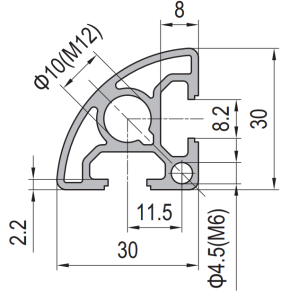 PG30 30×30 mm R90 Two Slot Aluminium Strut Profile Rounded Corner Rail
30 x 30 mm quarter round aluminium profile with one 8.2 mm T-slot on…
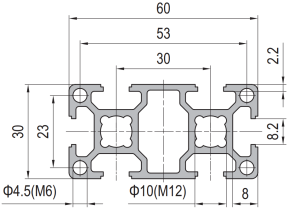 PG30 60×30 mm Six Slot Aluminium Strut Profile Rectangular T-Slot Extrusion for Cabinet Uprights
60 x 30 mm six slot PG30 rectangular aluminium strut profile in 6063-T5 with…
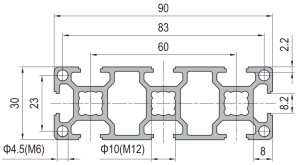 PG30 90×30 mm Eight Slot Aluminium Strut Profile Wide Beam T-Slot Extrusion for Door Frames
90 x 30 mm eight slot PG30 wide beam aluminium strut profile in 6063-T5…
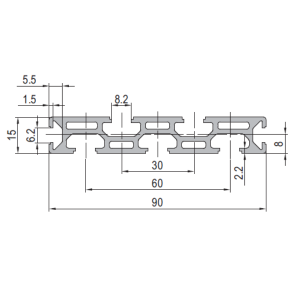 PG30 90 x 15 mm Seven Slot Aluminium Strut Profile Narrow Multi Slot Rail
90 x 15 mm seven-slot aluminium strut profile with 8.2 mm grooves on a…
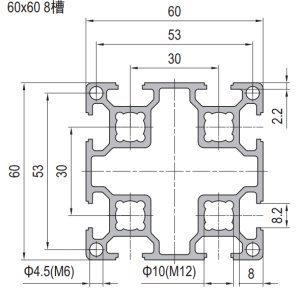 PG30 60×60 mm Eight Slot Aluminium Strut Profile Heavy Duty T-Slot Extrusion for Robot Pedestals
60 x 60 mm eight slot PG30 heavy duty aluminium strut profile in 6063-T5…
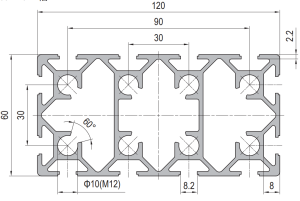 PG30 120 x 60 mm Twelve Slot Aluminium Strut Profile Heavy Frame Beam
A 120 x 60 mm twelve slot PG30 aluminium strut profile at about 5.20…
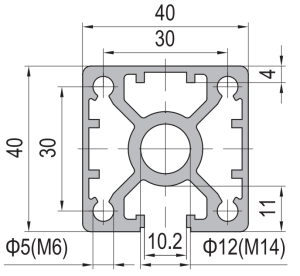 PG40 40 x 40 mm Single Slot Aluminium Strut Profile Guide Rail Base
40 x 40 mm single-slot aluminium strut profile with one 10.2 mm groove on…
 PG40 40 x 40 mm Two Slot Type A Aluminium Strut Profile Guide Rail
40 x 40 mm Type A two slot asymmetric PG40 aluminium strut profile in…
