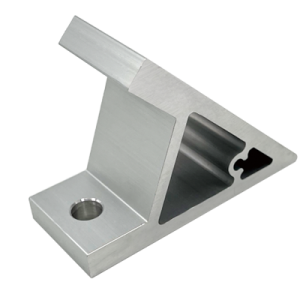
Aluminium Angle Profile Bracket 80x80x9 mm 45 Degree Corner Gusset for Angled Bracing
45 degree corner gusset 80 x 80 x 9 mm machined from 6061-T6 plate, for fixing a diagonal brace to a profile frame corner. Raises racking stiffness far more than a larger profile would.
| Material | Aluminium |
|---|---|
| Alloy Grade | 6061-T6 |
| Temper | T6 |
| Section Size | 80 x 80 mm legs |
| Slot | Round holes to drawing, M8 typical |
| Length | 80 x 80 x 9 mm |
| Tolerance | ISO 2768 medium for machined parts |
| Surface | Mill finish / anodised |
| MOQ | 500 |
| Lead Time | 18-28 days after deposit |
| Loading Port | Shanghai / Ningbo |
| Supply Ability | 200,000 pieces per month |
| Payment Terms | T/T 30% deposit + 70% before shipment | L/C at sight |
| Trade Terms | FOB | CIF | EXW |
| Certifications | ISO 9001:2015 | RoHS | REACH |
Connecting · 45 degree gusset
This is an 80 x 80 mm corner gusset, 9 mm thick, with one face set at 45 degrees to take a diagonal brace. It is used at the corner of a frame where a brace runs from one corner to the opposite corner, and it gives the brace a solid, drilled landing instead of relying on a bracket bolted through at an angle.
The reason to add a brace at all is that a rectangular frame is much weaker against racking than it looks. The four members are stiff in bending, but the frame is a four-bar linkage held square only by its corners. Push the top sideways and the frame does not bend its members much, it rotates about the corners. A diagonal brace turns that into an axial load in a single member, and axial stiffness for the same member is hundreds of times the bending stiffness. It is by a wide margin the cheapest stiffness available on a profile frame.
A right-angle frame is a linkage, not a beam
When a frame racks, most people picture the members bending. They do not, at least not at first. Four members joined at four corners form a four-bar linkage, and a linkage with pinned corners is free to rotate into a parallelogram. What stops it is the rotational stiffness of the corners, not the bending stiffness of the members.
That is why adding profile size to a racking problem helps so little. Making the members deeper makes them harder to bend, but bending is not what is happening. The frame is rotating about its corners, and the only thing resisting that is the bracket at each corner.
How much a brace is worth
A diagonal brace changes the mechanism into a triangulated structure. The lateral load no longer has to be carried by the corners rotating; it goes down the brace as an axial force. That is the whole benefit, and it is enormous because axial stiffness and bending stiffness are not comparable quantities.
Take a 40 x 40 profile with a second moment of area of about 13 cm4 and a cross section of about 5.6 cm2, so a radius of gyration of about 15 mm. Over a 500 mm span, the axial stiffness of that member is about 360 times its bending stiffness. Over a longer span it gets worse for bending, because the ratio rises with the square of the length: at 1,000 mm it is about 1,400 times.
| Span | Axial stiffness divided by bending stiffness | Comment |
|---|---|---|
| 300 mm | About 130 times | Short brace, still a large gain |
| 500 mm | About 360 times | Typical panel brace |
| 1,000 mm | About 1,400 times | Tall frame, huge gain |
| 2,000 mm | About 5,700 times | Very tall frame, brace is essential |
Why no profile upgrade can match it
The natural response to a frame that racks is to specify a bigger profile. It is worth working out what that would actually take. Stiffness in bending scales with the fourth power of the section depth, so to multiply the bending stiffness by 360 you need a section about 4.4 times as deep, because the fourth root of 360 is about 4.4.
On a 40 mm member that means going to a 175 mm section. That is not a bigger profile in the same family, it is a different order of structure, and it will weigh more, cost more and take up more space than the frame was designed for. One brace and two gussets do the same job in the plane that matters.
| Approach | Stiffness gain | Effect on the frame |
|---|---|---|
| Go from 40 x 40 to 45 x 45 profile | About 1.6 times | Slightly heavier, slightly dearer |
| Go from 40 x 40 to 60 x 60 profile | About 5 times | Noticeably heavier and dearer |
| Go from 40 x 40 to 80 x 80 profile | About 16 times | Much heavier, changes the design |
| Add one 45 degree brace with two gussets | Up to about 360 times | One extra member, two gussets |
Where the brace has to go
A brace works only in the plane of the frame it braces. A single brace on the front of a frame does nothing for racking in the side plane, so a frame that can be pushed in two directions needs a brace in each, or a braced panel that acts as a diaphragm.
The brace also has to be continuous. Two short braces meeting at a node in the middle of a member is not the same as one brace running corner to corner, because the node has to transfer the load through the member it lands on. Where a brace has to be split, put the node at a corner rather than mid-span.
Bolt layout for a 9 mm gusset
At 9 mm thick the gusset is stiff enough to spread load into the member, but it is not thick enough to ignore the bolt pattern. Three things decide whether it works.
First, the bolts on the flat leg should straddle the point where the brace force enters. If both bolts are on one side of that point the gusset rotates about them. Second, the bolt nearest the corner carries most of the load and should be as close to the corner as the profile allows. Third, the brace should land on the angled face square, so the brace end is cut at the matching angle rather than butted against a corner.
- Cut the brace end to match the angled face The brace should land flat on the 45 degree face. A brace end cut square and butted against the gusset transfers load through a line contact, which crushes the gusset edge and loosens the joint.
- Straddle the brace force with the leg bolts Place the two bolts on the flat leg so the line of the brace force passes between them. Both bolts on one side of that line leaves the gusset free to rotate.
- Use the corner bolt as the primary fixing The bolt nearest the corner takes the largest share of the load. Put it as close to the corner as the profile face allows, and do not move it out to make room for something else.
- Tighten the brace fixing before the leg fixings Set the brace on the angled face and tighten it first, then tighten the leg bolts. The other order pulls the gusset out of position before the brace is seated.
- Check the frame is square before final tightening A brace fixes the frame’s shape. Check the diagonals before the brace is tightened, because once it is tight the frame cannot be adjusted without slackening the brace.
Brace or bigger profile? If the problem is the frame racking, add a brace. If the problem is a member sagging under a load in the middle of its span, a bigger profile is the right answer, because that is bending. The two problems look similar on a drawing and are fixed in completely different ways, so identify which one you have before changing anything.
Frequently asked questions
What is a 45 degree gusset for?
Fixing a diagonal brace to the corner of a profile frame. It gives the brace a flat drilled landing at 45 degrees, so the brace loads the corner axially instead of transferring its force through a bolt in shear.
How much stiffer does a brace make a frame?
A great deal, because it changes the load path from bending to axial. Over a 500 mm span the axial stiffness of the same member is about 360 times its bending stiffness, and the ratio rises with the square of the span.
Can I just use a bigger profile instead?
In practice no. Bending stiffness scales with the fourth power of section depth, so matching a braced frame would take a section about 4.4 times as deep. On a 40 mm member that is a 175 mm section, which is a different structure altogether.
Do I need a brace in every direction?
Yes. A brace works only in the plane of the frame it is in, so a frame that racks in two directions needs a brace in each, or a closed panel acting as a diaphragm. One brace does not protect both planes.
How should the bolts be arranged on the gusset?
The two bolts on the flat leg should straddle the point where the brace force enters, and the bolt nearest the corner should be as close to it as the profile allows, because that bolt carries most of the load.
Tell us the frame and where it racks
Send the frame drawing and describe the load that makes it rack. We will confirm the brace size and the gusset angle, quote the bulk price and supply samples for a trial frame.
Request a QuoteRelated Products
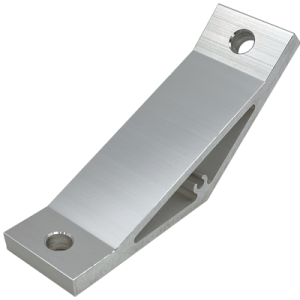 Aluminium Angle Profile Bracket 70x70x9 mm 135 Degree Corner Gusset for Obtuse Joints
Obtuse corner gusset 70 x 70 x 9 mm at 135 degrees, machined from…
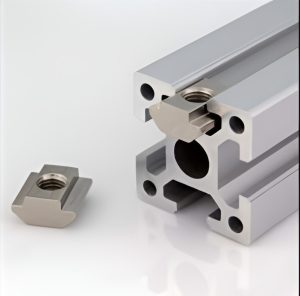 Pre-set T-Slot Nut for 8 mm Aluminium Profiles M5 M6 M8
Pre-set T-slot nut with anti-drop spring tab for 20, 30 and 40 series aluminium…
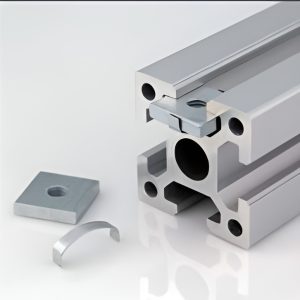 Square Nut for 8 mm T-Slot Aluminium Profiles M5 M6 M8
Square T-slot nut with four flat sides for 30 and 40 series aluminium profiles.…
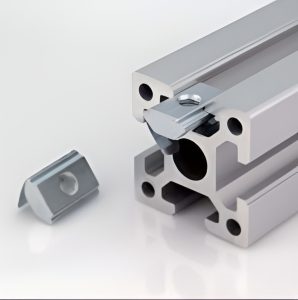 Subsequent Nut for 8 mm T-Slot Aluminium Profiles M5 M6 M8
Subsequent T-slot nut for 30 and 40 series aluminium profiles. M5, M6 and M8…
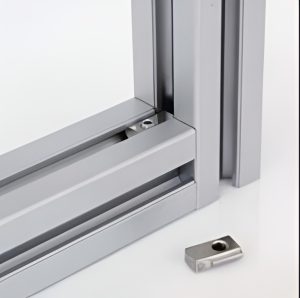 Anti-torsion Subsequent Nut for 8 mm T-Slot Aluminium Profiles
Anti-torsion subsequent T-slot nut with twin wings for 30 and 40 series aluminium profiles.…
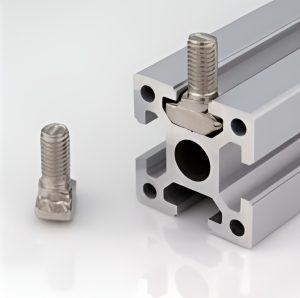 T-Bolt for 8 mm T-Slot Aluminium Profiles M6 M8 M10
T-bolt with integral T-head for 20, 30 and 40 series aluminium profiles. M5, M6,…
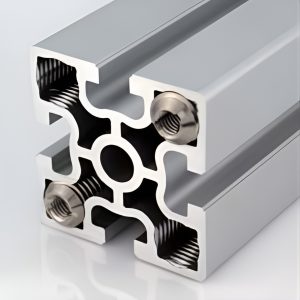 Hole Reducer Bolt for 8 mm T-Slot Aluminium Profiles
Hole reducer bolt with stepped M8 to M6 thread for 30 and 40 series…
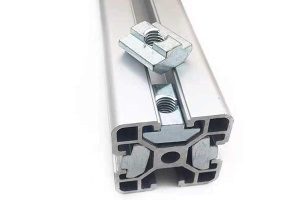 T-Nut and Bolt Set Aluminium Profile Fastener Kit M5 M6 M8 20-40 mm T-Slot Hardware
Matched T-nut, bolt and washer set for aluminium profile frames in M5, M6 and…
