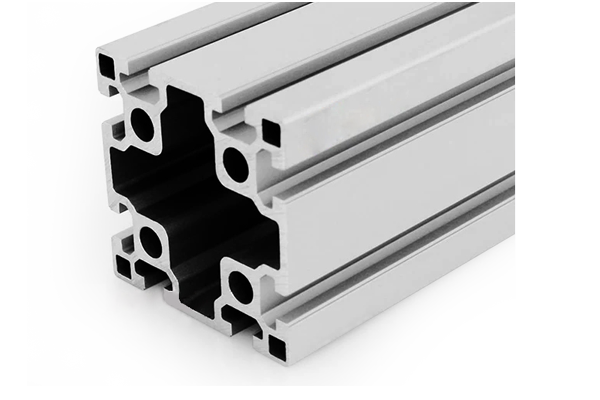
PG45 90×90 mm Eight Slot Heavy Aluminium Strut Profile for Heavy Machinery Frames
A 90 x 90 mm eight slot heavy PG45 aluminium strut profile with thicker internal walls and M10 corner holes. For heavy machinery frames where the 90 mm envelope is fixed.
| Material | Aluminium |
|---|---|
| Alloy Grade | 6063-T5 |
| Temper | T5 |
| Section Size | 90 x 90 mm |
| Slot | 8 x 10.2 mm groove, 10 mm mouth, 45 mm pitch, outer pair 45 mm apart |
| Length | 6 m stock, cut to drawing to +/-0.5 mm |
| Tolerance | EN 755-9 / GB/T 6892, wall +/-0.15 mm |
| Surface | Mill finish / clear anodised / black anodised |
| MOQ | 150 |
| Lead Time | 22-32 days after deposit for mill finish |
| Loading Port | Shanghai / Ningbo |
| Supply Ability | 200 t per month |
| Payment Terms | T/T 30% deposit + 70% before shipment | L/C at sight |
| Trade Terms | FOB | CIF | EXW |
| Certifications | ISO 9001:2015 | EN 755-9 | RoHS | REACH |
Structural framing · PG45 heavy column
A PG45 90 x 90 mm eight slot heavy aluminium strut profile is the heavy-wall version of the 45 series 90 x 90 mm column. The envelope, the 45 mm slot pitch, the 10.2 mm groove, the 10 mm slot mouth and the 8 x 8 mm corner holes tapped M10 are all unchanged; what increases is the internal wall. It weighs about 9.0 kg/m against about 7.6 kg/m for the standard wall.
The reason to be cautious about this section is that the 45 series is already a thick-wall range. Its standard column has a 6 mm flange and a 13 mm web, against 4 mm and 11 mm on the 40 series, so a 45 series standard is closer to a 40 series heavy than to a 40 series standard. Adding the heavy version on top is therefore a second, smaller increment — and once you are paying 9 kg/m for a member, it is worth checking what the same weight would buy in a larger section.
The second increment is smaller than the first
There are two ways to thicken a profile. The first is going from a thin standard wall to a heavy wall, which is a large change. The second is going from an already-thick wall to a heavier one, which is not. The 45 series standard sits in the second category before you even start, because its wall is already heavy for its size.
| Range | Flange and web | Character |
|---|---|---|
| 40 series standard | 4 mm / 11 mm | The thin-wall baseline |
| 40 series heavy | 4 mm / 11 mm plus diamond cavities | The first increment, a large step |
| 45 series standard | 6 mm / 13 mm | Already thick — closer to a 40 series heavy |
| 45 series heavy | 6 mm / 13 mm plus thicker cavities | The second increment, a much smaller step |
Look at the 45 series standard before ordering the heavy. Its 6 mm flange and 13 mm web already put it well above the 40 series in local strength. If you need the 45 series for its M10 joints, the standard wall may be all the member you need.
What the same weight buys in a larger section
This is the comparison that decides most enquiries, and it is worth doing explicitly. Take three options that all sit around 9 kg/m and compare the stiffness you get for that weight.
| Option | Weight | Second moment of area | Stiffness per kg |
|---|---|---|---|
| 90 x 90 mm standard wall | approx. 7.60 kg/m | approx. 230 cm4 | 30 |
| 90 x 90 mm heavy wall | approx. 9.00 kg/m | approx. 280 cm4 | 31 |
| 120 x 120 mm twelve slot | approx. 9.40 kg/m | approx. 600 cm4 | 64 |
The third row is the finding. For about the same weight as the 90 x 90 mm heavy section, the 120 x 120 mm column gives more than twice the stiffness. Wall thickness adds material close to the neutral axis, where it contributes comparatively little; a larger envelope puts material further from the neutral axis, where every square millimetre contributes far more. That is the whole reason depth beats thickness.
So the heavy 90 x 90 mm section is not a stiffness purchase at all. It is a local-strength and joint-durability purchase, and it is only the right answer when the 90 mm envelope cannot change.
Where the extra wall genuinely earns its keep
There are three situations where the heavy 45 series section is clearly the right answer rather than a marginal one.
The first is a heavily loaded bolted foot or base plate. A base plate transfers the whole column load into the section through a small area, and a thicker wall spreads that bearing stress over more material.
The second is repeated re-torquing. A heavier wall resists the local deformation at the slot lip and around the corner holes, so a joint that is opened and closed many times keeps its seat for longer.
The third is fatigue. A machine column that sees a reversing load benefits from a thicker wall because the local stress at the connections is lower, and in aluminium fatigue life is governed by local stress rather than by the average.
Choosing between the three options
- Work out whether the problem is stiffness or local strength If the column deflects or twists too much, it is a stiffness problem and a larger section is the answer. If the connections deform, fret or loosen, it is a local strength problem and the heavy wall is the answer.
- Check whether the envelope can grow If it can, price the larger section before ordering the heavy wall. At roughly the same weight, a 120 x 120 mm column gives about twice the stiffness.
- Keep the M10 corner holes for the structural connections The 8 x 8 mm holes tapped M10 are the strongest fixing in the section. They are unchanged on the heavy version.
- Torque to about 30 N m, not more The M10 slot ceiling is about 30 N m. A heavier wall does not raise it, because the limit is the slot lip.
- Plan for the weight during installation At 9 kg/m a 45 series heavy column is a serious lift. On a site-built frame, check that the handling is practical before committing.
Frequently asked questions
Is the heavy version much stiffer than the standard 45 series?
About 22 per cent, at about 18 per cent more weight. That is a fair exchange but a small one, and a larger section will beat it easily if there is room.
What is the difference between the 45 series standard and a 40 series heavy?
The 45 series standard already has a 6 mm flange and a 13 mm web, which is thicker than any 40 series section. The 45 series is a heavier range from the start, and it also gives you M10 corner holes.
Should I use this or a 120 x 120 mm section?
If the space allows, the 120 x 120 mm section. It gives roughly twice the stiffness for about the same weight. This section is for when the 90 mm envelope is fixed.
Does the heavy wall let me torque the bolts more?
No. The slot torque ceiling is about 30 N m for an M10 in a 45 series groove, and a heavier wall does not change it because the limit is the slot lip.
Can you supply it machined?
Yes. We cut to length, face and square the ends, drill and tap the corner holes to M10 and the centre bore to M14, and supply end and base plates.
Send the column envelope and what is bolted to it
Tell us the available envelope, the load and what is bolted to the column. If the space can grow we will price a larger section as well, so you can compare stiffness per kilogram before you decide.
Request a QuoteRelated Products
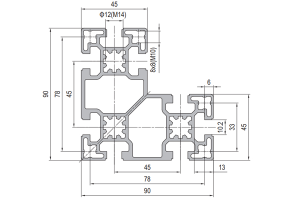 PG45 90×90 mm L-Shape Eight Slot Aluminium Strut Profile Corner Column for Frames
A 90 x 90 mm L-shaped eight slot PG45 aluminium strut profile with two…
 PG45 180 x 45 mm Ten Slot Aluminium Strut Profile Wide Gantry Beam
A 180 x 45 mm ten slot PG45 aluminium strut profile at about 6.20…
 PG50 100×100 mm Eight Slot Aluminium Strut Profile for Heavy Machine Columns
A 100 x 100 mm eight slot PG50 aluminium strut profile with two slots…
 PG50 100×50 mm Six Slot Aluminium Strut Profile Rectangular Machine Beam
A 100 x 50 mm six slot PG50 aluminium strut profile with slots on…
 PG45 90×45 mm Six Slot Aluminium Strut Profile Rectangular Machine Beam
A 90 x 45 mm six slot PG45 aluminium strut profile for machine frames…
 PG45 90 x 45 mm Six Slot Aluminium Strut Profile Heavy Rectangular Beam
90 x 45 mm six-slot heavy aluminium strut profile with 10.2 mm grooves and…
 PG45 45 x 45 mm Two Slot Type B Aluminium Strut Profile Opposite Rail
45 x 45 mm two-slot Type B aluminium strut profile with slots on opposite…
 PG40 120 x 80 mm Ten Slot Aluminium Strut Profile Wide Heavy Beam
120 x 80 mm ten-slot aluminium strut profile with six slots on the two…
