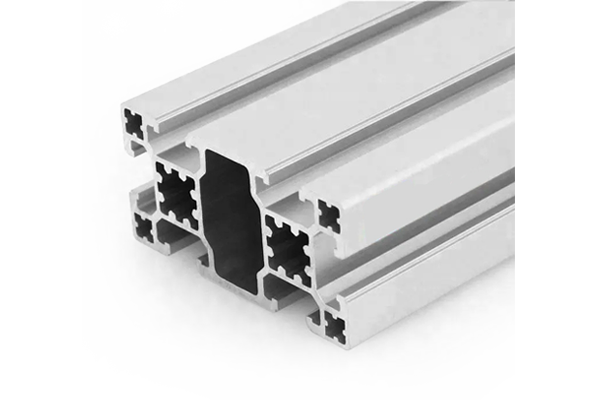
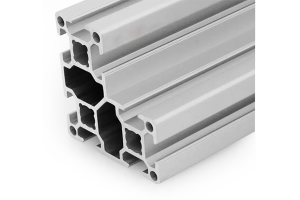
PG40 80×40 mm Six Slot Light Aluminium Strut Profile for Panel Frames
An 80 x 40 mm six slot light wall PG40 aluminium strut profile for panel frames, guards and long runs. Standard groove geometry with a reduced wall between the super light and standard sections.
| Material | Aluminium |
|---|---|
| Alloy Grade | 6063-T5 |
| Temper | T5 |
| Section Size | 80 x 40 mm |
| Slot | 6 x 10.2 mm groove, 8 mm mouth, 40 mm pitch, 2 slots per 80 mm face and 1 per 40 mm face, M8 |
| Length | 6 m stock, cut to drawing to +/-0.5 mm |
| Tolerance | EN 755-9 / GB/T 6892, wall +/-0.15 mm |
| Surface | Mill finish / clear anodised / black anodised |
| MOQ | 300 |
| Lead Time | 18-28 days after deposit for mill finish |
| Loading Port | Shanghai / Ningbo |
| Supply Ability | 400 t per month |
| Payment Terms | T/T 30% deposit + 70% before shipment | L/C at sight |
| Trade Terms | FOB | CIF | EXW |
| Certifications | ISO 9001:2015 | EN 755-9 | RoHS | REACH |
Structural framing · PG40 light wall beam
A PG40 80 x 40 mm six slot light aluminium strut profile is a reduced wall version of the standard 80 x 40 mm beam. The envelope, the six 10.2 mm grooves, the 40 mm pitch and the 8 mm mouth are unchanged, so every 40 series bracket, nut, cap and cover fits. It weighs about 2.55 kg/m against roughly 3.05 kg/m for the standard wall and is supplied in 6063-T5.
The light wall is a genuine middle option, not a compromise. It sits between the super light section, which is for covers and display frames, and the standard section, which is the general purpose machine framing choice. Where it earns its place is on frames that are long, carried by hand, or shipped — and where nothing in the design depends on a tapped thread or a heavily clamped joint.
The only honest way to compare walls
Comparing wall thicknesses on price per metre is meaningless, because a heavier section is not better, it is only heavier. Comparing them on stiffness alone is equally misleading, because the stiffest section is also the heaviest and might be overkill. The comparison that actually decides a design is stiffness per kilogram: how many cm4 of second moment of area you get for each kilogram per metre of profile.
On the 80 x 40 section that number is almost flat across the four walls, which is the most important fact about the range. A heavier wall is not a more efficient section; it is simply a bigger one.
| Wall | Weight | Stiffness on edge | cm4 per kg/m | Stiffness flat | cm4 per kg/m flat |
|---|---|---|---|---|---|
| Super light | approx. 2.10 kg/m | approx. 43 cm4 | approx. 20 | approx. 17 cm4 | approx. 8.1 |
| Light | approx. 2.55 kg/m | approx. 52 cm4 | approx. 20 | approx. 20 cm4 | approx. 7.8 |
| Standard | approx. 3.05 kg/m | approx. 62 cm4 | approx. 20 | approx. 24 cm4 | approx. 7.9 |
| Heavy | approx. 3.60 kg/m | approx. 74 cm4 | approx. 21 | approx. 29 cm4 | approx. 8.1 |
Stiffness per kilogram is flat, so weight alone does not choose the wall. What separates the four walls is not efficiency but capability: the ability to take a tapped thread, to hold torque in the slot lip, and to survive a concentrated load. Those are the criteria that should decide it.
When the light wall costs less
The light wall is cheaper per metre and lighter per metre, and on the right job it is cheaper in every sense.
On a guard frame the section carries a panel and very little else. The panel spans between the members, so the frame’s job is to hold the panel’s edges rather than to span anything itself. On that duty the light wall has ample stiffness, and the weight saved is weight that does not have to be lifted during assembly or paid for in freight.
On a long run — a conveyor side rail, a run of cladding support, a fence line — the saving is proportional to the length, and a run of a hundred metres turns a 0.5 kg/m saving into a significant freight line. On a frame that is shipped flat packed, the saving is in the carton weight as well.
When the light wall costs more
There are three situations where a light wall is the expensive choice, and all three are common enough to be worth checking before the order is placed.
| Application | Light wall verdict | Reason |
|---|---|---|
| Guard panel frame | Right choice | The panel spans, the frame only holds edges |
| Exhibition and display stand | Right choice | Handled and shipped repeatedly |
| Long conveyor side rail | Right choice | Saving multiplies with length |
| Cladding or fascia support | Right choice | Light, uniform load, long runs |
| Machine subframe under a unit | Standard wall | Concentrated load and possible tapping |
| Linear rail mounting beam | Standard wall | Rail flatness and joint stiffness both matter |
| Any member with a tapped hole | Standard or heavy | A light wall cannot hold the thread |
| Cantilever bracket arm | Standard or heavy | The joint must resist a moment |
Working with a light wall
- Design every joint as a bracket and slot nut joint No end face connectors, no self-tapping connectors, no tapped holes. Decide it at the drawing stage rather than on the bench.
- Keep the torque at about 10 to 12 N m for M8 The slot lip is the limit. A standard wall takes about 15 N m; the light wall should be held below it.
- Use more fixings rather than tighter ones A 40 mm pitch gives plenty of positions. Four lightly loaded joints outperform two heavily loaded ones on a reduced wall.
- Mount the 80 mm dimension vertical It gives about 2.6 times the stiffness of the flat orientation. On a light section the orientation matters more, not less.
- Add a mid support rather than stepping up a wall if it sags If the frame is already designed around the light section, a support is cheaper than a redesign. If it is not yet designed, choose the standard wall.
Frequently asked questions
How much lighter is the light wall than the standard?
About 2.55 kg/m against roughly 3.05 kg/m, so about 16 per cent. The stiffness difference is about 19 per cent, so the two track each other closely and the efficiency is essentially the same.
Can I tap a light wall?
Not reliably. The flange is too thin for an M8 thread and the corner bores do not have enough material around them. If a tapped connection is required, use the standard or heavy wall.
Will the standard 40 series fittings fit?
Yes. The envelope, the groove, the 40 mm pitch, the corner bores and the centre bore are all identical to the standard section, so every 40 series bracket, nut, cap and cover fits without change.
Is the light wall cheaper overall?
On the right job, yes. On a frame that ends up needing an extra support, or that has to be redesigned because a joint cannot be tapped, it costs more. The check is simple: does anything in the design depend on a tapped thread or a hard clamped joint? If yes, the light wall is the wrong choice.
What torque should I use?
About 10 to 12 N m for an M8 slot nut, against about 15 N m on the standard wall. The limit is the deformation of the slot lip, which is thinner on this section.
Send the frame duty and whether anything is tapped
Tell us what the frame carries and whether any joint is tapped or clamped hard. We will say honestly whether the light wall works or whether the standard section is the cheaper choice in the end.
Request a QuoteRelated Products
 PG40 80 x 40 mm Six Slot Aluminium Strut Profile Heavy Rectangular Beam
80 x 40 mm heavy-wall six-slot aluminium strut profile with four slots on the…
 PG40 80×80 mm Eight Slot Aluminium Strut Profile Square Column
An 80 x 80 mm eight slot standard wall PG40 aluminium strut profile square…
 PG30 30×30 mm Four Slot Aluminium Strut Profile Standard Wall Column
A 30 x 30 mm four slot standard wall PG30 aluminium strut profile square…
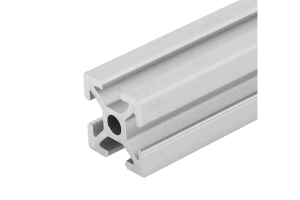 PG20 20 x 20 mm Four Slot Aluminium Strut Profile Miniature Frame
20 x 20 mm four-slot aluminium strut profile with 6.2 mm grooves and 6…
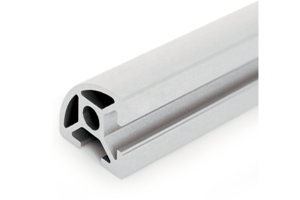 PG20 20 x 20 mm R90 Two Slot Aluminium Strut Profile Rounded Corner
20 x 20 mm quarter-round aluminium strut profile with a swept R90 outer corner…
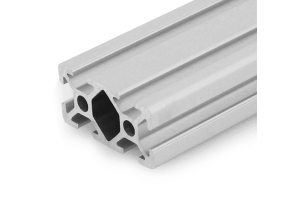 PG20 40 x 20 mm Six Slot Aluminium Strut Profile Rectangular Flat Beam
40 x 20 mm six-slot aluminium strut profile with 6.2 mm grooves on a…
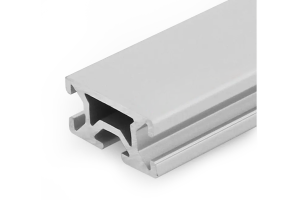 PG15 30 x 15 mm Three Slot Aluminium Strut Profile Light Panel Frame
30 x 15 mm three-slot aluminium strut profile with 6 mm grooves on a…
 PG30 60×60 mm L-Shape Eight Slot Aluminium Strut Profile Corner Column
A 60 x 60 mm L-shape eight slot PG30 aluminium strut profile corner column…
