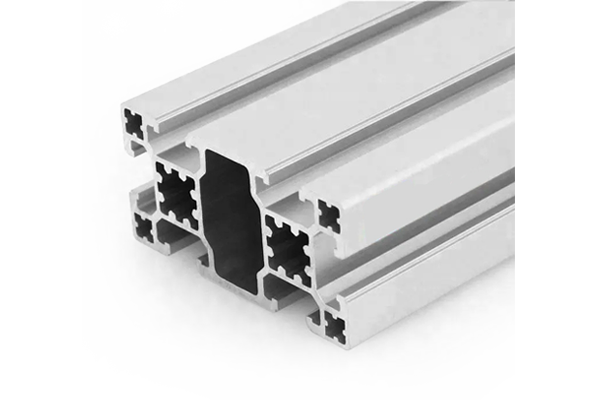
40 x 80 mm Aluminium Profile with 80 x 120 mm Beams: A Gantry Combination
Gantry pairing: 40 x 80 mm six-slot columns at 3.60 kg/m with an 80 x 120 mm ten-slot beam at 6.00 kg/m. Supplied cut, drilled and with rail faces machined flat for CNC and inspection gantries.
| Material | Aluminium |
|---|---|
| Alloy Grade | 6063-T5 |
| Temper | T5 |
| Section Size | 40 x 80 mm columns and 80 x 120 mm beam |
| Slot | 10.2 mm groove, 8 mm mouth, 40 mm pitch, M8 on both sections |
| Length | 6 m stock; cut to list to +/-0.5 mm |
| Tolerance | EN 755-9, wall +/-0.15 mm; machined rail face 0.05 mm per metre |
| Surface | Mill finish, or anodised AA15 to EN ISO 7599; clear or black |
| MOQ | 150 m, or one cut list for a single machine |
| Lead Time | 22 to 32 days for cut and machined members, plus 6 to 9 days air freight |
| Loading Port | Shanghai / Ningbo |
| Supply Ability | 600 t per month extrusion with in-house machining and anodising |
| Payment Terms | T/T 30% deposit + 70% before shipment | L/C at sight |
| Trade Terms | FOB | CIF | DAP |
| Certifications | Mill certificate per heat, machining inspection report, coating report where anodised, RoHS and REACH declarations |
01Why is the node the first bottleneck in a gantry?
Because a bolted corner rotates. Two members meeting at 90 degrees through a plate and four bolts behave, structurally, like a semi-rigid joint: it carries the moment, but it also allows rotation, and that rotation shows up directly as tool deflection at the cutting point. The beam can be perfectly sized and the gantry still deflects, because the deflection is happening at the corner rather than in the span.
The practical test is to measure the deflection at the tool with the beam loaded and then with the corner braced. If bracing the corner changes the number materially, the node was the problem, and no amount of extra beam depth would have fixed it.
- A single central bolt through a plate is the weakest common detail. It carries almost no moment before the plate starts to peel.
- A gusset or a triangular brace in the plane of the load is the cheapest effective fix, and it does not need to be large.
- A connector that engages both slot flanges, with two bolts per member, is much stiffer than a plate with one bolt per member.
- Preload matters. A loose joint is a hinge; a properly torqued joint is a semi-rigid connection. The difference is torque, not hardware.
02What are the three ways to make the beam-to-column joint?
Each has a different stiffness and a different cost, and the choice usually follows from whether the gantry has to come apart for shipping.
Butt plate and bolts
- Cheapest, easiest to ship flat
- Lowest rotational stiffness of the three
- Fine for light gantries and non-cutting axes
- Needs a gusset if any real moment is present
Internal connector and through bolts
- Better stiffness, still demountable
- Hides inside the slot, so no external obstruction
- Requires accurate cut lengths, because there is no adjustment
- The usual choice for a machine that ships in pieces
The third option is a machined corner block or a cast node, which is stiffer again and the most expensive. It is worth it when the gantry carries a spindle rather than a camera, because cutting forces are larger and the node rotation translates directly into chatter.
03Why does the rail face have to be machined?
Because a linear rail amplifies any error in its mounting face. A rail is straight to a few micrometres over its length, and it will follow the face it is bolted to. An as-extruded 40 x 80 face has about 1.5 mm per metre straightness and up to 2 degrees of twist, so a rail mounted directly on it inherits those errors and the carriage binds or wears.
Machining the rail face is not optional on a machine axis. It is also where most of the cost of a gantry kit sits, because it is a second operation on a long part and it needs a machine with the travel to do it in one setup.
| Face | As extruded | Machined |
|---|---|---|
| Straightness | About 1.5 mm per metre | 0.05 to 0.1 mm per metre |
| Twist | Up to 2 degrees | Within 0.05 mm across the width |
| Surface | Die lines, slight curvature | Cut finish, consistent |
| Use | Covers, guards, cable trays | Linear rails, racks, locating faces |
04How do you match column stiffness to beam stiffness?
The rule of thumb is that the column should not be the softer element in the load path, or the gantry behaves like a frame on rubber legs. A 40 x 80 column at 3.60 kg/m has roughly 40 cm4 about its strong axis; an 80 x 120 beam at 6.00 kg/m has roughly 170 cm4. The beam is about four times stiffer in bending, which sounds like a mismatch until the spans are considered.
A beam spanning 2 m deflects as the cube of the span; a column 1 m tall deflects as the cube of its height too, but it is loaded as a cantilever rather than simply supported, which makes it four times more compliant for the same length and section. In practice a 40 x 80 column at 1 m and an 80 x 120 beam at 2 m come out roughly balanced, which is why this pairing works and why it fails when the column gets taller without changing.
| Column height | 40 x 80 column | Comment |
|---|---|---|
| 0.8 m | Adequate | Balanced with an 80 x 120 beam at 2 m |
| 1.0 m | Balanced | The usual pairing |
| 1.4 m | Marginal | Brace the column, or go to 80 x 120 |
| 1.8 m | Too soft | Change the column section, not the beam |
05Why not use 80 x 120 for the columns as well?
Because it doubles the column mass and adds nothing where the load is not. An 80 x 120 column at 6.00 kg/m weighs 67 percent more per metre than a 40 x 80 at 3.60, and on a moving axis that mass has to be accelerated and stopped on every move. On a fixed gantry it is only cost; on a moving gantry it is performance.
The pairing is not a compromise, it is the correct answer to two different load cases. The beam sees bending between supports and needs depth. The column sees a moment at the base and needs depth in the direction of that moment, which is usually the same direction, so a 40 x 80 turned the right way does the job with less mass.
Gantry specification checklist
- Column orientation: the 80 mm dimension in the plane of the load, not across it.
- Node detail: gusset or internal connector, with a stated torque.
- Rail face: machined, with the allowance on the drawing.
- Beam span and load, so the deflection can be checked rather than assumed.
- Whether the axis moves: if it does, mass matters and 40 x 80 columns are the right call.
06What five numbers should be on the enquiry?
A gantry enquiry needs the geometry, the load and the accuracy, and the accuracy is what decides the machining.
- Beam span and column height
- clear dimensions, because both scale as the cube
- Moving load
- spindle or head mass, plus the cutting force if it is a cutting axis
- Accuracy target
- what the axis has to hold, which sets the rail face specification
- Node detail
- butt plate, internal connector or machined block
- Whether the axis moves
- because mass matters on a moving gantry and not on a fixed one
- Sections
- 40 x 80 mm at 3.60 kg/m for columns, 80 x 120 mm at 6.00 kg/m for beams
Send the span, the height and the accuracy target
- 40 x 80 mm columns, 3.60 kg/m, cut to 1.0 m
- 80 x 120 mm beam, 6.00 kg/m, cut to 2.0 m
- Rail face machined flat to 0.05 mm per metre
- Node detail: internal connector with two bolts per member
- Cut list and hole positions on the drawing
Tell us whether the gantry moves. A fixed gantry can afford 80 x 120 columns; a moving one usually cannot, because the extra mass is paid for on every acceleration.
Related sections and categories
Both sections are listed under 40 Series Aluminium Profiles. For the beam alone, the deflection tables are on the 40 x 80 mm span and load page, and the connectors are under joining plates.
Is a 40 x 80 column strong enough for a 2 m gantry span?
For a column about 1 m tall, yes, and it is the balanced pairing. The 40 x 80 has roughly 40 cm4 about its strong axis against roughly 170 cm4 for the 80 x 120 beam, but the column is loaded as a cantilever and is shorter, so the two come out roughly matched at 1 m against 2 m. Past about 1.4 m the column becomes the softer element and should be braced or changed.
Why does my gantry deflect even though the beam is oversized?
Almost always the node. A bolted corner rotates under load, and that rotation appears directly as tool deflection. Measure the deflection with the corner braced and compare: if it changes materially, the beam was never the problem. A gusset in the plane of the load is the cheapest effective fix.
Do the rail faces really need machining?
Yes, on any machine axis. A linear rail follows the face it is mounted on, and an as-extruded face is at about 1.5 mm per metre straightness with up to 2 degrees of twist. Machining brings it to 0.05 to 0.1 mm per metre. It is a second operation and it is where most of the cost of a gantry kit sits, but it is not optional.
Should the columns be 80 x 120 as well?
On a fixed gantry it is only a cost question, so it is defensible. On a moving gantry it is usually wrong, because 80 x 120 weighs 67 percent more per metre and that mass is accelerated on every move. The beam needs depth for bending; the column needs depth only in the direction of the base moment.
Can you supply the frame pre-machined and ready to assemble?
We supply cut, drilled and machined members with the rail faces finished. Assembly is normally done on site because the frame has to be squared to the machine bed, and a pre-assembled gantry of this size is difficult to ship without losing the alignment. We can supply a squaring procedure with the cut list.
Send the span, the height and the accuracy target
Give us the beam span, the column height, the moving mass and the accuracy the axis must hold. We will come back with the two sections, the rail face specification and the node detail.
Request a quotationRelated Products
 4080 Profile: 40 x 80 mm Aluminium Span and Load Limits
40 x 80 mm six-slot aluminium extrusion in 6063-T5, 3.60 kg/m, with the section…
 40 mm Aluminium Profile Range: Single, Four and Eight Slot Compared
The 40 series aluminium profile range: 40 x 40 in single, four and eight…
 40 x 40 mm Light Aluminium Profile for Mining Equipment
40 x 40 mm four-slot aluminium extrusion in 6063-T5 from 1.30 kg/m, for guards…
 Joining Plate PG40-4040
Joining plate sized for two 40 × 40 mm profiles meeting at 90°, the…
 Strut Aluminium Profile 40×40 mm 4-Slot T-Slot Extrusion Machine Frame
40 x 40 mm four-slot T-slot strut aluminium profile in 6063-T5 with M6 slots…
 Strut Aluminium Profile 20×40 mm 2-Slot T-Slot Extrusion for Light Frames
20 x 40 mm two-slot T-slot strut aluminium profile in 6063-T5 with two M6…
 Strut Aluminium Profile 30×30 mm 4-Slot Light T-Slot Extrusion
30 x 30 mm light-wall four-slot T-slot strut aluminium profile in 6063-T5 with M5…
 Strut Aluminium Profile 30×120 mm 3-Slot Wide Beam T-Slot Extrusion
30 x 120 mm three-slot wide-beam T-slot strut aluminium profile in 6063-T5 with three…
