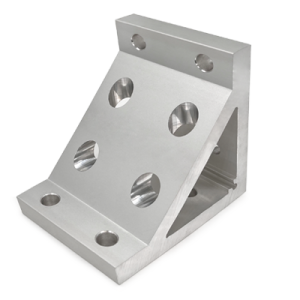
Aluminium Angle Profile Bracket 100 x 100 x 15 mm Heavy Duty Corner
100 x 100 x 15 mm heavy duty aluminium angle bracket with round fixing holes for M8 and M10 fasteners. Structural corner gusset for large frames, gantries and heavy equipment bases.
| Material | Aluminium |
|---|---|
| Alloy Grade | 6063-T6 |
| Temper | T6 |
| Section Size | 100 x 100 x 15 mm equal leg angle |
| Slot | Round holes to drawing, M8 and M10 clearance, tapped holes available |
| Length | Cut to drawing, supplied as finished brackets |
| Tolerance | EN 755-9 / GB/T 6892, +/-0.3 mm |
| Surface | Mill finish / clear anodised / black anodised |
| MOQ | Made to order; small trial batches available from stock offcuts |
| Lead Time | Typically 2 to 3 weeks for mill finish, about a week longer for anodising |
| Loading Port | Shanghai, Ningbo, Qingdao |
| Supply Ability | Extrusion and machining capacity for standard and custom brackets, with in-house anodising |
| Payment Terms | T/T 30 per cent deposit, balance against copy of bill of lading; L/C at sight for larger orders |
| Trade Terms | FOB, CIF, CFR, EXW |
| Certifications | Mill certificate to EN 10204 3.1 on request, RoHS and REACH declarations |
01What is the 100 x 100 x 15 mm angle bracket?
What makes this a heavy duty angle bracket?
The 15 mm wall thickness is the key figure. Most aluminium angle brackets in the catalogue range from 3 to 9 mm wall. At 15 mm, this bracket has a section modulus of about 45 cubic centimetres, which puts it in the structural gusset category rather than the trim or edge-protection category. It is designed to sit inside the corner of a large frame — a machine base, a gantry column or a heavy workbench — and transfer bending and shear loads through bolted joints that would otherwise need to be welded.
Why use an aluminium angle bracket instead of welding the corner?
Three reasons. First, disassembly: a bolted angle bracket lets you break the frame down for transport or maintenance. Second, heat distortion: welding a 100 mm aluminium corner pulls the material and changes the frame geometry by a millimetre or more. A bolted bracket keeps the frame square. Third, alloy control: the bracket is 6063-T6, and welding would put the heat-affected zone into a T4 or annealed state, dropping the yield strength. The bracket avoids that loss entirely.
What fasteners does it use?
The bracket has round holes sized to drawing for M8 and M10 bolts. M8 holes are typically 9 mm diameter for clearance; M10 holes are 11 mm. The hole pattern and positions are set by the customer’s drawing, so the bracket can be drilled to match whatever frame profile or plate the customer is using.
02Section data
| Item | Value | Note |
|---|---|---|
| Leg length | 100 mm x 100 mm | equal leg angle |
| Wall thickness | 15 mm | heavy duty, structural grade |
| Section modulus | approx. 45 cm3 | about the strong axis of the leg |
| Fixing holes | round, to drawing | M8 and M10 clearance |
| Corner type | internal gusset | sits inside the frame corner |
| Alloy | 6063-T6 | EN AW-6063, higher strength than T5 |
| Surface | mill or anodised | anodising 10 to 25 micron |
| Standard | EN 755-9 / GB/T 6892 | dimensional tolerance +/-0.3 mm |
| Length | cut to drawing | supplied as finished brackets, not stock bars |
The section modulus of 45 cubic centimetres is a nominal figure for the 100 x 100 x 15 equal leg section about its strong axis. The actual value depends on the hole positions and whether the bracket is loaded in bending or in shear. For a structural design check, ask for the certified section data on the quotation.
03Where the 100 x 100 x 15 bracket earns its place
This bracket is not a general-purpose angle. It is a structural corner gusset for frames where the joint has to carry real load — bending moments, shear forces, and sometimes torsion. Three applications cover most of what it does:
- Machine bases and heavy equipment frames: the bracket sits inside the corner of two 80 or 100 mm frame members, tying them together with M10 bolts. It replaces a welded corner joint and allows the frame to be disassembled for servicing.
- Gantry columns and overhead beam supports: the bracket reinforces the joint between a vertical column and a horizontal cross-beam, carrying the bending moment that the beam transfers into the column. The 15 mm wall gives enough section modulus to keep the joint rigid.
- Heavy workbench and table frames: on a workbench that carries several hundred kilograms of load, the corner brackets are what stop the frame from racking. Four brackets, one per corner, are standard.
In all three, the bracket is chosen because the joint load is too high for a die-cast corner fitting or a standard T-slot bracket, and welding is not an option or not wanted. The 100 x 100 x 15 is the bolted alternative to a welded structural corner.
04Bolted angle bracket vs welded corner: the cost comparison
The decision between a bolted angle bracket and a welded corner is rarely about raw material cost. It is about what happens after the joint is made. The table below compares the two on the criteria that actually drive the choice on a structural frame.
| Criterion | Bolted 100x100x15 bracket | Welded corner | Winner |
|---|---|---|---|
| Joint strength | depends on bolt count and size | full section, as strong as parent material | welded |
| Disassembly | yes, unbolt and separate | no, cut to dismantle | bolted |
| Heat distortion | none, frame stays square | 1 to 2 mm pull-in typical | bolted |
| Alloy strength | bracket stays T6 | HAZ drops to T4/annealed | bolted |
| Field repair | swap the bracket | grind out and re-weld | bolted |
| Cost per corner | bracket + bolts + machining | welder + weld + cleanup | similar |
| Tolerance | +/-0.3 mm on bracket holes | depends on welder skill | bolted |
The pattern is clear: the bolted bracket wins on everything except raw joint strength. On a frame that needs to be transported, serviced or assembled on site, the bolted bracket is the better choice. On a frame that is permanently fixed and never moved, welding may be simpler.
05Section modulus and allowable span for angle bracing
When the 100 x 100 x 15 bracket is used as a diagonal brace rather than a corner gusset, its section modulus determines how much compressive load it can take before buckling. The section modulus of the 15 mm wall equal leg is about 45 cubic centimetres, and the radius of gyration is about 30 mm.
| Brace length (mm) | Slenderness ratio | Allowable compressive load (kN) |
|---|---|---|
| 300 | 10 | approx. 85 |
| 500 | 17 | approx. 80 |
| 750 | 25 | approx. 70 |
| 1000 | 33 | approx. 55 |
| 1500 | 50 | approx. 35 |
The allowable compressive loads are estimates based on 6063-T6 yield strength of 215 MPa and an Euler buckling check with a safety factor of 2.5. They assume the brace is pin-ended at both ends. For a fixed-end condition, the loads are higher. Ask for a structural calculation on the quotation if the brace is load-bearing.
06Choosing between the 100x100x15 and smaller brackets
Choose the 100 x 100 x 15
- The frame uses 80 or 100 mm structural members
- The joint carries bending moment, not just shear
- You need M10 bolts for the joint tension
- The frame is large and a smaller bracket looks out of scale
- Disassembly or field assembly is a requirement
- The frame carries heavy equipment or static load
Choose a smaller bracket (50x50x9 or 30x30x4)
- The frame uses 20 to 50 mm T-slot profiles
- The joint carries shear only, no significant bending
- M5 to M8 bolts are sufficient for the load
- The frame is small and a 100 mm bracket would dominate the corner
- Weight is a driver (the 100x100x15 is heavy per piece)
- The frame is temporary and a die-cast fitting is cheaper
07Failure modes to design out
| What goes wrong | Why it happens | Design it out by |
|---|---|---|
| Bolt pulls through the hole | the 15 mm wall is thick but the hole is close to the edge | keep the edge distance at least 1.5 times the bolt diameter |
| Corner racks under lateral load | the bracket resists bending but not racking alone | add a diagonal brace or a second bracket on the opposite corner |
| Bolt loosens under vibration | aluminium threads are soft and M10 bolts can back out | use spring washers or thread-lock adhesive on all structural bolts |
| Galvanic corrosion at the bolt interface | steel bolts in aluminium brackets in wet environments | use stainless steel bolts, or isolate with a coating |
| Bracket does not sit flat on the frame | the extruded surface has a slight bow or die line | specify a machined-flat back face on the drawing for critical joints |
08What to check before you order
Procurement checklist for the 100x100x15 bracket
- Confirm the hole pattern: hole diameters, positions and edge distances. Supply a drawing if the pattern is non-standard.
- Confirm the bolt size: M8 or M10. The hole diameter changes with the bolt — 9 mm for M8, 11 mm for M10 clearance.
- Confirm the bracket length: the 100 mm leg is standard, but legs can be cut to 120, 150 or 200 mm if the frame needs a longer gusset.
- Confirm the finish: mill for hidden joints, anodised for exposed or corrosive environments.
- Confirm the quantity: brackets are sold per piece, not per metre. Count the corners in the frame and add spares.
- Confirm the alloy and temper: 6063-T6 is standard. 6061-T6 is available for higher-strength applications.
09Terms used on this page
- Section modulus
- A geometric property of the cross-section, in cubic centimetres, that determines bending strength. The 100 x 100 x 15 has about 45 cm3.
- Gusset
- A bracket or plate that sits inside a corner to reinforce the joint against bending and shear.
- Slenderness ratio
- The ratio of a brace’s length to its radius of gyration. It determines whether the brace fails by yielding or by buckling.
- Heat-affected zone
- The area around a weld where the heat has changed the material properties. In 6063-T6, the HAZ drops to near-annealed strength.
- Edge distance
- The distance from the centre of a bolt hole to the edge of the bracket. Minimum 1.5 times the bolt diameter for aluminium.
10Questions buyers ask
Can I get the bracket with tapped holes instead of clearance holes?
Yes. The 15 mm wall is thick enough to tap M8 and M10 threads directly. Specify tapped holes on the drawing if you need the bracket to accept bolts from one side only.
What is the maximum bolt size?
M10 is the standard maximum. M12 is possible but the edge distance gets tight on a 100 mm leg. For M12, specify a 120 mm leg length.
Is it available in 6061-T6?
Yes. 6063-T6 is standard for its extrudability and surface finish. 6061-T6 has a higher yield strength (about 240 MPa vs 215 MPa) and is available for higher-strength structural applications.
How many brackets do I need per frame?
One per corner for a basic box frame. For a frame with racking load, add a diagonal brace or a second bracket on the opposite corner. Four brackets is standard for a workbench; eight for a tall gantry.
Can it be supplied anodised?
Yes. Clear, black and bronze anodising at 15 to 25 micron. Anodising is recommended for brackets in corrosive or outdoor environments.
What is the lead time?
Typically two to three weeks for mill finish brackets cut to drawing. Anodising adds about a week. Custom hole patterns or non-standard leg lengths add one to two weeks for tooling.
What we need to quote this bracket
- The bracket drawing or the leg length, wall thickness and hole pattern.
- The hole specifications: diameters, positions, tapped or clearance.
- The bolt size: M8 or M10.
- The finish: mill, clear anodised, or a specified colour.
- The quantity in pieces and whether spares are needed.
- Any certification requirement: mill certificate to EN 10204 3.1, dimensional report, or structural calculation.
Send those six items and the quotation comes back with the material price, the machining charge, the finish surcharge and the lead time broken out separately. Browse the full aluminium profile catalogue and the angle profiles range for related brackets.
Need this heavy duty bracket quoted for your frame corners?
Send the bracket drawing, the hole pattern and the finish. We quote material, machining and anodising as separate lines.
Request a quotationRelated Products
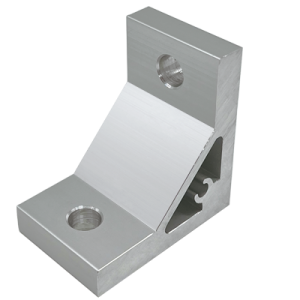 Aluminium Angle Profile Bracket 50 x 50 x 9 mm Medium Duty Corner
50 x 50 x 9 mm medium duty aluminium angle bracket with equal legs…
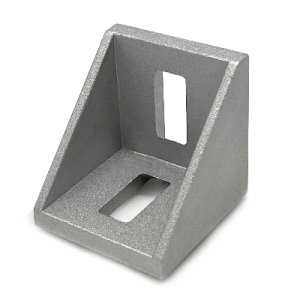 Die Cast Bracket for 20 to 50 mm Series Aluminium Profiles Corner
Die cast zinc alloy corner bracket for 20, 30, 40, 45 and 50 series…
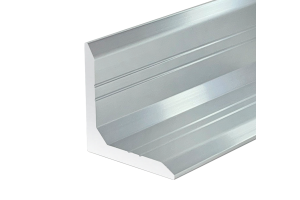 Extruded Aluminium Angle Profile 20 to 100 mm 6061 T6 Equal Leg
Extruded aluminium equal leg angle from 20 x 20 x 3 mm to 100…
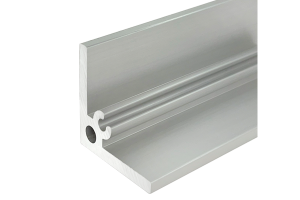 Aluminium Angle Extrusion 40x40x5 mm for Frame Assembly and Bracing
40 x 40 x 5 mm aluminium angle extrusion in 6061-T6 for frame assembly…
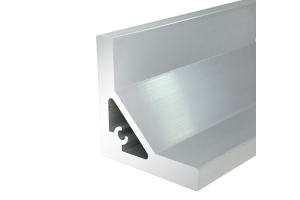 Custom Aluminium Extrusion Profile 20 to 100 mm, 6063-T5
Aluminium extrusion profiles supplied to Canada in 6063-T5 and 6061-T6, mill or anodised, with…
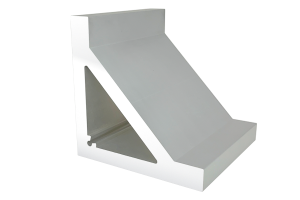 Aluminium Extrusion Manufacturing Factory: 20 to 100 mm Profiles
Aluminium extrusion profiles for Gujarat, India, in 6063-T5 and 6061-T6, with anodising film selected…
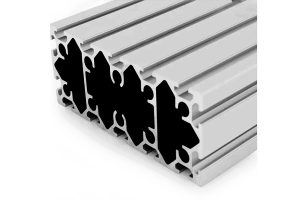 Aluminium Extrusion Profiles 20 to 45 Series for OEM, up to 100 mm
Aluminium extrusion profiles for Tamil Nadu in 6063-T5, with full batch traceability from heat…
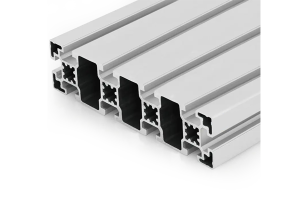 Aluminium Extrusion Manufacturer: 45 to 120 mm, 6063-T5
Aluminium extrusion for Chennai in 6063-T5, section supply with port logistics support through Chennai…
