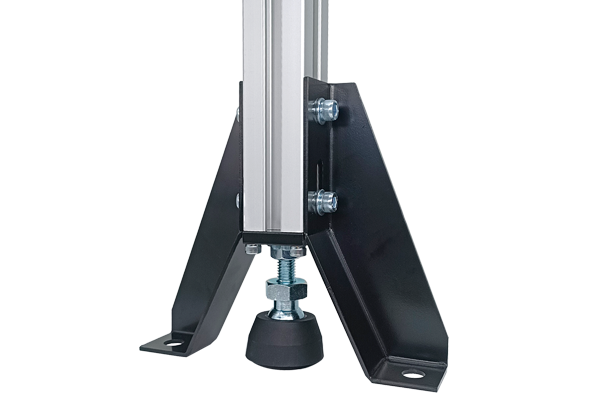
Base Angle Bracket
Gusseted angle bracket that braces the corner between a profile leg and the base, turning a flexible bolted corner into a stiff triangulated one.
| Material | Die-cast aluminium ADC12 or machined 6063; stainless option |
|---|---|
| Alloy Grade | ADC12 die-cast or 6063-T5 |
| Temper | custom |
| Section Size | Fits 30x30 to 60x60 mm and 40x80 mm sections |
| Slot | 2 + 2 to 3 + 3 bolts, M6 to M10 |
| Length | Bracket 60x60 to 120x120 mm; leg 30-60 mm |
| Tolerance | ±0.25 mm on bolt slot positions |
| Surface | Anodised, powder coated or zinc plated |
| MOQ | 500 |
| Lead Time | 20-30 days after deposit |
| Loading Port | Shanghai / Ningbo |
| Supply Ability | 150,000 pcs per month |
| Payment Terms | T/T 30% deposit + 70% before shipment | L/C at sight |
| Trade Terms | FOB | CIF | EXW |
| Certifications | ISO 9001:2015 | ISO 14001 | RoHS | REACH |
Floor elements · Corner bracing
A base angle bracket braces the corner where a leg meets the base of a frame. Two faces bolt to the two members and a gusset runs across the corner between them. Its purpose is stiffness: a bare corner joint between two profiles relies on the bolts to resist the bending moment, and bolts in a slot are not good at that. The gusset turns the bending into a compression and tension path through the plate, which is far stiffer.
The effect is easy to underestimate. On a frame with a cantilever or a side load, the corner is where most of the deflection happens. Adding a gusseted bracket at the base corners can raise the frame’s stiffness enough to change the natural frequency, which matters on a machine that vibrates, and it removes the visible wobble that a tall frame develops when it is pushed.
What a corner joint does without a bracket
- Bending is resisted by bolts in a slot. A T-slot bolt clamps the profile faces together, which is excellent in shear and poor in bending. Under a moment the joint rotates slightly, and the frame flexes at every corner.
- The rotation is cumulative. A tall frame with four flexible corners sways at the top even when each corner only moves a fraction of a degree. The sway is the sum of all of them.
- Fatigue follows. A joint that rotates under a cyclic load loosens over time, because each cycle works the bolts. A braced joint does not.
- Gussets change the load path. With a gusset, the moment at the corner is carried as tension in one leg of the bracket and compression in the other, which is a far more efficient use of the material than bending a bolt.
The bracket and the section
| Series | Leg | Bracket size | Fixing | Stiffness gain |
|---|---|---|---|---|
| 30 series | 30 × 30 | 60 × 60 × 30 mm | 2 + 2 × M6 | High |
| 40 series | 40 × 40 | 80 × 80 × 40 mm | 2 + 2 × M8 | High |
| 40 series | 40 × 80 | 80 × 120 × 40 mm | 2 + 3 × M8 | Medium-high |
| 45 series | 45 × 45 | 90 × 90 × 45 mm | 2 + 2 × M8 | High |
| 60 series | 60 × 60 | 120 × 120 × 60 mm | 3 + 3 × M10 | Medium |
Gusseted or plain: the difference in practice
- A plain angle bracket Two flat faces and no gusset. It locates the joint and takes shear, but it bends with the corner because there is nothing triangulating it. It is a locating bracket, not a stiffening one.
- A gusseted bracket A rib runs diagonally across the inside of the angle. The rib carries the corner moment as axial load, so the joint becomes dramatically stiffer for a small increase in material and cost.
- A double-gusseted bracket Two ribs, one each side of the centre. Used on heavy frames and on any corner that has to resist a moment in both directions, such as a frame that is pushed from either side.
- A die-cast bracket The gusset is cast in, so the bracket is one part with no welds and a consistent rib thickness. This is the normal construction for a base angle bracket.
Practical point: if the frame is tall or carries a cantilever, bracket the base corners first. It is the cheapest stiffness you can buy on a profile frame — a die-cast gusseted bracket costs a fraction of moving up a profile series, and it is fitted with the same bolts.
Frequently asked questions
Does a base angle bracket make the frame rigid?
It makes the corner much stiffer, which is usually where the flexibility is. A very tall frame may still need diagonal bracing, but bracketing the base corners removes most of the sway on a normal machine frame.
Can the bracket be used at the top of a frame?
Yes. The same part is used at any corner. Base corners benefit most because they carry the leg moment from the floor reaction.
Is the bracket strong enough to replace a diagonal brace?
On a short frame, often yes. On a tall frame or one with a large side load, a diagonal brace is still needed, because the bracket stiffens the corner but does not triangulate the frame as a whole.
Does the gusset interfere with the slot?
The gusset sits inside the corner, clear of the slots on the outside faces. The bracket bolts into the slots on the two members it joins.
Are the brackets available in stainless?
Yes, for wash-down and outdoor frames. Match the bolts to the bracket material so the joint does not develop galvanic corrosion.
Tell us where the frame is flexible
Describe the frame and where it deflects or sways. We will recommend the bracket, the gusset type and the fixing pattern, and return FOB pricing within one working day.
Request a QuoteRelated Products
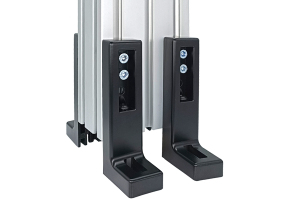 L-Base Corner Bracket
Unequal-leg L bracket that lets a profile leg stand on the floor, takes the…
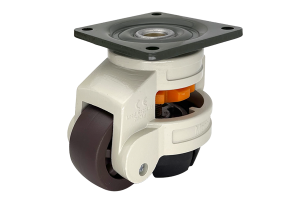 Levelling Castor
Combined castor and levelling foot: move the frame on the wheel, then wind the…
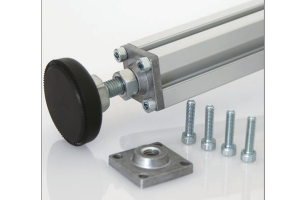 Foot Mounting Plate
Adapter plate bolted to the end of a profile leg that presents a standard…
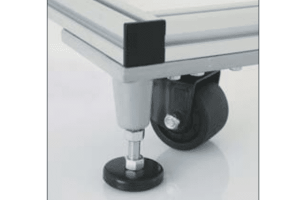 Foot and Castor Components
Spare and replacement components for foot and castor installations — pads, stems, locking nuts,…
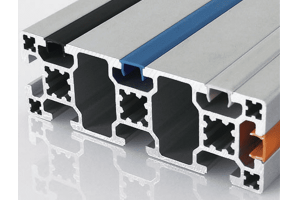 T-Slot Cover Profile
Snap-in T-slot cover strip that closes the open slot on aluminium framing profiles, giving…
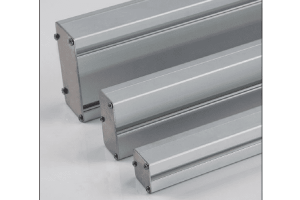 Aluminium Conduit End Cap
Snap-fit or screw-fixed end caps for aluminium conduit profiles from 40x40 to 80x200 mm,…
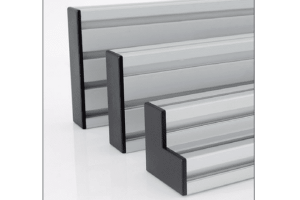 Aluminium Profile End Cap
Push-fit end caps for T-slot framing profiles from 15 to 60 series, sized to…
 T-Slot Reducing Profile
Reducing insert that narrows a wide T-slot to accept standard nuts and accessories from…
