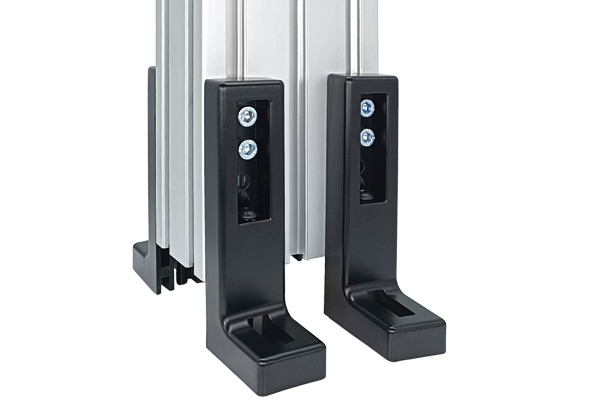
L-Base Corner Bracket
Unequal-leg L bracket that lets a profile leg stand on the floor, takes the floor anchors and braces the base corner, fixed to the side of the profile rather than its end.
| Material | Aluminium 6063-T5 or steel; stainless option |
|---|---|
| Alloy Grade | 6063-T5 or S235 steel |
| Temper | custom |
| Section Size | Fits 30x30 to 60x60 mm and 40x80 mm sections |
| Slot | 2-3 slot bolts M6-M10; 2-3 floor holes Ø9-Ø13 mm |
| Length | Long leg 60-120 mm; short leg 30-60 mm |
| Tolerance | ±0.2 mm on hole positions |
| Surface | Anodised, powder coated or zinc plated |
| MOQ | 500 |
| Lead Time | 15-25 days after deposit |
| Loading Port | Shanghai / Ningbo |
| Supply Ability | 120,000 pcs per month |
| Payment Terms | T/T 30% deposit + 70% before shipment | L/C at sight |
| Trade Terms | FOB | CIF | EXW |
| Certifications | ISO 9001:2015 | ISO 14001 | RoHS | REACH |
Floor elements · Floor mounting
An L-base bracket is an unequal-leg angle. The long leg lies flat on the floor and takes the anchor bolts; the short leg bolts into the slot of the profile that stands on it. In one part it does three jobs: it gives the profile a flat floor bearing, it anchors the leg to the floor, and it braces the bottom of the leg against a sideways push.
It is the part used when a frame leg has to be fixed to the floor without a separate base plate. Where a base plate closes the end face of the profile and the leg stands on it, an L-base bracket fixes to the side of the leg and spreads onto the floor beside it. That is the right arrangement where the leg is anchored against a wall or along a floor line and the end of the profile is not available.
When an L-base bracket beats a base plate
The unequal legs, and why the long one is long
The long leg is the floor leg and its length sets how far the anchor bolts sit from the leg. That distance is what resists the tipping moment: the further the bolts are from the line of the leg, the smaller the pull-out force on them for a given overturning moment. Doubling the bolt offset halves the tension in each bolt.
The short leg is set by the profile — it has to reach across enough of the side face to take two bolts in the slot and still leave the slot accessible. On a 40 series profile that is about 40 mm; on a 60 series, about 60 mm.
| Profile | Long leg | Short leg | Floor bolts | Slot bolts |
|---|---|---|---|---|
| 30 × 30 mm | 60 mm | 30 mm | 2 × Ø9 | 2 × M6 |
| 40 × 40 mm | 80 mm | 40 mm | 2 × Ø11 | 2 × M8 |
| 45 × 45 mm | 90 mm | 45 mm | 2 × Ø11 | 2 × M8 |
| 60 × 60 mm | 120 mm | 60 mm | 3 × Ø13 | 3 × M10 |
| 40 × 80 mm | 120 mm | 40 mm | 3 × Ø11 | 3 × M8 |
How it is used at a corner
- Set the frame in position Level and square the frame first, using levelling feet or shims. The bracket is fitted after the frame is where it should be, not before.
- Mark the floor bolt positions Offer the bracket to the leg, set it flat on the floor, and mark through the floor holes. Move the frame aside to drill if the floor is hard.
- Fix the bracket to the profile Bolt the short leg into the profile slot with T-nuts, finger-tight, so the bracket can still slide to align with the drilled holes.
- Set the anchors Drop the anchors through the long leg and tighten. On a corner, two brackets at right angles to each other resist a push from either direction.
- Tighten the slot bolts last Once the anchors are set, tighten the slot bolts to lock the bracket to the profile. That order stops the bracket pre-loading the leg out of square.
Practical point: at an inside corner, two L-base brackets at right angles give a corner that resists a push in any direction, and they cost less than a single heavy anchor plate. Where the corner is visible, the brackets can be supplied finished to match the frame.
Frequently asked questions
Does an L-base bracket replace a levelling foot?
No. The bracket fixes the frame to the floor at a fixed height. Where the frame also has to be levelled, fit levelling feet in the profile ends and use the bracket alongside them for anchoring.
Can it be used on a leg that is not vertical?
Yes, and that is one of its advantages. It fixes to the side of the profile and lands flat on the floor regardless of the leg angle.
How many brackets does a frame need?
At least one per leg for anchoring, and two at any corner that has to resist a push from more than one direction.
Can the bracket be fitted without dismantling the frame?
Yes. It fixes to the outside of the profile, so it can be retrofitted to a frame that is already standing.
Are the brackets available in stainless?
Yes, for wash-down and outdoor installations, with stainless anchors to match.
Send the leg detail and the anchor line
Tell us the profile, the leg angle and where the floor fixings are available. We will return the bracket, the leg lengths and the anchor bolt offset, with FOB pricing within one working day.
Request a QuoteRelated Products
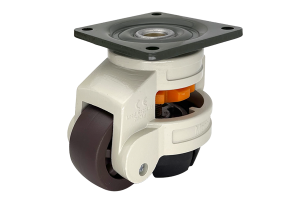 Levelling Castor
Combined castor and levelling foot: move the frame on the wheel, then wind the…
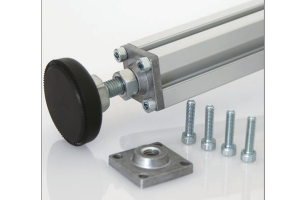 Foot Mounting Plate
Adapter plate bolted to the end of a profile leg that presents a standard…
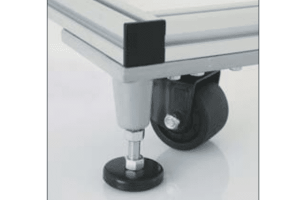 Foot and Castor Components
Spare and replacement components for foot and castor installations — pads, stems, locking nuts,…
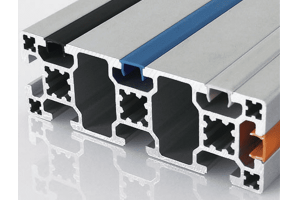 T-Slot Cover Profile
Snap-in T-slot cover strip that closes the open slot on aluminium framing profiles, giving…
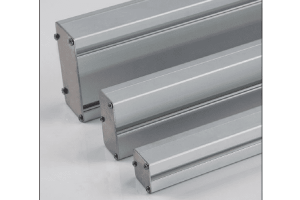 Aluminium Conduit End Cap
Snap-fit or screw-fixed end caps for aluminium conduit profiles from 40x40 to 80x200 mm,…
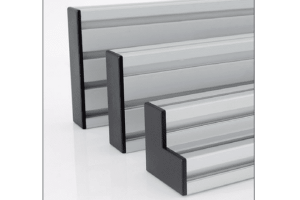 Aluminium Profile End Cap
Push-fit end caps for T-slot framing profiles from 15 to 60 series, sized to…
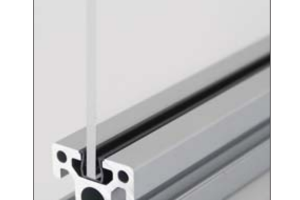 T-Slot Reducing Profile
Reducing insert that narrows a wide T-slot to accept standard nuts and accessories from…
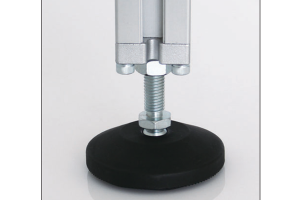 Swivel Ball Foot
Self-aligning levelling foot with a ball-and-socket joint between stem and pad, keeping the pad…
