Cross-Brand T-Slot Compatibility: Interchangeability Is a Hardware Question
Two 40 by 40 profiles from two suppliers can have the same outline, the same weight and the same price per metre, and accept none of the same hardware. The number that decides it is not on the drawing, and it is not in the CAD model either.
Short answer
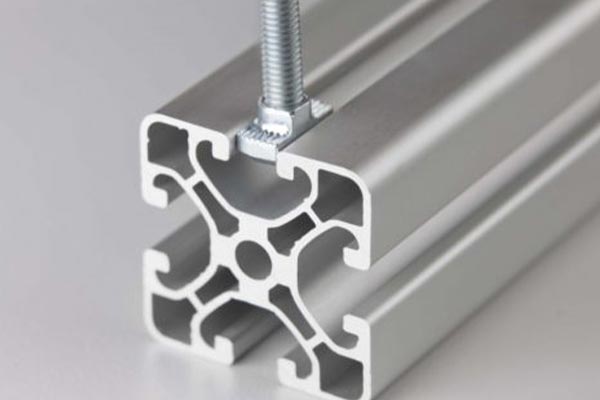
Whether hardware from one supplier fits a profile from another is decided by two dimensions: the width of the slot mouth and the diameter and position of the core hole. The envelope of the profile, its weight and its price per metre say nothing about either. In practice the established systems split along those two numbers. Bosch Rexroth’s standard connection slot is the 10 mm slot taking an M8 T-nut; Item and the Misumi HFS range use an 8 mm slot; MayTec uses an 8.2 mm slot with a core hole around 12 mm, which accepts a self-tapping anchor. A 10 mm nut will not enter an 8.2 mm slot, and an M14 core-hole anchor will not start in a profile whose core hole is smaller. The practical consequence is that interchangeability is a hardware question: the profile is only the envelope, and the nuts, anchors and brackets are the parts that have to match. Because a CAD model of a profile is usually a simple extrusion of an outline, it does not carry the slot tolerance that decides whether a substitution will work.
Interchangeability is decided by the hardware, not by the profile outline
The question a buyer usually asks is whether a generic profile can replace a branded one. The question that actually decides the answer is whether the existing hardware will fit the new profile, and that is a different question with a different answer.
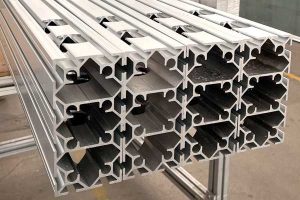
Start from what the hardware needs. A T-nut needs a slot mouth wide enough to admit it and a groove wide enough to rotate in, with enough depth for the nut and its bolt. An internal anchor needs a core hole of a specific diameter, in a specific position, so the anchor can be driven in and expanded. A bracket needs the slot position to line up so its fixing holes land in the slot. Each of these is a dimension on the profile, and none of them is the envelope.
So the substitution test is not whether the profiles look the same. It is whether the slot mouth, the groove, the core hole and the slot position are the same within the tolerance that the hardware can absorb. A supplier who answers a compatibility question with an outline drawing has not answered it.
The two numbers: slot mouth width and core-hole diameter
The slot mouth is the narrow opening at the face of the profile. It is the smallest dimension in the slot, and it is what a nut has to pass through or be inserted past. A slot mouth of 10 mm and a slot mouth of 8.2 mm look similar in a photograph and behave completely differently: a nut sized for 10 mm simply will not go in, and a nut sized for 8.2 mm will rattle in a 10 mm slot and will not develop the same clamping geometry.
The core hole is the central bore that runs down the middle of the profile and accepts an internal anchor. It has a diameter and a position, and both matter. An anchor that expands in a 12 mm bore needs a 12 mm bore; a larger bore lets it spin and a smaller one will not admit it. The position matters because the anchor has to reach the hole from the slot, so the distance from the slot mouth to the bore is part of the geometry.
A third dimension, less often quoted, is the groove depth and the lip thickness. These set how much load the lip can take and how deep a nut can sit. Two profiles with the same mouth and the same core hole but different lip thickness are not interchangeable for a heavy load, even though a nut drops in.
| Dimension | What it decides | If it is wrong |
|---|---|---|
| Slot mouth width | Whether a nut can be inserted at all | The hardware does not fit, or it fits loose and clamps poorly |
| Core-hole diameter | Whether an internal anchor can be used | The anchor spins, or will not start, or splits the bore |
| Core-hole position | Whether the anchor can reach the bore from the slot | The anchor bottoms out before it engages |
| Groove depth | How much of the nut is engaged | Reduced clamping force and a lip that is loaded in the wrong place |
| Lip thickness | The load the slot can carry | A nut that fits but pulls through under load |
Where the established systems actually differ
Most of the industrial aluminium framing market has settled into a small number of slot standards, and the differences between them are the source of most substitution problems.
The 10 mm slot is the heavy end. Bosch Rexroth’s standard connection slot is the 10 mm slot, and its T-nuts are sized accordingly, with an M8 nut as a typical example. A 10 mm slot takes a larger nut, a larger bolt and a larger core-hole anchor, which is why it appears on the heavier series and on systems intended for machine bases rather than light frames.
The 8 mm slot is the middle and the most widely copied. Item and the Misumi HFS range use an 8 mm slot, which takes an M6 or M8 nut depending on the series, and which is the geometry that a great deal of generic hardware is made to fit. An 8 mm slot is the de facto compatibility target for a large part of the market.
The 8.2 mm slot with a roughly 12 mm core hole is the variant that generates the most confusion. The extra two-tenths of a millimetre of mouth and the specific core hole are the numbers that a compatible system has to match, because the internal anchor that expands in that core hole is the defining connector of the system. A profile that is 8 mm rather than 8.2 mm may accept the external hardware and refuse the internal anchor, which is exactly the failure that a substitution checklist is meant to catch.
Two cautions. First, every supplier offers several series, and the slot can differ between a light and a heavy series within the same brand. Second, brand catalogues change, so the dimensions should be read from the current catalogue or measured from a sample, not assumed from a summary like this one.
Why CAD models do not carry the answer
This is the reason substitution failures survive design review. A profile in a CAD library is usually modelled as a constant section: an outline extruded along a length, with the slots represented as simple recesses. The model is dimensionally correct at the nominal level and it is silent about the things that decide interchangeability.
Three omissions are typical. The first is the slot tolerance: a nominal 8.2 mm mouth has a tolerance band, and a nut that fits a nominal slot may not fit a slot at the low end of the band. The second is the groove and lip detail, which is often simplified. The third is the core-hole position relative to the slot, which is sometimes drawn approximately because it does not matter for a visual model.
The practical control is to require a dimensioned section drawing with tolerances, not a CAD model, and to check the substitution against the hardware rather than against the model. Where a supplier can provide a measured sample, a fit test with the actual nut and anchor is worth more than any drawing.
The argument against a universal slot
There is a persistent idea that a single universal slot would solve all of this, and there is a good engineering reason why the established systems did not converge on one.
A slot is a compromise between three requirements that pull against each other. It has to admit the largest nut the system needs, which pushes the mouth wider. It has to keep enough lip to carry the load, which pushes the mouth narrower. And it has to leave room for a core hole large enough for an internal anchor, which pushes the wall thinner. A slot that tries to satisfy every system ends up with a mouth wide enough to weaken the lip and a groove shaped for no particular nut, so it fits everything approximately and nothing well.
That is why the practical answer is not a universal slot but a declared one. A supplier should state the slot geometry, the hardware it is compatible with, and the tolerance, and the buyer should match the hardware to the declaration. Interchangeability is then a documented property of a system rather than a hope about a shape.
How to check a substitution before you buy
Five checks cover most substitutions, and they take an afternoon rather than a project.
Measure the slot mouth on a sample with a caliper, at several points along the length, and compare with the hardware requirement rather than with the nominal. Measure the core-hole diameter and its position, and test the actual anchor. Fit the actual nut, not an equivalent, into the actual slot, and check that it rotates and clamps. Check the lip thickness against the load the joint has to carry, because a nut that fits can still pull through a thin lip. And check the surface finish, because a mill-finish slot and an anodised slot have different friction, which changes the torque that produces a given preload.
The last check is the one most often skipped and the one that causes the most arguments. A substitution that works mechanically can still fail in service if the clamping force is different, because the frame is held together by friction in the joints rather than by the bolts in shear.
What to send when compatibility matters
If a project has to be compatible with an existing system, say which one and which series, and say whether the existing hardware is being reused or replaced. Send a dimensioned section drawing of the profile being replaced, if you have one, and the hardware part numbers. State the load the joints have to carry, so the lip can be checked rather than assumed. And state whether the compatibility requirement is a hard constraint or a preference, because that decides how much of the existing design can be changed.
With those answers a supplier can either confirm compatibility against the declared geometry or say plainly that it is not compatible, which is a much more useful answer than a statement that the profiles look the same.
RFQ checklist — cross-brand compatibility
- Existing system and series — the brand, the series and, if possible, the part numbers of the profiles and hardware.
- Slot mouth — the measured width and its tolerance, not the nominal value.
- Core hole — diameter and position, if an internal anchor is used.
- Lip thickness — and the load the joint has to carry, so the slot can be checked.
- Hardware to be reused — whether existing nuts, anchors and brackets stay, which makes the slot a hard constraint.
- Finish — mill, anodised or coated, because friction changes the preload for a given torque.
- Section drawing — a dimensioned drawing with tolerances, rather than a CAD model alone.
- Priority — whether compatibility is a hard requirement or a preference, which sets how much can change.
Ask one question before quoting: whether the existing hardware has to be reused. If it does, the slot geometry is a hard constraint and the profile outline is almost irrelevant.
Four ways a substitution fails
Related on this site
- Metric vs imperial T-slot compatibility— the same substitution problem across two measurement systems
- Slot mouth tolerance and what it controls— why the mouth dimension is the one that decides fit
- Anchor pins: a preloaded joint, not a pin— what an internal anchor needs from the core hole
- Connecting elements category— nuts, anchors and brackets with their slot requirements
Terms used in this article
- Slot mouth
- The narrow opening at the face of a T-slot profile, which is the smallest dimension a nut has to pass.
- Core hole
- The central bore running along a profile, which accepts an internal anchor that expands inside it.
- Lip thickness
- The wall between the slot and the outside of the profile, which sets how much load the slot can carry.
- Internal anchor
- A connector that expands inside the core hole to join two profiles, leaving no external hardware.
- Interchangeability
- The property of two systems accepting each other’s hardware within a defined tolerance, which is a documented property rather than a similarity of shape.
- Preload
- The clamping force in a joint produced by tightening a fastener, which is what actually holds a bolted frame together.
Questions buyers ask
Will generic profiles fit branded hardware?
Only if the slot mouth, the core hole and the lip match within tolerance. The envelope tells you nothing. Ask for the slot geometry with tolerances and test the actual nut and anchor in an actual sample before committing.
What is the difference between an 8 mm and an 8.2 mm slot?
Two tenths of a millimetre of mouth, plus the core-hole geometry that usually goes with it. That is enough to decide whether a specific internal anchor can be used, which is why a nominally similar profile can accept external nuts and refuse internal anchors.
Can I tell compatibility from a CAD model?
Usually not. Profile models are typically a nominal outline with simplified slots, and they rarely carry the mouth tolerance, the lip detail or the core-hole position. A dimensioned section drawing and a fit test are the reliable checks.
Why is there no universal slot?
Because a slot is a compromise between admitting a large nut, keeping enough lip to carry load, and leaving room for a core hole. A slot that fits every system ends up with a weak lip and a groove shaped for no particular nut.
Does the finish affect compatibility?
It affects the joint rather than the fit. A mill-finish slot and an anodised slot have different friction, so the same torque produces a different preload. If a frame relies on friction in its joints, that difference matters.
Send the slot geometry you have to match
Give us the system, the series and the hardware you need to reuse, and we will confirm the slot mouth, core hole and lip against a dimensioned drawing before you commit.
Request a quoteRelated reading
Twelve more engineering notes from this blog, picked for this article — plus every category below.
 Sourcing and ProcurementImporting Aluminum Profiles from China: Nine Failures That Quietly Raise Your Landed Cost
 Engineering DesignHow to Choose the Right T-Slot Aluminium Profile for Your Project
 ApplicationsLean Pipe vs T-Slot Profile: Two Interface Philosophies, Not Two Generations
 Engineering DesignAluminum vs Steel Machine Frames: Choose by Deflection, Not by Strength
 Materials and EngineeringRecycled Aluminium Profiles: A Number You Have to Be Able to Evidence
 Sourcing and ProcurementAuditing an Aluminium Profile Supplier: Factory, Trader, or Something in Between
 ApplicationsAluminium Profile Applications
 Quality and InspectionT-Slot Aluminium Profiles for Industrial Frames and Automation: A Specification Playbook
 Materials and Engineering6063-T5 Aluminium Profile: What the Designation Actually Guarantees
 ApplicationsAluminium Profile for LED Strips: A Heat Sink First, a Housing Second
 Materials and EngineeringAluminum Extrusion Tolerances: How to Write a Specification Your QC Team Can Actually Inspect
 Materials and EngineeringAluminium Corrosion: Why a Salt Spray Number Is a Ranking, Not a Life
