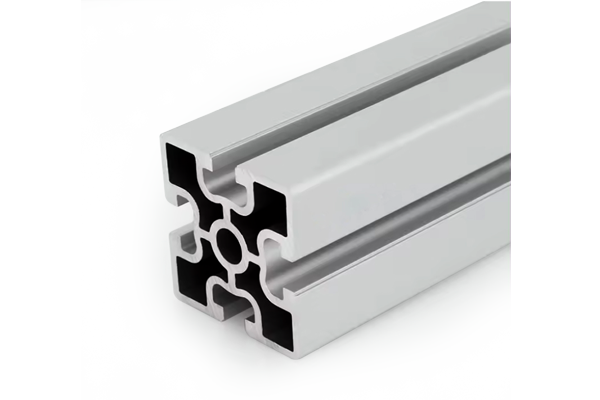
Aluminium 60 x 60 mm Four Slot Extrusion for Robot Cell Gantries
60 x 60 mm four slot aluminium extrusion for robot cell gantry columns and beams. 4.3 kg/m standard, 6.4 kg/m heavy, 10.2 mm slot mouth.
| Material | Aluminium |
|---|---|
| Alloy Grade | 6063-T5 |
| Temper | T5 |
| Section Size | 60 x 60 mm |
| Slot | 10.2 mm mouth, 14 x 14 mm groove, M8 and M10 slot nuts, 4 faces, 48 mm pitch |
| Length | 6 m stock, cut to list to +/-0.5 mm |
| Tolerance | EN 755-9 / GB/T 6892, wall +/-0.15 mm |
| Surface | Mill finish / clear anodised / black anodised |
| MOQ | 400 m for mill finish; heavy variant from 300 m |
| Lead Time | Typically 20 to 30 days after deposit for mill finish, 25 to 35 days for the heavy variant |
| Loading Port | Shenzhen, Guangzhou, Ningbo |
| Supply Ability | Extrusion and machining of heavy sections up to 120 mm envelope |
| Payment Terms | T/T 30 per cent deposit, balance against copy of bill of lading |
| Trade Terms | FOB, CIF, CFR, EXW |
| Certifications | Mill certificate to EN 10204 3.1 on request, RoHS and REACH declarations |
01When is a 60 x 60 column the right choice?
When the load is not the problem but the height is. A 60 x 60 mm four slot aluminium extrusion at about 4.3 kg/m is not a strong section in absolute terms — a 40 x 40 heavy will often carry as much in pure compression. What the 60 x 60 buys is resistance to bending over a long unsupported length, and that is what a robot cell gantry actually needs, because a fence post or a gantry column is loaded sideways far more often than it is loaded downwards.
Three cases where it is the right answer: a fence column between 2.0 and 3.0 m tall, a gantry beam spanning 1.5 to 2.5 m with light tooling on it, and a frame upright that has to resist a door being pushed or a pallet truck being nudged into it. Below those spans a 40 series is usually enough. Above them, no single extrusion is the answer and the design needs a truss or a steel section.
Looking for a 20 x 60 mm rail rather than a 60 x 60? That is a different section with a different slot system — see the 20 x 60 mm eight slot profile. The two are often confused because the numbers are the same in a different order, and the sections are not interchangeable.
02Will a 2.4 m column buckle?
Almost certainly not, and it is worth doing the sum anyway because the answer changes fast with length. For a slender column the critical load is given by Euler: P critical equals pi squared times E times I, divided by the square of the effective length. The effective length is the real length multiplied by a factor that depends on how the ends are held — 1.0 for pinned-pinned, 0.7 for fixed-pinned, 0.5 for fixed-fixed, and 2.0 for a free-standing cantilever.
The worked example below uses E = 70,000 N/mm2 for 6063 and an estimated I = 4.5 x 10^5 mm^4 for the 60 x 60 four slot envelope. That inertia figure is an estimate for this envelope, not a certified section property — substitute the value from the section data you are actually using, because every load in the table scales linearly with it.
| Effective length | Pinned-pinned (K = 1.0) | Fixed-pinned (K = 0.7) | Cantilever (K = 2.0) |
|---|---|---|---|
| 1.5 m | 138 kN | 282 kN | 34.5 kN |
| 2.0 m | 77.7 kN | 159 kN | 19.4 kN |
| 2.4 m | 54.0 kN | 110 kN | 13.5 kN |
| 3.0 m | 34.5 kN | 70.5 kN | 8.6 kN |
Two things to take from this. First, a 2.4 m pinned column at 54 kN is far beyond anything a robot fence will see — a fence panel weighs tens of kilograms, not tonnes. Buckling is therefore not the governing case for a cell fence. Second, look at the cantilever column: at 13.5 kN it is four times weaker than the pinned case, so how the base is fixed matters more than the section.
So what actually governs the design?
Deflection under lateral load, and the stiffness of the base connection. A fence column that sways 20 mm when someone leans on it will not collapse, but the panels will rattle, the door will not latch, and the cell will fail its guarding inspection. Design against a sway limit, not against a buckling load.
What sway limit is reasonable?
For a machine guard, a common working limit is height divided by 200 at the top of the column under the design lateral load. On a 2.4 m column that is 12 mm. It is a practical limit, not a code requirement — check what the guarding standard your customer works to actually says.
03How much does a gantry beam deflect at each span?
Deflection of a simply supported beam with a point load at mid span is P times L cubed, divided by 48 E I. The cube is what makes span the dominant variable: doubling the span increases the deflection eightfold for the same load and section.
| Span | 500 N at mid span | 1000 N at mid span | 2000 N at mid span |
|---|---|---|---|
| 1.0 m | 0.33 mm | 0.66 mm | 1.32 mm |
| 1.5 m | 1.12 mm | 2.23 mm | 4.47 mm |
| 2.0 m | 2.65 mm | 5.29 mm | 10.6 mm |
| 2.5 m | 5.17 mm | 10.3 mm | 20.7 mm |
| 3.0 m | 8.93 mm | 17.9 mm | 35.7 mm |
Same assumptions as the buckling table: E = 70,000 N/mm2 and I = 4.5 x 10^5 mm^4. At a 2 m span with 200 kg hanging in the middle, 10.6 mm of sag is visible and will upset any precision process under the gantry. That is the real reason gantries are built from deep sections rather than square ones — a 60 x 120 has roughly eight times the inertia of a 60 x 60 in its strong direction for twice the mass.
A gantry beam is usually loaded at a moving point, not at mid span. Deflection is worst at mid span, so design for that position even if the tool spends most of its time at one end.
04What is the centre bore for?
On the standard 60 x 60 the centre carries a bore that takes an M16 thread on the heavy variant. It is there for three jobs: an end connection where two lengths butt together, a levelling foot or castor with a central stud, and a lifting point during assembly. It is not a structural through-bolt hole for a base plate — the wall around it is thin, and a bolt tightened hard through the centre of the section will crush the bore rather than clamp the joint.
- Use the centre bore for end-to-end joints with a threaded connector, not for clamping a plate.
- For a base plate, use the four slots or four corner holes — the load path is through the walls, not through the bore.
- If the column is also a lifting point, fit a rated eye to the M16 thread and check the thread engagement is at least 1.5 times the diameter.
- Cap the bore on an outdoor or washdown cell, or it becomes a water trap.
05How should the base be fixed?
The base connection is where a gantry or fence column actually gets its stiffness, and it is usually the weakest link in an otherwise adequate design. A column bolted to the floor with four M10 anchors through a base plate behaves closer to fixed than to pinned — but only if the plate is thick enough not to flex and the anchors are spaced far enough apart.
- Base plate thickness
- at least 10 mm for a 60 series column, 12 mm preferred
- Anchor spacing
- as wide as the plate allows; spacing drives the fixity
- Anchor type
- mechanical expansion or chemical, matched to the floor build-up
- Grouting
- non-shrink grout under the plate if the floor is not flat
- Isolation
- an isolator pad only if the cell needs vibration isolation, and then the base detail has to change
06What lateral load does a fence actually see?
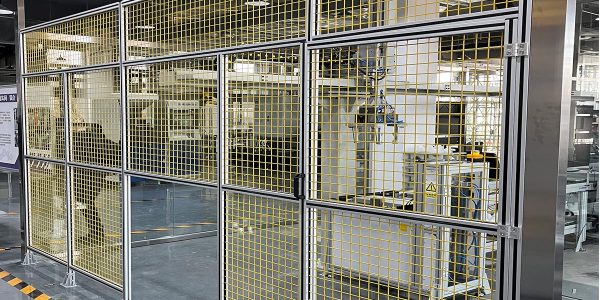
Three sources, and the smallest of them is usually the one that gets designed for.
| Source | Order of magnitude | How it is normally handled |
|---|---|---|
| Door slam | A few hundred newtons at the latch, applied dynamically | Design the door frame and latch, not the column |
| Person leaning or pushing | Around 0.5 to 1 kN at chest height | This is usually the governing case; design the column to a sway limit |
| Pallet truck or trolley impact | Several kilonewtons, unpredictable | Protect with a separate barrier, do not design the fence for it |
| Wind on an outdoor cell | Depends on panel area and location | Calculate from the panel area; an open mesh panel is far lower than a solid one |
The practical conclusion: do not use the fence as an impact barrier. A separate protection post in front of the column costs a fraction of the column and takes the damage without affecting the guarding.
07Standard 4.3 kg/m or heavy 6.4 kg/m?
Standard, approx. 4.3 kg/m
- Adequate for fence columns up to about 2.5 m
- M8 and M10 slot fixings, which covers most guard panels
- Lighter to handle and to erect
- Lower cost per metre, and stocked
- The default for a cell fence or a light gantry
Heavy, approx. 6.4 kg/m
- About 50 per cent more inertia, so noticeably stiffer in bending
- M16 slot fixings for heavier brackets and door hardware
- Better where the column is also a lifting or handling point
- Heavier and harder to erect without two people
- Choose it when the sway limit cannot be met with the standard section
The step from 4.3 to 6.4 kg/m is a 49 per cent increase in mass for roughly a 50 per cent increase in inertia, so stiffness per kilogram is essentially unchanged. The heavy section does not buy efficiency — it buys absolute stiffness in the same footprint. If the footprint is free, a larger standard section is usually the better trade.
Gantry and fence column checklist
- Unsupported column height and how the base is fixed, stated explicitly
- Governing case identified: buckling, sway, or beam deflection
- Sway limit agreed with the customer, and the lateral load it is checked against
- Gantry beam oriented with its depth in the bending direction
- Base plate thickness and anchor spacing drawn, not left to the installer
- Centre bore use decided: end joint, foot, lifting point, or capped
- Panel restraint method, so the fence does not rely on the slot nuts alone
- Separate impact protection where vehicles operate near the cell
08Questions from cell and gantry designers
Related sections and categories
Browse 60 Series Aluminium Profiles, Strut Profiles, the 60 x 60 mm four slot column, or see the 60 x 60 mm heavy variant with M16 fixings for the full section data.
What is the weight of 60 x 60 four slot extrusion?
Approximately 4.3 kg/m in the standard variant and 6.4 kg/m in the heavy variant, both with a 10.2 mm slot mouth, 14 x 14 mm groove and 48 mm slot pitch.
How tall can a 60 x 60 fence column be?
Fence columns are normally 2.0 to 3.0 m. Buckling is not the limit at that height; lateral sway is. Check the sway at the top of the column against a limit such as height divided by 200 under the design lateral load.
Can the column take a cantilever arm?
Yes, but treat it as a cantilever column and use the K = 2.0 case. The load capacity drops to roughly a quarter of the pinned case, so a cantilever arm needs a much stiffer base or a brace back to the structure.
Is 6063-T5 strong enough for a robot cell?
For the fence and the gantry structure, yes — the design is stiffness governed, not strength governed. Where a column is also a machine guarding structural element with a stated impact rating, the requirement should be checked against the guarding standard rather than assumed from the alloy.
Do you supply the frame cut and drilled to a cell drawing?
Yes. Send the cell layout with column heights, panel sizes and door positions. Columns are cut to length and drilled for brackets on a jig, so the door openings come out square across the whole run.
What to send for a 60 x 60 gantry quote
- Cell or gantry layout with column heights and beam spans
- Load on the gantry, and whether it moves
- Lateral load case, or the sway limit the customer requires
- Base detail: plate size, anchor type, floor build-up
- Panel and door sizes, if it is a fence
- Standard or heavy section, or the span if you want a recommendation
- Finish and colour, and whether cut faces need sealing
- Quantity in metres and number of columns
Send the span and the load rather than the section. On a gantry the span decides the section almost every time, and the section people ask for is often one size small.
Send the span and the lateral load
Tell us the column height, the gantry span, the load on it and how the base is fixed. We will run the deflection and buckling check against the section and come back with the standard or heavy variant and a price.
Request a quotationRelated Products
 Aluminium 4040 Extrusion 40 x 40 mm Single Slot for Machine Fixtures
40 x 40 mm single slot aluminium 4040 extrusion for machine fixture bases. Three…
 Aluminium 40 Series Extrusion 40 x 40 mm for PV Module Lines
40 x 40 mm aluminium 40 series extrusion for photovoltaic module lines. Four slots,…
 Anodised Aluminium Profile 40 x 40 mm AA15 Clear Finish for Visible Frames
40 x 40 mm anodised aluminium profile in 6063-T5 with an AA15 clear anodised…
 CNC Machined Aluminium Profile 40 x 40 mm Drilled and Tapped Cut List
40 x 40 mm aluminium profile supplied CNC machined to a cut list: saw…
 Aluminium Profile Sliding Door 40 Series 8 mm Slot for Machine Enclosures
Sliding door leaves framed in 40 series aluminium profile for machine enclosures. Top hung…
 Aluminium Lean Pipe Joint System 28 mm for Kaizen Cart Frames
28 mm lean pipe joint system in aluminium tube with a 1.0 mm wall,…
 ESD Aluminium Profile Workbench 40 x 40 mm Anti-Static Assembly Frame
ESD workbench built on a 40 x 40 mm aluminium profile frame, supplied mill…
 Aluminium Profile Stair Stringer 45 x 90 mm for Access Platforms
45 x 90 mm six slot heavy aluminium profile at about 4.85 kg/m, cut…
