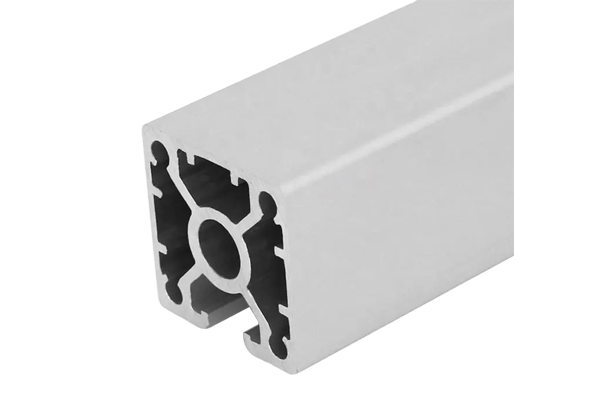
Aluminium 4040 Extrusion 40 x 40 mm Single Slot for Machine Fixtures
40 x 40 mm single slot aluminium 4040 extrusion for machine fixture bases. Three solid faces, 2.10 kg/m, M8 slot, machined datum faces on request.
| Material | Aluminium |
|---|---|
| Alloy Grade | 6063-T5 |
| Temper | T5 |
| Section Size | 40 x 40 mm square, single slot, three solid faces |
| Slot | 1 x 10.2 mm groove, 8 mm mouth, one face only, M8, three solid faces |
| Length | 6 m stock, cut to list to +/-0.5 mm |
| Tolerance | EN 755-9 / GB/T 6892, wall +/-0.15 mm; machined face 0.05 mm over 300 mm |
| Surface | Mill finish / clear anodised / black anodised |
| MOQ | Made to order; small trial lengths available from stock offcuts |
| Lead Time | Typically 2 to 3 weeks for mill finish, plus 1 to 2 weeks for datum machining, plus a week for anodising |
| Loading Port | Shenzhen, Guangzhou, Ningbo |
| Supply Ability | In-house saw cutting, datum face machining, drilling and tapping |
| Payment Terms | T/T 30 per cent deposit, balance against copy of bill of lading |
| Trade Terms | FOB, CIF, CFR, EXW |
| Certifications | Mill certificate to EN 10204 3.1 on request, RoHS and REACH declarations |
01Why use a single slot section as a fixture base?
Because most fixture bases do not need four slots, and the three solid faces are the feature that keeps chips out. A 40 x 40 mm aluminium 4040 extrusion in the single slot variant weighs about 2.10 kg/m and presents one 10.2 mm groove with an 8 mm mouth on a single face, with the other three faces closed. On a fixture that sits beside a cutting zone, that means swarf has exactly one route into the interior instead of four.
This page is about that environment specifically. It is not about using a T-slot profile as a machine frame — that is a different job with different failure modes. Here the questions are: where does the coolant go, what is actually flat enough to locate against, how deep can you tap, and how many clamp cycles before the aluminium gives up.
02Where do chips and coolant get in?
Four routes, and the single slot design closes three of them. The one that remains is the open slot itself, which is a horizontal channel running the full length of the fixture, exactly at the height where swarf lands.
| Route | Open on a four slot section | Open on this single slot section | Mitigation |
|---|---|---|---|
| Slot mouth, horizontal | Four faces | One face | Slot cover strip, or orient the slot downward |
| Slot mouth, vertical | Four faces | None | Not applicable on this section |
| End of the slot run | Both ends open | Both ends open | End cap, or a stop block that also closes the end |
| Centre bore and internal cavities | Open at both ends | Open at both ends | Cap or plug; blow out at every tool change |
The practical arrangement on a fixture is to turn the slot to face the machine table or the operator, never upward. A slot facing down still gives you adjustment, and it cannot fill with coolant because it drains. A slot facing up will fill within one shift and then the T-nuts stop sliding freely, which is the first symptom of a fixture that has stopped being repeatable.
A slot cover strip costs very little and solves the upward-facing case properly. Fit it after the fixture is set, and remove it only when the fixture is reconfigured.
03What is flat enough to locate against?
Not the extruded faces. An extruded profile face has a twist and a bow that are within the extrusion standard but far outside a fixture tolerance — the standard allows a straightness deviation along the length that is measured in tenths of a millimetre per metre, and a fixture that locates on that face inherits all of it.
- Machine the datum faces. We can machine one or two adjacent faces flat to about 0.05 mm over 300 mm, and those become the fixture datum.
- Machine adjacent faces, not opposite ones. Two adjacent machined faces define a corner and remove five of the six degrees of freedom.
- Keep the machined face away from the slot mouth — machining across the mouth leaves a burr inside the slot that the T-nut will find.
- Anodise after machining if the fixture sees coolant, and mask the machined datum if the coating thickness would affect the height.
- Re-check the datum after the first week. Aluminium fixtures bed into the table and a fixture that was flat on installation is often not flat after a thermal cycle.
04How deep can you tap into a 40 x 40 wall?
This section weighs about 2.10 kg/m, which back-calculates to a cross-section of roughly 778 mm2 and an average wall of about 5 mm. That is an estimate from the mass, not a drawing dimension, so confirm it against the section drawing before committing to a thread.
| Thread | Pitch | Full threads in a 5 mm wall | Suitable for |
|---|---|---|---|
| M5 | 0.8 mm | about 6 | Light stops, sensor brackets, cover fixings |
| M6 | 1.0 mm | about 5 | Clamp stops, light duty positioning |
| M8 | 1.25 mm | about 4 | The practical maximum in the wall itself |
| M8 through a T-nut | 1.25 mm | Full nut depth | Anything cycled repeatedly, or carrying clamp load |
The conclusion is uncomfortable but important: a tapped hole in a 5 mm wall is a locating feature, not a load-bearing one. Four full M8 threads in 6063 will hold a stop block in position, and will strip if someone leans on a clamp handle. For anything that carries clamp force or gets cycled, use a T-nut in the slot, or a through-bolt with a nut on the far face.
05How many clamp cycles before the aluminium gives up?
There is no single number, but there is a reliable pattern. Aluminium fixtures fail at the contact points, not in the body: the clamp pad embeds into the aluminium, the hole the clamp bolt passes through elongates, and the machined datum picks up dents from swarf trapped under the workpiece. All three are surface effects, and all three are worse on a mill finish than on an anodised one.
| Wear mode | What you see | Root cause | Fix |
|---|---|---|---|
| Clamp pad embedding | A dimple under each clamp pad, growing over weeks | Clamp force on a small pad area, aluminium yield strength is low | Steel or hardened pad under the clamp, larger pad area |
| Bolt hole elongation | The fixture shifts under load and will not re-clamp in the same place | Bolt shank bearing on the aluminium hole wall | Use a shouldered bolt or a bushing so the shank, not the thread, carries shear |
| Datum denting | Workpiece sits high on one corner | Swarf trapped between workpiece and datum, then crushed | Air blast at every load, and a relieved groove at the datum corner |
| Slot wear | T-nuts become loose along the slot | Abrasive swarf in the slot acting as a lap | Cover strip, and blow out the slot at every tool change |
If the fixture is cycled more than a few hundred times a month, the honest answer is that an aluminium fixture base is a consumable. It is cheap, quick to make, and easy to replace — but it is not a permanent precision fixture, and expecting it to be one is where the disappointment comes from.
06Does coolant attack the profile?
Water-miscible coolant is mildly alkaline in service, and that is exactly the range that attacks an anodised layer slowly. On a mill finish profile the effect is cosmetic staining. On an anodised profile it is a dull patch that grows, and at a cut face or a thread it becomes pitting.
Mill finish
- Cheapest, and available from stock
- Stains quickly and looks neglected after a month
- Fine where the fixture is not visible and not washed
- Cut faces need no special treatment
- Best choice for a fixture that will be replaced
Clear anodised, 10 to 15 micron
- Resists coolant staining and is easy to wipe down
- Harder surface, so clamp pads embed more slowly
- Must be anodised after machining and after drilling
- Mask the datum faces if coating thickness matters
- Better where the fixture is long-lived or inspected
One thing to check before specifying either: the coolant concentrate. Some high-pH or amine-borate products are noticeably more aggressive on aluminium than a standard emulsion, and a few will attack a mill finish within days. Ask the coolant supplier for the pH of the working solution, and if it is above about 9.5, treat the anodised option as the baseline rather than the upgrade.
07When should the fixture not be aluminium?
Four situations where this section is the wrong material, regardless of how convenient the slot system is.
- High clamp loads. If the clamp force is measured in kilonewtons, the aluminium will yield at the pad. Use steel.
- Heavy interrupted cutting. The vibration transmitted through the fixture will work every joint loose, and aluminium has very little damping. Cast iron is the traditional answer for a reason.
- Abrasive dust. Cast iron or composite dust in an open slot is a lapping compound. If the process makes abrasive dust, use a closed section.
- A fixture that must hold tolerance for years. Aluminium creeps under sustained clamp load at elevated temperature, and a fixture that is flat when new will not be flat in two years.
Fixture base checklist for a cutting cell
- Slot orientation decided: facing down or toward the operator, never up
- Datum faces identified, and whether they are machined or as-extruded
- Tapping depths checked against the actual wall, not the nominal
- Which joints carry clamp load, and whether they use a T-nut instead of a thread
- Coolant type and working pH, so the finish can be chosen
- Clamp pad material and area, so the aluminium is not the wear surface
- Air blast at every load, and a relieved corner at the datum
- Expected life, so the fixture is designed to be replaced rather than repaired
08Questions from fixture and process engineers
Related sections and categories
Browse 40 Series Aluminium Profiles, Strut Profiles, the 40 x 40 mm single slot section, or see the 40 x 40 mm four slot section for the full section data.
What is the difference between this and the four slot 40 x 40?
This section has one slot and three solid faces at about 2.10 kg/m. The four slot variant has a slot on every face and weighs 1.30 to 2.35 kg/m depending on wall. The single slot version is chosen for chip control and for stiffness in the three closed directions, not for fixing flexibility.
Can the profile be supplied with machined datum faces?
Yes, one or two adjacent faces machined flat to about 0.05 mm over 300 mm, with the machined face held away from the slot mouth. State which faces and the datum relationship on the drawing.
What thread can I tap into the wall?
M8 is the practical maximum, giving about four full threads in a 5 mm wall. That is enough for a stop or a cover, not for anything that carries clamp load or is cycled. Use a T-nut in the slot for those.
Will coolant damage an anodised fixture base?
Not quickly, if the coolant is a standard emulsion at a working pH below about 9.5. High-pH or amine-borate coolants attack the anodised layer, and any cut face or thread is where it starts.
Do you supply fixtures machined to a drawing?
Yes. Send the fixture drawing with the datum faces and hole pattern marked. The profile is cut, the datum faces machined, then holes drilled and tapped on a jig so the pattern repeats across a batch of fixtures.
What to send for a fixture base quote
- Fixture drawing with datum faces and hole pattern marked
- Which faces are to be machined, and the flatness required
- Thread sizes and depths, or the clamp type if you want a recommendation
- Coolant type and working pH, so the finish can be chosen
- Slot orientation in service, if it affects the cut list
- Whether the fixture is a one-off or a batch that must repeat
- Finish: mill or clear anodised, and whether datum faces are masked
If the fixture is replacing one that has worn, send a photo of the worn area. Where an aluminium fixture fails is far more informative than where it was dimensioned.
Send the fixture drawing
Tell us which faces are datum, what the clamps do, and which coolant you run. We will come back with the section, the machining allowance and a price per fixture.
Request a quotationRelated Products
 Aluminium 40 Series Extrusion 40 x 40 mm for PV Module Lines
40 x 40 mm aluminium 40 series extrusion for photovoltaic module lines. Four slots,…
 Anodised Aluminium Profile 40 x 40 mm AA15 Clear Finish for Visible Frames
40 x 40 mm anodised aluminium profile in 6063-T5 with an AA15 clear anodised…
 CNC Machined Aluminium Profile 40 x 40 mm Drilled and Tapped Cut List
40 x 40 mm aluminium profile supplied CNC machined to a cut list: saw…
 Aluminium Profile Hinge 40 Series 180 Degree for 8 mm Slot Guard Doors
180 degree hinge for 40 series aluminium profile guard doors. Two leaves clamp into…
 Aluminium Profile Sliding Door 40 Series 8 mm Slot for Machine Enclosures
Sliding door leaves framed in 40 series aluminium profile for machine enclosures. Top hung…
 Aluminium Lean Pipe Joint System 28 mm for Kaizen Cart Frames
28 mm lean pipe joint system in aluminium tube with a 1.0 mm wall,…
 ESD Aluminium Profile Workbench 40 x 40 mm Anti-Static Assembly Frame
ESD workbench built on a 40 x 40 mm aluminium profile frame, supplied mill…
 Aluminium Profile Stair Stringer 45 x 90 mm for Access Platforms
45 x 90 mm six slot heavy aluminium profile at about 4.85 kg/m, cut…
