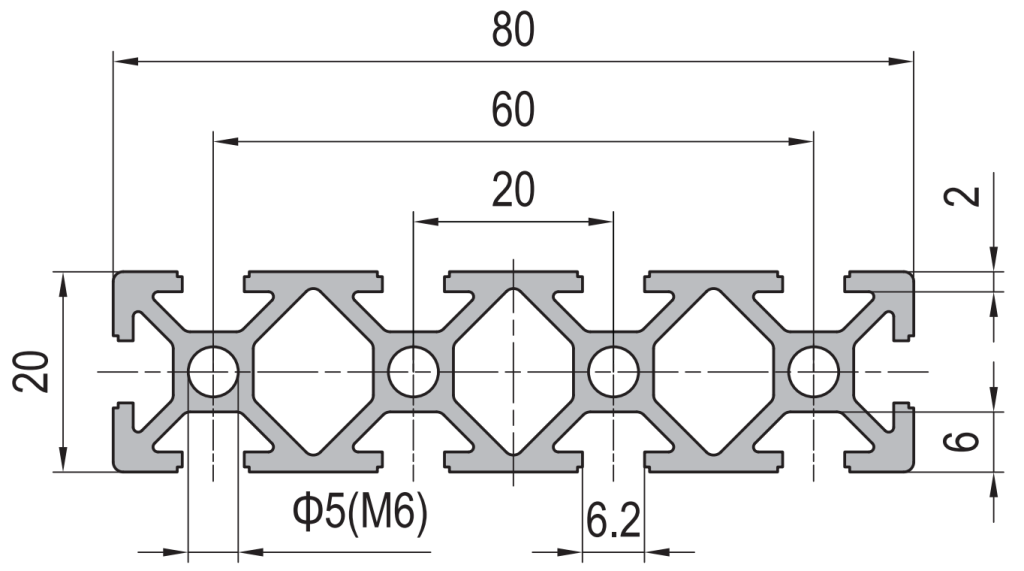
20 x 80 mm Narrow Aluminium Profile for Textile and Diamond Machinery
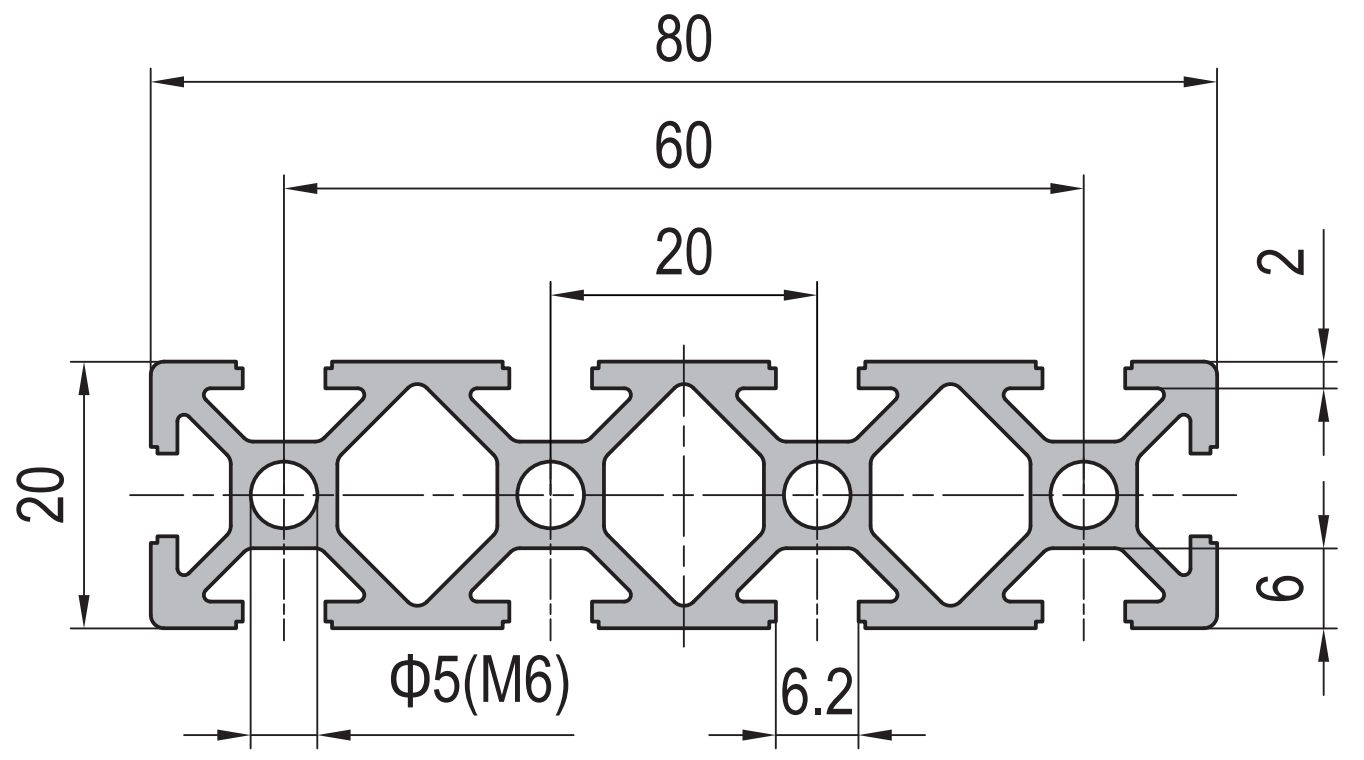
20 x 80 mm ten slot narrow aluminium profile in 6063-T5 for machinery where the frame gap is too narrow for a square section. New die required; the 20 x 40 six slot is available from stock as an interim.
| Material | Aluminium |
|---|---|
| Alloy Grade | 6063-T5 |
| Temper | T5 |
| Section Size | 20 x 80 mm, ten slots on the 20 mm face |
| Slot | Ten slots on the 20 mm face, typically M5 or M6 thread; confirm against the slot mouth |
| Length | 6 m stock once tooled; cut to list to +/-0.5 mm |
| Tolerance | EN 755-9, wall +/-0.15 mm; straightness 1.5 mm per metre |
| Surface | Mill finish, or clear or black anodised |
| MOQ | 300 to 500 kg for a new die; no minimum for the 20 x 40 interim route |
| Lead Time | 4 to 6 weeks to first good part for a new die, including trial and correction; 20 x 40 interim ships in days |
| Loading Port | Shanghai / Ningbo |
| Supply Ability | 600 t per month extrusion with in-house die shop |
| Payment Terms | Die and first run: T/T 50% with order + 50% before shipment | L/C at sight for repeat orders |
| Trade Terms | FOB | CIF | EXW |
| Certifications | Mill certificate per heat, coating report per lot, RoHS and REACH declarations |
01Why does a textile or diamond machine need a 20 x 80 section at all?
Because the space between the working elements is often narrower than the load requires. On a winding, slitting or gang-saw frame the gap between two shafts might be 30 mm, so a 40 or 45 mm wide profile will not fit no matter how much stiffer it is. The only way to get bending stiffness into a 20 mm slot is to grow the section in the other direction — which is exactly what a 20 x 80 mm profile is.
This is a real constraint in the Surat cluster, where textile machinery and diamond processing equipment are built in tightly packed frames. The section is not chosen because it is elegant; it is chosen because nothing wider fits. That single fact drives every other decision on this page.
Second moment of area scales with the cube of depth and only linearly with width. Going from 20 x 40 to 20 x 80 doubles the depth of the bending direction, so for the same wall the stiffness goes up by roughly eight times while the weight only doubles. That is why narrow-deep beats square when the envelope is constrained.
02What does a nine to one axis ratio actually mean in service?
It means the profile has two completely different personalities depending on which way the load arrives. Estimating from the 20 x 40 six slot family at the same nominal wall, a 20 x 80 section comes out at roughly 21 cm4 about the strong axis and roughly 2.2 cm4 about the weak axis. Those are estimates to be confirmed on a drawing, not catalogue values — the point is the ratio, not the third digit.
| Loading direction | Second moment of area | What it behaves like |
|---|---|---|
| Bending across the 80 mm depth | approx. 21 cm4 | a proper beam, 1.5 m span is fine |
| Bending across the 20 mm width | approx. 2.2 cm4 | a strip, sags under its own weight |
| Compression along the axis | governed by the weak axis | buckles about 20 mm long before it yields |
| Torsion | very low | twists if loaded off centre |
The practical consequence is that the orientation is part of the design, not a detail for the fitter. A frame drawn with the 80 mm face vertical and the load arriving sideways will deflect ten times more than the drawing implies, and the failure will be blamed on the material rather than on the orientation.
03How do you stop a narrow section buckling about its weak axis?
You cannot fix it with a thicker wall — wall thickness barely moves the weak axis because that axis is dominated by the 20 mm dimension. The only effective answers are shortening the unbraced length or restraining the section laterally.
- Brace at intervals. Treat the weak axis as an unbraced column of length equal to the distance between braces, not the full span. Two braces turn one 2 m column into three 0.67 m columns and the buckling load goes up roughly ninefold.
- Use the slot pattern as the brace. A 20 x 80 ten slot section has slots on the 20 mm face precisely so a flat plate or a second profile can be bolted across it. That plate is doing structural work, not just closing the frame.
- Load through the strong axis only. Route the force path so bending lands on the 80 mm depth. If a load has to arrive sideways, add a bracket that transfers it rather than letting the profile take it.
- Avoid eccentric connections. A T-nut set off the centreline introduces torsion, and a section with 2.2 cm4 about one axis has almost nothing to resist it.
A narrow deep section that is braced is excellent. The same section unbraced is a spring. The difference is two brackets and a line on the drawing.
04What can ten slots on a 20 mm face actually hold?
More than people expect, because the slots run along the 20 mm face and give you a linear array of fixing positions rather than a single line. On a 20 mm face with ten slots the pitch is small, so you can put several fasteners into a short length and share a load across them instead of hanging everything on one T-nut.
- Multiple fasteners close together resist rotation at a joint, which a single fastener cannot.
- The small pitch lets you mount a plate anywhere along the length without drilling, which matters when positions are set on site.
- Thread size follows the slot, and on this family it is typically M5 or M6 — do not assume M8 will fit a 20 mm face.
- Slot nuts for a narrow section are small, so check the tightening torque against the nut manufacturer’s figure rather than using the M8 habit.
05What does it cost to open a die for a section that does not exist?
Our production range does not include a 20 x 80 ten slot section. The nearest thing we run is a 20 x 40 six slot at about 0.80 kg/m, and that is a genuinely different animal. So an order for 20 x 80 means a new die, and it is worth being straight about what that involves.
| Item | Typical range | Notes |
|---|---|---|
| Die cost | 1,500 to 4,000 USD | depends on section complexity and number of cavities |
| Die lead time | 7 to 15 working days | design, machining, nitriding |
| Trial run | 1 to 2 attempts | first trial often needs a correction |
| Minimum first order | 300 to 500 kg | the die has to be paid back on the first run |
| Total to first good part | 4 to 6 weeks | including trial, correction and production |
| Die ownership | negotiable | get it in writing, it matters if you change supplier |
Two commercial points that buyers forget. Who owns the die should be settled before you pay for it — if you paid, you should be able to take it elsewhere. And trial material is usually chargeable, because it is real metal that went through a real press even though the section was not yet right.
06Is there a way to avoid the die entirely?
Yes, for a first build or a low-volume machine: two 20 x 40 six slot sections bolted back to back make a 20 x 80 envelope with a joint down the middle. It is not the same thing, and it is honest to say why.
Two 20 x 40 back to back
- Available now, about 1.6 kg/m for the pair
- Strong axis roughly comparable for bending
- A joint line down the middle, visible and cleanable
- Fasteners carry shear across the joint
- Good for prototypes and one-off machines
Single 20 x 80 die
- 4 to 6 weeks to first part, die cost up front
- approx. 1.3 kg/m, lighter for the same depth
- No joint line, better for hygiene and appearance
- Torsion carried by the section, not by bolts
- Worth it once volume justifies the die
For a single machine or a prototype, the bolted pair is usually the right answer — it ships in days and lets you prove the design before committing to tooling. For a production run of machines, the single section wins on weight, cleanliness and assembly time, and the die pays back quickly.
Send the envelope and the load direction
- 20 x 80 mm ten slot, 6063-T5, new die or the 20 x 40 pair as an interim.
- Tell us the gap the profile has to fit and which way the load arrives.
- We quote both routes: die plus first run, and the bolted pair from stock.
A sketch with the available gap, the span and the load is enough. Drawings in PDF, DWG, DXF or STEP.
Related sections and categories
The 20 mm family is listed under 20 Series Aluminium Profiles and Aluminium Sections. The section we do run from stock is PG20 20 x 40 mm six slot strut profile, and wider narrow-deep sections are in Strut Profiles.
Do you have 20 x 80 in stock?
No. The 20 x 80 ten slot section is not in our production range and needs a new die. We do run a 20 x 40 six slot at about 0.80 kg/m.
How much is the die?
Typically 1,500 to 4,000 USD for a section this size, with 7 to 15 working days for the die and 4 to 6 weeks to the first good production part.
Can I avoid the die for a prototype?
Yes. Two 20 x 40 six slot sections bolted back to back give a 20 x 80 envelope in days, with a joint line down the middle.
Which way should the 80 mm face point?
So that the bending load lands on the strong axis. Turned the other way the section has about one ninth of the stiffness.
What thread fits a 20 mm face?
Typically M5 or M6 on this family. Do not assume M8 fits, and use the nut maker’s torque figure.
How do I stop it buckling?
Brace the weak axis at intervals. Two braces on a 2 m length can raise the buckling load roughly ninefold.
Send the gap and the load direction
Tell us how much space the frame has and which way the load arrives. We will quote both the new die route and the bolted 20 x 40 pair from stock.
Request a quotationRelated Products
 45 x 180 mm Aluminium Extrusion: Arrival Inspection for Importers
45 × 180 mm aluminium extrusion in 6063-T5 for importers clearing at Nhava Sheva.…
 45 x 90 mm Aluminium Profile for Pharma Cleanroom Framing
45 x 90 mm aluminium extrusion in 6063-T5 for GMP cleanroom framing. Six 10.2…
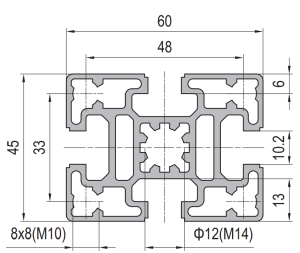 45 x 60 mm Aluminium Profile for Textile Machine Frames
45 x 60 mm four-slot aluminium extrusion in 6063-T5 for loom, winder and conveyor…
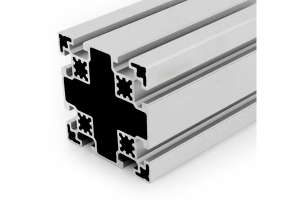 Aluminium Company Profile: How a 90 x 90 mm Section Is Made and Inspected
90 x 90 mm eight-slot aluminium extrusion in 6063-T5 for machine bases, robot pedestals…
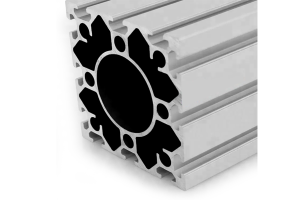 120 x 120 mm Aluminium Profile for Automotive Line Tooling
120 x 120 mm twelve-slot aluminium extrusion in 6063-T5 for welding jigs, assembly fixtures…
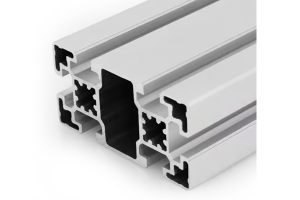 45 x 90 mm Aluminium Profile: Stock Planning for Distributors
45 x 90 mm six-slot aluminium extrusion in 6063-T5 for distributor stock. 4.10 kg/m,…
 45 x 180 mm Aluminium Profile for Maghreb / EU-Bound Projects
45 × 180 mm aluminium extrusion in 6063-T5 for Maghreb fabricators feeding EU-bound projects.…
 45 x 180 mm Aluminium Profile for ESD-Safe Electronics Frames
45 × 180 mm aluminium extrusion in 6063-T5 for ESD-safe electronics frames sought by…
