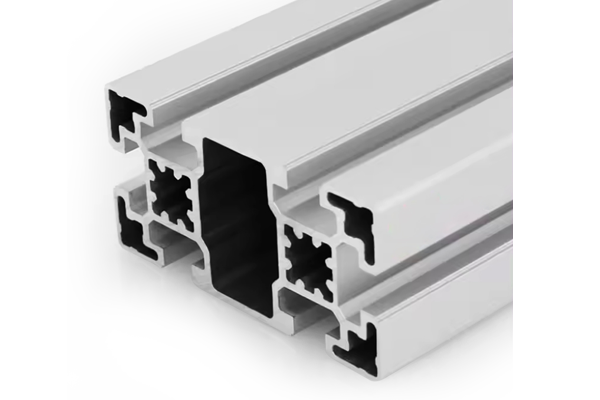
45 x 90 mm Aluminium Profile for Pharma Cleanroom Framing
45 x 90 mm aluminium extrusion in 6063-T5 for GMP cleanroom framing. Six 10.2 mm slots on a 45 mm pitch, 4.10 kg/m, satin etch AA15 sealed for cleanability, supplied cut to the frame list with capped slot ends.
| Material | Aluminium |
|---|---|
| Alloy Grade | 6063-T5 |
| Temper | T5 |
| Section Size | 45 x 90 mm, six slots |
| Slot | 6 x 10.2 mm groove, 10 mm mouth, 45 mm pitch, two per 90 mm face and one per 45 mm face, M10 |
| Length | 6 m stock; cut to frame list to +/-0.5 mm |
| Tolerance | EN 755-9, wall +/-0.15 mm; straightness 1.5 mm per metre; twist 2 degrees |
| Surface | Satin etch anodised AA15 to EN ISO 7599, sealed; clear or black |
| MOQ | 150 m |
| Lead Time | 20 to 30 days after deposit, plus 6 to 9 days air freight to Hyderabad |
| Loading Port | Shanghai / Ningbo |
| Supply Ability | 600 t per month extrusion with in-house anodising |
| Payment Terms | T/T 30% deposit + 70% before shipment | L/C at sight |
| Trade Terms | FOB | CIF | DAP |
| Certifications | Mill certificate per heat, coating thickness and seal quality report per lot, cleaner compatibility statement, RoHS and REACH declarations |
01Why does a cleanroom frame built from bare profile fail a GMP walkthrough?
Not because the aluminium is wrong. Because the geometry of a butt joint is a dust trap. Where two 45 x 90 extrusions meet at 90 degrees, the inside corner is a square recess roughly 45 mm deep with a radius of about 1 mm at the root. A wipe moving across that corner bridges it, lifts, and leaves a film of residue in the root. Over a qualification cycle the residue accumulates, and the swab result eventually shows it.
The fix is not a better extrusion. It is a coved cover: a radiused fillet piece that sits over the internal corner and presents a surface a wipe can follow continuously. The usual radius is 25 mm or more, and the cover has to be removable for cleaning behind it, which means it is a separate part, not a welded or bonded detail.
- Internal corners need a coved cover of 25 mm radius or greater; a 5 mm fillet is cosmetic and still traps.
- External corners are less critical but should be radiused, because a sharp arris sheds particles when a trolley hits it.
- The profile to cover interface must be sealed, not just butted, or the gap becomes a horizontal ledge.
- Avoid any horizontal surface wider than about 10 mm anywhere above floor level; that is the rule auditors apply in practice, whether or not it is written down.
This is the single most common reason a frame that looked fine on the drawing gets a remark at qualification. It costs very little to design in at the start and a great deal to retrofit, because the covers change the room dimensions.
02What surface finish is actually cleanable?
Roughness matters more than gloss, and the two are not the same thing. A bright anodised surface reads as clean to the eye and can be the harder one to wipe, because the bright finish is produced by chemical polishing, which rounds and deepens the micro-profile rather than flattening it. A matte or satin etch gives a lower Ra and a more repeatable wipe.
For an extruded frame, the surface the wipe touches is the extrusion surface, not a machined one. That means the Ra is set by the die bearing and the etch, typically in the 0.6 to 1.2 micrometre band for a satin etch, and it cannot be improved after the fact without machining the faces, which is expensive on a 6 m length.
| Finish | Typical Ra | How it wipes | Where it is used |
|---|---|---|---|
| Mill finish | 1.5 to 3.0 um | Drags, and the oxide film is uneven | Never in a graded room |
| Satin etch, AA15 | 0.6 to 1.2 um | Even wipe, low residue | Walls, ceilings, Grade C and D |
| Bright chemical polish, AA15 | 0.3 to 0.6 um but wavy | Wipes clean but shows streaks | Visible trim only |
| Machined face | 0.4 um or better | Best wipe, highest cost | Small parts and pass boxes |
One more point that surprises people: the anodic film itself is porous before sealing. A sealed film is chemically inert and wipes clean; an unsealed or poorly sealed film absorbs residue into the pore structure and then releases it slowly, which shows up as recurring failures at the same swab point. Ask for the seal quality test, not just the thickness.
03Which cleaning agents attack the anodic film, and how fast?
The anodic film is aluminium oxide, which is amphoteric: it dissolves in both acid and alkali. That single fact drives the whole compatibility table, and it is why a cleaner that works perfectly on stainless steel can destroy an anodised frame in a year of daily use.
| Agent | Typical use | Effect on a sealed anodic film |
|---|---|---|
| IPA 70 percent | Daily wipe | No attack; the standard choice |
| Ethanol 70 percent | Daily wipe | No attack |
| Hydrogen peroxide 6 percent | Sporicidal, occasional | Slight dulling after repeated use; acceptable if rinsed |
| Sodium hypochlorite 0.5 percent | Biocide, occasional | Attacks the film; pitting appears within months of weekly use |
| Quaternary ammonium | Daily wipe | Generally compatible; check the surfactant package |
| Sodium hydroxide, any strength | Never | Dissolves the film quickly; this is the same chemistry used to strip anodising |
| Citric acid 2 percent | Passivation of steel parts | Slow attack; keep off aluminium or rinse within minutes |
If your SOP already specifies hypochlorite for floor and wall disinfection, the frame needs either a different cleaner at the frame, or a finish that tolerates it. That is a conversation to have at design stage, because the answer changes the coating specification and the cost.
04How is differential pressure held at the frame, not the panel?
A cleanroom holds 10 to 15 Pa between a graded room and its neighbour, and the frame’s job is to not be the leak. The panel is usually the tight element; the frame is where the leaks are, at three places: the panel to profile joint, the profile to profile joint, and the profile to floor or ceiling joint.
The panel joint is a gasket compressed between the panel edge and the profile face. Gasket compression should sit between 25 and 30 percent of free height. Below 20 percent it leaks under pressure; above 40 percent it takes a permanent set and leaks later, which is worse because it passes the initial test and fails in year two.
- Panel to profile. Continuous gasket, 25 to 30 percent compression, no butt joints in the gasket at a corner. Corners are mitred and bonded.
- Profile to profile. Sealant in the joint, and the sealant must be neutral cure silicone. Acetoxy cure releases acetic acid as it sets, which attacks the anodic film and leaves a chalky line that shows up on a wipe test.
- Profile to floor. A continuous bead, not a spot fix, and a floor channel rather than a direct fix, so the bead is in compression rather than shear.
Then test it. A pressure decay test at 50 Pa on a closed room, with the frame penetrations temporarily sealed, tells you whether the frame or the services are the leak. Doing that before the ceiling goes in saves a week of chasing.
05Why are zinc plated connectors a problem in a graded room?
Two reasons, and the second one is the one that gets missed. First, a zinc or zinc nickel plated connector inside a profile slot is a coated part in a washdown environment; the coating wears at the contact points and the exposed zinc corrodes, producing a white salt that migrates out of the slot. Second, and more important for particle counting, the plating itself can shed.
The practical alternatives are stainless connectors, or aluminium connectors with a clear anodised finish, or a zinc flake coating if the load requires steel. Stainless against aluminium introduces a galvanic couple, so the joint needs an isolating washer or a sealant barrier; that is a real trade-off, not a free upgrade.
Stainless connector
- No coating to shed, no zinc salt
- Higher cost, roughly two to three times a plated part
- Galvanic couple with the aluminium, needs isolation
- Best where the joint is washed down daily
Anodised aluminium connector
- Same metal family, no galvanic couple
- Lower strength than steel, so more fasteners per joint
- Film can be damaged by the fastener, needs a washer
- Best where the joint is dry wiped, not washed
06What does the audit actually look at?
Not the alloy certificate, in most cases. The auditor walks the room and looks at surfaces, joints and the cleaning record. The frame comes up in three specific ways, and knowing them at design stage is worth more than any test report.
The three frame questions that come up in a walkthrough
- Is there any horizontal ledge above floor level wider than about 10 mm? A profile slot facing up is a ledge. Fit a slot cover.
- Can a wipe travel from wall to floor without lifting? That is the coved skirting question, and it is the same detail as the internal corner.
- Is there a visible fastener head or an open slot end inside the room? Slot end caps and flush fasteners, or the joint gets flagged.
- Bonus: is the sealant line continuous and smooth? A tooled bead reads as controlled; a smeared one reads as a gap.
07What five numbers should be on the enquiry?
A cleanroom frame is quoted from the room, not from the profile. Give us the room and the grade, and the section follows.
- Room size and grid
- length, width, height, and the panel module, because the grid pitch follows the panel
- Grade and pressure
- ISO 14644 class or Grade C/D, and the pressure differential in Pa
- Cleaner list
- the actual agents in the SOP, because hypochlorite changes the finish specification
- Corner detail
- coved covers supplied or not, and the radius required by your QA
- Delivery and installation
- flat packed with covers and gaskets, or frame only
- Section
- 45 x 90 mm six slot at 4.10 kg/m as standard, 4.85 kg/m heavy wall for spans over 2.4 m
Send the room drawing and the cleaner list
- 45 x 90 mm, 6063-T5, six 10.2 mm slots, 4.10 kg/m
- Satin etch AA15, sealed, clear
- Cut to the frame list, deburred, slot ends capped
- Coved corner covers and skirting quoted separately
- Cleaner list attached for film compatibility check
The cleaner list is the item most buyers leave out, and it is the one that most often changes the specification. A room wiped with hypochlorite needs a different answer from one wiped with IPA, and the difference is not in the profile.
Related sections and categories
The same 45 mm pitch family is listed under 45 Series Aluminium Profiles. For longer ceiling spans the 45 x 90 mm heavy wall section at 4.85 kg/m is the direct upgrade, and the finish options are set out in anodised aluminium profiles.
Can a cleanroom frame be built from standard 45 x 90 profile without special parts?
It can be built, but it will usually get a remark at qualification. The profile itself is fine; the butt joint between two extrusions creates a square internal corner about 45 mm deep that a wipe cannot follow. The usual remedy is a coved cover of 25 mm radius or more over each internal corner, plus slot covers on any upward facing slot. Both are separate parts and both need to be designed in before the room dimensions are fixed.
Which anodising thickness is right for a cleanroom?
AA15 is normally sufficient indoors, because the film is there for cleanability and corrosion resistance rather than abrasion. The thickness matters less than the seal quality: a well sealed 15 micron film wipes clean and resists the cleaners, while a poorly sealed 25 micron film absorbs residue into the pores. Ask for the seal quality test result, not just the thickness reading.
Will hypochlorite cleaning damage the frame?
Yes, over time. Sodium hypochlorite attacks aluminium oxide, and weekly use at 0.5 percent produces visible pitting within months. If your SOP requires hypochlorite for disinfection, either restrict it to floors and use a compatible agent on the frame, or plan for a finish that tolerates it and accept a shorter service life. This is worth settling at design stage because it changes the specification.
Do you supply the coved corners and slot covers?
We supply the extrusion, the cut list and the slot end caps. Coved corner covers are usually sourced locally or from the panel supplier, because they have to match the panel system and the room radius your QA has specified. We will quote them separately if you want them from one source, but we will not pretend a generic cover fits every panel system.
What span can 45 x 90 carry as a ceiling grid member?
At 4.10 kg/m with roughly 68 cm4 about the strong axis, a 2.4 m span carrying a light panel and ceiling load deflects within L/360 comfortably. Beyond about 2.8 m the deflection starts to govern and the heavy wall version at 4.85 kg/m becomes the better choice. Send the panel weight and the grid pitch and we will run the number rather than generalise.
Send the room drawing and the cleaner list
Give us the room size, the panel module, the grade and the agents in your cleaning SOP. We will come back with the cut list, the coved corner detail and a finish recommendation that survives your own disinfection routine.
Request a quotationRelated Products
 45 x 60 mm Aluminium Profile for Textile Machine Frames
45 x 60 mm four-slot aluminium extrusion in 6063-T5 for loom, winder and conveyor…
 Aluminium Company Profile: How a 90 x 90 mm Section Is Made and Inspected
90 x 90 mm eight-slot aluminium extrusion in 6063-T5 for machine bases, robot pedestals…
 120 x 120 mm Aluminium Profile for Automotive Line Tooling
120 x 120 mm twelve-slot aluminium extrusion in 6063-T5 for welding jigs, assembly fixtures…
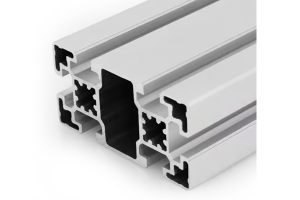 45 x 90 mm Aluminium Profile: Stock Planning for Distributors
45 x 90 mm six-slot aluminium extrusion in 6063-T5 for distributor stock. 4.10 kg/m,…
 45 x 180 mm Aluminium Profile for Maghreb / EU-Bound Projects
45 × 180 mm aluminium extrusion in 6063-T5 for Maghreb fabricators feeding EU-bound projects.…
 45 x 180 mm Aluminium Profile for ESD-Safe Electronics Frames
45 × 180 mm aluminium extrusion in 6063-T5 for ESD-safe electronics frames sought by…
 45 x 180 mm Aluminium Extrusion vs Casting: Which One to Specify
45 × 180 mm aluminium extrusion in 6063-T5 as the worked example for extrusion…
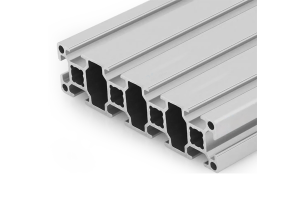 30 x 120 mm Aluminium Profile for Heavy Equipment Frames
30 x 120 mm ten-slot aluminium extrusion in 6063-T5 for construction equipment guards, platform…
