3030 vs 4040 Aluminium Profile
Choose 3030 when the frame is light and short; move to 4040 the moment span or load starts to govern. The switch is driven by deflection, not strength — 3030 runs 0.62–1.15 kg/m, 4040 runs 1.05–2.35 kg/m.
Short answer
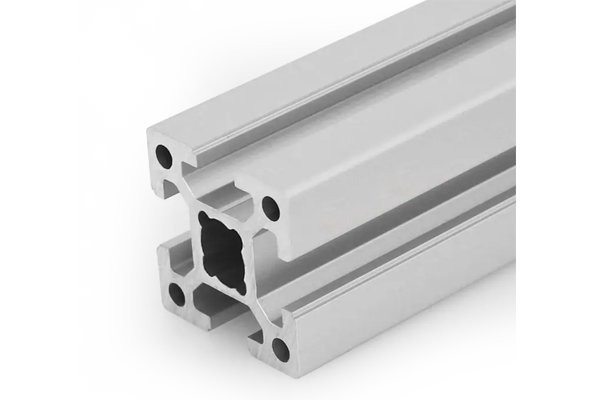
Keep 3030 for light benches, short guards and fixtures with bays under about 0.8–1.0 m. Step to 4040 for machine frames, loaded workbenches, conveyor side rails and any metre-class rail that must stay flat. Mid-wall Ix jumps from ~2.8–3.3 cm⁴ to ~9–11 cm⁴ — roughly 3× stiffness for roughly 50–70% more mass at mid-band. Slot families often move from an 8.2 mm groove class toward a 10.2 mm / 8 mm mouth industrial slot, so M6/M8 hardware plans change with the section. 2026 USD: $1.60–$2.55/m vs $2.10–$3.45/m; trial lengths on existing dies. Use max-span math, not outline photos.
The numbers side by side
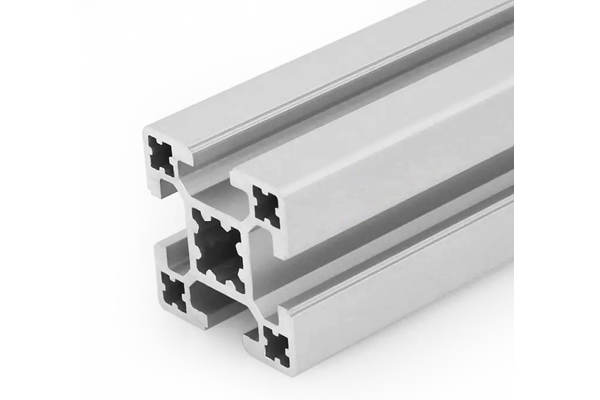
4040 is the default industrial square because I rises much faster than mass from 30 to 40 mm.
Compare Ix and allowable span at 100 kg to L/500, then check whether your slot/hardware line can follow. Wall variants sit inside the brief mass bands.
| Criterion | 3030 | 4040 | Verdict |
|---|---|---|---|
| Envelope | 30 × 30 mm | 40 × 40 mm | 4040: industrial default square |
| Weight | 0.62–1.15 kg/m | 1.05–2.35 kg/m | ~3× I for modest mass rise |
| Slot | Varies — often 8.2 mm groove, 6 mm mouth class, 30 mm pitch | Varies — often 10.2 mm groove, 8 mm mouth, M8 class | Plan hardware with the section |
| Ix (typical mid-wall) | ≈ 2.8–3.3 cm⁴ | ≈ 9–11 cm⁴ | 4040 ~3× stiffer |
| Max span @100 kg (L/500 mid) | ≈ 0.45 m | ≈ 0.8 m | 4040 for metre-class industrial bays |
| Price band (2026) | $1.60 – $2.55 / m | $2.10 – $3.45 / m | Delta small vs rebuild cost |
| MOQ | Made to order; trial lengths available | Made to order; small trial lengths available | Both trial-friendly on stock dies |
When 3030 is enough
3030 is enough for light fixtures, short workbench bays and guards that never see metre-plus loaded spans.
Pass cases: assembly fixtures under 0.8 m; light carts without heavy decks; display and lab stands; short fence bays without doors; secondary braces beside a 4040 perimeter. If mid-span working load at 1 m already exceeds what L/500 allows on ~3 cm⁴, do not “brace harder” forever — step the section.
When you must move to 4040
Move to 4040 when span approaches 1 m under tens of kilograms, when a vise or plate sits on the top, or when automation vibration appears.
Triggers: workbench perimeter ≥ 1.0–1.2 m; conveyor rails on production pitch; cleanroom equipment skeletons; CNC bases and pick-and-place carcasses; any face that mounts a linear guide. The ~3× I jump is why a soft 3030 cross-rail often settles after one upsize without layout changes. Need more in one axis only? Look at 4080 next, not a second 4040 stacked for show.
The cost of choosing wrong
Mid-band masses near 0.90 vs 1.55 kg/m make a 50 m frame about 32 kg heavier in 4040 — priced inside $1.60–$2.55 vs $2.10–$3.45 per metre in 2026.
That metre delta is usually smaller than one delayed FAT after a soft 3030 perimeter is re-cut. Wrong the other way: specifying 4040 on every 300 mm brace when 3030 would close. Hybrid frames — 4040 load paths, 3030 covers — keep aluminium where I works. See price per metre for kg × USD/kg.
RFQ checklist — 3030 vs 4040
- Section and wall — kg/m inside the brief bands.
- Span and load — with L/500 or mm limit.
- Slot series — 8 mm-class vs 10 mm-class hardware to reuse.
- Finish and standard — EN 755-9 / GB/T 6892; anodise if cleanroom.
State whether existing 30-series nuts must stay. That alone can freeze the size.
Four ways this pair goes wrong
Related on this site
- What is a 3030 aluminium profile — 3030 on its own
- What is a 4040 aluminium profile — 4040 on its own
- Maximum span and load — deflection tables
- Price per metre — weight difference in USD
Terms used in this article
- Ix
- Second moment of area about the bending axis; ~3× from mid-wall 3030 to 4040.
- L/500
- Deflection limit used for automation and work surfaces.
- Industrial slot
- Often ~8–10 mm mouth on 40-series profiles taking M6–M8 T-nuts.
Questions buyers ask
Is 3030 strong enough for a workbench?
For a light assembly bench with bays under about 0.8–1.0 m, mid-wall 3030 can pass. For an industrial top with vise loads, heavy plates or metre-plus spans, 4040 is the usual perimeter. “Strong enough” means stiff enough at L/500, not tensile yield.
Is 3030 strong enough for a conveyor frame?
Only for light belt conveyors on short pitch. Continuous distributed load softens 3030 side rails above ~0.8–1.0 m. Default to 4040 (or 4080 on long pitches) for production conveyors.
Is 3030 strong enough for a cleanroom equipment frame?
Rarely as the primary metre-class rail. Short instrument stands may stay 3030; equipment skeletons that must stay square under panels and utilities usually need 4040 plus sealed anodising.
Is 3030 strong enough for a CNC router gantry?
Not as the sole production gantry beam. Small desktop machines may use 3030 briefly; routers with real cutting load need 4040/4080 or twin rails so guide mounting faces stay flat under acceleration.
Is 3030 strong enough for a test rig?
Yes for light fixtures and short spans. If the rig applies measured force or holds alignment under load, step to 4040 so frame compliance does not dominate the measurement error.
Is 3030 strong enough for a pick-and-place frame?
Light static stands with short bays can use 3030. Moving gantries and long X-rails usually need 4040 or a rectangular section so residual vibration settles before the next place cycle.
Is 3030 strong enough for a display stand?
Yes for most retail and exhibition stands with short members and panel weight only. Upsize if freestanding height creates sway or if hanging loads sit mid-span on long headers.
Is 3030 strong enough for a greenhouse frame?
Only for small light structures with short bays. Wind and snow on longer runs push you toward 4040 or rectangular members; check the governing span and local load case before freezing 3030.
Send the span for 3030 vs 4040
Give bay length, payload, deflection limit and slot hardware to reuse. We confirm kg/m and I before you freeze the BOM.
Request a quoteRelated reading
Twelve more engineering notes from this blog, picked for this article — plus every category below.
 Engineering DesignModular Aluminium Components: Where the System Saves Money and Where It Costs You
 Engineering DesignAluminum vs Steel Machine Frames: Choose by Deflection, Not by Strength
 Engineering DesignAluminium Profile Anchor Pins: A Preloaded Joint, Not a Pin
 Engineering DesignWhat Is a 2020 Aluminium Profile? (Weight, Slot and Load)
 Materials and Engineering6063-T5 Aluminium Profile: What the Designation Actually Guarantees
 Materials and EngineeringIndustrial Aluminium Extrusion: Five Advantages and the Conditions Attached to Each
 Engineering Design30 Series T-Slot Profiles: The Middle That Has to Justify Itself
 Materials and EngineeringAluminium Extrusion Section Design: What Each Feature on the Drawing Costs You
 Quality and InspectionEuropean Anodised Aluminium Specification: What Should a Purchase Order Contain?
 Sourcing and ProcurementAluminium Extrusion Price per kg in 2026 (China FOB)
 Quality and InspectionSampling and First Article Approval for Aluminium Extrusion
 Sourcing and ProcurementDistributor Terms: Territory, Margin and Price Protection
