How to Mount Frameless Acrylic and Glass Doors
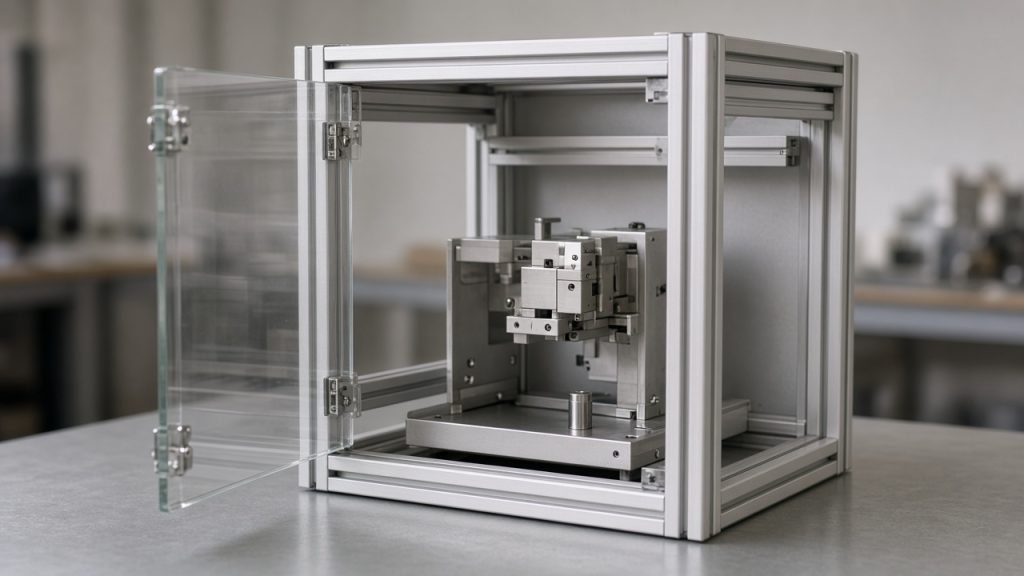
A buyer of compact laboratory instruments is building a 30×30 aluminium frame with a frameless 6 mm clear acrylic front door. They want a metallic hinge whose one leaf bolts into the 30-series T-slot and whose other leaf clamps directly onto a 5–8 mm acrylic or tempered-glass sheet, with rubber protective gaskets, in a 1,200-piece black-anodised release. That construction is real engineering. It is not, today, a listed GrownParts SKU.
Short answer
GrownParts does not currently list a profile-to-glass or profile-to-acrylic clamp hinge, and we will not invent a SKU, a stock 5–8 mm clamp capacity, leaf dimensions, or a rubber-gasket part number. The construction is straightforward: one leaf bolts into the T-slot with T-nuts; the other leaf either clamps the sheet or is through-bolted through it; a soft pad sits between metal and acrylic or glass so the sheet is not crushed. A 1,200-piece enquiry for a 30×30 frame and a frameless 6 mm clear acrylic door, with a requested 5–8 mm clamp range and a black-anodised finish, is quoted to drawing from the door size, the sheet and the series. The only published hinge, GP-HG-40-180, is a 40-series, 8 mm-slot, 180° profile-to-profile part: both leaves clamp into the slot with M6 T-nuts. Use it when you add a light 30- or 40-series leaf frame around the acrylic — that is a framed door, not a frameless clamp. A 30-series leaf is to-drawing, not a stock hinge page. Black anodised is not a published finish on GP-HG-40-180 (zinc as-cast or black coated; PA6 black; stainless passivated). Detent or torque hinges that hold an upward-opening lid at an angle are also unlisted, with no invented N·m hold-up figure. Panel-mounting strips and blocks hold fixed glazing; they are not door hinges.
How a profile-to-acrylic clamp hinge is built
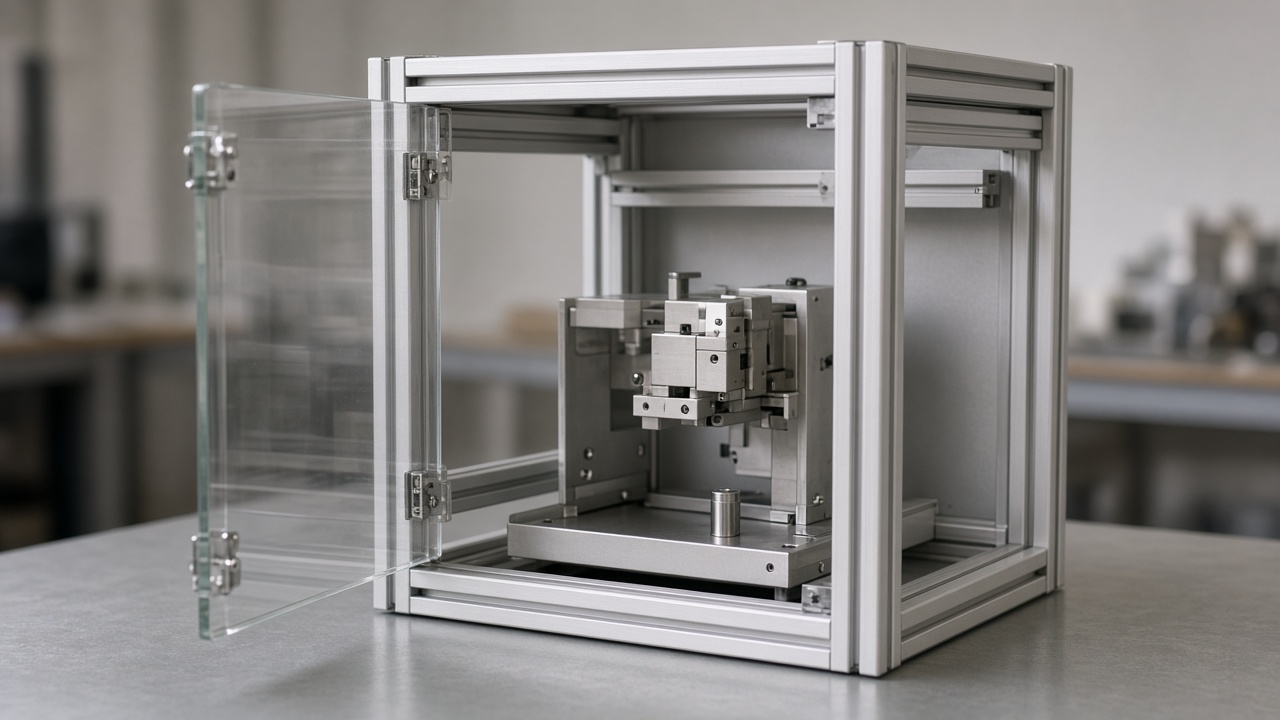
A profile-to-sheet clamp hinge joins a T-slot frame to a frameless transparent door: one leaf locks into the profile groove, the other leaf either clamps the sheet or is through-bolted on it, and a soft pad protects the acrylic or glass from being crushed.
On a 30×30 laboratory frame the frame-side leaf is the familiar T-slot connection — typically two fixings into T-nuts, so the hinge can be slid along the post and locked without drilling the extrusion. How that leaf is sized to a 30-series slot is part of the drawing, because our listed hinge page is 40 series and 8 mm slot only. The door-side leaf is the part we do not list. In a clamp design, the leaf forms a throat around the sheet edge and is tightened onto a protective gasket or pad. In a through-bolted design, the leaf is a flat plate (or a back-plate pair) and the sheet is drilled so a screw can pass through, still with a pad or a large washer so the bearing stress is spread. Both arrangements exist in the market; neither is a GrownParts catalogue hinge today.
The buyer’s 6 mm clear acrylic door, and the 5–8 mm clamp capacity they asked for, belong on that drawing. So do the door width and height, the hinge count and centres, and whether the sheet is acrylic, polycarbonate or tempered glass. We will not print a throat opening, a pad thickness, or a clamp force as if they were already in the catalogue.
Why GP-HG-40-180 is a profile-to-profile hinge, not a glass clamp
The published hinge is a 40-series, 8 mm-slot, 180° profile-to-profile part. Both leaves clamp into the slot with M6 T-nuts; it is not a frameless-glass clamp hinge.
GP-HG-40-180 opens far enough for the door to lie flat against the frame. Each leaf has two M6 T-nut fixings, so the hinge can be positioned along the groove after the frame is built, and the profile itself is not drilled. The body is die-cast zinc (ZAMAK 3) where load matters, PA6 where a quieter door is the point, or AISI 304 for washdown. The published finishes are zinc as-cast or black coated, PA6 in black, and stainless passivated. A backing plate can spread the load over 100 mm of slot; a door-stop block is offered so the open door is taken in compression rather than by the knuckle alone. In zinc the hinge weighs about 0.35 kg each. Knuckle clearance is the dominant contributor to door sag, and hinge count is a stiffness decision, not only a load decision. There is no fixed minimum order; we price per hinge or per door set, and stock hinges ship in about a week. The guard or instrument as a whole remains the machine builder’s assessment — we do not issue a CE or laboratory-instrument certificate for the hinge.
None of that is a leaf that grips a 6 mm acrylic sheet. If the door can accept a light 30- or 40-series frame around the glazing, this hinge is the listed answer. The stock page is 40 series and 8 mm slot only; a 30-series leaf is made to drawing, not taken from a second hinge page.
Clamping versus drilling transparent doors
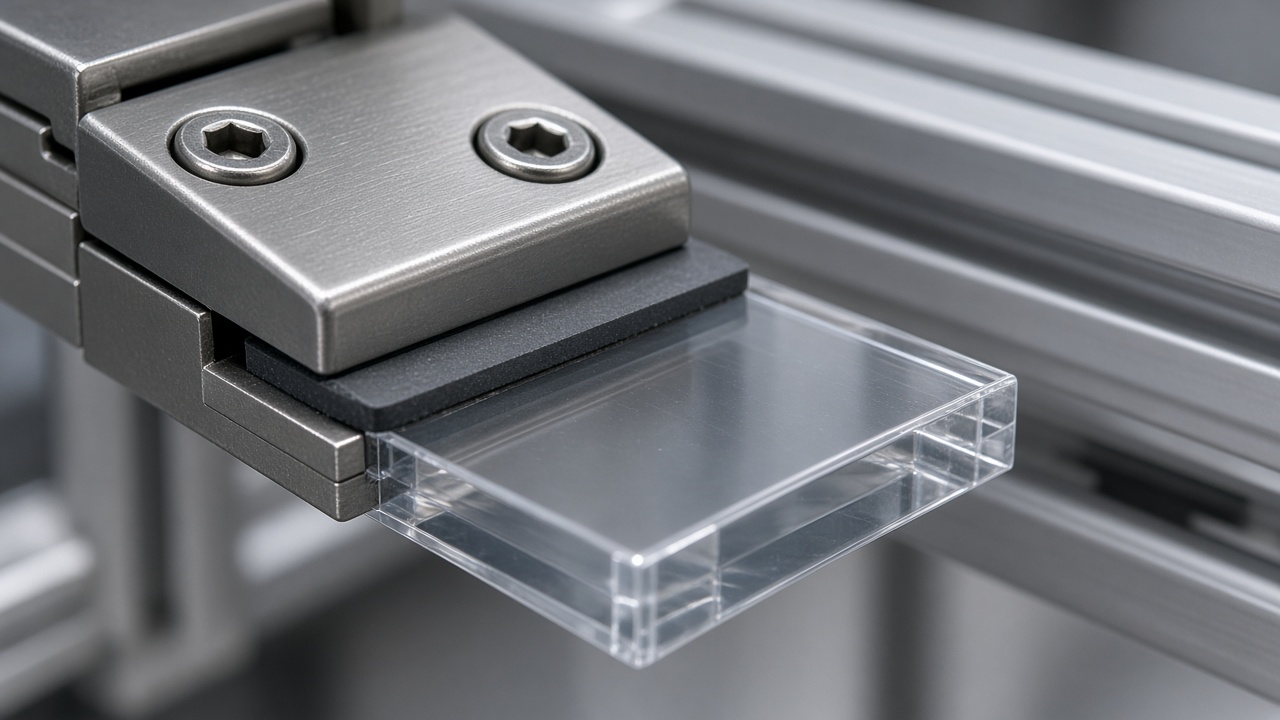
Clamping avoids holes in brittle acrylic and in tempered glass, and it still needs a protective pad; through-bolting is the simpler leaf, but it concentrates stress at the hole and usually still needs a pad and a controlled tightening torque.
Acrylic (PMMA) is optically clear and notch-sensitive: a drilled hole is a stress raiser, and a tightly pulled screw can start a crack, especially near a cold-cut or poorly polished edge. Polycarbonate is tougher and takes a hole more willingly, though a pad is still good practice and a sustained clamp load can allow the sheet to creep. Tempered glass must not be drilled after tempering; any hole has to be processed before the toughening cycle. For a tempered-glass door, a clamp leaf with an even gasket is usually the only sensible mechanical choice.
We will not invent a maximum tightening torque in N·m, a recommended hole diameter, or an edge-distance rule and present it as a catalogue figure. Those values depend on the sheet material, the measured thickness, the washer or pad, and the leaf design, and they belong on the tightening instruction that travels with a to-drawing part.
Gaskets, pads, and why fixed-panel strips are not door hinges
A soft pad between the metal leaf and the sheet is essential on a hinged transparent door; the published panel-mounting strips and blocks do that job for fixed glazing, and they are not hinges.
The pad’s job is to spread the clamp pressure, take up small thickness variation, and keep bare metal off a scratch-sensitive face. We do not list a rubber gasket SKU or a pad thickness for a clamp hinge, and we will not invent one. Specify the sheet and the measured thickness on the drawing; the pad compound and the throat are chosen against that, not against a nominal 6 mm figure alone.
If the glazing is fixed — a window in a hood, not a swinging door — use the listed panel hardware instead. The panel-mounting strip (GP-PI-PMS-01) holds a panel along its whole edge. It is published for 6, 8 and 10 mm slots and for thicknesses of 2–12 mm as standard, so 6 mm sits inside the range, with covering-lip and gasketed glazing versions. The panel-mounting block (GP-PI-PMB-01) clamps a 1.5–12 mm edge without drilling the profile or the panel, with a protective-pad option. A nut-block (GP-PI-PNB-01) gives a captive M5 to M10 thread; a published torque guide of 4–35 N·m applies to that block thread, not to a screw through acrylic. The finishing-accessories article covers these parts in more detail. None of them swings a door.
When a light leaf frame is the faster answer
If the instrument can accept a slim aluminium leaf around the acrylic, the listed 40-series 180° hinge becomes the stock path, and the door is no longer frameless.
A 40×40, or a lighter 30-series, leaf frame lets both hinge leaves sit in an 8 mm slot in the usual way, protects the sheet edge, and allows the published backing plate and door-stop options. The acrylic is then an infill, held by a strip, a block, or a groove, rather than by the hinge itself. A 30-series leaf mated to a 30×30 frame is still to-drawing, because the listed hinge page is 40 series only.
Do not confuse this with a sliding leaf: the 40-series sliding door is a framed leaf on a rail, not a frameless clamp hinge. And do not specify “black anodised” against GP-HG-40-180. That finish is not published on the zinc, PA6 or stainless hinge. A black-anodised aluminium clamp hinge would be a made-to-drawing construction and finish, quoted as such.
Detent and torque hinges for upward-opening lids
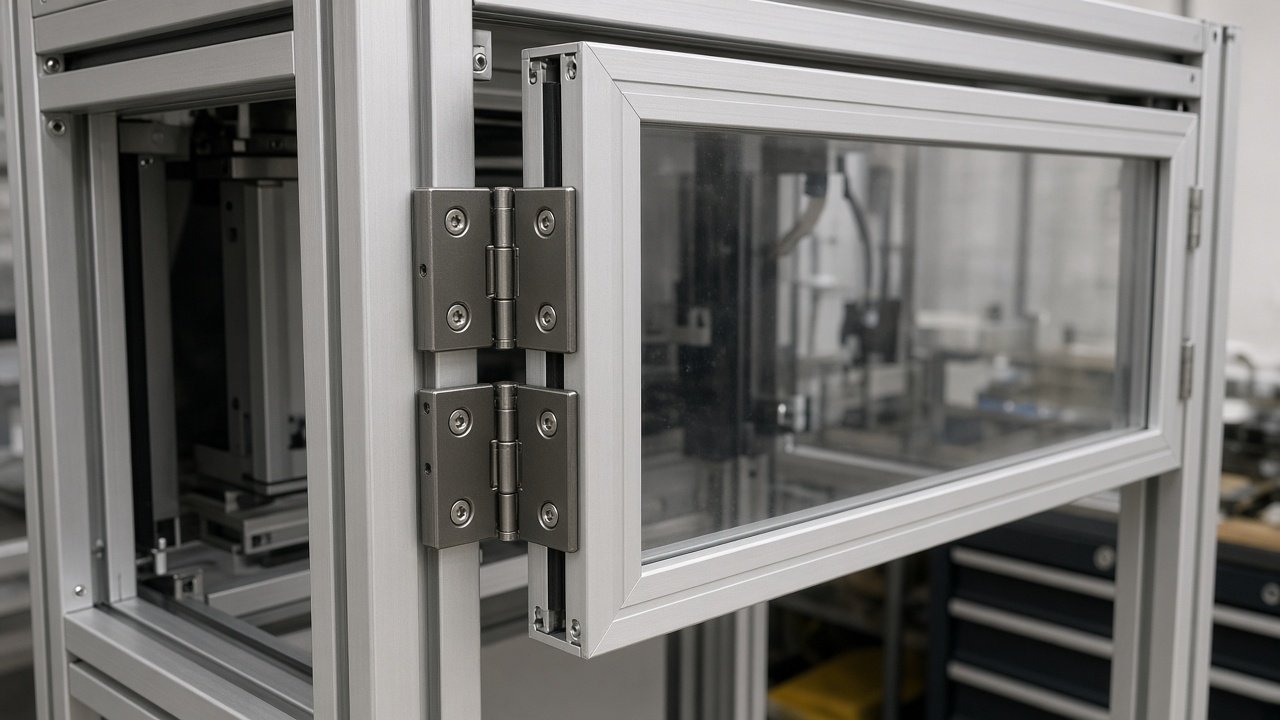
Detent or torque hinges that hold an upward-opening lid at an angle are a real duty on compact instrument hoods, and GrownParts does not currently list one, nor any hold-up torque in N·m.
A free-swinging hinge is enough when the door hangs vertically and a latch or a stop defines the open and closed positions. An upward-opening lid is a different mechanism. Once the lid is past top dead centre, its weight wants to slam it shut, or to flop fully open onto its stops. A technician who needs both hands on the instrument cannot hold the lid. The usual answers in the market are a constant-torque (positioning) hinge, whose knuckle friction or cartridge holds the lid at any angle; a detent hinge, which clicks into one or more set positions; or a stay, gas strut or counterbalance used with an ordinary hinge.
We will describe that choice and quote a to-drawing part if the lid duty requires it. We will not invent a hold-up torque, a lid mass, or a SKU, and we will not present a fictitious catalogue detent hinge. Send the lid size, the sheet or frame mass, the opening direction, and the angle at which the lid must hover.
How a 1,200-piece black-anodised enquiry is quoted
A 1,200-piece release is quoted to drawing, per construction and finish, not as an invented lump sum and not as a 2026 unit price we have not published.
Tell us whether you want a frameless profile-to-sheet clamp hinge (to drawing, including the pad), a framed leaf using the 40-series 180° stock hinge, a 30-series framed leaf (also to-drawing), or a detent or torque hinge for an upward lid. Price follows the door size, the measured sheet (here 6 mm acrylic, with a requested 5–8 mm clamp capacity), the 30×30 series, the finish — black anodised applies only to an aluminium to-drawing part — and the quantity. For GP-HG-40-180 we price per hinge or per door set, with no fixed minimum; stock hinges ship in about a week, and frame kits typically take two to three weeks plus finish. CAD for a listed part is supplied on request as PDF, DWG, DXF, STEP or IGES; we do not keep a public library of an unlisted clamp hinge. Overview PDFs sit on the downloads page.
We can supply a material declaration and RoHS / REACH on request. We do not certify the hinge as a CE laboratory instrument, and guard or instrument assessment stays the builder’s scope.
| Construction | What the leaves do | Catalogue status |
|---|---|---|
| Frameless clamp or through-bolt hinge | Frame leaf in the T-slot; door leaf clamps or is bolted on the sheet, with a pad | Not listed; quoted to drawing from door size, sheet and series |
| GP-HG-40-180 with a leaf frame | Both leaves in the 8 mm slot with M6 T-nuts, 180°, 40 series | Listed for 40 series / 8 mm; a 30-series leaf is to-drawing |
| Panel-mounting strip or block | Holds a fixed edge continuously or at points | Listed (strip 2–12 mm; block 1.5–12 mm). Not a hinge |
| Detent / torque hinge | Holds an upward-opening lid at an angle | Not listed; quoted to drawing. No published N·m |
Related on this site
- 40-series 180° aluminium profile hinge — both leaves in the 8 mm slot, not a glass clamp
- Panel-mounting strips — continuous support for fixed glazing, 2–12 mm
- Panel-mounting blocks — clamp a 1.5–12 mm edge without drilling
- Panel-mounting nut-blocks — captive M5 to M10 in the slot
- T-slot finishing accessories — end caps, slot covers and panel edging
- How to join aluminium profiles — members in a T-slot frame
- Downloads — overview PDFs; per-part CAD on request
Terms used
- Profile-to-sheet clamp hinge
- One leaf in the T-slot; the other clamps or through-bolts a frameless sheet, with a soft pad. Not a listed SKU; quoted to drawing.
- GP-HG-40-180
- The published 40-series, 8 mm-slot, 180° profile-to-profile hinge. Both leaves use M6 T-nuts. Not a frameless-glass clamp.
- Protective pad / gasket
- A soft interlayer so acrylic or glass is not crushed. No pad thickness or gasket SKU is listed for a clamp hinge.
- Detent / torque hinge
- Holds an upward-opening lid at an angle. Not listed; no published hold-up torque in N·m.
- Knuckle clearance
- The published dominant contributor to door sag on GP-HG-40-180. Hinge count is a stiffness decision.
- Panel-mounting strip
- A continuous strip (GP-PI-PMS-01) for a 2–12 mm fixed panel edge. Not a hinge.
- Framed leaf
- A light 30- or 40-series frame around the sheet so a slot hinge can be used. A framed door, not a frameless clamp.
Questions buyers ask
Do you supply aluminium profile hinges that clamp a 5–8 mm acrylic or tempered-glass sheet on a 30-series frame?
Not as a listed SKU. One leaf in the T-slot with T-nuts, the other clamping or through-bolting the sheet with a soft pad, is quoted to drawing from the door size, the sheet (here 6 mm acrylic, requested 5–8 mm clamp capacity) and the 30×30 series. We will not invent a part number, a stock clamp range, leaf dimensions, or a rubber-gasket code.
How do you mount a frameless polycarbonate or acrylic door directly to a T-slot aluminium profile using a clamp hinge?
The frame-side leaf bolts into the T-slot with T-nuts and can be adjusted along the post without drilling the extrusion. The door-side leaf either forms a throat around the sheet edge or is through-bolted through it, with a protective pad so the sheet is not crushed. GrownParts quotes this to drawing; it is not a catalogue hinge.
Should we drill the transparent sheet or clamp it?
Clamping avoids holes in brittle acrylic and in tempered glass, and still needs a gasket. Through-bolting is simpler, but it concentrates stress at the hole and usually still needs a pad and a controlled tightening torque. Tempered glass must not be drilled after tempering. We publish no tightening torque in N·m for a screw through the sheet.
Do you have detent or torque hinges that hold an upward-opening lid at any angle?
Not as a listed part, and we publish no hold-up torque in N·m. The duty is real: a lid that must hover so it does not slam. We will quote a to-drawing positioning hinge, or a stay used with an ordinary hinge, from the lid size, mass, opening direction and hover angle.
Can we use the 40-series 180° hinge on a frameless 6 mm acrylic door?
Not as a frameless clamp. GP-HG-40-180 is a profile-to-profile hinge: both leaves clamp into an 8 mm slot with M6 T-nuts. Add a light 30- or 40-series leaf frame around the acrylic and it is the listed answer. A 30-series leaf is to-drawing; the stock page is 40 series only. Black anodised is not a published finish on that hinge.
Can you quote 1,200 pieces in black anodised?
Yes, to drawing, per construction and finish — not as an invented lump sum or an unpublished 2026 unit price. Black anodised applies to a made-to-drawing aluminium clamp hinge, not to GP-HG-40-180 (zinc as-cast or black coated; PA6 black; stainless passivated). Stock 40-series hinges are priced per hinge or door set, with no fixed minimum, and ship in about a week.
Also searched as: frameless acrylic clamp hinges, profile-to-glass T-slot hinge, 6 mm acrylic door on 30-series aluminium, detent torque hinge for instrument lid, rubber gasket hinge for tempered glass, GP-HG-40-180 framed leaf, clamping vs drilling acrylic machine guards, black anodised aluminium clamp hinge.
Send the door drawing, not a clamp-hinge part number we do not list
Give us the door size, the measured sheet (6 mm acrylic in this enquiry, with any 5–8 mm clamp range you need), the 30×30 series, whether the door stays frameless or can take a light leaf frame, the finish, and whether an upward lid must hover. You will get a written offer that distinguishes the listed 40-series 180° hinge from a to-drawing clamp or detent part.
Request a door-hinge quoteRelated reading
Twelve more engineering notes from this blog, picked for this article — plus every category below.
 Engineering DesignMoment of Inertia and Section Modulus of T-Slot Profiles
 ApplicationsAluminium Conveyor Frames: Why Belt Tracking Is a Geometry Problem
 ApplicationsAluminium Profile Shelving: It Buckles and Tips Before It Bends
- Engineering DesignWhat Is a 4080 Aluminium Profile? (Weight, Slot and Load)
 Engineering DesignAluminium Conduit Profiles & Angle Sections
- Engineering Design4080 vs 4545 Aluminium Profile: Which for Your Frame
 ApplicationsAluminium Partitions: The Three Performance Numbers Behind the Aesthetic
 Engineering DesignAluminium Extrusion Tolerances: What to Write, and How to Inspect
 Quality and InspectionHow to Choose (and Audit) an Aluminium Extrusion Supplier
 Quality and InspectionAluminium Extrusion Claims: What the Contract Must Say
 Materials and Engineering6063-T5 Aluminium Profile: What the Designation Actually Guarantees
 Materials and EngineeringAluminium Extrusion Section Design: What Each Feature on the Drawing Costs You