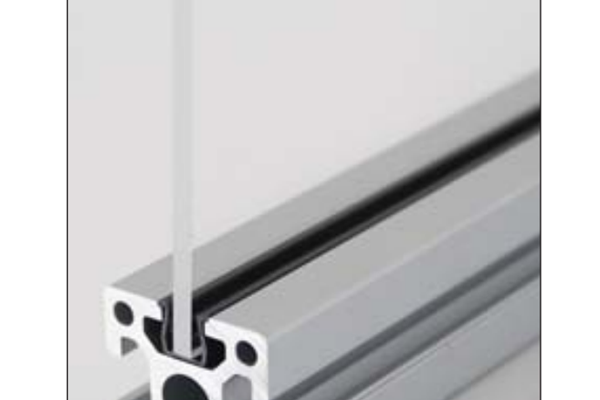
T-Slot Reducing Profile
Reducing insert that narrows a wide T-slot to accept standard nuts and accessories from a smaller series, so one frame can carry components from two profile ranges without a special part.
| Material | PA6 nylon / aluminium |
|---|---|
| Alloy Grade | 6063-T5 on aluminium inserts |
| Temper | custom |
| Section Size | Fits 6, 8 and 10 mm slots |
| Slot | Reduces slot width by 2 mm per step |
| Length | Full member length, or cut to accessory positions |
| Tolerance | ±0.15 mm on reduced slot width |
| Surface | Moulded (PA6) / anodised (aluminium) |
| MOQ | 500 |
| Lead Time | 15-25 days after deposit |
| Loading Port | Shanghai / Ningbo |
| Supply Ability | 300,000 pcs per month |
| Payment Terms | T/T 30% deposit + 70% before shipment | L/C at sight |
| Trade Terms | FOB | CIF | EXW |
| Certifications | ISO 9001:2015 | RoHS | REACH |
Profile accessories · Slot adaptation
A T-slot reducing profile is an insert that sits inside a wide slot and narrows it to the width of a smaller series. Its purpose is compatibility: it lets a standard nut, hinge or bracket from a small profile range fit into the slot of a large one, so a designer is not forced to buy every accessory twice.
The case that drives most orders is a machine frame built from 45 series profiles that has to accept 8 mm-slot accessories, or a 40 series frame that has to take 6 mm hardware at a sensor bracket. Rather than machining a special nut, the insert brings the slot down to the size the standard part already expects.
Why a slot width mismatch appears in the first place
Slot width follows the profile series, and the series is chosen for structural reasons rather than for the accessories. A frame that has to carry a heavy cantilever gets 45 or 50 series profiles; the sensors, hinges and cable clips that bolt to it are usually made for 8 mm slots because that is the most common accessory standard.
The mismatch is normal, not a design error. The three ways to resolve it are: buy the accessory in the large-series version (if it exists), machine a special adaptor, or fit a reducing insert. The insert is the only one that does not add lead time or a special part number.
| Frame slot | Insert reduces to | Accepts | Typical use |
|---|---|---|---|
| 10 mm (45 / 50 series) | 8 mm | 40 series nuts, hinges, brackets | Sensor and guard brackets on heavy frames |
| 8 mm (30 / 40 series) | 6 mm | 20 series nuts and small fittings | Light fittings on a stiff frame |
| 10 mm heavy wall | 8 mm | 40 series heavy-duty nuts | High-load accessory points |
| 6 mm (20 series) | 5 mm | Miniature series fittings | Compact instrument frames |
Two geometries, and when each is right
The load question a buyer should ask
An insert transfers the load of an accessory into the slot walls of a larger profile. The insert itself is not the weak point in tension, but it can be in shear if a long lever arm hangs off the accessory — a guard panel on a single bracket, for example. Where the accessory carries a side load, the insert should be a local insert fitted with two fasteners rather than a single point.
The other practical limit is the reduced bearing area. A 6 mm nut in an 8 mm slot through an insert has the same thread but less of the slot shoulder to bear against, so the torque figure for the bolt is set by the insert, not by the nut. We supply the recommended torque with every insert order.
Practical point: if you tell us the accessory and the profile series, we will tell you whether an insert is the right answer or whether the accessory is available in the large-series version — sometimes the second answer is cheaper, and it is worth asking before you commit to an insert.
Related slot components
An insert changes slot width; it does not close the slot. Where the slot has to be closed as well — for hygiene or appearance — a T-slot cover profile is fitted over the reduced slot. Where the slot ends open at a member end, the end cap closes the end face.
The three parts are complementary rather than alternatives, and on a frame that needs all three the order of fitting is: insert, then fasteners, then cover, then end cap.
Frequently asked questions
Does a reducing insert work with any 8 mm nut?
It works with any nut sized to the slot the insert presents. A standard 40 series T-nut drops into the reduced slot and behaves as it would in a genuine 40 series profile, subject to the lower torque limit set by the insert.
Will the insert rattle in the slot?
A retained insert with moulded barbs does not. A loose insert can move if the accessory is not tightened, so we recommend the retained version wherever the accessory position is fixed.
Can the insert be cut to length on site?
Yes. It is extruded polymer or aluminium and cuts with a fine saw. Cut ends should be deburred so they do not sit proud of the slot mouth.
Does the insert reduce the frame’s strength?
No. The insert carries only the load of the accessory bolted through it. The structural capacity of the profile is unaffected.
Is an insert available in aluminium rather than polymer?
Yes. An aluminium insert is used where the accessory sees heat or where a higher bolt torque is needed. It costs more and offers no benefit on a normal frame.
Send the accessory and the profile series
Tell us the accessory you want to mount and the profile it has to go on. We will confirm whether a reducing insert is needed or whether the accessory is already available in the large-series version, and quote FOB within one working day.
Request a QuoteRelated Products
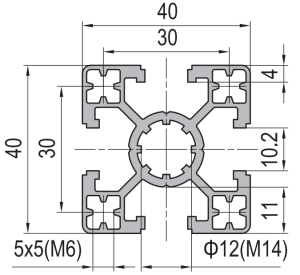 Strut Aluminium Profile 40×40 mm 4-Slot T-Slot Extrusion Machine Frame
40 x 40 mm four-slot T-slot strut aluminium profile in 6063-T5 with M6 slots…
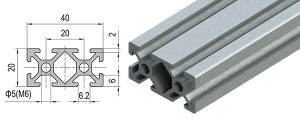 Strut Aluminium Profile 20×40 mm 2-Slot T-Slot Extrusion for Light Frames
20 x 40 mm two-slot T-slot strut aluminium profile in 6063-T5 with two M6…
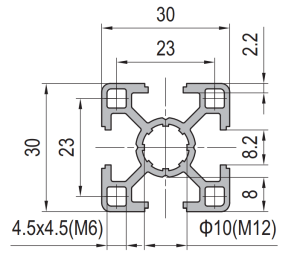 Strut Aluminium Profile 30×30 mm 4-Slot Light T-Slot Extrusion
30 x 30 mm light-wall four-slot T-slot strut aluminium profile in 6063-T5 with M5…
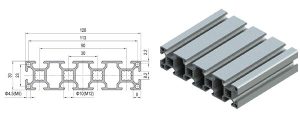 Strut Aluminium Profile 30×120 mm 3-Slot Wide Beam T-Slot Extrusion
30 x 120 mm three-slot wide-beam T-slot strut aluminium profile in 6063-T5 with three…
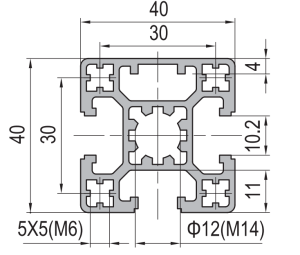 Strut Aluminium Profile 40×40 mm 3-Slot T-Slot Extrusion Closed Face
40 x 40 mm three-slot T-slot strut aluminium profile in 6063-T5 with one solid…
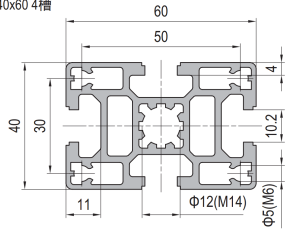 Strut Aluminium Profile 40×60 mm 4-Slot Rectangular T-Slot Extrusion
40 x 60 mm four-slot rectangular T-slot strut aluminium profile in 6063-T5 with M6…
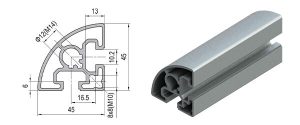 Radius Corner Aluminium Profile 45×45 mm Quarter Round Trim Section
45 x 45 mm quarter-round radius corner aluminium trim section in 6063-T5 with an…
 Strut Aluminium Profile 45×45 mm 4-Slot Heavy Duty T-Slot Extrusion
45 x 45 mm heavy duty four-slot T-slot strut aluminium profile in 6063-T5 with…
