Strut Aluminium Profile 20×40 mm 2-Slot T-Slot Extrusion for Light Frames
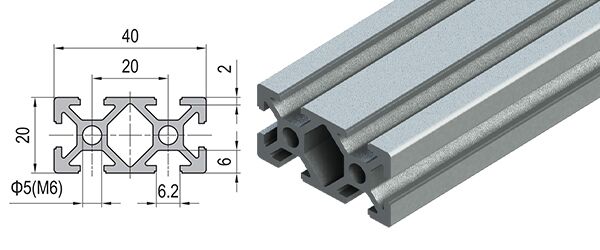
20 x 40 mm two-slot T-slot strut aluminium profile in 6063-T5 with two M6 slots on a 20 mm pitch and an M6 centre bore. A light, low-cost member for display frames, small guards, benches and growing racks.
| Material | Aluminium |
|---|---|
| Alloy Grade | 6063-T5 |
| Temper | T5 |
| Section Size | 40 x 20 mm |
| Slot | M6 slot, 6.2 mm mouth, 2 slots, 20 mm pitch |
| Length | 6 m stock, cut to drawing to plus or minus 0.5 mm |
| Tolerance | EN 755-9 / GB/T 6892, wall plus or minus 0.15 mm |
| Surface | Mill finish / clear anodised / black anodised |
| MOQ | 1000 |
| Lead Time | 18-28 days after deposit for mill finish |
| Loading Port | Shanghai / Ningbo |
| Supply Ability | 550 t per month |
| Payment Terms | T/T 30% deposit + 70% before shipment | L/C at sight |
| Trade Terms | FOB | CIF | EXW |
| Certifications | ISO 9001:2015 | EN 755-9 | RoHS | REACH |
Light framing · 20 series
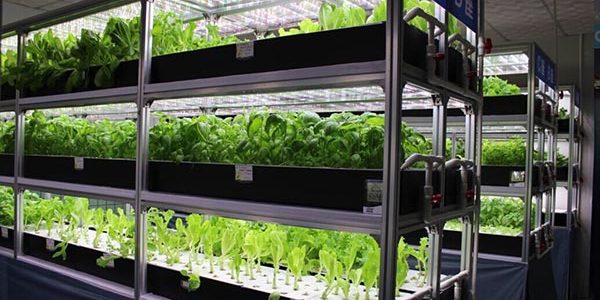
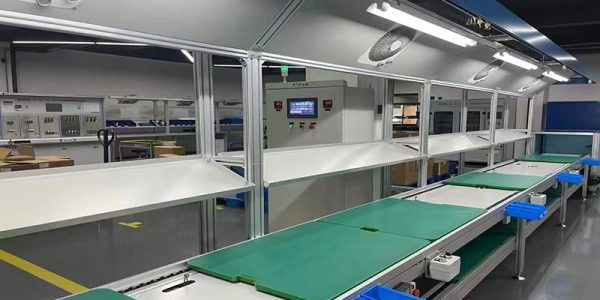
A 20 x 40 two-slot strut profile is a light T-slot aluminium extrusion with a 40 mm wide face carrying two parallel slots on a 20 mm pitch and an overall height of 20 mm. It sits at the light end of the framing range and is specified where a frame has to hold its shape, be cheap enough to build in quantity and light enough to be moved by hand: display frames, light machine guards, small benches, camera and sensor mounts, and the internal frames of control enclosures.
It is extruded in 6063-T5 with M6 slots on a 6.2 mm mouth and a O 5 mm centre bore tapped M6, and weighs about 1.05 kg/m on a 1.8 mm wall, so a 6 m length is a one-person lift. The two-slot layout is what separates it from a 20 x 20 single-slot section: the 40 mm face gives two independent fixing lines, so a panel or a shelf can be held along two edges without an extra bracket, and the section is far stiffer across its 20 mm height than a 20 x 20. Where it stops being enough, the correct move is up to the 30 series rather than a heavier wall in this die.
Where the light end of the range actually ends
Light framing fails in one of three ways, and it is worth knowing which one applies before a section is chosen. The first is deflection: the member bends visibly under load and the frame looks wrong even though nothing has broken. The second is a joint that will not hold, where the bolt is fine but the wall it is anchored in is too thin, so the thread strips or the slot lips open. The third is assembly, where a frame is stiff enough but fiddly to build because the fixing points sit too far apart.
A 20 x 40 addresses the third case well and the first two up to a point. Two slots on a 20 mm pitch give four usable fixing positions across the face instead of two, which makes a small frame much quicker to square up. But the 1.8 mm wall sets a ceiling on torque: the section is designed for M6 fixings at modest tightening values, not for the torque used on 40 series. If a joint has to be tightened hard and left, this is the wrong section and no amount of extra brackets will fix it.
| Property | 20 x 20 single slot | 20 x 40 two slot | 30 x 30 four slot |
|---|---|---|---|
| Envelope | 20 x 20 mm | 40 x 20 mm | 30 x 30 mm |
| Slots | 1 (M5) | 2 (M6) | 4 (M6) |
| Slot pitch | not applicable | 20 mm | 15 mm |
| Centre bore | O 4.2 mm, tapped M5 | O 5 mm, tapped M6 | O 8.2 mm, tapped M8 |
| Wall | approx. 1.5 mm | approx. 1.8 mm | approx. 1.8 mm |
| Moment of inertia | approx. 0.6 cm4 | approx. 2.0 cm4 | approx. 3.0 cm4 |
| Weight | approx. 0.55 kg/m | approx. 1.05 kg/m | approx. 1.15 kg/m |
| Sensible unsupported span | under 400 mm | under 600 mm | under 1000 mm |
What the second slot actually buys
The reason to pay for the wider face is not stiffness alone. It is that a second slot changes the way a light frame goes together.
Rule of thumb: if a frame is under about 600 mm between supports and carries panels, lights or sensors rather than machinery, 20 x 40 is usually the cheapest section that will do the job. If it carries a motor, a moving axis or a person, it is not.
Choosing between 20 series and 30 series
- Span first, load second Measure the longest unsupported span in the design. Under about 600 mm, 20 x 40 is normally fine for a light load. Between 600 mm and 1 m the section starts to look springy, and past 1 m the 30 series is the sensible starting point even when the load is small, because the limit is stiffness rather than strength.
- Check the bolt you actually need 20 series slots take M6 fixings at reduced torque. 30 series takes M6 at full torque and offers an M8 centre bore. If the design calls for a bolt larger than M6, or for a joint that has to survive vibration, the decision has already been made by the fastener.
- Count the joints, not the metres A light frame with many joints costs more in brackets and assembly time than in extrusion. Where a design needs more than two fixings per corner, the wider slot pitch and larger brackets of the 30 series usually reduce total cost even though the section is dearer per metre.
- Plan the accessory range Both series have a full accessory range, but the 20 series range is smaller and some parts are made only for 30 series and above. Check that the feet, hinges and handles on the parts list exist in 20 series before committing to the light section.
How it is fixed and finished
The two slots take standard T-slot nuts in M6. Corners are usually made with a small angle bracket or a butt connector where the joint is hidden inside the section. Light frames are often stood on levelling feet or small base plates, and panels are held with panel mounting blocks rather than drilled through the face. The slot is closed with cover strip where the frame is on show, which also stops dust collecting in the groove.
Finish matters more on a light frame than on a machine base, because these frames are usually visible. We supply mill finish, clear anodised and black anodised. On a light section the anodic layer is a larger fraction of the wall thickness than on a heavy one, so specify the class at the enquiry stage wherever a nut has to slide freely in the slot.
Frequently asked questions
Can a 20 x 40 profile carry a shelf or a panel?
Yes. Two slots on a 20 mm pitch let a shelf or panel be bolted to the face with two rows of T-slot nuts, which is the main reason to choose this section over a 20 x 20. Keep the shelf span under about 600 mm and support it at both ends.
What is the difference between 20 x 40 two-slot and 20 x 20 single-slot?
The 20 x 40 has a 40 mm wide face with two slots instead of one, roughly three times the stiffness about the same axis and about twice the weight. It also uses M6 fixings with a O 5 mm centre bore instead of the M5 fixings typical of a 20 x 20.
When should I move up to the 30 series?
When the unsupported span passes about 600 mm, when the design needs a bolt larger than M6, when a joint has to survive vibration, or when the accessory on the parts list is only made for 30 series and above. Change the section rather than the wall thickness.
How much does the 20 x 40 profile weigh and what lengths do you supply?
About 1.05 kg/m on a 1.8 mm wall, so a 6 m length is around 6.3 kg. We supply 6 m stock and cut to drawing to plus or minus 0.5 mm, deburred and bagged by assembly.
Can you supply it cut, tapped and anodised to a drawing?
Yes. We cut to length, tap the centre bore and slot ends, drill and counterbore for brackets, and supply mill, clear anodised or black anodised. Send DWG, DXF, STEP or PDF and we quote from the drawing.
Send the frame layout, get a section recommendation and a price
Tell us the longest span, what the frame carries and how many joints per corner. We will confirm whether 20 x 40 is enough or whether the design should move to the 30 series, then quote the section, the machining and FOB pricing, cut and bagged by assembly.
Request a QuoteRelated Products
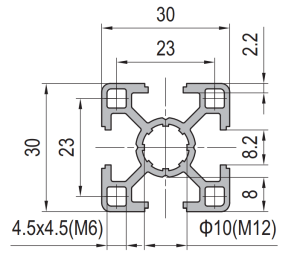 Strut Aluminium Profile 30×30 mm 4-Slot Light T-Slot Extrusion
30 x 30 mm light-wall four-slot T-slot strut aluminium profile in 6063-T5 with M5…
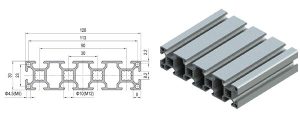 Strut Aluminium Profile 30×120 mm 3-Slot Wide Beam T-Slot Extrusion
30 x 120 mm three-slot wide-beam T-slot strut aluminium profile in 6063-T5 with three…
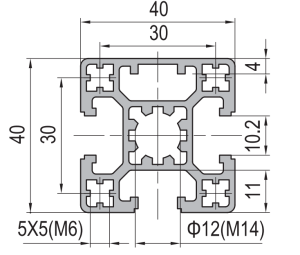 Strut Aluminium Profile 40×40 mm 3-Slot T-Slot Extrusion Closed Face
40 x 40 mm three-slot T-slot strut aluminium profile in 6063-T5 with one solid…
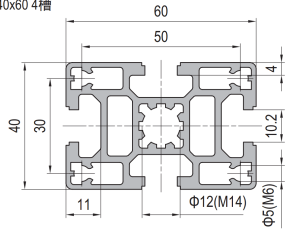 Strut Aluminium Profile 40×60 mm 4-Slot Rectangular T-Slot Extrusion
40 x 60 mm four-slot rectangular T-slot strut aluminium profile in 6063-T5 with M6…
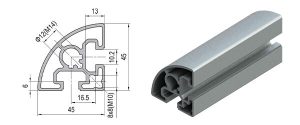 Radius Corner Aluminium Profile 45×45 mm Quarter Round Trim Section
45 x 45 mm quarter-round radius corner aluminium trim section in 6063-T5 with an…
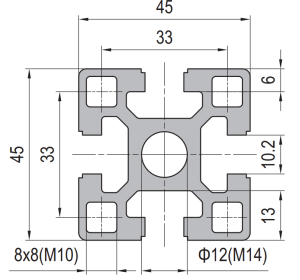 Strut Aluminium Profile 45×45 mm 4-Slot Heavy Duty T-Slot Extrusion
45 x 45 mm heavy duty four-slot T-slot strut aluminium profile in 6063-T5 with…
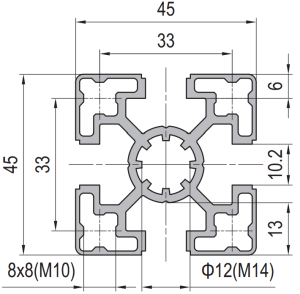 Strut Aluminium Profile 45×45 mm 4-Slot Light T-Slot Extrusion
45 x 45 mm light wall four-slot T-slot strut aluminium profile in 6063-T5 with…
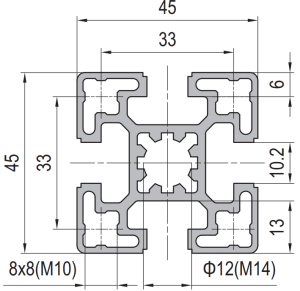 Strut Aluminium Profile 45×45 mm 4-Slot Standard T-Slot Extrusion
45 x 45 mm four-slot standard T-slot strut aluminium profile in 6063-T5 with walls…
