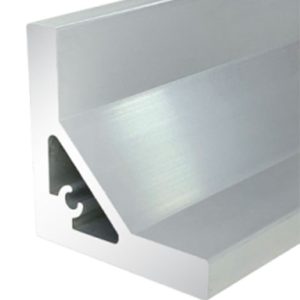
Aluminium Angle Profiles Equal Leg Corner Sections 20 to 100 mm
Equal leg aluminium angle profiles from 20 x 20 mm to 100 x 100 mm in 6061-T6 and 6063-T5. Solid L-sections for corner gussets, braces and frame reinforcement.
| Material | Aluminium |
|---|---|
| Alloy Grade | 6061-T6 / 6063-T5 |
| Temper | T6 |
| Section Size | 10 x 10 mm to 100 x 100 mm |
| Slot | Not applicable, these are solid angle sections with no slot |
| Length | Saw cut to length, ends square or 45 degree mitre, +/-0.5 mm |
| Tolerance | EN 755-9, wall +/-0.15 mm |
| Surface | Mill finish / clear anodised / black anodised |
| MOQ | Made to order; small quantities from stock |
| Lead Time | Typically 1 to 2 weeks for cutting and drilling, plus a week for anodising |
| Loading Port | Shanghai, Ningbo, Qingdao |
| Supply Ability | In-house saw cutting, drilling and CNC machining capacity |
| Payment Terms | T/T 30 per cent deposit, balance against copy of bill of lading |
| Trade Terms | FOB, CIF, CFR, EXW |
| Certifications | Mill certificate to EN 10204 3.1 on request, RoHS and REACH declarations |
01What are equal leg aluminium angle profiles?
What is an equal leg angle?
An L-shaped extrusion where both legs are the same length, from 20 x 20 mm up to 100 x 100 mm. Unlike T-slot strut profiles, the angle is a solid section with no groove, so it is used for corner gussets, braces and reinforcement rather than for sliding fasteners along a slot.
What is the size range?
From 20 x 20 mm up to 100 x 100 mm in leg length, with the wall thickness rising with the size. The smallest (20 x 20 x 1.5 mm) weighs about 0.07 kg/m and the largest (100 x 100 x 15 mm) weighs about 5.13 kg/m. The thicker the wall, the more bending moment the angle can carry.
6061-T6 or 6063-T5?
6061-T6 is the stronger alloy and is the default for a loaded corner or brace. 6063-T5 is softer but weldable and easier to anodise to a clean finish, so it is chosen when the angle is welded or when appearance matters more than strength. Section 04 gives the selection rule.
02Size map and weights
| Size (mm) | Typical wall (mm) | Weight (kg/m) | Typical use |
|---|---|---|---|
| 20 x 20 | 1.5 to 3 | 0.07 to 0.30 | instrument frames, small brackets |
| 30 x 30 | 2 to 4 | 0.30 to 0.60 | display frames, light gussets |
| 40 x 40 | 3 to 5 | 0.60 to 1.0 | general frame corners |
| 50 x 50 | 4 to 9 | 1.0 to 2.5 | medium duty gussets, braces |
| 100 x 100 | 8 to 15 | 4.0 to 5.13 | heavy duty corners, diagonal braces |
The weight figures span the available wall range for each size. The exact weight depends on the wall you select. Ask for the specific section weight on the quotation when the figure feeds a transport or lifting calculation.
03Where angle beats T-slot profile
Angle and T-slot strut profile solve different problems. The T-slot is for building a frame with sliding, adjustable joints. The angle is for reinforcing a frame at the corners, where a solid L-section carries a moment across the joint better than a slotted face.
- Corner gussets: a short length of angle bolted across a corner spreads the load and stops the joint opening up.
- Diagonal braces: a length of angle cut at 45 degrees on both ends spans the corner and resists racking.
- Edge protection and trim: a light angle on an exposed edge protects the corner and finishes the frame.
- Mounting rails: a length of angle bolted to a wall or bench gives a simple bracket rail without any slot.
The angle is cheaper per metre than T-slot profile of the same size, because the L-section is simpler to extrude and has no groove geometry to hold. For a joint that only needs a solid corner, the angle is usually the lower-cost choice.
04Alloy selection: 6061 vs 6063
| Property | 6061-T6 | 6063-T5 |
|---|---|---|
| Tensile strength | approx. 290 MPa | approx. 185 MPa |
| Yield strength | approx. 240 MPa | approx. 145 MPa |
| Weldability | good (needs filler) | very good |
| Anodising finish | good | excellent, cleaner colour |
| Cost | slightly higher | lower |
| Best for | loaded corners and braces | welded or visible trim |
The rule is simple: if the angle carries a structural load, use 6061-T6. If it is welded or anodised for appearance, use 6063-T5. The two are close in price, so the decision is usually about strength versus finish.
05Angle as a diagonal brace: span limits
The most common structural use of angle is a diagonal brace. The brace spans the corner of a frame and carries axial load (tension or compression) to stop racking. The limit is the brace’s own buckling length.
| Angle size | Max brace length (m) | Approx. axial load at limit |
|---|---|---|
| 20 x 20 x 3 | 0.4 | up to 0.5 kN |
| 30 x 30 x 4 | 0.7 | up to 1.5 kN |
| 50 x 50 x 9 | 1.2 | up to 5 kN |
| 100 x 100 x 15 | 2.0 | up to 20 kN |
These are indicative limits for a brace pinned at both ends. For a brace under compression, keep the slenderness low by choosing a thicker wall or a shorter brace. Section 07 lists the failure modes to design out.
06Angle + bolts vs welded corner: cost
Choose bolted angle
- The frame is low to medium volume and needs to be dismantlable
- No welding skill or fixturing is available
- The joint must not suffer heat distortion
- Lead time matters more than the last gram of weight
- The angle is a visible trim or gusset, not a fully optimised brace
Choose welded or cast
- The frame is high volume (100+) and weight matters
- Welding is available and distortion is managed
- The joint is heavily loaded and needs an optimised section
- A flush appearance without bolts is required
- The frame will never be dismantled
07Failure modes to design out
| What goes wrong | Why it happens | Design it out by |
|---|---|---|
| Bolt tears out at the hole edge | edge distance is under 2x the hole diameter | keep the edge distance at least 2x the bolt hole diameter |
| Brace buckles under compression | the brace is too slender for its length | shorten the brace or step up the wall thickness |
| Joint opens at the corner | the angle is under-sized for the moment | check the section modulus, or use two angles back to back |
| Anodising colour mismatch | the angle and frame are anodised in different runs | specify a single anodising run for angle and frame |
| Galvanic corrosion with steel bolts | steel bolts in aluminium without isolation | use stainless fasteners or isolating washers on exposed joints |
08What to check before you order
Procurement checklist for angle profiles
- Confirm the size and wall: leg length and thickness. A thicker wall changes the weight and the strength.
- Confirm the alloy: 6061-T6 for strength, 6063-T5 for welding or finish.
- Confirm the cut length and end cuts: square or 45 degree mitre for braces.
- Confirm the hole pattern if the angle is drilled to your drawing.
- Confirm the finish: mill or anodised, and whether it must match the frame.
- Confirm the quantity in metres or pieces, and whether holes are needed.
09Terms used on this page
- Equal leg angle
- An L-section with both legs the same length, from 20 x 20 mm up to 100 x 100 mm.
- Section modulus
- A geometric property, in cm3, that determines bending strength. It rises with the wall thickness.
- Racking
- The lateral distortion of a frame into a parallelogram. A diagonal brace resists it.
- Buckling
- Sudden sideways failure of a slender member under compression.
- Galvanic corrosion
- Corrosion when dissimilar metals (steel and aluminium) touch in the presence of moisture.
10Questions buyers ask
What is the size range?
Equal leg angles from 20 x 20 mm up to 100 x 100 mm, with wall thickness from 1.5 mm up to 15 mm. Weight spans 0.07 kg/m to 5.13 kg/m.
6061 or 6063?
6061-T6 for structural corners and braces; 6063-T5 for welding or a cleaner anodised finish.
Can the angle be drilled?
Yes. The angle is supplied as cut lengths and drilled to your drawing, with the hole pattern, bolt size and edge distance you specify.
Is it cheaper than T-slot profile?
Usually yes for a solid corner, because the L-section is simpler to extrude and has no groove. For an adjustable sliding joint, T-slot is the right tool.
Can it be anodised?
Yes. Mill or anodised. 6063-T5 gives the cleanest anodised colour.
What is the lead time?
Saw cutting and drilling to drawing typically one to two weeks, plus a week for anodising.
What we need to quote angle profiles
- The size and wall: leg length and thickness for each size.
- The alloy: 6061-T6 or 6063-T5.
- The cut length and end cuts (square or mitre).
- The hole pattern if drilled to drawing.
- The finish: mill or anodised.
- The quantity in metres or pieces.
Send those six items and the quotation comes back with the material, cutting, drilling and finish broken out separately. Browse the full aluminium profile catalogue and the angle profiles range.
Need angle profiles quoted across the size range?
Send the sizes, alloy, cut list and finish. We quote material, cutting, drilling and anodising as separate lines.
Request a quotationRelated Products
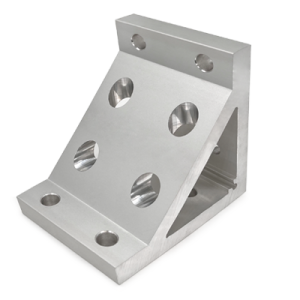 Aluminium Angle Profile Bracket 100 x 100 x 15 mm Heavy Duty Corner
100 x 100 x 15 mm heavy duty aluminium angle bracket with round fixing…
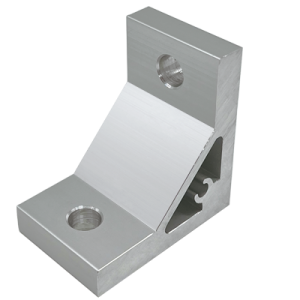 Aluminium Angle Profile Bracket 50 x 50 x 9 mm Medium Duty Corner
50 x 50 x 9 mm medium duty aluminium angle bracket with equal legs…
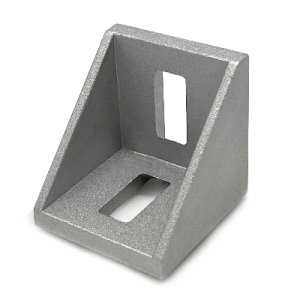 Die Cast Bracket for 20 to 50 mm Series Aluminium Profiles Corner
Die cast zinc alloy corner bracket for 20, 30, 40, 45 and 50 series…
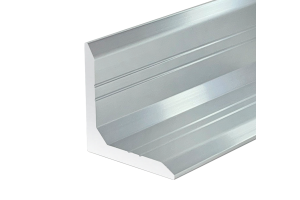 Extruded Aluminium Angle Profile 20 to 100 mm 6061 T6 Equal Leg
Extruded aluminium equal leg angle from 20 x 20 x 3 mm to 100…
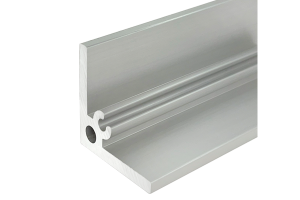 Aluminium Angle Extrusion 40x40x5 mm for Frame Assembly and Bracing
40 x 40 x 5 mm aluminium angle extrusion in 6061-T6 for frame assembly…
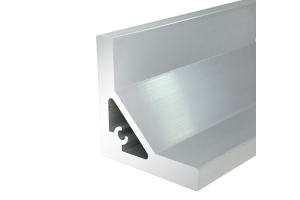 Custom Aluminium Extrusion Profile 20 to 100 mm, 6063-T5
Aluminium extrusion profiles supplied to Canada in 6063-T5 and 6061-T6, mill or anodised, with…
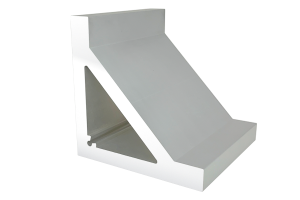 Aluminium Extrusion Manufacturing Factory: 20 to 100 mm Profiles
Aluminium extrusion profiles for Gujarat, India, in 6063-T5 and 6061-T6, with anodising film selected…
 Aluminium Extrusion Profiles 20 to 45 Series for OEM, up to 100 mm
Aluminium extrusion profiles for Tamil Nadu in 6063-T5, with full batch traceability from heat…
