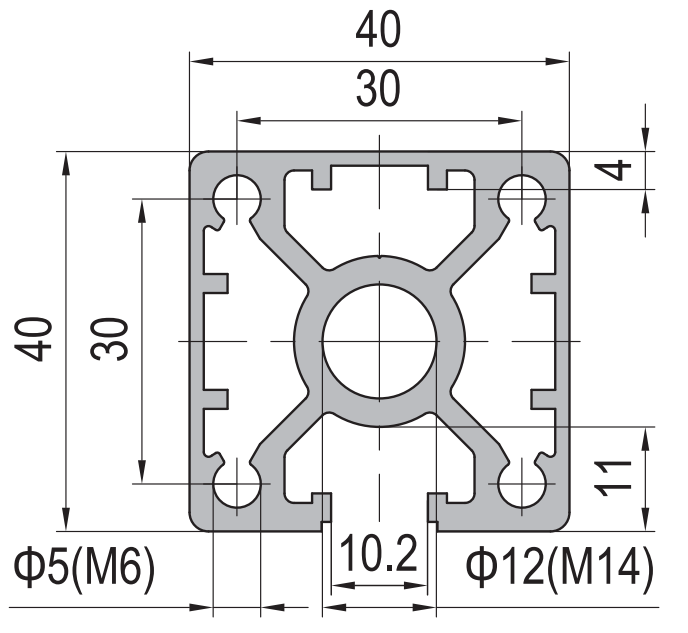
PG40 40 x 40 mm Single Slot Aluminium Strut Profile Guide Rail Base
40 x 40 mm single-slot aluminium strut profile with one 10.2 mm groove on one face and three solid reference faces. Guide rail base for linear motion systems using M8 fasteners.
| Material | Aluminium |
|---|---|
| Alloy Grade | 6063-T5 |
| Temper | T5 |
| Section Size | 40 x 40 mm square, single slot, three solid faces |
| Slot | 1 x 10.2 mm groove, 8 mm mouth, one face only, M8, three solid faces |
| Length | 6 m stock, cut to drawing to +/-0.5 mm |
| Tolerance | EN 755-9 / GB/T 6892, wall +/-0.15 mm |
| Surface | Mill finish / clear anodised / black anodised |
| MOQ | Made to order; small trial lengths available from stock offcuts |
| Lead Time | Typically 2 to 3 weeks for mill finish, plus 1 to 2 weeks for reference face machining, plus a week for anodising |
| Loading Port | Shanghai, Ningbo, Qingdao |
| Supply Ability | Extrusion and precision machining capacity for guide rail base profiles, with in-house anodising |
| Payment Terms | T/T 30 per cent deposit, balance against copy of bill of lading; L/C at sight for larger orders |
| Trade Terms | FOB, CIF, CFR, EXW |
| Certifications | Mill certificate to EN 10204 3.1 on request, RoHS and REACH declarations |
01What is the 40 x 40 mm single slot profile?
Why would you only want one slot on a 40 x 40?
Because the other three faces are solid, and solid faces can be machined flat to act as reference surfaces. On a standard four-slot profile, every face has a groove that interrupts the surface. On a single-slot profile, the three solid faces give you uninterrupted flat surfaces that can be milled, ground or used as-is for locating fixtures, guide rails and precision mounting. The single slot carries the guide element — a guide rail, a cable chain or a sensor track.
What is it used for?
It is the standard section for linear motion base rails. The solid faces provide the reference surface that a linear guide or a sliding carriage rides on, and the single slot carries the fasteners or the guide element. It is also used for precision fixtures where three flat reference faces are needed for locating work.
Is it as strong as the four-slot?
It is slightly stronger in bending, because removing three slots leaves more material in the wall. The weight is about 2.10 kg/m, compared to 1.49 kg/m for the standard four-slot. The second moment of area is about 7.2 cm4, compared to 5.8 cm4 for the four-slot. The single-slot is a stiffer, heavier section, not a weaker one.
02Section data
| Item | Value | Note |
|---|---|---|
| Envelope | 40 x 40 mm square | same as the standard four-slot |
| Slots | 1 | 10.2 mm groove, 8 mm mouth, one face only |
| Solid faces | 3 | no groove, flat reference surfaces |
| Slot pitch | n/a | single slot on one face |
| Centre bore | Phi12 mm typically | for through-bolts or location |
| Wall | approx. 3.5 mm on solid faces | full wall, no slot interruption |
| Weight | approx. 2.10 kg/m | heavier than the 1.49 kg/m four-slot |
| I (second moment of area) | approx. 7.2 cm4 | vs 5.8 cm4 for four-slot |
| Alloy | 6063-T5 | EN AW-6063 |
| Standard | EN 755-9 / GB/T 6892 | wall tolerance +/-0.15 mm |
| Length | 6 m stock | cut to drawing to +/-0.5 mm |
The weight is higher than the four-slot because the three solid faces have full wall thickness with no material removed for grooves. The second moment of area is also higher for the same reason. If you need a lighter section, use the four-slot; if you need reference faces, use the single-slot.
03The reference-face principle
The whole point of the single-slot profile is the three solid faces. On a four-slot profile, every face has a groove that creates a discontinuity — a step, a sharp edge and a potential stress riser. On the single-slot, three faces are continuous and flat, which means they can be used as:
- Machined reference surfaces: the solid faces can be milled or ground flat to a tolerance of 0.05 mm over the full length, providing a datum for locating fixtures and guide rails.
- Flat mounting surfaces: brackets, plates and guide elements can be bolted directly to the solid faces without needing a slot nut — just drill and tap.
- Sliding surfaces: a carriage or slider can ride on the solid face directly, or on a guide rail that is bolted to it. The absence of a groove means no interruption to the sliding path.
The single slot is reserved for the guide element — a linear guide rail, a cable chain, a sensor track or a pneumatic line. It carries M8 fasteners from the 40 series range.
04Guide rail base assembly
The typical assembly for a linear motion system uses the single-slot profile as the base rail. The solid top face is machined flat and carries the linear guide rail, bolted down with M6 socket head cap screws in tapped holes. The single slot on the front face carries the cable chain or the sensor track. The carriage slides on the guide rail, and the cable chain follows the carriage along the slot.
| Face | Surface type | Typical use |
|---|---|---|
| Top (solid) | machined flat to 0.05 mm | linear guide rail mounting |
| Front (slotted) | 10.2 mm T-slot | cable chain or sensor track |
| Bottom (solid) | as-extruded or machined | mounting to the frame |
| Side (solid) | as-extruded | locating datum or secondary mounting |
The key to this assembly is the parallelism between the machined top face and the slotted front face. The slot must be parallel to the guide rail to within 0.1 mm, or the cable chain will bind as the carriage moves. The extrusion is designed so that the slot and the opposite solid face are on the same axis, which makes the parallelism achievable with a single machining pass.
05Parallelism and machining tolerance
The reference face on the single-slot profile is typically machined flat after extrusion. The as-extruded surface has a bow of about 0.3 mm per metre and a die line of about 0.05 mm. After a light milling pass, the flatness improves to 0.05 mm over the full length.
| Machining step | Flatness (mm/m) | Parallelism to slot (mm/m) |
|---|---|---|
| As-extruded | 0.3 | 0.3 |
| Light mill (0.2 mm removal) | 0.05 | 0.1 |
| Ground finish | 0.01 | 0.02 |
The parallelism between the machined reference face and the slot centre line is the critical dimension for guide rail applications. A light milling pass on the opposite solid face is usually sufficient to achieve 0.1 mm/m parallelism. Grinding gives 0.02 mm/m but adds cost.
06Choosing between the single-slot and the four-slot
Choose the single-slot
- You need three flat reference faces for precision mounting
- The profile is a guide rail base for linear motion
- You want to bolt directly to the face without slot nuts
- Sliding surfaces are needed on one or more faces
- You need a stiffer section (I = 7.2 cm4 vs 5.8 cm4)
Choose the four-slot
- You need fixing positions on all four faces
- The frame is a general-purpose structure, not a guide rail
- Weight matters: the four-slot is 1.49 kg/m vs 2.10 kg/m
- You want the full range of 40 series accessories on every face
- Cost per metre is the primary driver
07Failure modes to design out
| What goes wrong | Why it happens | Design it out by |
|---|---|---|
| Reference face is not flat enough | the as-extruded bow is 0.3 mm/m | specify a light milling pass on the reference face, to 0.05 mm/m |
| Guide rail is not parallel to the slot | the slot and the machined face are on different axes | machine the reference face on the opposite side from the slot, on the same axis |
| Cable chain binds as carriage moves | the slot is not parallel to the guide rail | check parallelism to 0.1 mm/m; re-machine the reference face if needed |
| Bolts loosen on the solid face | tapped holes in aluminium can strip under vibration | use thread-lock adhesive or helicoil inserts for critical bolts |
| Profile is heavier than expected | the single-slot weighs 2.10 kg/m vs 1.49 kg/m for four-slot | use the four-slot if reference faces are not needed |
08What to check before you order
Procurement checklist for the single-slot profile
- Confirm the slot orientation: which face carries the slot and which three are solid. Specify on the drawing.
- Confirm the machining requirement: do the solid faces need to be milled flat, and to what tolerance?
- Confirm the parallelism requirement: if the profile is a guide rail base, specify the parallelism between the slot and the reference face.
- Confirm the finish: mill for hidden use, anodised for exposed service. Anodising adds 10 to 15 micron.
- Confirm the centre bore: does it need to be pre-tapped M14, or left as a clearance bore?
- Confirm the quantity in metres. A 6 m bar yields six 950 mm rails with 300 mm of offcut.
09Terms used on this page
- Reference face
- A solid face of the profile, with no groove, used as a machined datum for locating fixtures and guide rails.
- Parallelism
- The deviation between two surfaces measured over a length. For a guide rail base, the slot and the reference face must be parallel to 0.1 mm/m.
- Guide rail base
- A profile whose primary function is to carry a linear guide rail. The solid faces provide the mounting surface and the slot carries the cable chain.
- Light mill
- A machining pass that removes 0.2 mm from the as-extruded surface to improve flatness from 0.3 mm/m to 0.05 mm/m.
- Solid face
- A face of the profile with no T-slot groove. The single-slot has three; the four-slot has none.
10Questions buyers ask
Can I use standard 40 series slot nuts in the single slot?
Yes. The single slot uses the same 10.2 mm groove and 8 mm mouth as the standard 40 series, so M8 slot nuts, T-bolts, cover strips and hinges all fit. There is only one slot, so the accessory count is limited to one face.
What is the difference between this and the four-slot?
The single-slot has one slot and three solid faces. The four-slot has four slots, one per face, and no solid reference faces. The single-slot is heavier (2.10 vs 1.49 kg/m) and stiffer (7.2 vs 5.8 cm4) because the solid faces have more material.
Can the solid faces be machined flat?
Yes. The as-extruded surface has a bow of about 0.3 mm/m. A light milling pass improves flatness to 0.05 mm/m. Grinding achieves 0.01 mm/m. Specify the machining requirement on the drawing.
What is it used for?
Guide rail bases for linear motion systems, precision fixtures with reference faces, and any application where three flat surfaces and one slot are needed.
What is the weight per metre?
Approximately 2.10 kg/m, from the published product specification.
Can it be anodised?
Yes. Clear, black, champagne and bronze at 10 to 15 micron. Anodising is recommended for the solid faces if they are used as sliding surfaces, to reduce friction and wear.
What we need to quote this section
- The section drawing or the profile reference GP-SP-4040-1S.
- The cut length for each member and the number of members.
- The machining requirement: do the solid faces need milling, and to what flatness and parallelism tolerance?
- The finish: mill, clear anodised, or a specified colour.
- The annual or per-order quantity, in metres or pieces.
- Any certification requirement: mill certificate to EN 10204 3.1.
Send those six items and the quotation comes back with the extrusion price, the machining charge, the finish surcharge and the lead time broken out separately. Browse the full aluminium profile catalogue and the 40 series aluminium profiles range for related sections.
Need this guide rail base section quoted for your linear motion system?
Send the section, the machining requirement and the finish. We quote extrusion, machining and anodising as separate lines.
Request a quotationRelated Products
 PG40 40 x 40 mm Two Slot Type A Aluminium Strut Profile Guide Rail
40 x 40 mm Type A two slot asymmetric PG40 aluminium strut profile in…
 PG40 40 x 40 mm Two Slot Type B Aluminium Strut Profile Opposite Rail
40 x 40 mm Type B two-slot aluminium strut profile with two 10.2 mm…
 PG40 40 x 40 mm Four Slot Heavy Aluminium Strut Profile Standard Frame
40 x 40 mm heavy-wall four-slot aluminium strut profile with 10.2 mm grooves, 8…
 PG40 40×40 mm Four Slot Light Wall Aluminium Strut Profile Cost Optimised T-Slot Extrusion
40 x 40 mm four slot light wall PG40 aluminium strut profile in 6063-T5…
 PG40 40×40 mm R90 Quarter Round Aluminium Strut Profile Radius Corner Guard Frame Extrusion
40 x 40 mm R90 quarter round PG40 aluminium strut profile in 6063-T5 with…
 PG40 200 x 80 mm Fourteen Slot Aluminium Strut Profile Large Section Beam
A 200 x 80 mm fourteen slot PG40 aluminium strut profile at about 7.80…
 PG45 180 x 90 mm Twelve Slot Aluminium Strut Profile Heavy Duty Column
A 180 x 90 mm twelve slot PG45 aluminium strut profile at about 9.50…
 Aluminium Conduit Profile 120×60 mm Cable Duct Extrusion 2 mm Wall for Machine Wiring
120 x 60 mm aluminium conduit profile duct in 6063-T5 with a 2 mm…
