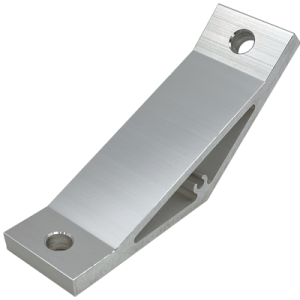
Aluminium Angle Profile Bracket 70x70x9 mm 135 Degree Corner Gusset for Obtuse Joints
Obtuse corner gusset 70 x 70 x 9 mm at 135 degrees, machined from 6061-T6 plate. For octagonal enclosures, sloped covers and angled frames where the members meet wider than a right angle.
| Material | Aluminium |
|---|---|
| Alloy Grade | 6061-T6 |
| Temper | T6 |
| Section Size | 70 x 70 mm legs |
| Slot | Round holes to drawing, M6 or M8 typical |
| Length | 70 x 70 x 9 mm, 135 degrees |
| Tolerance | ISO 2768 medium for machined parts |
| Surface | Mill finish / anodised |
| MOQ | 500 |
| Lead Time | 18-28 days after deposit |
| Loading Port | Shanghai / Ningbo |
| Supply Ability | 200,000 pieces per month |
| Payment Terms | T/T 30% deposit + 70% before shipment | L/C at sight |
| Trade Terms | FOB | CIF | EXW |
| Certifications | ISO 9001:2015 | RoHS | REACH |
Connecting · Obtuse gusset
This is a 70 x 70 mm corner gusset, 9 mm thick, machined with its two legs set at 135 degrees rather than 90. It is used where two members meet at an obtuse angle: octagonal and hexagonal enclosures, sloped machine covers, angled display frames and any decorative frame with a corner that is deliberately wider than a right angle.
An obtuse joint behaves differently from a right-angle one, and the difference is not obvious from the drawing. As the angle opens, the two bolt lines move closer to being in line with each other, so the lever arm they form against the corner moment gets shorter. At 135 degrees the arm is only about 54 per cent of what it is at 90 degrees, so for the same corner moment the bolts carry about 1.85 times as much force. Since a T-nut’s pull-out from the groove is already the limiting element of a profile joint, that increase is the difference between a joint that holds and one that does not.
What changes when the angle opens past 90 degrees
A right-angle joint is comfortable because the two members are at right angles and the bracket sits in the corner with plenty of room. The load that tries to open the corner is resisted by a couple formed between the bolts on one member and the bolts on the other, and the lever arm of that couple is generous.
As the angle opens towards a straight line, the two members become more nearly parallel and the bracket becomes a flat plate rather than a corner. The bolt lines move into line with each other, the lever arm they form collapses, and the same corner moment has to be resisted by a much larger bolt force. At the limit, a 180 degree joint has no lever arm at all and no bolt arrangement will hold it against bending.
How fast the couple arm collapses
The effect can be worked out exactly. Put a bolt line at the same distance from the vertex on each member, and calculate the perpendicular distance from the vertex to the line joining the two bolt positions. That distance is the lever arm the bolts work over, and it shrinks steadily as the angle opens.
The table below uses a 90 degree joint as the reference. The multiplier is how much more force the bolts have to carry for the same corner moment, so it is also the factor by which the joint’s usable moment falls.
| Angle between the members | Lever arm | Bolt force for the same moment |
|---|---|---|
| 90 degrees | 0.707 of the bolt distance | 1.00, the reference |
| 105 degrees | 0.609 of the bolt distance | 1.16 times |
| 120 degrees | 0.500 of the bolt distance | 1.41 times |
| 135 degrees | 0.383 of the bolt distance | 1.85 times |
| 150 degrees | 0.259 of the bolt distance | 2.73 times |
| 165 degrees | 0.131 of the bolt distance | 5.42 times |
The practical reading of that table is that a 135 degree joint made with the same bracket and the same bolts as a 90 degree joint carries a little over half the moment. If the corner was sized with any margin at 90 degrees, it will be marginal at 135 degrees, and past 150 degrees it will not work at all without more or bigger bolts.
Why tension, not shear, becomes the design case
At 90 degrees a corner bracket’s bolts are loaded mostly in shear along the flange, and the profile face behind the flange carries the compression side of the couple. The joint has two mechanisms working for it.
At 135 degrees the two end faces are nearly parallel and the contact between them carries very little. Almost all of the load has to go through the bolts, and it goes into them as tension rather than shear. The bolt’s own tensile strength is not the problem. The problem is what the bolt pulls on: a T-nut in a groove, whose hold depends on the groove lips. Our 40 series T-nut is rated at about 1.5 to 2.2 kN of pull-out, and the bolt force at 135 degrees is nearly twice what it is at 90 degrees, so the pull-out rating is reached at a little over half the corner moment.
Why a bolt line on each member is mandatory
On an obtuse joint there is no mechanism left except the bolts, so every load direction has to have a bolt line resisting it. That means at least one bolt on each member, and preferably two per member.
A joint with bolts on only one member is a hinge. The member without a bolt line is free to rotate about the vertex, and the corner will open under the first load it sees. This sounds obvious, but it is a common error on angled frames because the gusset looks symmetrical and it is easy to bolt one leg fully and treat the other as a locating tab.
- Put a bolt line on each member before anything else Decide the bolt positions on both members first, then work out the gusset size that spans them. Designing the gusset first and then finding the bolt positions is how the one-sided joint happens.
- Keep both bolt lines as far from the vertex as the members allow The lever arm is the perpendicular distance from the vertex to the line joining the two bolt lines. Moving either bolt line away from the vertex increases it, and the gain is worth more on an obtuse joint than on a right-angle one.
- Allow for the pull-out rating of the T-nut Size the joint against the T-nut pull-out, not the bolt strength. At 135 degrees the bolt force is about 1.85 times the 90 degree value, so a joint that was marginal at 90 degrees will not hold.
- Use a second bolt line where the moment is significant Two bolt lines per member share the load and restore part of the couple arm. On a 135 degree joint that carries a real moment, this is usually the difference between adequate and not.
- Check the joint with the frame loaded An obtuse joint with too few bolts does not fail suddenly; it creeps open over time. Load the frame, leave it, and measure the angle again a day later.
Obtuse gusset or a brace? If the joint is obtuse for appearance and the frame is lightly loaded, the gusset with two bolt lines per member is enough. If the joint carries a real moment, adding a brace across the obtuse corner is far more effective than adding bolts, because it changes the load from bending into axial.
Frequently asked questions
What is a 135 degree gusset used for?
Joining two members that meet at an obtuse angle: octagonal and hexagonal enclosures, sloped machine covers, angled display frames and decorative frames with a corner wider than a right angle.
Why is an obtuse joint weaker than a right-angle joint?
Because the lever arm the bolts work over gets shorter as the angle opens. At 135 degrees it is about 54 per cent of the 90 degree value, so the bolts carry about 1.85 times as much force for the same corner moment.
Can I use the same bolts as on a 90 degree corner?
You can, but the joint will carry only a little over half the moment. Size the joint against the T-nut pull-out rating rather than the bolt strength, and add a second bolt line per member where the corner carries a real moment.
Why do I need bolts on both members?
Because at a shallow angle the end faces carry almost no load, so there is no mechanism left except the bolts. A gusset bolted to only one member is a hinge, and the corner will open under the first load it sees.
Do you make gussets at other obtuse angles?
Yes. We machine to drawing from 500 pieces, at any angle, with any leg length and hole pattern. Tell us the angle the members meet at and the load at the corner and we will confirm the gusset and the bolt layout.
Tell us the angle and the moment at the corner
Send the angle the two members meet at, the sections you are using and what the corner has to carry. We will confirm the gusset and the bolt layout, quote the bulk price and supply samples.
Request a QuoteRelated Products
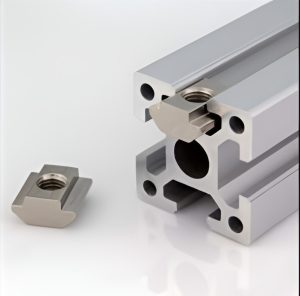 Pre-set T-Slot Nut for 8 mm Aluminium Profiles M5 M6 M8
Pre-set T-slot nut with anti-drop spring tab for 20, 30 and 40 series aluminium…
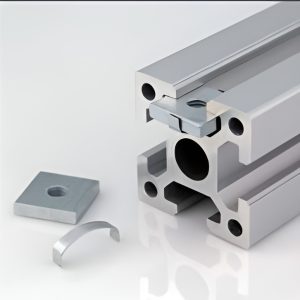 Square Nut for 8 mm T-Slot Aluminium Profiles M5 M6 M8
Square T-slot nut with four flat sides for 30 and 40 series aluminium profiles.…
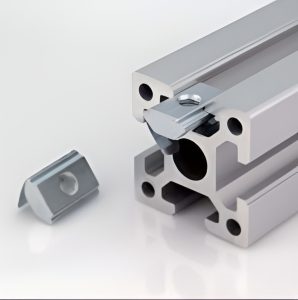 Subsequent Nut for 8 mm T-Slot Aluminium Profiles M5 M6 M8
Subsequent T-slot nut for 30 and 40 series aluminium profiles. M5, M6 and M8…
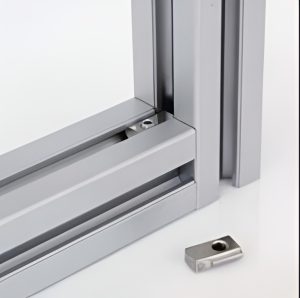 Anti-torsion Subsequent Nut for 8 mm T-Slot Aluminium Profiles
Anti-torsion subsequent T-slot nut with twin wings for 30 and 40 series aluminium profiles.…
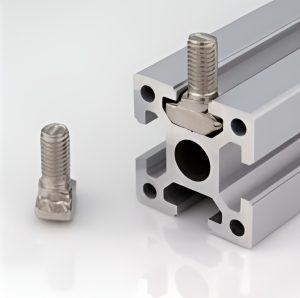 T-Bolt for 8 mm T-Slot Aluminium Profiles M6 M8 M10
T-bolt with integral T-head for 20, 30 and 40 series aluminium profiles. M5, M6,…
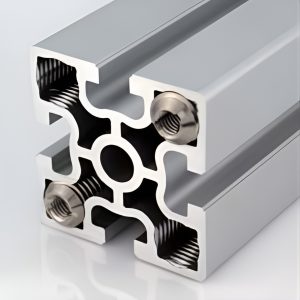 Hole Reducer Bolt for 8 mm T-Slot Aluminium Profiles
Hole reducer bolt with stepped M8 to M6 thread for 30 and 40 series…
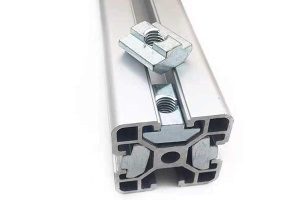 T-Nut and Bolt Set Aluminium Profile Fastener Kit M5 M6 M8 20-40 mm T-Slot Hardware
Matched T-nut, bolt and washer set for aluminium profile frames in M5, M6 and…
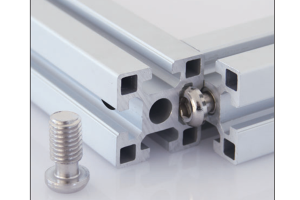 Screw Type Anchor Connector Aluminium Profile Hidden Joint Fastener 30 40 mm Series
Screw type anchor connector for aluminium profile giving a hidden joint with no visible…
