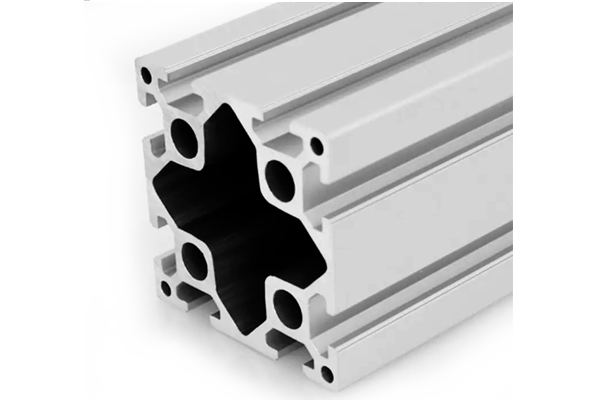
PG40 80×80 mm Eight Slot Heavy Aluminium Strut Profile High Load Column
An 80 x 80 mm eight slot heavy PG40 aluminium strut profile with diamond internal cavities and an 11 mm web. Same envelope as the standard 80 x 80, about half again the stiffness.
| Material | Aluminium |
|---|---|
| Alloy Grade | 6063-T5 |
| Temper | T5 |
| Section Size | 80 x 80 mm |
| Slot | 8 x 10.2 mm groove, 8 mm mouth, 40 mm pitch, outer pair 40 mm apart, M8 |
| Length | 6 m stock, cut to drawing to +/-0.5 mm |
| Tolerance | EN 755-9 / GB/T 6892, wall +/-0.15 mm |
| Surface | Mill finish / clear anodised / black anodised |
| MOQ | 150 |
| Lead Time | 20-30 days after deposit for mill finish |
| Loading Port | Shanghai / Ningbo |
| Supply Ability | 250 t per month |
| Payment Terms | T/T 30% deposit + 70% before shipment | L/C at sight |
| Trade Terms | FOB | CIF | EXW |
| Certifications | ISO 9001:2015 | EN 755-9 | RoHS | REACH |
Structural framing · PG40 heavy column
A PG40 80 x 80 mm eight slot heavy aluminium strut profile is a square column with 8 x 10.2 mm slots on a 40 mm pitch, an 8 mm slot mouth taking 40 series M8 hardware, 5 mm corner holes tapped M6 and a Ø12 mm bore tapped M14. The flange is 4 mm and the web 11 mm, the outer slots are 40 mm apart, and the internal cavities are formed as diamonds rather than squares. It weighs about 6.8 kg/m against roughly 4.5 kg/m for a standard wall 80 x 80 mm section, and it is supplied in 6063-T5.
Two 80 x 80 mm profiles can look identical from the outside and behave very differently, and this section is the example. The envelope is the same, the slot layout is the same, and every bracket that fits a standard 80 x 80 mm section fits this one. What has changed is the wall thickness and the shape of the cavities inside, and the consequence is a stiffer column for about half again the weight. Whether that is a bargain or a waste depends on one thing: whether the column is actually stiffness-limited.
Same envelope, different inside
A T-slot profile is mostly void. In a standard-wall 80 x 80 mm section the aluminium occupies perhaps a quarter of the 80 x 80 envelope, and the rest is slot mouths, grooves and internal cavities. That leaves a great deal of room to redistribute material without changing the outside at all, and that is exactly what a heavy section does.
| Standard 80 x 80 mm | Heavy 80 x 80 mm | |
|---|---|---|
| Envelope | 80 x 80 mm | 80 x 80 mm |
| Slots | 8 x 10.2 mm on a 40 mm pitch | 8 x 10.2 mm on a 40 mm pitch |
| Flange | Thinner | 4 mm |
| Web | Thinner | 11 mm |
| Cavity shape | Square cavities | Diamond cavities |
| Weight | approx. 4.5 kg/m | approx. 6.8 kg/m |
| Bending stiffness | Reference | About half again as stiff |
| Torsional stiffness | Reference | Substantially higher |
Every bracket still fits. Because the envelope and the slot layout are unchanged, a heavy section is a drop-in replacement for a standard one. That is what makes it useful: you can upgrade a frame’s stiffness without redesigning any of the connections.
What a diamond cavity does that a square one cannot
The cavity shape is the interesting part, because it is not cosmetic. Three things change when the internal cells are rotated to a diamond.
First, the webs triangulate the section. A square cell can rack into a parallelogram under torsion; a diamond cell, whose walls are at 45 degrees to the slot axes, cannot rack without changing the length of a side. That is why the torsional stiffness improves far more than the bending stiffness does — and torsion is what a column sees when it is loaded off-centre.
Second, the cavity corners move away from the slot roots. On a square-cavity section the cavity corner and the slot root can end up close together, which leaves a thin ligament where the stress concentrates. Rotating the cavity puts the corner where there is no slot, so the slot root stays properly supported.
Third, the webs can be made thicker without intruding into the slot cavity. That is what allows the 11 mm web of this section while keeping the slot geometry identical to the standard version.
When the heavy version earns its weight
The extra weight costs money three times: in the material, in the freight, and in the handling during assembly. So it is worth being clear about when it pays. The rule is that a heavy section is worth it when the column is stiffness-limited, and it is not worth it when the column is strength-limited or when a bigger envelope is available.
| Situation | Verdict | Reason |
|---|---|---|
| Column is stiffness-limited and the envelope is fixed | Use the heavy section | Same outside, about half again the stiffness, and no redesign |
| Column sees torsion from an off-centre load | Use the heavy section | The diamond cavities give the biggest gain in torsion |
| Column is strength-limited only | Standard section | Adding material where stress is not the problem buys nothing |
| A larger envelope will fit | Step up a size instead | Depth is a far cheaper way to buy stiffness than wall thickness |
| Frame is a light guard or a cover | Standard section | The extra stiffness has no function on a non-structural member |
That fourth row is the one people miss. Stiffness goes with the cube of the depth, so moving from 80 x 80 mm to 100 x 100 mm buys far more than doubling the wall thickness does, and it often costs less weight. The heavy 80 x 80 mm section is the right answer when the envelope is genuinely fixed — inside a machine, behind a panel, or where a cover has to close over it.
Specifying a heavy column
- Work out whether the column is stiffness or strength limited If the deflection or the twist is what fails first, it is stiffness-limited and the heavy section helps. If it is the stress, the heavy section does not.
- Check whether a larger envelope will fit If it will, compare the cost and weight of going up a size against going up a wall. Depth usually wins.
- Use the M14 bore for the structural connection The Ø12 mm bore tapped M14 is the strongest fixing point in the section. Keep the slots for adjustable items and brackets.
- Consider the weight during handling At 6.8 kg/m an 80 x 80 mm heavy column is a two-person lift in a long length. That matters on an installation where the frame is built on site.
- Keep the torque at the slot ceiling About 15 N m for an M8 nut in a 40 series groove. A heavier wall does not raise the slot ceiling, because the limit is the lip, not the bolt.
Frequently asked questions
What is the difference between this and the standard 80 x 80 mm section?
Wall thickness and cavity shape. This section has a 4 mm flange, an 11 mm web and diamond cavities, at about 6.8 kg/m against roughly 4.5 kg/m. The outside and the slot layout are identical, so brackets interchange.
How much stiffer is it?
About half again in bending and considerably more in torsion, because the diamond cavities triangulate the cells. Send us the load case and we will give you the deflection figures for both sections so you can compare.
Should I use this or a 100 x 100 mm section?
If a 100 x 100 mm envelope will fit, use it. Depth buys stiffness far more efficiently than wall thickness. The heavy 80 x 80 mm section is for when the envelope cannot change.
Does the heavier wall mean I can torque the bolts more?
No. The torque ceiling is set by the slot lip rather than by the wall, so an M8 nut in a 40 series groove is still limited to about 15 N m on this section.
Can you supply it machined?
Yes. We cut to length, face and square the ends, drill and tap the corner holes and the M14 bore, and supply end caps and covers.
Send the column load and the available envelope
Tell us the load, the height and whether the space around the column is fixed. We will compare the heavy 80 x 80 mm section against going up a size and quote the better answer.
Request a QuoteRelated Products
 PG40 160×40 mm Ten Slot Aluminium Strut Profile Wide Beam for Overhead Rails
A 160 x 40 mm ten slot PG40 aluminium strut profile wide beam with…
 PG40 160×40 mm Ten Slot Heavy Aluminium Strut Profile for Cantilever Arms
A 160 x 40 mm ten slot heavy PG40 aluminium strut profile with round…
 PG40 120×40 mm Eight Slot Aluminium Strut Profile Standard Beam for Table Frames
A 120 x 40 mm eight slot PG40 aluminium strut profile standard beam with…
 PG40 120×40 mm Eight Slot Heavy Aluminium Strut Profile for Machine Bases
A 120 x 40 mm eight slot heavy PG40 aluminium strut profile with round…
 PG40 80×40 mm Six Slot Super Light Aluminium Strut Profile for Enclosures
An 80 x 40 mm six slot super light PG40 aluminium strut profile with…
 PG45 90×90 mm Eight Slot Aluminium Strut Profile M10 Column Section
A 90 x 90 mm eight slot PG45 aluminium strut profile with 8 x…
 PG45 90×90 mm Eight Slot Heavy Aluminium Strut Profile for Heavy Machinery Frames
A 90 x 90 mm eight slot heavy PG45 aluminium strut profile with thicker…
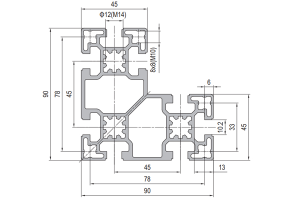 PG45 90×90 mm L-Shape Eight Slot Aluminium Strut Profile Corner Column for Frames
A 90 x 90 mm L-shaped eight slot PG45 aluminium strut profile with two…
