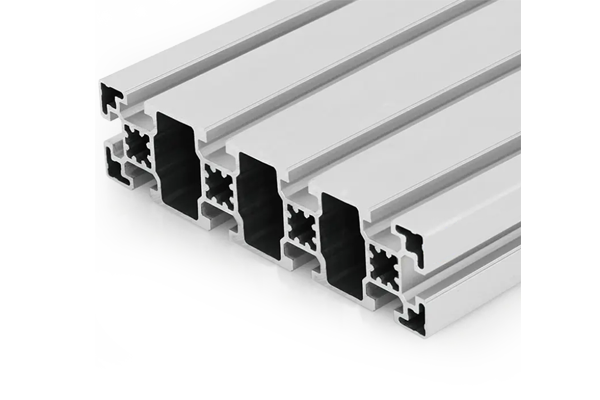
PG45 180 x 45 mm Ten Slot Aluminium Strut Profile Wide Gantry Beam
A 180 x 45 mm ten slot PG45 aluminium strut profile at about 6.20 kg/m, with 10.2 mm grooves on a 45 mm pitch and the outermost pair 135 mm apart. Twist governs the usable span, not bending strength.
| Material | Aluminium |
|---|---|
| Alloy Grade | 6063-T5 |
| Temper | T5 |
| Section Size | 180 x 45 mm |
| Slot | 10 x 10.2 mm groove, 10 mm mouth, 45 mm pitch, outermost pair 135 mm apart |
| Length | 6 m stock, cut to drawing to +/-0.5 mm |
| Tolerance | EN 755-9 / GB/T 6892, wall +/-0.15 mm |
| Surface | Mill finish / clear anodised / black anodised |
| MOQ | 150 m |
| Lead Time | Typically 22 to 32 days after deposit for mill finish |
| Loading Port | Shanghai, Ningbo, Qingdao |
| Supply Ability | Extrusion, cutting, machining and anodising in house |
| Payment Terms | T/T 30 per cent deposit, balance against copy of bill of lading; L/C at sight for larger orders |
| Trade Terms | FOB, CIF, CFR, EXW |
| Certifications | ISO 9001:2015, EN 755-9, RoHS and REACH declarations |
01What is the 180 x 45 mm ten slot profile?
Where does this section sit?
It is the wide member of the 45 series. Ten 10.2 mm grooves with a 10 mm mouth on a 45 mm pitch, with the outermost pair 135 mm apart. At about 6.20 kg/m a 6 m bar weighs roughly 37 kg, so it is a member you plan the handling for rather than pick up casually.
What is it used for?
Gantry and portal cross beams, long span machine bases, wide conveyor side frames, test rig beds and any structure that needs a 180 mm wide mounting face. The width is the point: it gives you ten fixing lines and a broad face for a carriage, a rail or a platen.
What limits how far it can span?
Twist, not strength. This is the part buyers get wrong. A 180 x 45 section has plenty of bending strength for a long span, but it is a wide, shallow, open-sided section and it has relatively little torsional stiffness. Long before the beam is anywhere near its bending limit, it will twist under an off-centre load and the wide face will go out of flat.
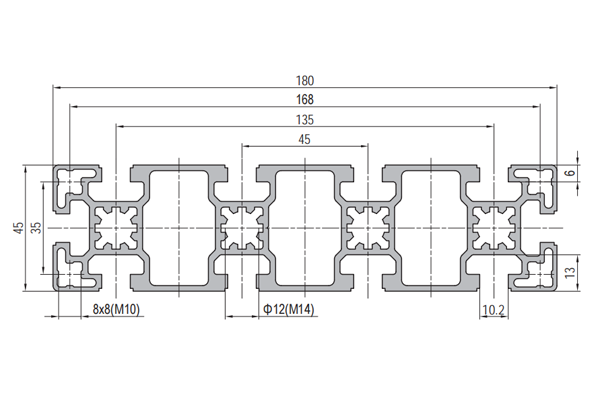
02Section data
| Item | Value | Note |
|---|---|---|
| Envelope | 180 x 45 mm | wide, shallow section |
| Slots | 10 | 10.2 mm groove, 10 mm mouth |
| Slot pitch | 45 mm | the 45 series module |
| Outermost pair | 135 mm apart | across the wide face |
| Fastener | M8 and M10 | 45 series slot nuts |
| Weight | approx. 6.20 kg/m | a 6 m bar is about 37 kg |
| Alloy | 6063-T5 | EN AW-6063 |
| Standard | EN 755-9 / GB/T 6892 | wall tolerance +/-0.15 mm |
| Length | 6 m stock | cut to drawing to +/-0.5 mm |
| Finish | mill, clear or black anodised | 10 to 20 micron |
Two numbers govern every decision about this member: 6.20 kg/m, which sets how you handle and support it, and 135 mm, the width of the outermost fixing pair, which sets how far off-centre a load can sit before twist becomes the problem.
03Why twist governs and not strength
A beam fails in bending when the material yields, and it fails in twist when the section rotates about its own axis. On a compact section like a square tube the two are comparable. On a wide, shallow section they are not, because torsional stiffness depends on how much of the material is enclosed, and a slotted extrusion is full of openings.
Every slot is a break in the wall. Ten slots along two wide faces remove a lot of the material that would otherwise resist twisting, and the 10 mm mouth is wider than the 6 mm mouth of the 30 series, so more is removed. The result is a section that is strong in bending and comparatively soft in torsion.
That matters because real loads are rarely on the centreline. A carriage that runs along the wide face, a bracket mounted on one of the outer grooves, a cable chain pulling to one side: all of them apply a load at some distance from the shear centre, and every one of them is a twisting moment as well as a bending one.
The symptom is not a broken beam. It is a wide face that is no longer flat, a carriage that binds at one end of its travel, and a machine that loses accuracy long before anything looks overloaded.
| Load position on the wide face | Effect | What to do |
|---|---|---|
| On the centreline | bending only, the section is strong here | nothing special needed |
| On one of the inner grooves | small twist, usually acceptable | check flatness under full load |
| On the outermost groove, 67.5 mm off centre | significant twist | reduce the span or add a stay |
| Overhanging the edge of the face | large twist, flatness is lost | redesign: put the load inboard or support the edge |
| Moving, as on a carriage | twist varies along the span | add a centre stay and check at the worst position |
The practical test is simple: measure how far the load sits from the centreline. Under about 20 mm and you can treat it as a bending problem. Out past 60 mm, which is most of the way to the outermost groove, and you are designing against twist.
04When you have to add a centre stay
A centre stay is anything that stops the wide face rotating: a second member across the span, a diagonal back to a post, a gusseted bracket, or a torque tube running parallel. It is cheap and it changes the span limit out of all proportion, because twist falls much faster than bending as the span shortens.
The working guidance we give for this section, for a load that is not on the centreline:
| Span | Without a stay | With a centre stay |
|---|---|---|
| Up to 1.5 m | fine, bending governs | not needed |
| 1.5 to 2 m | usable, check flatness under load | not needed but cheap insurance |
| 2 to 2.5 m | twist becomes visible | add a stay |
| 2.5 to 3.5 m | not recommended without a stay | stay required |
| Above 3.5 m | not recommended | consider a deeper section or a fabricated beam |
These are approximate working figures for a load carried on the wide face, not a design calculation. They assume the section is properly supported at both ends and the load is within the outermost grooves. Send the span, the load and its offset from the centreline and we will run it against the die drawing.
05Handling a 6.20 kg/m member
Plan the handling
- A 6 m bar weighs about 37 kg: two people, or a lift
- Support it along its length in storage or it will take a set
- Lift at two points, not the middle, to avoid bending it under its own weight
- Check the wide face for flatness before machining
- Protect the anodised face during handling: a 180 mm face marks easily
- Fit the end connections before it goes up, at bench height
Treat it like a light section
- It gets bent by its own weight when carried at one end
- It twists when set down on one edge
- Slot lips get damaged by dragging it across a bench
- The wide face gets marked by straps and clamps
- Ends go out of square if it is dropped
- Flatness is lost and the carriage binds afterwards
This is the part of the job that goes wrong on site rather than on the drawing. A member that arrives flat and is stored on two supports an inch apart will not be flat when it is fitted, and no amount of design margin recovers that.
06Failure modes to design out
| What goes wrong | Why it happens | Design it out by |
|---|---|---|
| Wide face goes out of flat | twist, not bending, was the governing case | keep the load inboard, shorten the span, or add a centre stay |
| Carriage binds at one end | the face is no longer flat under load | check flatness under full load, not empty |
| Beam takes a set in storage | it was supported at two points far apart, or stacked badly | store flat on continuous bearers, interleaved |
| Anodised face marked during handling | a 180 mm face is a big target for straps and clamps | use soft slings and protect the face until installation |
| End connection works loose | the load path at the ends is where twist is resisted | use the full depth of the end connection and check torque after a week |
07What to check before you order
Procurement checklist for the 180 x 45 mm ten slot section
- Confirm the series: 45 series is a 10.2 mm groove with a 10 mm mouth on a 45 mm pitch.
- Confirm the span and where the load sits relative to the centreline. This decides whether twist or bending governs.
- Confirm whether a centre stay is needed, from the span table above.
- Confirm the handling plan: a 6 m bar is about 37 kg.
- Confirm the end connections and how twist is resisted at the ends.
- Confirm the accessory list as a 45 series kit: M8 and M10 slot nuts, brackets, cover strips, end caps.
- Confirm the finish and the quantity in metres, with the offcut allowance.
08Terms used on this page
- Torsional stiffness
- Resistance to twisting about the length of the member. Slots reduce it, so a wide slotted section twists more than a closed tube of the same size.
- Shear centre
- The point through which a load can be applied without causing twist. Loads off the centreline twist the section.
- Centre stay
- A second member, diagonal or bracket that stops the wide face rotating. It raises the usable span substantially.
- Flatness
- How much the wide face deviates from a plane. It is the property that governs whether a carriage runs smoothly.
- Outermost pair
- The two grooves furthest apart on the wide face, here 135 mm apart.
- Series
- A family of sections sharing a slot mouth, a pitch and an accessory range. 45 series uses a 10 mm mouth on a 45 mm pitch.
09Questions buyers ask
What is the maximum span?
For a load on the wide face and off the centreline, about 2 m without a centre stay and about 3.5 m with one. On the centreline, bending governs and the span is longer. Send the load and its offset and we will calculate it.
Why does twist matter more than strength here?
Because the section is wide, shallow and full of slots. It has plenty of bending strength and comparatively little torsional stiffness, so the wide face goes out of flat before the material is anywhere near its limit.
What is the weight per metre?
Approximately 6.20 kg/m, so a 6 m stock length is about 37 kg.
What is the outermost fixing width?
135 mm between the outermost pair of grooves, so a bracket can sit up to about 67 mm off the centreline.
Is 45 series compatible with 40 series?
No. The mouth is 10 mm against 8 mm and the pitch is 45 mm against 40 mm, so the slot nuts and brackets do not interchange.
Can it be supplied cut and machined?
Yes. Send the cut list with the end machining and any hole pattern on the wide face, dimensioned from the centreline.
What we need to quote this section
- The section reference and the series, stated explicitly.
- The span between supports.
- Where the load sits relative to the centreline of the wide face.
- Whether a centre stay is part of the design.
- The cut list with end machining and any hole pattern.
- The finish and the quantity in metres.
Quotations are broken out into extrusion, cutting, machining, finish and hardware, so you can see which step is driving the cost on a long span. Browse the full aluminium profile catalogue and the 45 series aluminium profiles range for related sections.
Designing a gantry or long span with a 45 series beam?
Send the span, the load and its offset from the centreline. We will confirm whether twist or bending governs and whether you need a stay.
Request a quotationRelated Products
 PG50 100×100 mm Eight Slot Aluminium Strut Profile for Heavy Machine Columns
A 100 x 100 mm eight slot PG50 aluminium strut profile with two slots…
 PG50 100×50 mm Six Slot Aluminium Strut Profile Rectangular Machine Beam
A 100 x 50 mm six slot PG50 aluminium strut profile with slots on…
 PG45 90×45 mm Six Slot Aluminium Strut Profile Rectangular Machine Beam
A 90 x 45 mm six slot PG45 aluminium strut profile for machine frames…
 PG45 90 x 45 mm Six Slot Aluminium Strut Profile Heavy Rectangular Beam
90 x 45 mm six-slot heavy aluminium strut profile with 10.2 mm grooves and…
 PG45 45 x 45 mm Two Slot Type B Aluminium Strut Profile Opposite Rail
45 x 45 mm two-slot Type B aluminium strut profile with slots on opposite…
 PG40 120 x 80 mm Ten Slot Aluminium Strut Profile Wide Heavy Beam
120 x 80 mm ten-slot aluminium strut profile with six slots on the two…
 PG40 80×40 mm Six Slot Aluminium Strut Profile Standard Wall Beam
An 80 x 40 mm six slot standard wall PG40 aluminium strut profile. Two…
 PG40 80×40 mm Six Slot Light Aluminium Strut Profile for Panel Frames
An 80 x 40 mm six slot light wall PG40 aluminium strut profile for…
