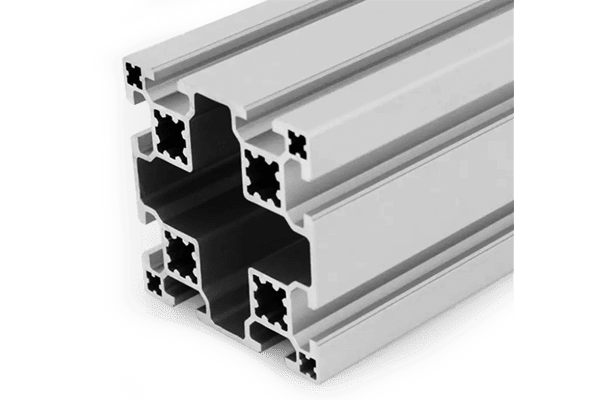
PG40 80×80 mm Eight Slot Aluminium Strut Profile Square Column
An 80 x 80 mm eight slot standard wall PG40 aluminium strut profile square column. Equal stiffness about both axes, so it cannot be installed the wrong way round. For legs, masts and gantry uprights.
| Material | Aluminium |
|---|---|
| Alloy Grade | 6063-T5 |
| Temper | T5 |
| Section Size | 80 x 80 mm |
| Slot | 8 x 10.2 mm groove, 8 mm mouth, 40 mm pitch, 2 slots per face on all four faces, M8 |
| Length | 6 m stock, cut to drawing to +/-0.5 mm |
| Tolerance | EN 755-9 / GB/T 6892, wall +/-0.15 mm |
| Surface | Mill finish / clear anodised / black anodised |
| MOQ | 200 |
| Lead Time | 18-28 days after deposit for mill finish |
| Loading Port | Shanghai / Ningbo |
| Supply Ability | 250 t per month |
| Payment Terms | T/T 30% deposit + 70% before shipment | L/C at sight |
| Trade Terms | FOB | CIF | EXW |
| Certifications | ISO 9001:2015 | EN 755-9 | RoHS | REACH |
Structural framing · PG40 square column
A PG40 80 x 80 mm eight slot aluminium strut profile is a square column section on the 40 series groove system. Eight 10.2 mm grooves with an 8 mm mouth are cut on a 40 mm pitch, two on each face. The corners carry 5 x 5 mm bores and the web carries a 12 mm bore tapped M14 at the end. It weighs about 5.80 kg/m and is supplied in 6063-T5.
A square section is the right shape for a post because a post does not know which way the load will come from. The 80 x 80 has about 130 cm4 about both axes, so it cannot be installed the wrong way round and it does not need to be checked in two orientations. That makes it the default choice for legs, masts, gantry uprights and any member whose load direction is not yet fixed.
Why a square column is the safe answer
A beam is designed against a known load direction, so a rectangular section can be tuned to it. A column is different. A column carries axial load, and the axial load is not what usually breaks it — buckling is. Buckling always happens about the weaker axis, which means a rectangular column is only as strong as its narrow direction.
That is why a 120 x 80 section used as a post is a false economy: it has the same weight as a section with more balanced stiffness but only one strong direction, and the post will buckle about the 80 mm axis regardless of how much material there is in the other one. The 80 x 80 square removes the whole problem.
| Section | Weight | Stiffness, weak axis | Weak axis relative to 80 x 80 |
|---|---|---|---|
| 80 x 80 eight slot | approx. 5.80 kg/m | approx. 130 cm4 | Reference |
| 120 x 80 ten slot | approx. 6.00 kg/m | approx. 180 cm4 | 1.4 x, at 3 per cent more weight |
| 90 x 90 eight slot | approx. 7.60 kg/m | approx. 230 cm4 | 1.8 x, at 31 per cent more weight |
| 100 x 100 eight slot | approx. 9.20 kg/m | approx. 380 cm4 | 2.9 x, at 59 per cent more weight |
For a column, compare the weak axis, not the strong one. A 120 x 80 section is stiffer than an 80 x 80 in one direction and about the same in the other, which is why it is a beam and not a post. If the load direction is genuinely unknown, a square section is the only honest choice.
Buckling, in one page
A short column fails by crushing: the stress reaches the yield strength of the material and the section simply squashes. A long column fails by buckling, at a load far below the crushing load, because a small sideways imperfection grows until the column bends over. The load at which that happens is given by Euler’s formula, and the only section property in it is the second moment of area.
For this section in 6063-T5, with a Young’s modulus of about 70,000 MPa and 130 cm4 about both axes, the buckling load falls with the square of the free length. At short lengths the crushing load governs; above about 2 m buckling takes over and the capacity drops quickly.
| Free length | Slenderness ratio | Crushing load | Euler buckling load | Safe load at 3:1 |
|---|---|---|---|---|
| 1.0 m | 41 | approx. 236 kN | Not governing | approx. 78 kN |
| 1.5 m | 61 | approx. 236 kN | approx. 399 kN | approx. 78 kN |
| 2.0 m | 81 | approx. 236 kN | approx. 224 kN | approx. 75 kN |
| 2.5 m | 102 | approx. 236 kN | approx. 144 kN | approx. 48 kN |
| 3.0 m | 122 | approx. 236 kN | approx. 100 kN | approx. 33 kN |
| 4.0 m | 163 | approx. 236 kN | approx. 56 kN | approx. 19 kN |
| 5.0 m | 203 | approx. 236 kN | approx. 36 kN | approx. 12 kN |
| 6.0 m | 244 | approx. 236 kN | approx. 25 kN | approx. 8.3 kN |
The table is for a pin ended column, which is the conservative assumption. Fixing the ends raises the capacity, but a bolted profile frame is rarely rigid enough at the joints to justify treating a post as fixed, and assuming pinned ends is the safe engineering habit.
A 6 m post carries about a tenth of what a 2 m post carries. Same section, same material, three times the length, one tenth the capacity. Nothing else in structural design falls away that fast, and it is why tall frames are usually braced rather than built from bigger posts.
What to do when the column is too tall
The instinct when a post is not strong enough is to step up a section size. On a column that is usually the wrong answer, because the capacity falls with the square of the length and only rises with the section’s stiffness. Doubling the section stiffness buys about 41 per cent more capacity; halving the free length buys four times.
Frequently asked questions
Why a square section rather than a rectangular one?
Because a column buckles about its weaker axis. A rectangular section’s capacity as a post is set by its narrow direction, so the extra material in the wide direction is largely wasted. A square section is equally strong in both directions and cannot be installed the wrong way round.
How tall can an 80 x 80 post be?
It depends on the load. At 3 m the Euler load is about 100 kN and the safe load at a three to one factor is about 33 kN. At 6 m the safe load is only about 8.3 kN. The capacity falls with the square of the length, so height is the dominant variable.
Is it strong enough for a mezzanine or a platform?
Only with the buckling check done properly and the frame braced. An 80 x 80 post at 2.5 to 3 m is a sensible leg for a light platform; above that the frame needs bracing or a larger section. Send us the leg height and the load and we will run the check.
Does the slot reduce the column capacity?
Slightly, and it is already allowed for in the 130 cm4 figure. The more important effect is that the slots give the bracing and the platform members somewhere to bolt, which is what actually keeps the column stable.
Can I bolt two together to make a bigger post?
Yes, and it is a common way to build a heavy post from standard parts. Two 80 x 80 sections bolted face to face give roughly four times the stiffness of one, which is a better return than stepping up a size. The joint has to be bolted at the 40 mm pitch along the full length, not just at the ends.
Send the leg height and the axial load
Tell us how tall the post is and what it carries. We will run the buckling check and say whether the section works, needs bracing, or genuinely needs a larger size.
Request a QuoteRelated Products
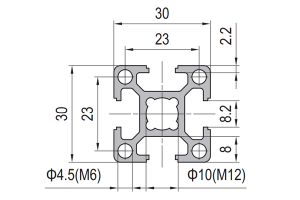 PG30 30×30 mm Four Slot Aluminium Strut Profile Standard Wall Column
A 30 x 30 mm four slot standard wall PG30 aluminium strut profile square…
 PG20 20 x 20 mm Four Slot Aluminium Strut Profile Miniature Frame
20 x 20 mm four-slot aluminium strut profile with 6.2 mm grooves and 6…
 PG20 20 x 20 mm R90 Two Slot Aluminium Strut Profile Rounded Corner
20 x 20 mm quarter-round aluminium strut profile with a swept R90 outer corner…
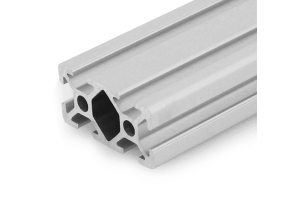 PG20 40 x 20 mm Six Slot Aluminium Strut Profile Rectangular Flat Beam
40 x 20 mm six-slot aluminium strut profile with 6.2 mm grooves on a…
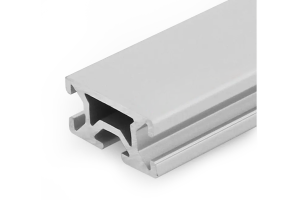 PG15 30 x 15 mm Three Slot Aluminium Strut Profile Light Panel Frame
30 x 15 mm three-slot aluminium strut profile with 6 mm grooves on a…
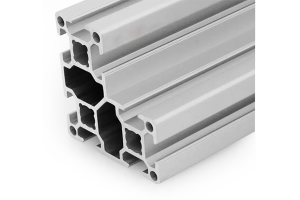 PG30 60×60 mm L-Shape Eight Slot Aluminium Strut Profile Corner Column
A 60 x 60 mm L-shape eight slot PG30 aluminium strut profile corner column…
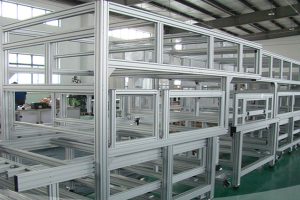 Aluminium Profile Shelf System 40×40 mm T-Slot Uprights for Workshop Racking
A bolted aluminium profile shelf system in 40 x 40 mm T-slot uprights and…
 Aluminium Extrusion Table Frame 20×20 40 mm Workbench Base
20 series aluminium extrusion table frame with 40x40 mm four-slot legs and 40x80 mm…
