PG30 30×30 mm Four Slot Aluminium Strut Profile Standard Wall Column
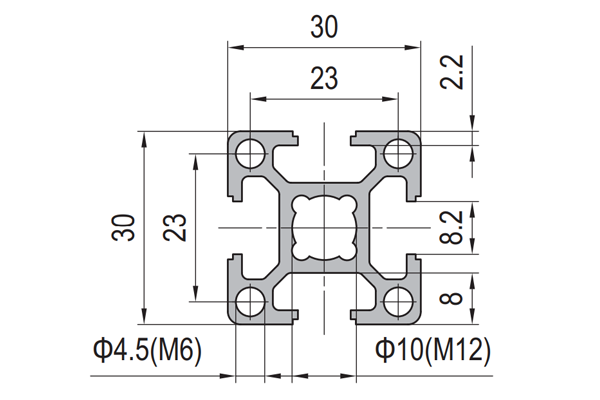
A 30 x 30 mm four slot standard wall PG30 aluminium strut profile square column. For guard frames, small enclosures and secondary framing, with M6 hardware throughout.
| Material | Aluminium |
|---|---|
| Alloy Grade | 6063-T5 |
| Temper | T5 |
| Section Size | 30 x 30 mm |
| Slot | 4 x 8.2 mm groove, 6 mm mouth, 30 mm pitch, 1 slot per face, M6 |
| Length | 6 m stock, cut to drawing to +/-0.5 mm |
| Tolerance | EN 755-9 / GB/T 6892, wall +/-0.15 mm |
| Surface | Mill finish / clear anodised / black anodised |
| MOQ | 400 |
| Lead Time | 18-28 days after deposit for mill finish |
| Loading Port | Shanghai / Ningbo |
| Supply Ability | 450 t per month |
| Payment Terms | T/T 30% deposit + 70% before shipment | L/C at sight |
| Trade Terms | FOB | CIF | EXW |
| Certifications | ISO 9001:2015 | EN 755-9 | RoHS | REACH |
Structural framing · PG30 square column
A PG30 30 x 30 mm four slot aluminium strut profile is a square column section on the 30 series groove system. Four 8.2 mm grooves with a 6 mm mouth are cut on a 30 mm pitch, one on each face. The corners carry 4.5 mm bores taking M6 and the centre carries a 10 mm bore tapped M12 at the end. It weighs about 1.15 kg/m and is supplied in 6063-T5.
The 30 x 30 is the smallest section in the range that can be called a column rather than a frame member, and it comes with the one limitation that catches almost everyone who builds a frame from T-slot profile for the first time. Four slot mouths cut the outer surface into four separate strips, and separate strips are very poor at resisting twist. The section is fine in bending; it is the frame’s resistance to racking that has to be designed separately.
Closed sections and open sections behave differently
Bending and torsion are carried by completely different parts of a section, and this is where most T-slot frames get their first surprise.
Bending is carried by material at the extremes of the section — the flanges. That is why a T-slot profile is good in bending: its flanges are exactly where they need to be, and the 30 x 30 section has about 3 cm4 about both axes.
Torsion is carried by a closed loop. A tube resists twist because the shear flows round a continuous ring of material. Cut that ring anywhere and the shear has nowhere to flow, so the section stops behaving like a tube and starts behaving like a bundle of flat strips, which is dramatically weaker.
| Section form | Torsional constant | Relative | Comment |
|---|---|---|---|
| Closed box, 30 x 30, 2.2 mm wall | approx. 47 cm4 | 110 x | Shear flows round a continuous ring |
| T-slot profile, four 6 mm slot mouths | Between the two, nearer the box | Well below 110 x | The mouth is narrow, so much of the ring survives |
| The same section cut fully open along one length | approx. 0.43 cm4 | Reference | Shear can only run along the wall thickness |
A single lengthways cut turns a tube into a bundle of strips. On the calculation above the torsional constant falls by a factor of about a hundred. A T-slot profile is not cut fully open — the 6 mm mouth leaves most of the ring intact — but it is far enough from a closed box that torsion has to be designed for rather than assumed.
What this means for a bolted frame
A frame made of bolted T-slot profiles has two sources of flexibility: the sections themselves, and the joints. In bending the sections dominate, and the frame is usually fine. In torsion the joints dominate, because a bolted joint in a groove is not rigid in rotation — it can slip a fraction of a millimetre before the friction is overcome.
That is why a bolted T-slot frame racks even when the sections are generously sized. Push the top of the frame sideways and the rectangle becomes a parallelogram, not because anything has broken but because each of the four corners has rotated slightly. Stepping up from a 30 x 30 to a 45 x 45 section makes the members stiffer and does very little for the racking.
| Fix | Effect on racking | Cost | When to use it |
|---|---|---|---|
| Step up a section size | Small | High, on every member | Only if bending is also a problem |
| Diagonal brace in one plane | Large | Low, one member and two brackets | Almost always the right first answer |
| Panel fixed to one face | Large, if it is a real panel | Low, and it may be needed anyway | Guards, enclosures, machine covers |
| Gusset plate at each corner | Moderate | Low | Where a brace would obstruct |
| Corner bracket with a wide footprint | Moderate | Low | Standard practice, better than a narrow bracket |
| Bolting the frame to a rigid floor or wall | Large | Site work | Where the frame is fixed down anyway |
The 30 series limits
The 30 series groove is 8.2 mm wide with a 6 mm mouth, which takes M6 slot nuts and M6 T-bolts. The corner bores are 4.5 mm for M6 clearance and the centre bore is 10 mm, tapped M12 at the end. Those three sizes set the section’s ceiling, and they are worth knowing before the design is fixed.
| Feature | Size | What it takes | What it will not take |
|---|---|---|---|
| Slot groove | 8.2 mm, 6 mm mouth | M6 slot nuts and T-bolts | M8 hardware, which needs the 40 series |
| Corner bores | 4.5 mm | M6 clearance bolts | M8 clearance |
| Centre bore | 10 mm | M12 tap, or M12 threaded bar | M14 or larger |
| Slot torque ceiling | About 8 to 10 N m for M6 | Normal assembly torque | Heavy clamping loads |
| Section stiffness | About 3 cm4 | Short spans and light loads | Long unbraced spans |
The section is at its best in machine guards, small enclosures, sensor mounts, light workstations and display frames, and in any structure where the members are short and the loads are measured in tens of kilograms rather than tonnes. It is also widely used as the secondary framing inside a heavier 40 or 45 series frame, where it carries panels rather than structural load.
Frequently asked questions
Why does my 30 x 30 frame rack?
Because the sections are cut into four strips by the slot mouths, so they are much weaker in torsion than a closed tube, and because bolted joints in a groove are not rigid in rotation. Both effects are normal. The fix is a diagonal brace or a panel, not a bigger section.
Will a larger section fix the racking?
Not much. Racking is dominated by rotation at the joints, and the joints do not become rigid just because the members are stiffer. A brace or a panel is the answer, and it costs a fraction of stepping up every member in the frame.
What hardware fits the 30 series?
M6 slot nuts and M6 T-bolts in the 8.2 mm groove with its 6 mm mouth, and M6 bolts through the 4.5 mm corner bores. The 10 mm centre bore takes an M12 tap. M8 hardware needs the 40 series.
How tall can a 30 x 30 post be?
Keep unbraced posts under about 1.5 m. Beyond that the section buckles at a low load and the frame becomes wobbly. For anything taller, brace it or step up to the 40 series.
What is the slot pitch for?
30 mm, which is the 30 series accessory pitch. One slot per face on this section means the mounting positions are on the face centre lines, with the slot centres 23 mm apart across each corner.
Send the frame size and whether it has to resist racking
Tell us the frame size, the load and whether the frame has to stay square under a sideways push. We will quote the brace and the brackets alongside the profile rather than selling you a heavier section.
Request a QuoteRelated Products
 PG20 20 x 20 mm Four Slot Aluminium Strut Profile Miniature Frame
20 x 20 mm four-slot aluminium strut profile with 6.2 mm grooves and 6…
 PG20 20 x 20 mm R90 Two Slot Aluminium Strut Profile Rounded Corner
20 x 20 mm quarter-round aluminium strut profile with a swept R90 outer corner…
 PG20 40 x 20 mm Six Slot Aluminium Strut Profile Rectangular Flat Beam
40 x 20 mm six-slot aluminium strut profile with 6.2 mm grooves on a…
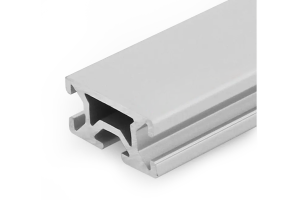 PG15 30 x 15 mm Three Slot Aluminium Strut Profile Light Panel Frame
30 x 15 mm three-slot aluminium strut profile with 6 mm grooves on a…
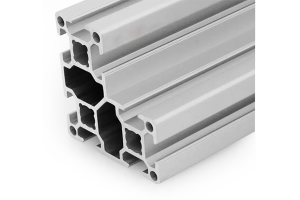 PG30 60×60 mm L-Shape Eight Slot Aluminium Strut Profile Corner Column
A 60 x 60 mm L-shape eight slot PG30 aluminium strut profile corner column…
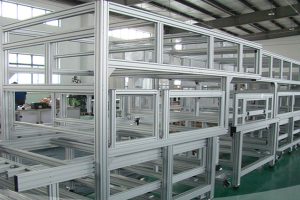 Aluminium Profile Shelf System 40×40 mm T-Slot Uprights for Workshop Racking
A bolted aluminium profile shelf system in 40 x 40 mm T-slot uprights and…
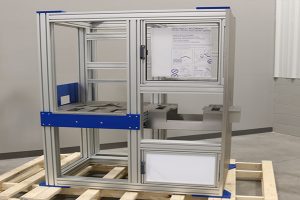 Aluminium Extrusion Table Frame 20×20 40 mm Workbench Base
20 series aluminium extrusion table frame with 40x40 mm four-slot legs and 40x80 mm…
Aluminium Framing Extrusion Kit 40×40 mm 40 Series Cut List for Machine Frames
A cut-to-length aluminium framing extrusion kit in the 40 series: profile cut to a…
