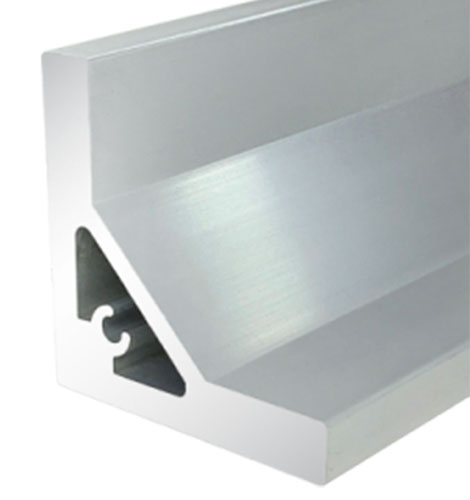
Aluminium Angle Profile 35 x 35 x 4 mm Panel Edge Trim for Guarding
35 x 35 x 4 mm aluminium angle profile with an inner corner slot, used as a guard panel edge trim. 6061-T6, cut and mitred to list.
| Material | Aluminium |
|---|---|
| Alloy Grade | 6061-T6 |
| Temper | T6 |
| Section Size | 35 x 35 x 4 mm |
| Slot | Open slot on the inner face for a gasket or panel edge, with a round bore beside it; slot width confirmed against the drawing for each order |
| Length | Cut to list up to 6 m; square or 45 degree mitre |
| Tolerance | Wall +/-0.15 mm, length +/-0.5 mm, mitre angle +/-0.5 deg |
| Surface | Mill finish / clear anodised / black anodised |
| MOQ | Small trial lengths from stock offcuts; production batches from about 100 m |
| Lead Time | Typically 2 to 3 weeks for mill finish, plus about a week for anodising |
| Loading Port | Shenzhen or Guangzhou |
| Supply Ability | Around 20 tonnes per month of cut and machined angle sections |
| Payment Terms | 30 per cent deposit, balance against copy of documents |
| Trade Terms | FOB, CIF, EXW |
| Certifications | Mill certificate to EN 10204 3.1 on request, RoHS and REACH declarations |
01What does this angle actually do at a guard panel edge?
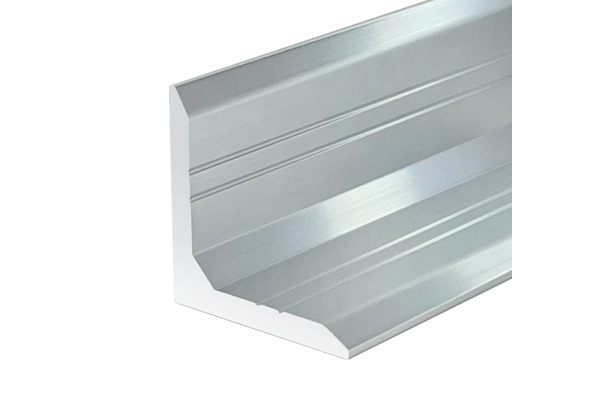
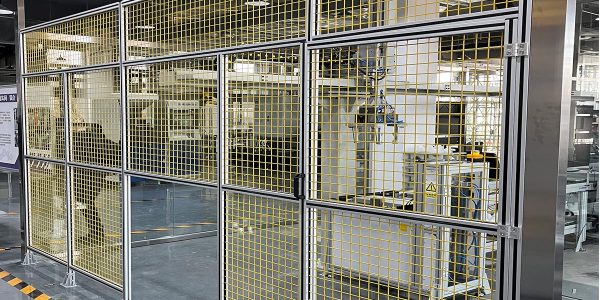
It closes the edge of a panel. On a machine guard, a polycarbonate window or a mesh infill sits inside a 40 x 40 mm aluminium frame, and the raw cut edge of that panel is the weakest, sharpest and least sealed part of the whole enclosure. The 35 x 35 x 4 mm aluminium angle profile caps that edge, gives the panel a bearing surface, and — when the inner slot carries a gasket — turns a loose infill into something that keeps coolant, dust and fingers out.
This page is not a description of an L section. It is the checklist for specifying the trim correctly the first time, because almost every complaint about panel edge trims comes down to one of four numbers that were never agreed: panel thickness, slot width, gasket compression and edge engagement. Get those four right and the trim is invisible. Get one wrong and the panel either rattles, cracks at the corner, or pushes the gasket out of the slot within a month.
Is this the same as the plain 35 x 35 x 4 angle you already list?
No. The plain equal leg angle is a solid corner section used for bracing. This one has a slot machined into the inner face and a round bore beside it, so it can retain a panel edge or a gasket. If you only need a corner brace, the solid angle is cheaper and stiffer for the same weight. If you need to hold a panel, you need the slot.
Can the trim be used on both sides of the panel?
Yes, and on a guard it usually is. One angle on the outside face and one on the inside face clamps the panel between them, which means the panel no longer relies on the gasket alone to stay put. The trade-off is that the two angles have to be drilled as a pair so the fixing holes line up through the panel.
02Which four dimensions decide whether the trim fits?
A panel edge trim is a tolerance stack, not a single part. Before a quote is worth anything, four dimensions have to be fixed. They are listed below in the order that they cause problems in practice — thickness first, because it is the one buyers most often quote as a nominal figure when the delivered sheet is something else.
| Dimension | What it controls | Where it goes wrong | What to state on the drawing |
|---|---|---|---|
| Panel thickness | Which slot and gasket the trim needs | Nominal 5 mm sheet often arrives at 4.7 or 5.3 mm | Actual measured thickness, plus the standard it is made to |
| Slot width | Whether the gasket is compressed or loose | Slot cut to nominal, gasket made to nominal, nothing left for tolerance | Slot width and its tolerance, not just the nominal |
| Gasket compression | Sealing, rattle, and the force needed to seat the panel | Over-compressed gasket creeps out of the slot; under-compressed one leaks | Target compression range as a percentage of free height |
| Edge engagement | How much panel sits inside the trim | Too little and the corner cracks; too much and the panel will not go in | Minimum engaged depth, measured from the panel edge |
A trim that is quoted against nominal dimensions and delivered against real ones is the single most common reason a first article does not fit. Send the measured panel thickness with the enquiry, not the catalogue figure.
03How much should the gasket be compressed?
For a closed cell EPDM or silicone gasket in an aluminium slot, the working range is 20 to 30 per cent of free height. Below about 15 per cent the gasket does not seal against dust or coolant mist. Above about 35 per cent it stops behaving like a spring: the rubber takes a permanent set, the panel sits hard against metal, and on the next re-fit the gasket has lost the thickness it needed.
| Gasket free height | Target compressed height at 25 per cent | Panel thickness this suits |
|---|---|---|
| 3 mm | 2.25 mm | 3 mm |
| 4 mm | 3.0 mm | 4 mm |
| 5 mm | 3.75 mm | 5 mm |
| 6 mm | 4.5 mm | 6 mm |
The numbers above assume the slot depth equals the gasket free height and the panel sits flat on the gasket face. If the slot is deeper than the gasket, the gasket never gets compressed and the seal is decorative. If the slot is shallower, the panel bottoms out on aluminium and the gasket is crushed to whatever is left. Both cases are invisible on a drawing and obvious on a leak test.
04Where do panel edge trims fail in service?
The failures are repetitive and predictable. All four below are design failures rather than manufacturing failures, which means they can be designed out before the first cut is made.
| Failure | What you see | Root cause | Design fix |
|---|---|---|---|
| Corner crack | A star crack radiating from the panel corner, usually within weeks | Fastener too close to the panel edge, or no clearance for thermal movement | Keep fixings at least 2x hole diameter from the panel edge and use slotted holes in the trim, not in the panel |
| Gasket extrusion | Rubber bulging out of the slot along one side | Compression above 35 per cent, or gasket free height larger than slot depth | Match gasket free height to slot depth and state the compression range |
| Panel rattle | Audible buzz at certain motor speeds | Compression below 15 per cent, or the panel is only held on two edges | Trim all four edges, or add a mid-span retainer on panels over 900 mm |
| Galvanic stain | White powder or dark streaks at the trim to steel interface | Aluminium in contact with a dissimilar metal in the presence of moisture | Use a isolating washer or a coated fastener; keep the anodised layer intact under the fixing |
05How much of the panel edge has to sit inside the trim?
Enough that the corner is not the load path. As a working rule, the engaged depth should be at least 1.5 times the panel thickness and never less than 8 mm, measured from the cut edge of the panel to the deepest point of the slot. On a 5 mm polycarbonate window that means 8 mm minimum, and on a 6 mm sheet it means 9 mm.
There is an upper limit too. Pushing more than about 20 mm of panel into the trim buys no extra strength and makes assembly harder, because the panel has to be slid in along its full length rather than dropped in. On a 1.5 m window that difference in assembly method is the difference between a two-minute fit and a two-man job.
- Minimum engaged depth
- 1.5 x panel thickness, never below 8 mm
- Maximum practical depth
- about 20 mm, beyond which assembly gets harder
- Fixing to panel edge
- at least 2 x hole diameter
- Hole type in trim
- slotted, to allow thermal movement
0635 x 35 or 40 x 40 — which size for which panel?
35 x 35 x 4 mm, approx. 0.71 kg/m
- Suits panels up to roughly 1.0 m x 1.0 m
- Lighter trim, easier to handle on a ladder
- 4 mm wall is enough for M6 fixings
- Lower cost per metre at any quantity
- Better where the trim is visible and the look matters
40 x 40 x 5 mm, approx. 1.01 kg/m
- Suits panels from about 1.2 m x 1.2 m upward
- 5 mm wall takes M8 and resists local distortion
- Less bow between fixings on long edges
- Heavier, and the extra mass is at the perimeter
- Choose it when the panel is structural, not just an infill
The crossover is not a rule about panel size, it is a rule about span between fixings. A 35 x 35 x 4 trim with fixings every 300 mm is stiffer in service than a 40 x 40 x 5 trim with fixings every 800 mm, because the deflection of the trim between supports grows with the cube of the spacing. Fixing pitch, not section size, is the first lever.
07How is the trim cut, mitred and drilled?
Trims are cut on a CNC saw to +/-0.5 mm and mitred at 45 degrees where two runs meet at a corner. The mitre has to be cut as a pair from the same setting, because two independently cut 45 degree ends will not close on a long run even if each one is individually within tolerance. On a guard frame the visible corner gap is the first thing a customer notices.
- Square cuts for butt joints against a frame post, +/-0.5 mm on length.
- 45 degree mitres cut as matched pairs; a 0.2 mm error on each end opens a 0.4 mm gap.
- Drilling on a jig, not freehand, so the hole pattern repeats across a batch.
- Deburr both the cut face and the slot mouth — a burr in the slot tears the gasket on assembly and the leak shows up months later.
- Anodise after cutting and drilling. Cutting anodised stock leaves bare aluminium at every cut face, which is exactly where corrosion starts.
08What belongs on the drawing?
A trim drawing that can be quoted and made without a single question back needs eight items. Anything missing from this list becomes an assumption, and assumptions are what first articles get rejected for.
Panel edge trim drawing checklist
- Section size and wall, with the slot called out separately from the legs
- Actual measured panel thickness, with the sheet standard it is made to
- Slot width and its tolerance
- Gasket free height, material and target compression range
- Minimum engaged depth of the panel into the trim
- Fixing pitch along each edge, and hole size and type
- Cut list: each length, whether square or mitred, and which end
- Finish and colour, and whether cut faces are to be touched up
If the trim is going onto a guard that has to meet a machinery safety standard, add the panel retention method as a separate line. A gasket-only retention is fine for dust, but on a guard that has to contain a fragment the panel needs a mechanical retainer behind it, not just friction.
09Questions buyers ask before the first order
Related sections and categories
Browse Aluminium Angle Profiles, Panel Installation Elements, the 35 x 35 x 4 mm equal leg angle, or see the aluminium angle range for the full section data.
What is the minimum order for a cut and mitred trim?
Small trial lengths are available from stock offcuts, so a single guard can be trimmed without committing to a die run. A production batch is normally quoted from about 100 m of section, and anodising is priced per batch rather than per metre, which is why a small anodised order costs disproportionately more.
Can you supply the gasket as well as the trim?
Yes, and it is the better way to buy. The trim slot and the gasket free height have to match, and if they come from two suppliers neither will accept responsibility for a poor seal. Supplying both against one drawing removes that gap.
How long does an anodised trim take?
Typically 2 to 3 weeks for mill finish after the cut list is approved, plus about a week for anodising. Colour matched anodising adds more, because the batch has to be scheduled with other work of the same shade.
Will the trim fit a panel that is already cut?
Usually yes, if the panel edge is straight and undamaged. Send the measured thickness and the measured edge length; if the panel was cut on a table saw the edge may be 0.2 to 0.3 mm out of square over a metre, which is enough to stop a tight slot from closing.
Do you supply the trim drilled to a hole pattern?
Yes, drilled and countersunk to drawing on a jig so the pattern repeats across the batch. Send the drawing as DXF, DWG or STEP; a PDF is accepted but a dimensioned PDF is slower to program and more likely to be queried.
What to send for a panel edge trim quote
- Measured panel thickness and panel material
- Panel outline size, and how many edges are trimmed
- Section size required, or the panel size if you want us to choose
- Gasket requirement, or state that the trim is unsealed
- Cut list with square or mitred ends marked per piece
- Hole pattern drawing if the trim is to be drilled
- Finish and colour, and the quantity in metres
A photo of the existing trim alongside a rule is often faster than a drawing, because it settles the slot question in one glance.
Send a panel thickness and a cut list
Tell us the measured panel thickness, how many edges need trimming, and the finish. We will come back with a section recommendation, the gasket that matches the slot, and a price per metre.
Request a quotationRelated Products
 L Aluminium Angle 30 x 30 x 4 mm for Washdown Equipment Frames
30 x 30 x 4 mm L aluminium angle for washdown equipment frames. 6061-T6,…
 Aluminium 2020 Extrusion 20 x 20 mm for 3D Printer Frames
20 x 20 mm four slot aluminium 2020 extrusion for 3D printer and desktop…
 Aluminium 2020 Profile 20 x 20 mm for Laboratory Instrument Stands
20 x 20 mm aluminium 2020 profile for laboratory instrument stands. 0.62 kg/m, 6.2…
20 x 20 Aluminium Extrusion 6.2 mm Slot Stock Lengths and MOQ
20 x 20 mm aluminium extrusion with a 6.2 mm slot, supplied in 6…
 Aluminium 60 x 60 mm Four Slot Extrusion for Robot Cell Gantries
60 x 60 mm four slot aluminium extrusion for robot cell gantry columns and…
 Aluminium 4040 Extrusion 40 x 40 mm Single Slot for Machine Fixtures
40 x 40 mm single slot aluminium 4040 extrusion for machine fixture bases. Three…
 Aluminium 40 Series Extrusion 40 x 40 mm for PV Module Lines
40 x 40 mm aluminium 40 series extrusion for photovoltaic module lines. Four slots,…
 Anodised Aluminium Profile 40 x 40 mm AA15 Clear Finish for Visible Frames
40 x 40 mm anodised aluminium profile in 6063-T5 with an AA15 clear anodised…
