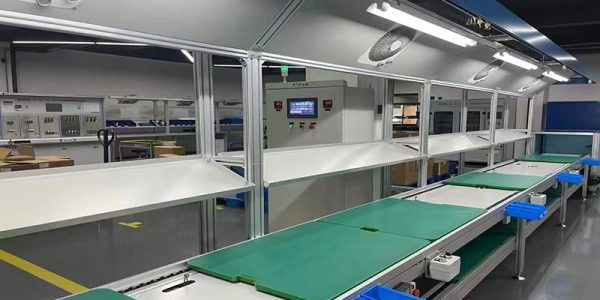
45 x 180 mm Aluminium Profile for ESD-Safe Electronics Frames
45 × 180 mm aluminium extrusion in 6063-T5 for ESD-safe electronics frames sought by Bangalore-area EMS buyers. Ten 10.2 mm slots, 6.20 kg/m, masked earth pad, conductive anodising or conversion coating—exported from Shanghai/Ningbo.
| Material | Aluminium |
|---|---|
| Alloy Grade | 6063-T5 |
| Temper | T5 |
| Section Size | 45 x 180 mm, ten slots |
| Slot | 10 x 10.2 mm groove, 10 mm mouth, 45 mm pitch, outermost pair 135 mm apart |
| Length | 6 m stock; cut to frame list to +/-0.5 mm |
| Tolerance | EN 755-9, wall +/-0.15 mm; straightness 1.5 mm per metre; twist 2 degrees |
| Surface | Conductive anodised, clear anodised AA15, or chemical conversion coating; earth pad masked |
| MOQ | 150 m |
| Lead Time | 22 to 32 days after deposit, plus 5 to 8 days air freight to Bengaluru |
| Loading Port | Shanghai / Ningbo |
| Supply Ability | 600 t per month extrusion with in-house anodising |
| Payment Terms | T/T 30% deposit + 70% before shipment | L/C at sight |
| Trade Terms | FOB | CIF | DAP |
| Certifications | Mill certificate per heat, coating report per lot, surface resistance test report, RoHS and REACH declarations |
EMS and test-equipment buyers around Bengaluru specifying an ESD-safe SMT, test-cell or clean-assembly frame need a China-export supplier that can deliver a 45 × 180 mm ten-slot section with a documented earthing path—not another catalogue of decorative anodising. GrownParts extrudes and finishes in China and ships from Shanghai or Ningbo; we do not operate a plant in Bangalore.
GrownParts ships this section from Shanghai / Ningbo as GP-SP-45180-10S-BL: 6063-T5, ~6.20 kg/m, ten 10.2 mm slots on a 45 mm pitch, cut to the frame list. This page is written for electronics-manufacturing buyers in Bengaluru and the surrounding EMS cluster who must pass an ESD audit—not for a generic framing RFQ.
What Bangalore electronics buyers actually need from a 45 × 180 frame
EMS and test-equipment builders around Bengaluru (Peenya, Electronic City, Whitefield, Hosur corridor) ask the same engineering question: can this deep section carry the machine load and sit inside the facility earthing plan? A 180 mm depth gives roughly 400 cm⁴ about the strong axis at 6.20 kg/m—enough stiffness for long SMT guards and metrology booths without jumping to a fabricated box. Ten slots on a 45 mm pitch let panels, cable trays and hinge blocks land on standard T-nuts. None of that helps if the finish isolates the frame from earth.
GrownParts is a China extrusion supplier serving export buyers. We supply an ESD-capable 45 × 180 with a bond detail you can put on a drawing. If your job is EU paperwork or typhoon wind instead, see EU-bound Maghreb supply or typhoon-zone frames.
Why sealed anodising fails an ESD control plan
Sealed aluminium oxide is a ceramic. A typical AA15 clear film sits many orders of magnitude above the dissipative band that IEC 61340-style facility plans expect on work surfaces and equipment frames. Operators see bare-looking silver metal and assume continuity; the audit probe does not. That mismatch is the most common failure mode we see on “anodised everywhere” frames imported for Indian electronics lines.
| Finish on 45 × 180 | Typical surface resistance | Where it belongs |
|---|---|---|
| Sealed clear anodise AA15 | > 10⁹ Ω (insulating) | Cosmetic covers only—never the bonded member |
| Conductive anodise | 10⁴ – 10⁶ Ω | Handled frames that still need a durable film |
| Chemical conversion coating | 10³ – 10⁵ Ω | Lightly handled frames; thinner dimensional add |
| Masked bare pad + stud | Metal-to-metal bond | Mandatory earth point on every ESD frame |
Pick the film for handling and cleaning; pick the pad for the bond. Do not abrade a sealed film on site and call it done—the fresh oxide grows before the next shift and the bond drifts out of the acceptance band.
Earth-pad detailing that survives an audit
Put the pad on the drawing before anodising. We mask a flat land (typically sized for an M8 stainless stud), run conductive anodise or conversion coat on the rest of the section, and leave the pad bare under tape until assembly. On site: abrade, fit serrated or star washer, torque the stud, and measure bond resistance with a four-wire instrument in the same shift. Record the reading on the inspection sheet that travels with the frame serial.
- One bond per frame on the member that carries the sensitive equipment is usually enough. Claiming the whole bolted assembly is a continuous conductor creates an audit problem you cannot defend.
- Slot-and-nut joints are not bonds. Both faces carry film. Continuity through a T-nut is unreliable over vibration and cleaning cycles.
- Cleanroom constraint: state ISO class and whether IPA wipe-down is daily. Packaging (timber cradle, interleaved, pad tape) is chosen so the pad arrives protected, not seeded with packing dust in a clean bay.
Section facts to freeze on the RFQ (45 × 180 / 10 slots)
Keep the engineering numbers stable so ESD finish choices do not get renegotiated as a “new product.” Envelope 45 × 180 mm; ten grooves ~10 × 10.2 mm, 10 mm mouth, 45 mm pitch, outermost pair 135 mm apart; alloy 6063-T5; wall tolerance EN 755-9 ±0.15 mm; straightness 1.5 mm/m; twist 2°; mass ~6.20 kg/m; stock 6 m, cut to frame list ±0.5 mm. MOQ 150 m. Lead time typically 22–32 days after deposit, with air freight to Bengaluru when the line install date is fixed. Loading ports: Shanghai / Ningbo. Mill certificate, coating report, surface-resistance test report, RoHS and REACH declarations available per lot.
- Surface resistance in the stated band on three faces per cut length
- Pad uncoated, tape intact at goods-in
- Bond resistance logged after stud fit
- Coating thickness by eddy current per lot
- Sealed AA15 on a member marked “earth path”
- Pad anodised through a missed mask
- Bond reading taken days after abrasion with no re-prep
- Frame continuity claimed through painted panels only
Failure modes unique to electronics framing
- False conductor: silver anodise passes a visual check, fails a parallel-probe check.
- Pad drift: abraded pad left open overnight; natural oxide returns; bond climbs out of band.
- Joint myth: assemblers trust T-nut continuity; vibration opens the path.
- Thermal loop: 6063 moves ~23.6 µm/m·K—sub-micron fixtures need equilibration or compensation, not a different-alloy fantasy.
- Particulate: mill-finish bundles unpacked in a clean bay without wipe protocol seed the line.
RFQ questions for Bengaluru ESD frames
Send the resistance band and the bond detail—not a decorative colour chart.
- Target surface band: dissipative (e.g. 10⁴–10⁶ Ω) or conversion-coat band?
- Earth-pad size, face, and stud (M6 / M8) on the PDF/DWG
- Room class / cleaning chemistry (IPA frequency)
- Cut list with quantities; total metres (MOQ 150 m)
- Finish colour only after the electrical choice is fixed
- Air vs ocean to Bengaluru / Chennai; surface-resistance report required per lot?
Example line: 45 × 180, 6063-T5, ten 10.2 mm slots, 240 m cut to list, conductive anodise dark grey 10⁴–10⁶ Ω, M8 pad masked, bond resistance on IR sheet, FOB Shanghai.
What Karnataka / Tamil Nadu EMS sites typically require
Frames shipping into Karnataka or Tamil Nadu EMS sites usually combine three constraints: delivery into the plant, a member deep enough for long unsupported runs, and an electrical bonding story that will survive a customer ESD audit. A generic “6063 profile, MOQ 150 m” quote misses the audit. Conductive finish options, pad masking, and a four-wire bond record match what goods-in and the customer auditor expect. Keep decorative anodising quotes for non-bonded covers only.
If you later need arrival packing into Mumbai or an extrusion-versus-casting comparison on the same section, see the importer inspection page or the process comparison page.
Commercial supply: samples available; OEM/ODM cut lists accepted; payment T/T 30% deposit + 70% before shipment or L/C at sight; trade terms FOB / CIF / DAP; process capability covers extrusion, cut, deburr, drill, tap, pad masking, conductive anodising and conversion coating. Inspection includes parallel-probe surface resistance, eddy-current thickness, pad visual, and string-line straightness.
FAQ — ESD framing with this section
Can we use standard clear anodising and abrade a spot later?
Only as an emergency repair, not as a process. Abrade, bond and measure in one shift; better: mask before coating.
Must the whole frame be one continuous conductor?
Usually no. One controlled bond on the equipment-carrying member is auditable; bolted continuity is not.
Conductive anodise or conversion coating?
Conductive anodise for regularly handled frames; conversion coat when film thickness must stay minimal. Both need the pad discipline.
Do you stock this section in Bangalore?
No. We extrude and finish in China and export from Shanghai or Ningbo. We do not claim a Karnataka mill.
Ready for an ESD-capable cut list? Send the resistance band, pad sketch and metres. We return a finish recommendation, mask plan and quotation against GP-SP-45180-10S-BL—not a decorative-anodise default.
Related Products
 45 x 180 mm Aluminium Extrusion vs Casting: Which One to Specify
45 × 180 mm aluminium extrusion in 6063-T5 as the worked example for extrusion…
 30 x 120 mm Aluminium Profile for Heavy Equipment Frames
30 x 120 mm ten-slot aluminium extrusion in 6063-T5 for construction equipment guards, platform…
 90 x 90 mm Aluminium Profile Supply: Stock Planning and Lead Time
90 x 90 mm eight-slot aluminium extrusion in 6063-T5 for multi-site supply across Maharashtra.…
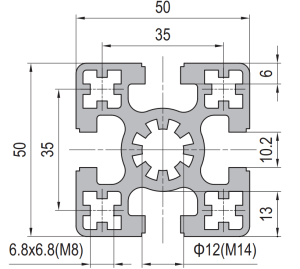 50 x 50 mm Aluminium Profile for Precision and Aerospace Fixtures
50 x 50 mm four-slot aluminium extrusion in 6063-T5 for inspection and assembly fixtures.…
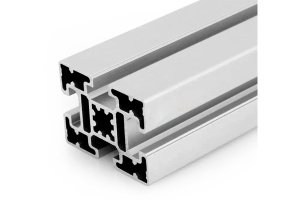 45 x 60 mm Aluminium Profile Solutions for Windows and Facades
45 x 60 mm four-slot aluminium extrusion in 6063-T5 for shopfront, screen and facade…
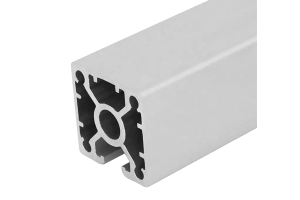 40 x 40 mm Light Aluminium Profile for Mining Equipment
40 x 40 mm four-slot aluminium extrusion in 6063-T5 from 1.30 kg/m, for guards…
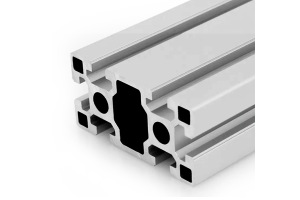 Custom 45 x 90 mm Aluminium Extrusion: Dies, Tooling and Lead Time
45 x 90 mm six-slot aluminium extrusion in 6063-T5 from a China plant. 4.10…
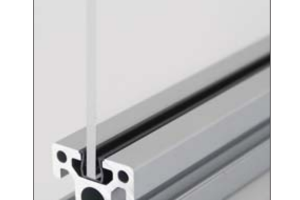 T-Slot Reducing Profile
Reducing insert that narrows a wide T-slot to accept standard nuts and accessories from…
