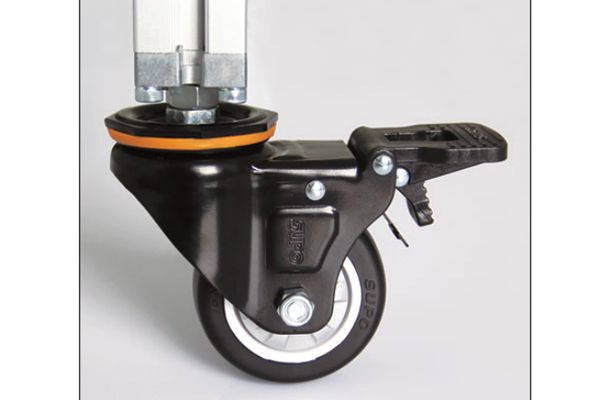
Aluminium Profile Castors
Castors for aluminium profile frames in seven configurations — plate fixed, swivel, braked and thread stem — rated 60 to 300 kg per castor, supplied with the matching base or mounting plate.
| Material | Zinc-plated steel bracket, polyurethane / nylon / rubber wheel |
|---|---|
| Alloy Grade | Aluminium core on heavy-duty wheels |
| Temper | custom |
| Section Size | Wheel Ø50–200 mm |
| Slot | Plate 60x60 / 100x100 mm; thread stem M12 / M16 |
| Length | Overall height 72–245 mm depending on wheel diameter |
| Tolerance | ±0.5 mm on plate hole pattern |
| Surface | Zinc plated / stainless steel |
| MOQ | 100 |
| Lead Time | 15-25 days after deposit |
| Loading Port | Shanghai / Ningbo |
| Supply Ability | 60,000 pcs per month |
| Payment Terms | T/T 30% deposit + 70% before shipment | L/C at sight |
| Trade Terms | FOB | CIF | EXW |
| Certifications | ISO 9001:2015 | ISO 14001 | RoHS | REACH |
Floor elements · Mobile frames
A castor is the load path between a moving aluminium frame and the floor. On a profile system the castor never bolts to the profile directly — it bolts to a base plate or foot mounting plate, and that plate is what spreads a point load into the end face of the extrusion.
We build seven castor configurations on one shared mounting footprint, from 60 kg to 300 kg per castor. Because the plate geometry does not change between them, a trolley can start as a fixed-wheel unit and be upgraded to a braked swivel unit later without touching the frame. Every order ships with the plate bolts, the wheel material data sheet, and a per-castor load calculation for the frame you describe.
The mounting interface decides the castor, not the wheel
Buyers usually start by choosing a wheel diameter. In practice the mounting interface is the decision that is expensive to reverse. A plate-mounted castor needs a flat, drilled surface with enough bolt spacing to resist the overturning moment; a thread-stem castor needs a tapped hole and only works where the leg ends in a solid block rather than an open profile slot.
Both types are supplied here on the same plate and stem standards, so the choice comes down to how the leg is built rather than to availability. If the leg is a standard 40 or 45 series profile, the plate route through a foot mounting plate is almost always the simpler one.
| Configuration | Wheel Ø | Load per castor | Where it is used |
|---|---|---|---|
| Plate fixed | 50–100 mm | 80–120 kg | Two wheels on one end of a trolley, keeping it tracking straight |
| Plate fixed, heavy | 100–150 mm | 150–300 kg | Heavy gantries and tool cabinets that are pushed, not steered |
| Plate swivel | 50–125 mm | 60–150 kg | The default steering end of a mobile workstation |
| Plate swivel, braked | 50–125 mm | 60–150 kg | Any frame that must lock in position while work is carried out |
| Plate swivel, heavy | 125–200 mm | 150–300 kg | Mobile machine bases, weld tables, heavy assembly fixtures |
| Thread stem swivel | 50–100 mm | 60–120 kg | Legs that end in a tapped block or a threaded insert |
| Thread stem swivel, braked | 50–100 mm | 60–120 kg | Adjustable-height mobile frames with locking requirement |
Reading a castor rating the way a buyer should
The number printed on a castor is a static laboratory rating. What a frame actually sees is lower, and the gap is where most mobile frames fail. Three corrections matter.
- Use three castors, not four, in the calculation. Floors are never perfectly flat, so on a four-castor frame one wheel usually carries little or no load while the diagonally opposite one carries double. Designing on the assumption that three castors share the total weight is the standard safe rule.
- Derate for speed. A rating quoted at walking pace falls by roughly a third once the trolley is pushed at speed over an expansion joint, because the impact is dynamic rather than static.
- Check the swivel offset. The distance from the swivel axis to the wheel centre creates the trailing action that lets the castor steer. A larger offset steers more easily but raises the frame slightly and increases the overturning moment on the plate.
Practical point: if you tell us the total loaded weight and the number of castors, we will return the rating each castor has to meet — including the three-castor derating — before you commit to a wheel size. It takes less time than replacing a collapsed wheel.
Wheel materials and where each one belongs
Matching a castor set to an aluminium frame
- Confirm the leg end A profile that ends open needs a base plate or mounting plate; a leg that ends in a machined block can take a thread stem. This single answer removes half the catalogue.
- Fix the load case Total loaded weight, plus the weight of the frame itself, divided by three. Add the derating for speed if the trolley is pushed rather than positioned.
- Choose the steering layout Two swivel castors on the steering end and two fixed on the trailing end tracks straight. Four swivel castors manoeuvre in any direction but are harder to keep in a straight line.
- Decide the braking requirement If work is carried out on the frame, at least two braked castors are needed — and they should be the two that carry most of the load when it is stationary.
- Confirm the floor Smooth epoxy floors suit polyurethane; rough concrete suits a larger diameter wheel; grated or slotted floors need a wheel wide enough not to drop in.
What we manufacture and what we customise
The castors, plates and stems are produced to our own drawings, and the mounting plate patterns are held as standard tooling. That means the bolt spacing on our castor plate matches our base plate and mounting plate without adaptors, which removes the tolerance stack-up that appears when a castor, a plate and a profile come from three different suppliers.
For OEM programmes we machine the plate pattern to the customer’s own leg geometry, mould or machine the wheel in a specified hardness, and print the customer’s part number and batch code on the plate. Tooling for a custom plate pattern is quoted once and then amortised across the programme.
Frequently asked questions
How many castors should a mobile frame have?
Four is the practical minimum for stability, and six is common on long trolleys to stop the frame sagging in the middle. Whatever the number, size the castors on three of them carrying the whole load, because uneven floors mean one castor is usually unloaded.
Do I need a base plate to fit a castor to a profile?
For a plate-mounted castor, yes. The plate spreads the load into the end face of the extrusion and provides the bolt pattern. A thread-stem castor can go directly into a tapped end, but only where the leg end is solid enough to take the thread.
Which castors should be braked?
Braked castors should be the pair that carries the load when the frame is stationary, which is normally the two swivel castors. On a frame where work is carried out at height, brake all four and add a floor lock for the final hold.
Can the castors be supplied with the frame as a kit?
Yes. We supply cut, machined and marked profile members together with the base plates, castors and fasteners, bagged by assembly. That is the usual route for OEM trolley and workstation programmes, and it removes a second supplier from the tolerance chain.
What floor will the wheels damage?
Polyurethane and rubber wheels are safe on epoxy, vinyl and painted floors. Nylon and cast iron can mark softer finishes and are normally specified for concrete or steel-track installations.
Can you produce a custom castor plate for our leg?
Yes. Send the leg end geometry and the load case and we will quote a custom plate pattern, including the tooling, with the amortised unit price for your expected volume.
Send us the frame and we will size the castors
Tell us the loaded weight, the number of castors and the leg end detail. We will return the rating each castor has to meet, the plate pattern that fits your profile, and FOB pricing within one working day.
Request a QuoteRelated Products
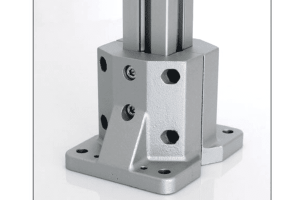 Aluminium Profile Base Plate
Drilled base plate bolted to the end of an aluminium profile leg to spread…
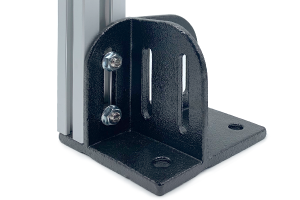 Base Plate 40×80 with Gasket
Rectangular base plate for 40 × 80 mm profiles with a full-perimeter EPDM gasket…
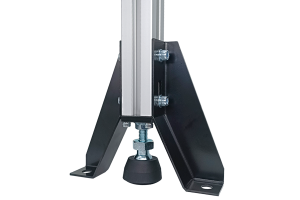 Base Angle Bracket
Gusseted angle bracket that braces the corner between a profile leg and the base,…
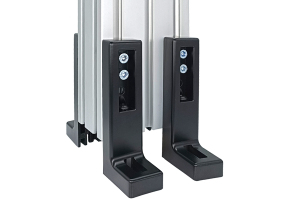 L-Base Corner Bracket
Unequal-leg L bracket that lets a profile leg stand on the floor, takes the…
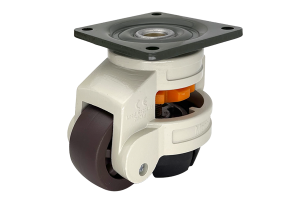 Levelling Castor
Combined castor and levelling foot: move the frame on the wheel, then wind the…
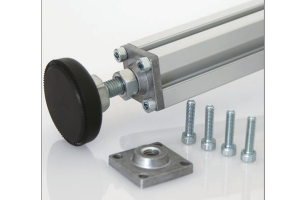 Foot Mounting Plate
Adapter plate bolted to the end of a profile leg that presents a standard…
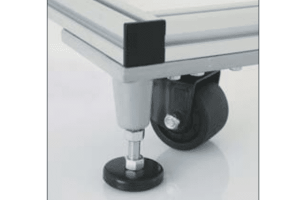 Foot and Castor Components
Spare and replacement components for foot and castor installations — pads, stems, locking nuts,…
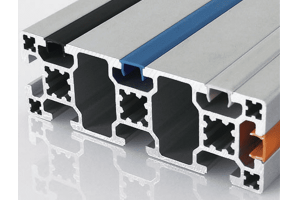 T-Slot Cover Profile
Snap-in T-slot cover strip that closes the open slot on aluminium framing profiles, giving…
