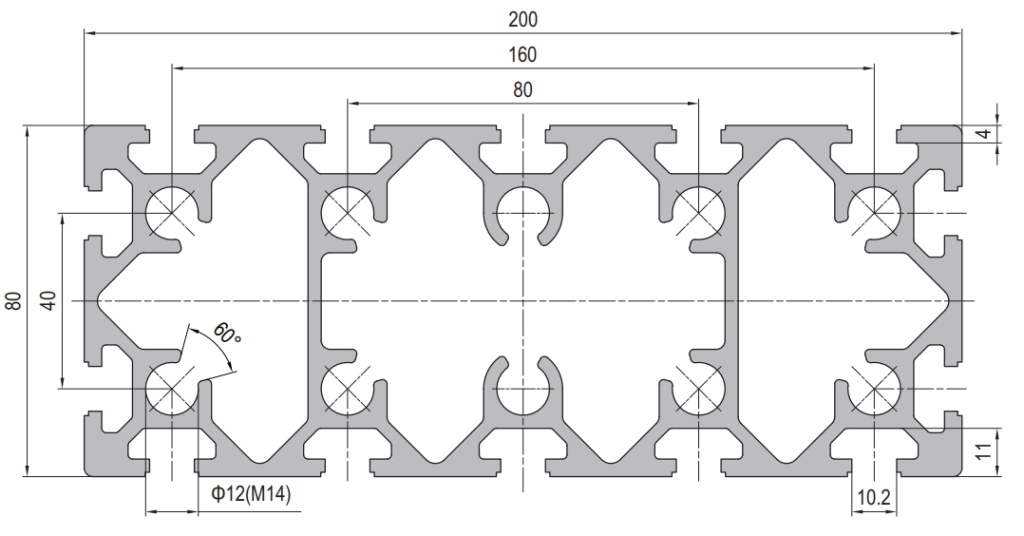
PG40 200 x 80 mm Fourteen Slot Aluminium Strut Profile Large Section Beam
A 200 x 80 mm fourteen slot PG40 aluminium strut profile at about 7.80 kg/m. A 6 m bar is about 46.8 kg, so lifting points, joint seams and pre-drilled hole patterns decide whether this section works.
| Material | Aluminium |
|---|---|
| Alloy Grade | 6063-T5 |
| Temper | T5 |
| Section Size | 200 x 80 mm |
| Slot | 14 x 10.2 mm groove, 8 mm mouth, 40 mm pitch, outer pair 160 mm apart, M8 |
| Length | 6 m stock, cut to drawing to +/-0.5 mm |
| Tolerance | EN 755-9 / GB/T 6892, wall +/-0.15 mm |
| Surface | Mill finish / clear anodised / black anodised |
| MOQ | 150 m |
| Lead Time | Typically 22 to 32 days after deposit for mill finish |
| Loading Port | Shanghai, Ningbo, Qingdao |
| Supply Ability | Extrusion, cutting, machining and anodising in house |
| Payment Terms | T/T 30 per cent deposit, balance against copy of bill of lading; L/C at sight for larger orders |
| Trade Terms | FOB, CIF, CFR, EXW |
| Certifications | ISO 9001:2015, EN 755-9, RoHS and REACH declarations |
01What is the 200 x 80 mm fourteen slot profile?
What is it for?
The largest standard section in the range. Press and machine bases, large gantry beams, heavy conveyor beds, shipyard and rail fixtures, and structures that would otherwise be welded steel fabrication. It gives you a 200 mm wide mounting face and a member stiff enough to span where a smaller section would not.
How heavy is it, really?
About 7.80 kg/m, so a 6 m stock length is roughly 46.8 kg. That is the single fact that shapes the whole job: how it is delivered, how it is lifted, how many people are on the crew, and whether a joint can be made at bench height or has to be made in situ.
How are the fourteen slots arranged?
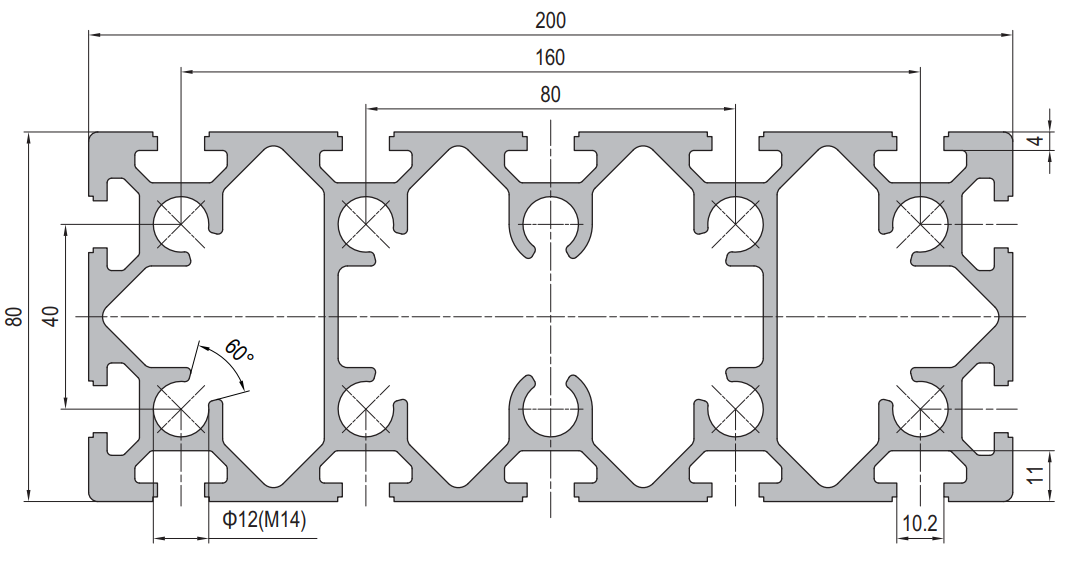
Five on each 200 mm face and two on each 80 mm face, at 40 mm centres, with the outer pair on the wide faces 160 mm apart. That spread is what makes the section useful as a base: a machine can be bolted down across 160 mm without a fabricated plate.
02Section data
| Item | Value | Note |
|---|---|---|
| Envelope | 200 x 80 mm | large rectangular section |
| Slots | 14 | 10.2 mm groove, 8 mm mouth |
| Slot layout | 5 per 200 mm face, 2 per 80 mm face | as drawn |
| Slot pitch | 40 mm | the 40 series module |
| Outer pair | 160 mm apart | across the wide face |
| Fastener | M8 | 40 series slot nuts |
| Weight | approx. 7.80 kg/m | a 6 m bar is about 46.8 kg |
| Alloy | 6063-T5 | EN AW-6063 |
| Standard | EN 755-9 / GB/T 6892 | wall tolerance +/-0.15 mm |
| Length | 6 m stock | cut to drawing to +/-0.5 mm |
Everything below follows from 46.8 kg per bar. Not from the strength, not from the slot count: from the weight. Plan the lifting before you plan the joints.
03Lifting: what 46.8 kg actually means on site
A 46.8 kg bar is not heavy for a crane and it is far too heavy to handle casually. It sits in the awkward band where a lifting plan is needed but is often skipped, and that is where the damage happens.
Three things go wrong. The bar is picked up at one point, which bends it under its own weight and puts a permanent set into a section that was flat when it left the factory. It is set down on an edge, which twists it. And it is dragged across a floor or a bench, which damages the slot lips on the face that matters most.
The rules are simple and they cost nothing: lift at two points roughly a quarter of the length in from each end, use soft slings rather than chain or wire, set it down flat on continuous bearers, and never drag it. If it arrives with a set in it, no amount of design margin recovers that.
| Task | Two people | With lifting gear |
|---|---|---|
| Short cut lengths, under 1.5 m | yes, about 12 kg each | not needed |
| 1.5 to 3 m lengths | yes, with care | preferred |
| A full 6 m bar, 46.8 kg | not recommended | required |
| Positioning into an assembly | awkward and risky | required |
| Overhead or above bench height | no | required |
Note the middle row. Two people can carry a 3 m length, but positioning it into an assembly is a different job from carrying it, and that is when it gets dropped or twisted. Have the gear available even on a small job.
04Joint seams: where two lengths meet
Above about 6 m the section has to be joined, and the joint is the part of a large section job that gets underestimated. A seam between two lengths of a 200 mm member is a structural joint, not a trim detail, and it has to be designed.
The three things a seam has to do: carry the bending moment across the joint, keep the two faces flush so anything mounted across the seam stays flat, and stay tight under vibration rather than working loose over time.
The slots give you the first two if the joint is designed to use them. A connection that spans the outer pair, 160 mm apart, resists moment the same way an offset joint does on a smaller section. What the slots do not give you is the third: a slotted joint on a member this size will work loose unless it is designed with that in mind, which means either a mechanical lock, a through connection, or a joint that is inspected and re-torqued.
| Joint method | Carries moment | Keeps faces flush | Stays tight |
|---|---|---|---|
| Slot nuts in the outer pair | yes, over 160 mm | yes if fitted carefully | needs re-torquing |
| Through bolts across the section | yes | yes | yes, if preloaded |
| Internal splice plate | yes | yes | yes, the usual choice |
| External gusset plates | yes | no, they stand proud | yes |
| Welded | yes | yes | yes, but it is a fabrication job |
For most buyers the internal splice plate is the right answer: it carries the moment, it keeps both faces flush so equipment can still be bolted across the seam, and it stays tight. Welding aluminium of this size is a fabrication job with its own procedure qualification and it anneals the heat affected zone, so it is rarely worth it on a bolted framing system.
05Can it be machined on site?
Machine it in the workshop
- Drilling and tapping to a drawing: yes, bench height and repeatable
- Milling a face flat or to a step: yes, on a bed that supports it
- Cutting to length square and deburred: yes, and it is included
- End machining for a joint: yes, and it is the usual choice
- Anodising after machining: yes, and it covers the cut ends
- Inspection before it ships: yes, dimensional report per batch
Machine it on site
- Drilling and tapping: possible but slow and hard to hold accurately
- Milling: not practical without a machine on site
- Cutting to length: possible with a chop saw, ends will need dressing
- End machining for a joint: possible but accuracy suffers
- Anodising: not possible, cut ends stay bare
- Reworking a mistake: expensive, the section is not a consumable
The recommendation is straightforward: specify every hole and every cut before it ships. On a section at 7.80 kg/m, a misplaced hole is not a scrap bin item, it is a phone call and a delay. Send the cut list with the hole pattern and the lengths arrive machined and deburred.
06Failure modes to design out
| What goes wrong | Why it happens | Design it out by |
|---|---|---|
| Bar arrives with a set in it | it was lifted at one point or stored on two supports | lift at two points, store flat on continuous bearers |
| Seam works loose over time | a slotted joint on a heavy member was not designed to stay tight | use an internal splice plate or a preloaded through connection |
| Seam faces not flush | the joint was made with external plates standing proud | use an internal splice so equipment can bolt across the seam |
| Slot lips damaged before assembly | the section was dragged or landed on an edge | soft slings, set down flat, never drag |
| Misplaced hole becomes a delay | the hole pattern was marked on site rather than drawn | send the cut list and hole drawing with the order |
07What to check before you order
Procurement checklist for the 200 x 80 mm fourteen slot section
- Confirm the weight and the handling plan: about 7.80 kg/m, a 6 m bar is about 46.8 kg, and lifting gear is required for full lengths.
- Confirm the delivery length against site access: a 6 m bar may not get through a door or into a lift.
- Confirm whether the design needs a joint seam, and specify the splice method.
- Confirm the hole pattern and end machining on the drawing, so it ships machined rather than being marked on site.
- Confirm the series: 40 series is a 10.2 mm groove with an 8 mm mouth on a 40 mm pitch.
- Confirm the outer pair spread is what the equipment needs: 160 mm.
- Confirm the finish and the quantity in metres.
08Terms used on this page
- Outer pair
- The two grooves furthest apart on the wide face, here 160 mm apart. It is the fixing spread that lets equipment bolt straight down.
- Splice plate
- A plate inside the section that joins two lengths and carries the bending moment across the seam without standing proud.
- Seam
- The joint between two lengths of section where a run is longer than the stock length.
- Set
- A permanent bend or twist left in a member after it has been handled badly. It cannot be removed.
- Preload
- The tension deliberately put into a bolt so a joint stays tight under vibration rather than working loose.
- Bearers
- Continuous supports under stored lengths, so a heavy section is not left spanning between two points.
09Questions buyers ask
How heavy is it?
About 7.80 kg/m, so a 6 m stock length is roughly 46.8 kg. Lifting gear is required for full lengths.
How are the fourteen slots arranged?
Five on each 200 mm face and two on each 80 mm face, at 40 mm centres, with the outer pair 160 mm apart.
Can two lengths be joined?
Yes. An internal splice plate is the usual method: it carries the moment and keeps both faces flush so equipment can still bolt across the seam.
Can it be drilled on site?
It can, but it is slow and accuracy suffers. On a section this size a misplaced hole is a delay, so specify the hole pattern before it ships.
Is 40 series compatible with 45 series?
No. The mouth is 8 mm against 10 mm and the pitch is 40 mm against 45 mm, so the slot nuts and brackets do not interchange.
What is the delivery length?
6 m stock, cut to drawing to +/-0.5 mm. Check site access before ordering full lengths.
What we need to quote this section
- The section reference and the series, stated explicitly.
- The cut list with lengths and end preparation.
- The hole pattern and any milling, dimensioned on a drawing.
- Whether the design needs a splice and how many seams.
- The delivery constraints: access, length, and whether lifting gear is available.
- The finish and the quantity in metres.
Quotations are broken out into extrusion, cutting, machining, finish and packing, so you can see which step is driving the cost on a large section order. Browse the full aluminium profile catalogue and the 40 series aluminium profiles range for related sections.
Specifying the largest section in the range?
Send the cut list, the hole pattern and the delivery constraints. We quote extrusion, machining, finish and packing as separate lines.
Request a quotationRelated Products
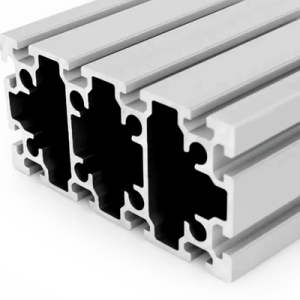 PG45 180 x 90 mm Twelve Slot Aluminium Strut Profile Heavy Duty Column
A 180 x 90 mm twelve slot PG45 aluminium strut profile at about 9.50…
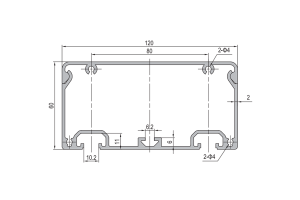 Aluminium Conduit Profile 120×60 mm Cable Duct Extrusion 2 mm Wall for Machine Wiring
120 x 60 mm aluminium conduit profile duct in 6063-T5 with a 2 mm…
 Aluminium Conduit Profile 160×80 mm Cable Duct Extrusion with Two Sided Mounting for Machine Frames
160 x 80 mm aluminium conduit profile duct in 6063-T5 with a 2 mm…
 Aluminium Conduit Profile 200×80 mm Cable Duct Extrusion 2.5 mm Wall for Long Production Line Runs
200 x 80 mm aluminium conduit profile duct in 6063-T5 with a 2.5 mm…
 Agricultural Framework Aluminium Profile System 45×45 mm T-Slot for Shelving and Storage Racks
A bolted 45 x 45 mm T-slot aluminium profile framing system for agricultural shelving,…
 Assembly Line Workstation Aluminium Profile Frame 40×40 mm T-Slot Workbench Structure
A re-configurable assembly workstation frame in 40 x 40 mm T-slot aluminium profile with…
 Conveyor System Aluminium Profile Extrusion Frame 45×60 mm for Belt and Roller Lines
A bolted conveyor frame in 45 x 60 mm T-slot aluminium profile with 45…
 PG20 60 x 20 mm Eight Slot Aluminium Strut Profile Wide Miniature Rail
60 x 20 mm eight-slot aluminium strut profile with 6.2 mm grooves on a…
