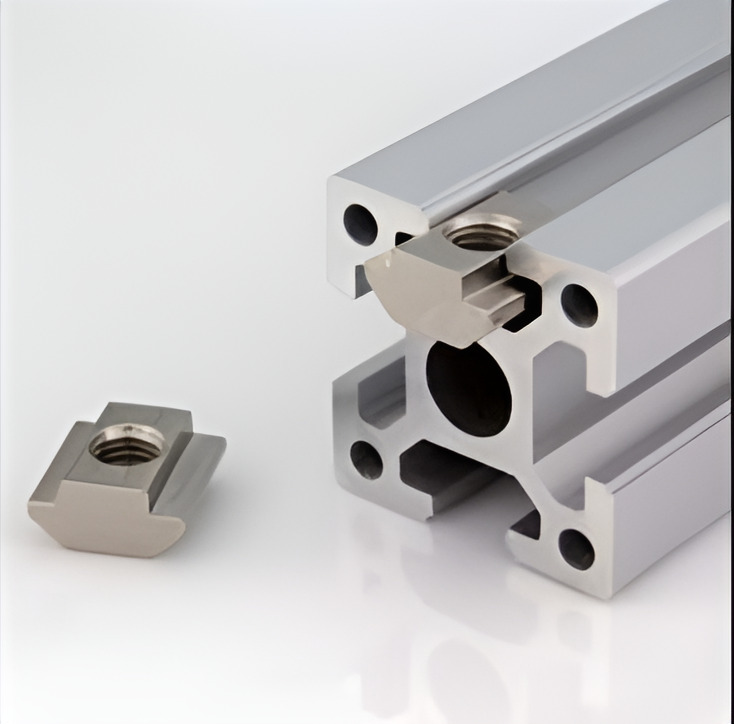
Pre-set T-Slot Nut for 8 mm Aluminium Profiles M5 M6 M8
Pre-set T-slot nut with anti-drop spring tab for 20, 30 and 40 series aluminium profiles. M5, M6 and M8 thread sizes. Placed before assembly, bolted from outside.
| Material | Carbon steel |
|---|---|
| Alloy Grade | Carbon steel C1035, spring steel 65Mn |
| Temper | custom |
| Section Size | n/a (piece part) |
| Slot | Fits 6 mm, 8 mm and 10 mm groove widths (20/30/40 series) |
| Length | n/a (piece part, sold per nut) |
| Tolerance | Thread 6H, body width +/-0.1 mm |
| Surface | Zinc plated / stainless steel A2 or A4 |
| MOQ | No MOQ for stock sizes; 500 pieces for custom sizes |
| Lead Time | Stocked sizes ship in 2 to 3 days; custom sizes about 2 weeks |
| Loading Port | Shanghai, Ningbo, Qingdao |
| Supply Ability | Stocked carbon steel sizes in volume; stainless and custom sizes produced to order |
| Payment Terms | T/T 30 per cent deposit, balance against copy of B/L; L/C at sight for larger orders |
| Trade Terms | FOB, CIF, CFR, EXW |
| Certifications | RoHS, REACH declarations; material certificate for stainless steel on request |
01What is a pre-set T-slot nut?
How does a pre-set nut differ from a subsequent nut?
A pre-set nut is dropped into the T-slot groove before the profiles are assembled into a frame. Once the frame is built, you simply thread the bolt in from the outside and tighten. A subsequent nut, by contrast, is slid into the groove from the end face of an already-assembled profile, which means the profile must have an open end. The pre-set approach is faster at final assembly but requires planning the nut placement upfront.
Why would you choose pre-set over subsequent?
When you know exactly where every bolt will go before you start building. Pre-set nuts are the standard choice for production jigs and fixtures where the same frame is built repeatedly: the assembler drops nuts at marked positions, connects the profiles, then bolts on brackets, panels and sensors without reaching into the slot. Subsequent nuts are the rescue part for when you forgot a nut or need to add something later.
Does the anti-drop tab really hold the nut in place?
Yes, but only against gravity and light vibration during assembly. The spring tab presses against the slot lip and stops the nut from falling out of the 8 mm or 10 mm mouth when the profile is rotated or moved. Once the bolt is tightened, the tab plays no structural role — the clamping force is carried by the nut body bearing against the back of the groove.
02Pre-set vs subsequent: the assembly logic
The choice between pre-set and subsequent nuts is not about strength — both types seat the same way behind the groove lip and carry the same pull-out load once bolted. The difference is when the nut enters the slot, and that determines the entire assembly sequence.
With pre-set nuts, you place every nut before connecting the profiles. That means you must know the final position of every bracket, panel and fitting before you start building. If you forget a nut, you have to disassemble the joint to add it — or switch to a subsequent nut for that one position.
With subsequent nuts, you build the frame first, then slide nuts in from the open ends. That is more flexible but slower: each nut has to be pushed along the slot to its position, and the profile must have an unobstructed end.
| Property | Pre-set nut | Subsequent nut |
|---|---|---|
| When placed | before assembly | after assembly |
| Entry point | slot mouth (top) | slot end (face) |
| Assembly speed | fast at final bolt-up | slower, nut must slide |
| Planning required | high — all positions known upfront | low — add as needed |
| Forgotten nut fix | disassemble joint | slide in from end |
| Pull-out strength | same as subsequent | same as pre-set |
| Cost per piece | slightly higher (tab) | slightly lower |
03Thread and groove compatibility
Pre-set nuts are available in three thread sizes to match the three most common aluminium profile series. The groove width determines the nut body width, and the thread determines the tapped hole in the nut. Matching the nut to the series is critical: a 30 series nut will not seat properly in a 20 series groove, and a 20 series nut will slide sideways in a 40 series groove.
| Series | Groove width | Nut thread | Bolt size | Mouth width |
|---|---|---|---|---|
| 20 series | 6 mm | M5 | M5 x 8 / 10 / 12 | 4 mm |
| 30 series | 8 mm | M6 | M6 x 10 / 12 / 16 | 5.5 mm |
| 40 series | 10 mm | M8 | M8 x 12 / 16 / 20 | 8 mm |
| 30 series | 8 mm | M5 (reducer) | M5 x 10 / 12 | 5.5 mm |
| 40 series | 10 mm | M6 (reducer) | M6 x 12 / 16 | 8 mm |
The M5 in a 30 series groove and M6 in a 40 series groove are reducer configurations: the nut body fits the wider groove but the thread is smaller than the series default. This is used when a lighter bolt is sufficient or when matching an existing M5 or M6 fitting.
04The anti-drop fool-proof design
The defining feature of a pre-set nut is the spring tab on the nut body. When the nut is pressed into the groove from the mouth, the tab flexes inward. Once the nut clears the slot lip and seats behind it, the tab springs back out and hooks against the lip. This prevents the nut from falling back out through the mouth when the profile is handled, rotated or bumped during assembly.
The tab is a convenience feature, not a structural one. Before the bolt is installed, the nut is held in place only by the tab and by friction with the slot walls. After the bolt is tightened, the clamping force pushes the nut body against the back wall of the groove, and the tab is irrelevant to the load path.
- Tab material: spring steel, hardened to HRC 42 to 48, so it flexes without taking a set after repeated insertions.
- Tab cycle life: rated for about 50 insertion cycles before the spring force drops below the holding threshold. In practice, nuts are rarely inserted and removed more than a few times.
- Tab failure mode: if the tab breaks off, the nut becomes a subsequent nut — it still works once bolted, but will fall out of the mouth if the bolt is removed.
- Fool-proof geometry: the tab only engages when the nut is inserted in the correct orientation. Inserting the nut upside down will not engage the tab, making the orientation error obvious.
05Assembly time comparison
The time saving from pre-set nuts is real but only materialises at a certain frame complexity. For a simple two-profile joint with one bolt, pre-set and subsequent nuts take roughly the same time. The advantage appears when a frame has many fittings on the same profile, because pre-set nuts are all placed in one pass before the profiles are connected.
The table below is based on timed assembly of a 1200 x 800 mm workbench frame with 8 brackets and 2 panel mounts, built by an experienced assembler with all parts pre-cut and pre-positioned.
| Step | Pre-set nuts (8 min) | Subsequent nuts (14 min) |
|---|---|---|
| Place nuts in slots | 2 min (all at once) | n/a |
| Connect profiles | 3 min | 3 min |
| Position nuts at marks | n/a (already placed) | 5 min |
| Insert and tighten bolts | 3 min | 6 min |
| Total | 8 min | 14 min |
The 6 minute saving is for one frame. For a production run of 50 identical frames, pre-set nuts save 5 hours of assembly time. For a one-off prototype with uncertain fitting positions, subsequent nuts are still the better choice because they allow late additions.
06When to choose pre-set, when to choose subsequent
Choose pre-set nuts
- Production runs of identical frames where nut positions are known
- Frames with many fittings per profile (8 or more per metre)
- Jigs and fixtures that will be assembled and disassembled repeatedly
- Frames where the end of the profile will be capped or sealed
- Automated or semi-automated assembly stations where nut placement is done by a jig
Choose subsequent nuts
- Prototypes where fitting positions may change during build
- Frames where only a few fittings are needed per profile
- Retrofit or modification of an existing frame
- Frames where the profile ends are accessible for sliding nuts in
- When you forgot to place a pre-set nut and need a rescue part
07What goes wrong and how to design it out
| What goes wrong | Why it happens | Design it out by |
|---|---|---|
| Nut falls out before bolt is installed | spring tab broken or fatigued from repeated insertion | use a new nut; do not reuse pre-set nuts more than 10 times |
| Nut at wrong position when frame is assembled | nut shifted along slot during profile handling | use a positioning clip or tape to hold nut at mark until bolted |
| Cannot insert bolt — nut threads misaligned | nut rotated in slot so tapped hole is not perpendicular | pre-set nuts with a flat side stay oriented; round nuts may rotate |
| Nut too tight in groove, will not seat | groove lip has anodising build-up or burr from cutting | deburr the slot mouth and check groove width with a gauge before inserting |
| Tab engages but nut still slides along slot | tab prevents drop-out but not sliding; friction alone holds position | this is expected — tighten the bolt to lock the nut in position |
08What to specify when ordering
Procurement checklist for pre-set T-slot nuts
- Confirm the profile series: 20 (6 mm groove), 30 (8 mm) or 40 (10 mm). The nut body width is matched to the groove.
- Confirm the thread size: M5, M6 or M8. If using a reducer configuration (smaller thread in a larger series groove), call it out explicitly.
- Confirm the bolt length you will use. Pre-set nuts have a fixed body height; the bolt must be long enough to fully engage the thread after passing through the bracket and profile.
- Confirm the surface finish: zinc plated is standard for indoor use; stainless steel is available for cleanroom or food-grade applications.
- Confirm the quantity. Nuts are priced per piece, with price breaks at 100, 500 and 1000 pieces.
- If the frame uses mixed series (e.g. 30 series cross beams on 40 series legs), specify the nut series for each joint separately.
09Terms used on this page
- Pre-set nut
- A T-slot nut placed into the groove before the profiles are assembled. Also called a drop-in nut or a pre-loaded nut.
- Subsequent nut
- A T-slot nut slid into the groove from the end face of an already-assembled profile. Also called a slide-in nut or post-assembly nut.
- Anti-drop tab
- A spring steel tab on the nut body that hooks behind the groove lip, preventing the nut from falling out of the slot mouth before the bolt is installed.
- Groove lip
- The inward-facing edge of the T-slot that the nut hooks behind. The lip width determines the slot mouth, which must be narrower than the nut body.
- Reducer nut
- A nut whose body fits one series groove but whose thread is smaller than the series default. For example, an M5 thread in a 30 series (8 mm) groove.
- Pull-out force
- The axial force required to pull the nut out of the groove. Determined by the nut body engagement with the groove lip, not by the thread size.
10Questions buyers ask
Can I reuse pre-set nuts after disassembling a frame?
Yes, but the spring tab loses force with each cycle. After about 10 insertion cycles, the tab may not hold the nut in place before the bolt is installed. The nut still works once bolted, but it behaves like a subsequent nut during assembly.
Are pre-set nuts stronger than subsequent nuts?
No. Once the bolt is tightened, both types seat the same way behind the groove lip. The pull-out force is determined by the nut body engagement and the groove wall strength, not by how the nut entered the slot. The difference is in assembly convenience, not in load capacity.
Can I use pre-set nuts in any series of aluminium profile?
Pre-set nuts are made for 20, 30 and 40 series grooves. Each nut body width is matched to a specific groove width. A 30 series nut will not fit a 20 series groove, and a 20 series nut will be loose in a 40 series groove. Always match the nut series to the profile series.
What material are pre-set nuts made from?
Carbon steel with zinc plating is the standard for indoor use. Stainless steel (A2 or A4) is available for corrosive environments, cleanrooms and food-grade applications. The spring tab on stainless nuts is made from the same material, hardened to achieve the necessary spring force.
What is the minimum order quantity?
Nuts are stocked items with no minimum order. Price breaks apply at 100, 500 and 1000 pieces. For custom thread sizes or stainless steel, the MOQ is typically 500 pieces.
Do you supply the bolts as well?
Yes. We supply the matching T-slot bolts in M5, M6 and M8, in lengths from 8 mm to 30 mm. When ordering nuts and bolts together, specify the thread, the bolt length and the series for each joint.
What we need to quote pre-set T-slot nuts
- The profile series (20, 30 or 40) and the groove width for each joint location.
- The thread size: M5, M6 or M8. Call out reducer configurations explicitly.
- The material: carbon steel zinc plated, or stainless steel A2 or A4.
- The quantity per size, with the total across all sizes.
- Whether you need matching bolts and at what lengths.
- Any certification requirement: RoHS, REACH, or material certificate for stainless steel.
Send those six items and the quotation comes back with the unit price at each quantity break, the material surcharge for stainless if applicable, and the lead time for stocked and non-stocked sizes. Browse the full connecting elements range for related fasteners.
Need pre-set nuts quoted for your frame build?
Send the series, thread size, material and quantity. We quote unit price at quantity breaks and can supply matching bolts in the same shipment.
Request a quotationRelated Products
 Square Nut for 8 mm T-Slot Aluminium Profiles M5 M6 M8
Square T-slot nut with four flat sides for 30 and 40 series aluminium profiles.…
 Subsequent Nut for 8 mm T-Slot Aluminium Profiles M5 M6 M8
Subsequent T-slot nut for 30 and 40 series aluminium profiles. M5, M6 and M8…
 Anti-torsion Subsequent Nut for 8 mm T-Slot Aluminium Profiles
Anti-torsion subsequent T-slot nut with twin wings for 30 and 40 series aluminium profiles.…
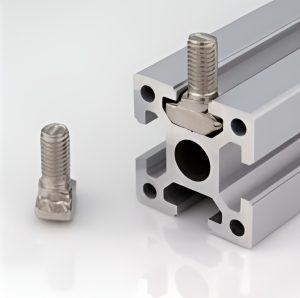 T-Bolt for 8 mm T-Slot Aluminium Profiles M6 M8 M10
T-bolt with integral T-head for 20, 30 and 40 series aluminium profiles. M5, M6,…
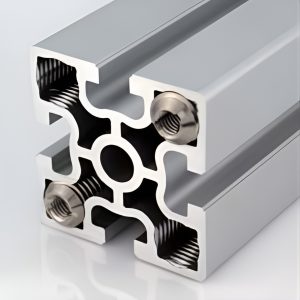 Hole Reducer Bolt for 8 mm T-Slot Aluminium Profiles
Hole reducer bolt with stepped M8 to M6 thread for 30 and 40 series…
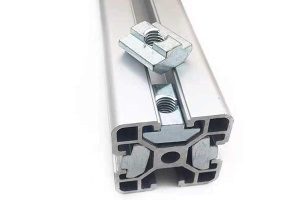 T-Nut and Bolt Set Aluminium Profile Fastener Kit M5 M6 M8 20-40 mm T-Slot Hardware
Matched T-nut, bolt and washer set for aluminium profile frames in M5, M6 and…
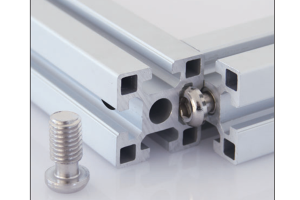 Screw Type Anchor Connector Aluminium Profile Hidden Joint Fastener 30 40 mm Series
Screw type anchor connector for aluminium profile giving a hidden joint with no visible…
 Miter Connector Model P 45 Degree Corner Joint for 30 and 40 mm Aluminium Profiles
Miter connector Model P, a hidden 45 degree corner joint for 30 and 40…
