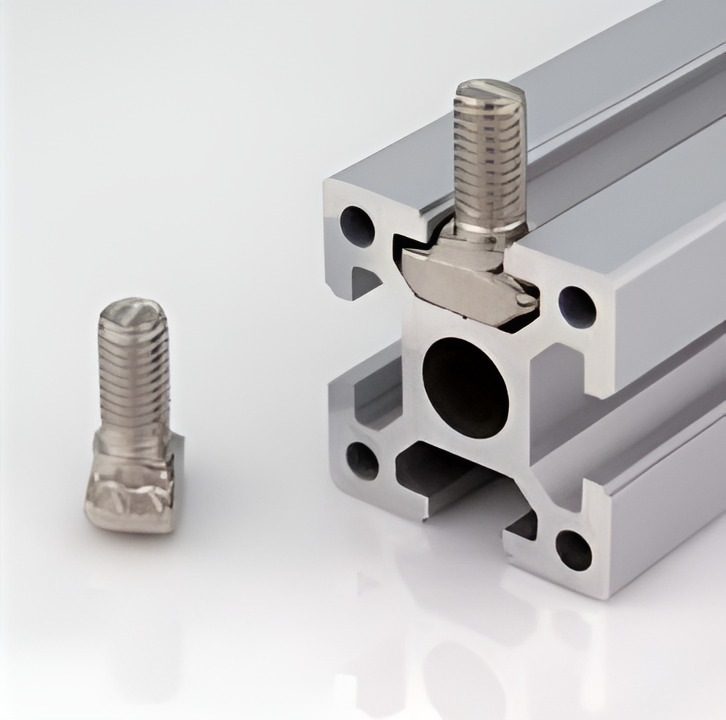
T-Bolt for 8 mm T-Slot Aluminium Profiles M6 M8 M10
T-bolt with integral T-head for 20, 30 and 40 series aluminium profiles. M5, M6, M8 and M10 threads. Replaces separate T-nut, faster assembly. Carbon steel or stainless steel.
| Material | Carbon steel |
|---|---|
| Alloy Grade | Carbon steel grade 8.8 / 10.9, stainless A2 / A4 |
| Temper | custom |
| Section Size | n/a (piece part) |
| Slot | Fits 6 mm, 8 mm and 10 mm groove widths (20/30/40 series) |
| Length | Stock 8-30 mm; custom 6-50 mm (6-60 mm M10) |
| Tolerance | Thread 6g, head width +/-0.1 mm, head thickness +/-0.05 mm |
| Surface | Zinc plated / stainless steel A2 or A4 |
| MOQ | No MOQ for stock sizes; 500 pieces for custom sizes |
| Lead Time | Stocked sizes ship in 2 to 3 days; custom sizes about 2 weeks |
| Loading Port | Shanghai, Ningbo, Qingdao |
| Supply Ability | Stocked carbon steel sizes in volume; stainless and custom sizes produced to order |
| Payment Terms | T/T 30 per cent deposit, balance against copy of B/L; L/C at sight for larger orders |
| Trade Terms | FOB, CIF, CFR, EXW |
| Certifications | RoHS, REACH, material certificate for stainless steel, bolt grade test report |
01What is a T-bolt?
How is a T-bolt different from a bolt-plus-nut combination?
A T-bolt has a flat T-shaped head formed integrally with the bolt shank. The head slides into the T-slot groove and bears against the slot lip from behind, exactly like a T-nut would. The difference is that there is no separate nut to place, slide or drop into the groove — the head is already on the bolt. You slide the T-bolt into the slot, position it, put the bracket on and tighten the single fastener.
When is a T-bolt better than a bolt plus a separate nut?
When assembly speed is the priority and the fitting position is known. A T-bolt saves one handling step (placing or sliding the nut) per joint. On a frame with 20 joints, that saves about 3 minutes. The trade-off is that the T-bolt head occupies slot depth, so it may not fit in the thinnest-walled profiles, and the head cannot be repositioned without sliding it along the groove like a nut.
Can you still use a nut if you want to?
Yes, a T-bolt works with a separate T-nut too, but that defeats the purpose. The T-bolt head and a T-nut would both be behind the groove lip, and the bolt would pass through both. The standard use is T-bolt head bearing on the groove, with the bracket on the outside and the nut on top of the bracket.
02T-bolt vs bolt-plus-nut: the assembly logic
The T-bolt is a one-piece fastener that combines the functions of bolt and nut. The T-head plays the role of the nut — it bears against the back of the groove lip and resists the clamping force. The bolt shank passes through the bracket, panel or fitting, and a standard hex nut on the outside provides the clamping.
This is different from a bolt-plus-nut combination, where the T-nut is inside the groove and the bolt passes through the bracket from outside. In that case, the T-nut bears on the groove and the bolt head is on the outside. The clamping force path is the same, but the handling is different: two pieces (nut plus bolt) instead of one piece (T-bolt plus plain nut).
| Property | T-bolt + plain nut | Plain bolt + T-nut |
|---|---|---|
| Pieces per joint | 2 (T-bolt, hex nut) | 2 (bolt, T-nut) |
| Nut placement in slot | not needed — head is integral | must place or slide T-nut |
| Assembly speed | faster (no nut handling) | slower (nut must be positioned) |
| Head in slot | T-bolt head (flat, fixed) | T-nut body (can slide along slot) |
| Head on outside | hex nut (can be positioned freely) | bolt head (fixed by bolt length) |
| Slot depth used | T-head thickness (2.5 to 4.5 mm) | T-nut body height (4 to 6 mm) |
| Repositioning | must slide T-bolt along groove | must slide T-nut along groove |
In practice, both approaches require sliding a component along the groove. The T-bolt saves the step of placing the nut separately, but the T-head still has to be slid to the correct position. The saving is real but smaller than it first appears.
03T-head thickness and slot depth
The T-head has a specific thickness that must fit within the groove depth. The groove depth is the distance from the slot mouth to the back wall of the profile. If the T-head is thicker than the groove depth, it will not seat and the bolt cannot be tightened.
The table below shows the T-head thickness for each series and the minimum groove depth required. The groove depth is set by the profile design and cannot be changed, so the T-bolt must be matched to the series.
| Series | Groove width | Groove depth | T-head thickness | Head clearance |
|---|---|---|---|---|
| 20 series | 6 mm | 7.3 mm | 2.5 mm | 4.8 mm |
| 30 series | 8 mm | 9.5 mm | 3.5 mm | 6.0 mm |
| 40 series | 10 mm | 12.0 mm | 4.5 mm | 7.5 mm |
Head clearance is the remaining groove depth after the T-head seats. This space is available for cable routing, cover strip legs or other accessories that sit in the groove behind the T-bolt. A thicker T-head (e.g. a 40 series bolt in a 30 series groove) will not seat because the head is thicker than the groove depth.
04Thread sizes and bolt lengths
T-bolts are available in three thread sizes matched to the three standard series. The bolt length determines how thick a bracket or panel stack can be clamped. Standard lengths are stocked; custom lengths are cut and threaded to order.
| Series | Thread | Stock lengths (mm) | Custom range (mm) |
|---|---|---|---|
| 20 series | M5 | 8, 10, 12, 15, 20 | 6 to 30 |
| 30 series | M6 | 10, 12, 16, 20, 25 | 8 to 40 |
| 40 series | M8 | 12, 16, 20, 25, 30 | 10 to 50 |
| 40 series | M10 (on request) | 16, 20, 25, 30 | 12 to 60 |
M10 T-bolts are available for 40 series on request but are not stocked. The 40 series groove is wide enough for the M10 T-head, but the bolt torque is limited by the groove wall strength to 35 Nm, not by the bolt grade.
05Bolt grades and torque limits
T-bolts are available in two grades: 8.8 (medium carbon, quenched and tempered) and 10.9 (alloy steel, quenched and tempered). The grade determines the bolt’s tensile strength and the maximum recommended torque. However, the actual torque limit is usually set by the groove wall strength, not the bolt grade.
On a 40 series profile, an M8 grade 8.8 T-bolt can withstand 25 Nm of torque, but the groove wall will start to deform at about 30 Nm. Using a 10.9 bolt does not increase the usable torque — it just means the bolt will not break before the groove deforms.
| Thread | Grade 8.8 max (Nm) | Grade 10.9 max (Nm) | Groove limit (Nm) |
|---|---|---|---|
| M5 (20s) | 4.5 | 6.0 | 5.0 |
| M6 (30s) | 9.0 | 12.0 | 10.0 |
| M8 (40s) | 22.0 | 30.0 | 25.0 |
| M10 (40s) | 35.0 | 49.0 | 35.0 |
The groove limit column shows the torque at which the groove wall begins to deform. This is the practical maximum torque, regardless of bolt grade. For applications that need higher clamping force, use the centre bore through-bolt instead of the T-slot.
06When to choose T-bolts over bolt-plus-nut
Choose T-bolts
- Production frames with many joints — the assembly time saving multiplies
- Frames where the fitting position is known before the bolt is inserted
- Automated or jig-guided assembly where placing a separate nut is awkward
- Joints where the outside of the bracket needs a hex nut (e.g. levelling feet with a threaded post)
- When you want to minimise parts count in the fastener kit
Choose bolt-plus-nut
- Prototypes where fitting positions may change
- Joints where the nut needs to be positioned after the bracket is in place
- Frames where the groove depth is shallow and the T-head does not seat
- Retrofit work on existing frames that already have T-nuts installed
- When you need higher torque than the groove wall allows — use through-bolt in the centre bore
07Failure modes to design out
| What goes wrong | Why it happens | Design it out by |
|---|---|---|
| T-head does not seat in groove | head thickness exceeds groove depth (wrong series match) | match T-bolt series to profile series; check head thickness vs groove depth |
| T-bolt slides in groove under load | T-head is narrower than groove width (wrong series match) | use the correct series T-bolt; a 20s T-bolt in a 40s groove will slide |
| Groove wall deforms under torque | bolt torque exceeds groove wall strength | stay within groove limit torque; use centre bore for higher loads |
| Bolt loosens under vibration | T-head does not prevent rotation; only friction holds position | use anti-torsion nut-plus-bolt, or add a spring washer under the hex nut |
| T-head breaks off under lateral load | the head-to-shank junction is the weakest cross section | use grade 10.9 for lateral loads; avoid using T-bolts as shear pins |
08What to specify when ordering
Procurement checklist for T-bolts
- Confirm the profile series: 20 (6 mm), 30 (8 mm) or 40 (10 mm). The T-head width and thickness must match the groove.
- Confirm the thread size: M5, M6 or M8. M10 is available on request for 40 series.
- Confirm the bolt length: the thickness of the bracket, panel or fitting stack, plus the nut and any washers.
- Confirm the bolt grade: 8.8 is standard for most applications; 10.9 for higher strength. Note that groove limit applies regardless of grade.
- Confirm the finish: zinc plated for indoor, stainless steel for corrosive environments.
- Specify the quantity per size. Price breaks apply at 100, 500 and 1000 pieces.
09Terms used on this page
- T-bolt
- A bolt with an integral flat T-shaped head that slides into the T-slot groove and bears against the slot lip, replacing a separate T-nut.
- T-head
- The flat, rectangular head at the end of a T-bolt. Its width matches the groove width and its thickness must be less than the groove depth.
- Groove depth
- The distance from the slot mouth to the back wall of the T-slot. It determines the maximum T-head thickness that will seat.
- Bolt grade
- A designation of bolt tensile strength. Grade 8.8 has a tensile strength of 800 MPa; grade 10.9 has 1000 MPa.
- Groove limit
- The maximum bolt torque before the groove wall begins to deform. This is usually lower than the bolt grade limit.
- Through-bolt
- A long bolt that passes through the central bore of the profile, independent of the T-slots. Used for loads that exceed the groove wall strength.
10Questions buyers ask
Do T-bolts replace T-nuts entirely?
No. T-bolts and T-nuts serve different assembly strategies. A T-bolt has the head on the bolt, so there is no nut inside the groove. A T-nut sits inside the groove and a plain bolt passes through from outside. Both are valid; the choice depends on assembly speed and fitting position requirements.
Can I use a T-bolt from one series in a different series groove?
No. The T-head width and thickness are matched to a specific groove width and depth. A 20 series T-bolt head will slide sideways in a 40 series groove, and a 40 series T-bolt head will not fit in a 20 series groove at all.
What bolt lengths are available?
Stock lengths for M5 are 8 to 20 mm, for M6 are 10 to 25 mm, and for M8 are 12 to 30 mm. Custom lengths from 6 to 50 mm (M5 to M8) and 12 to 60 mm (M10) can be cut and threaded to order.
Are stainless steel T-bolts available?
Yes, in A2 and A4 stainless steel. The T-head is machined from the same stainless bar, so there is no galvanic issue. Stainless T-bolts are used in food-grade, cleanroom and marine applications.
What is the maximum torque?
The groove wall strength sets the practical limit: 5 Nm for M5 in 20 series, 10 Nm for M6 in 30 series, 25 Nm for M8 in 40 series, and 35 Nm for M10 in 40 series. Higher bolt grades do not increase the usable torque.
Do you supply the matching hex nuts?
Yes. We supply standard hex nuts in the same thread sizes and materials, and spring washers for anti-loosening. Specify the thread, material and quantity when ordering.
What we need to quote T-bolts
- The profile series (20, 30 or 40) and the groove width for each joint.
- The thread size: M5, M6, M8 or M10 (40 series only).
- The bolt length for each fitting: bracket thickness plus nut and washer allowance.
- The bolt grade: 8.8 standard or 10.9 high-strength.
- The material: carbon steel zinc plated, or stainless steel.
- The quantity per size, with total across all sizes.
Send those six items and the quotation comes back with the unit price at each quantity break and the lead time for stocked and custom lengths. Browse the full connecting elements range for related fasteners.
Need T-bolts quoted for your frame build?
Send the series, thread, length, grade and quantity. We quote unit price at quantity breaks and can supply matching hex nuts and washers.
Request a quotationRelated Products
 Hole Reducer Bolt for 8 mm T-Slot Aluminium Profiles
Hole reducer bolt with stepped M8 to M6 thread for 30 and 40 series…
 T-Nut and Bolt Set Aluminium Profile Fastener Kit M5 M6 M8 20-40 mm T-Slot Hardware
Matched T-nut, bolt and washer set for aluminium profile frames in M5, M6 and…
 Screw Type Anchor Connector Aluminium Profile Hidden Joint Fastener 30 40 mm Series
Screw type anchor connector for aluminium profile giving a hidden joint with no visible…
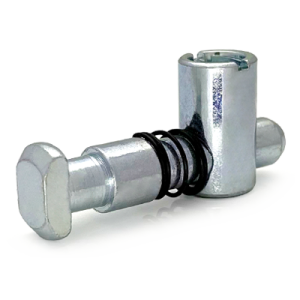 Miter Connector Model P 45 Degree Corner Joint for 30 and 40 mm Aluminium Profiles
Miter connector Model P, a hidden 45 degree corner joint for 30 and 40…
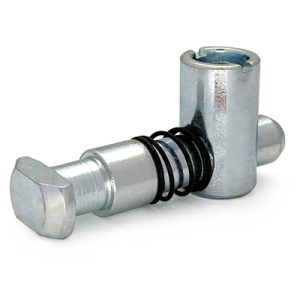 Standard Connector Model C Aluminium Profile Corner Joint 90 Degree 30 40 mm Series
Model C standard connector for a 90 degree corner in aluminium profile with both…
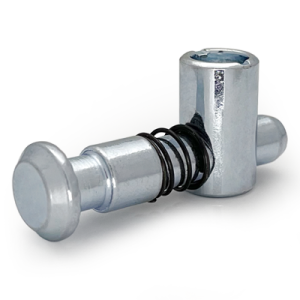 Universal Connector Aluminium Profile Adjustable Angle Joint Fastener M8 30 40 mm
Universal connector for aluminium profile with an angle set during assembly. Suits diagonal braces,…
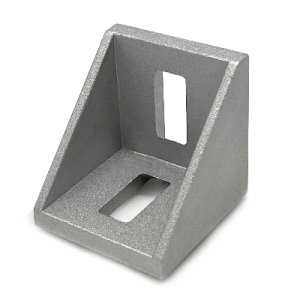 Die Cast Bracket for 20 to 50 mm Series Aluminium Profiles Corner
Die cast zinc alloy corner bracket for 20, 30, 40, 45 and 50 series…
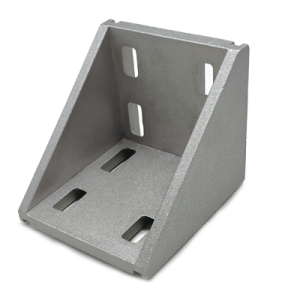 Heavy Duty Die Cast Corner Bracket for Aluminium Profile 60 80 90 100 mm Series
Heavy duty die cast corner bracket for large aluminium profile frames in 60, 80,…
