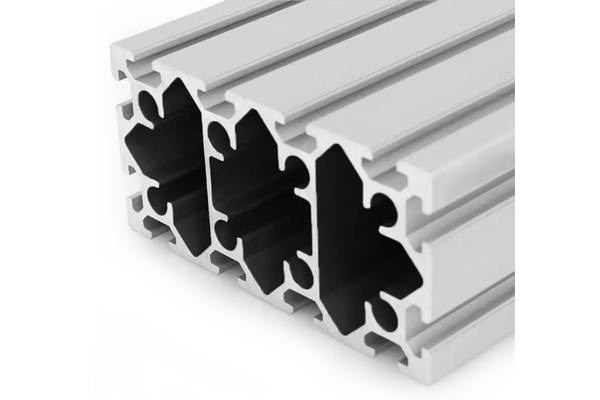
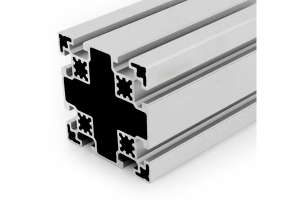
PG40 160×80 mm Twelve Slot Aluminium Strut Profile Heavy Beam for Gantry Frames
A 160 x 80 mm twelve slot PG40 aluminium strut profile heavy beam with 60 degree internal webs and eight M14 bores. For gantry beams, portal frames and heavy machine cross members.
| Material | Aluminium |
|---|---|
| Alloy Grade | 6063-T5 |
| Temper | T5 |
| Section Size | 160 x 80 mm |
| Slot | 12 x 10.2 mm groove, 8 mm mouth, 40 mm pitch, outer pair 120 mm apart, M8 |
| Length | 6 m stock, cut to drawing to +/-0.5 mm |
| Tolerance | EN 755-9 / GB/T 6892, wall +/-0.15 mm |
| Surface | Mill finish / clear anodised / black anodised |
| MOQ | 150 |
| Lead Time | 22-32 days after deposit for mill finish |
| Loading Port | Shanghai / Ningbo |
| Supply Ability | 250 t per month |
| Payment Terms | T/T 30% deposit + 70% before shipment | L/C at sight |
| Trade Terms | FOB | CIF | EXW |
| Certifications | ISO 9001:2015 | EN 755-9 | RoHS | REACH |
Structural framing · PG40 heavy beam
A PG40 160 x 80 mm twelve slot aluminium strut profile is a rectangular heavy beam with a 40 mm slot pitch, a 10.2 mm groove and an 8 mm slot mouth, taking 40 series M8 hardware. Eight Ø12 mm bores tapped M14 run through the cells, the outer slots on the 160 mm face are 120 mm apart, the flange is 4 mm and the web 11 mm, and the internal cavities are set at 60 degrees. It weighs about 6.6 kg/m and is supplied in 6063-T5, cut and machined to order.
The single most important thing about a 160 x 80 mm beam is which way up it is mounted. The stiffness of a beam depends on the cube of its depth, so the same section mounted on edge is about four times as stiff as the same section laid flat. That is not a marginal difference — it is the difference between a gantry that holds position and one that visibly sags, from the identical piece of aluminium.
On edge or flat: a factor of four
The second moment of area of a rectangular section is proportional to the width times the cube of the depth. Double the depth and you multiply the stiffness by eight. For a 160 x 80 mm section that means the two mounting orientations are not close to each other at all.
| Orientation | Depth in the load direction | Second moment of area | Deflection under the same load |
|---|---|---|---|
| On edge, 160 mm vertical | 160 mm | approx. 950 cm4 | Reference |
| Laid flat, 80 mm vertical | 80 mm | approx. 240 cm4 | About four times the reference |
Four times the deflection for the same aluminium is a large penalty for what looks like a trivial assembly decision, and it is the commonest mistake on a gantry build. The section has twelve slots and eight M14 bores, and every one of them is still available whichever way you mount it — which is exactly why the error is so easy to make and so hard to spot. The beam looks right, the bolts go in, and the gantry sags.
Decide the orientation on the drawing, not on the bench. Mark the 160 mm dimension as vertical on the assembly drawing and check it before the frame is bolted up. Once the gantry is assembled and the rails are set, changing the orientation means taking the whole structure apart.
What the 60 degree internal webs do
The internal webs in this section meet the outer walls at 60 degrees rather than at right angles, and that choice does two jobs at once.
From the extrusion side, a 60 degree included angle is about the practical limit for a die tongue. The internal webs are formed by metal flowing through gaps in the die, and those gaps are bounded by tongues of tool steel. A sharp internal corner concentrates stress in the die and the tongue either breaks or wears quickly; opening the angle out to 60 degrees spreads the load and gives the die a working life measured in tonnes rather than in metres. Sections with internal angles below about 45 degrees are difficult to extrude and expensive to keep running.
From the structural side, diagonal webs triangulate the section. A rectangular box with right-angle webs resists bending well but is comparatively soft in torsion, because a right-angled cell can rack into a parallelogram. A cell with 60 degree walls is closer to a triangle, and a triangle cannot rack without changing the length of a side. That is what makes this section usable as a gantry beam carrying a moving load off-centre, where the beam is twisted as well as bent.
| Internal web angle | Effect on the die | Effect on the section |
|---|---|---|
| Below about 45 degrees | Fragile tongues, short die life, difficult extrusion | Marginal torsional gain |
| 60 degrees, as drawn here | Robust tongues, long die life | Good torsional stiffness through triangulation |
| 90 degrees | Easy to extrude | Bending stiffness only, weak in torsion |
Sizing a gantry beam
- Fix the span and the allowable deflection first On a gantry the deflection limit comes from the process, not from a standard. A pick-and-place head and a welding torch have very different tolerances.
- Calculate the required second moment of area For a central point load on a simply supported beam, the deflection is the load times the cube of the span divided by 48 times the modulus times the second moment of area. Solve it for the second moment of area and that is your target.
- Check the target against 950 cm4 on edge If the answer is under 950 cm4 this section works with the 160 mm dimension vertical. If it is over, either reduce the span with a mid support or step up to a deeper section.
- Use the eight M14 bores for the end connections The gantry end plate carries the whole bending moment. Four M14 bolts per end into the bores — not the slots — is the arrangement that keeps the joint stiff.
- Include the beam’s own weight At about 6.6 kg/m the self weight is a real part of the load on a long span. Include it rather than treating it as negligible.
Frequently asked questions
What is the maximum span for this beam?
It depends on the load and the allowable deflection. At a 5 kN central load and an L/1000 limit, roughly 2.5 m on edge. Send us the span, the load and the tolerance and we will calculate it for this section.
Why does the section have 60 degree internal webs?
Two reasons. The angle is the practical minimum for a robust extrusion die tongue, and the diagonal webs triangulate the cells so the beam resists twisting as well as bending.
Can I mount it flat if the height is restricted?
You can, but expect about four times the deflection for the same load. If height is tight, reduce the span with a mid support rather than laying the beam flat.
What is the difference between this and the 200 x 80 mm fourteen slot beam?
Depth. The 200 x 80 mm section is deeper and therefore much stiffer, at about 7.80 kg/m against 6.6 kg/m here. Choose on the span and the deflection limit.
Do you machine the ends for the gantry connections?
Yes. We face and square the ends, drill and tap the M14 bores, machine end plates and supply them fitted. Send DWG, DXF, STEP or PDF.
Send the gantry span and the deflection limit
Tell us the span, the load and how much deflection the process can tolerate. We will confirm whether this section holds it on edge, and quote cut lengths, end machining and FOB pricing.
Request a QuoteRelated Products
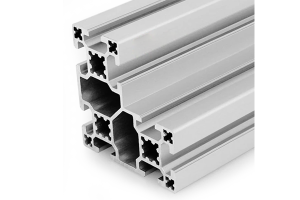 PG40 80×80 mm L-Shape Eight Slot Aluminium Strut Profile Corner Section
An 80 x 80 mm L-shape eight slot PG40 aluminium strut profile corner section…
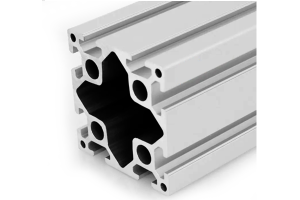 PG40 80×80 mm Eight Slot Heavy Aluminium Strut Profile High Load Column
An 80 x 80 mm eight slot heavy PG40 aluminium strut profile with diamond…
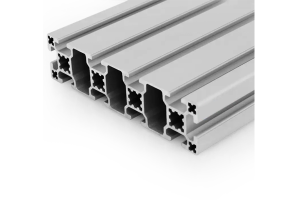 PG40 160×40 mm Ten Slot Aluminium Strut Profile Wide Beam for Overhead Rails
A 160 x 40 mm ten slot PG40 aluminium strut profile wide beam with…
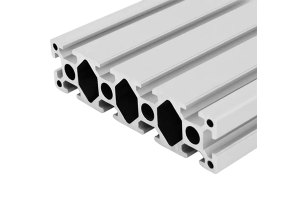 PG40 160×40 mm Ten Slot Heavy Aluminium Strut Profile for Cantilever Arms
A 160 x 40 mm ten slot heavy PG40 aluminium strut profile with round…
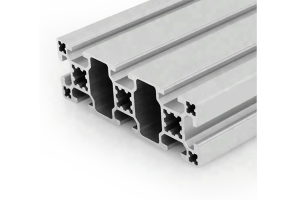 PG40 120×40 mm Eight Slot Aluminium Strut Profile Standard Beam for Table Frames
A 120 x 40 mm eight slot PG40 aluminium strut profile standard beam with…
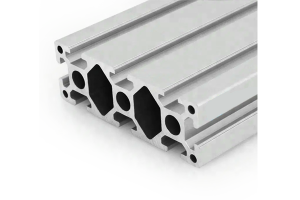 PG40 120×40 mm Eight Slot Heavy Aluminium Strut Profile for Machine Bases
A 120 x 40 mm eight slot heavy PG40 aluminium strut profile with round…
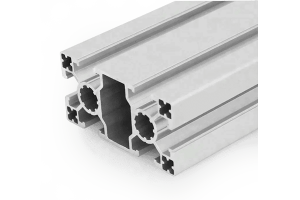 PG40 80×40 mm Six Slot Super Light Aluminium Strut Profile for Enclosures
An 80 x 40 mm six slot super light PG40 aluminium strut profile with…
 PG45 90×90 mm Eight Slot Aluminium Strut Profile M10 Column Section
A 90 x 90 mm eight slot PG45 aluminium strut profile with 8 x…
