Aluminium Profile Display Boards: The Panel Is the Hard Part
A display board is quoted as a frame and delivered as a panel problem. The frame is the straightforward half. Holding a flat panel flat, without visible fixings, and being able to change the content later, is where the design is actually decided.
Short answer
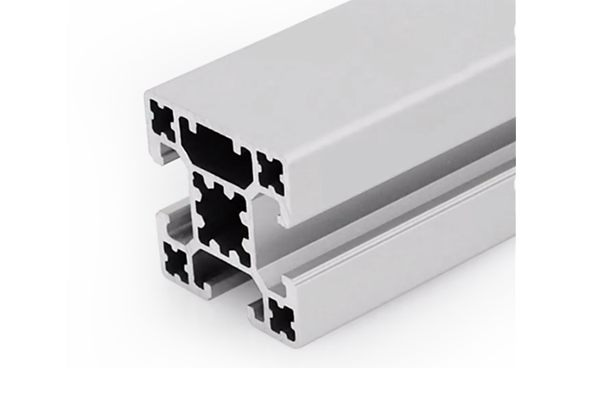
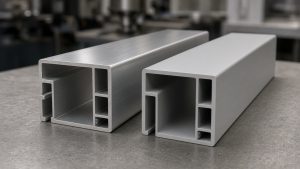
Choose the retention method for the panel before choosing the frame, because the retention method decides the section. A panel that slides into a slot needs a closed groove and end access. A panel fixed with clips or a magnetic surface needs a flat face and a ferrous layer, since anodised aluminium will not hold a magnet. A hinged or opening panel adds load and needs a frame that can carry it. On top of that, a free-standing board is a tall narrow object that overturns long before it breaks, and a board in a circulation route is an obstruction with a legal dimension. Decide those four things and the frame almost designs itself.
The frame is the easy half
A display board frame is a rectangle with four corners. It is lightly loaded, it is rarely tall, and it is not a structural challenge in the way a machine frame or a platform is. Almost any of the common sections will carry it.
The reason boards still go wrong is that the frame is designed first and the panel is treated as something that will be sorted out later. That sequence produces a frame that cannot accept the panel the client actually wants, or that requires visible fixings through the front face, or that cannot be re-used when the content changes.
Reverse the order. The panel material, its thickness, its weight, its flatness and how often it changes are the real inputs. Everything else follows from them.
Retention decides the section
There are four common ways to hold a panel, and each one makes a different demand on the profile.
| Retention | What the frame must provide | Where it suits |
|---|---|---|
| Slot-in | A groove wide enough for the panel, with access at one end to slide it in | Thin panels, graphics that change rarely |
| Clip or bezel | A flat face and a return, with clearance for the clip | Rigid panels, content changed on site |
| Magnetic | A ferrous backing surface and a frame that can carry it | Notices, drawings, anything re-arranged daily |
| Hinged | Hinge load, a stop, and a frame stiff enough not to twist | Access behind the board, displays with services |
The magnetic case is the one that catches people out. Anodised aluminium is not magnetic, and neither is bare aluminium. A magnetic board is only magnetic because there is a steel sheet behind the face, and that sheet has to be specified, carried and protected. Where a steel backing sits against an aluminium frame in a damp environment, the pair forms a galvanic couple and the aluminium is the metal that corrodes, so the interface needs to be dry or isolated rather than simply bolted together.
The slot-in case has a subtler requirement: the groove depth and width have to be stated against the actual panel thickness with a tolerance, not against a nominal figure. A panel that is a fraction over nominal will not enter the groove, and one that is under will rattle.
Flatness, weight and how it is lifted
The panel spans between the frame members, and its own stiffness decides how far apart those members can be. A thin composite panel will bow between rails that a rigid panel would happily span. If the board is read from a distance this rarely matters; if it carries a fine drawing or a photograph it matters immediately, because the eye sees the reflected distortion before it reads the content.
Weight matters for a different reason: a board is an object that has to be mounted, and a 2.4 by 1.2 metre board can weigh anywhere from about ten to thirty kilograms depending on the panel. That range decides whether it is a two-person lift with a step ladder or a job for a hoist, and it decides whether the wall fixings are ordinary plugs or a designed fixing. It also decides whether the frame needs lifting points, which are easy to add at the design stage and awkward to add afterwards.
A free-standing board tips before it breaks
A wall-mounted board is in shear and tension and is almost never the limiting element. A free-standing board is a different structure: tall, narrow and top-heavy, and its failure mode is overturning.
Two factors govern. The first is the ratio of height to base depth: a board that is 1.8 metres tall on a base a few hundred millimetres deep is on the edge of stability before anyone leans on it. The second is where the load is applied. A person leaning on the top edge of a board applies a load high up, at a long lever arm, which produces a much larger overturning moment than the weight of the board itself.
Practical controls are to increase the base depth, add ballast low down, or tie the board back to the wall. Castors make it worse: a mobile board is usually parked on castors that are small, and small castors on a hard floor transmit every push straight into a tipping moment. Where mobility is genuinely needed, the honest answer is a wider base and a lower centre of gravity, not a heavier top frame.
Hidden fixing is a trade, not a free upgrade
Concealed connectors give a clean front face, which is exactly what a display board is usually bought for. They also consume slot length at the joint, need access from the correct direction during assembly, and cannot be inspected or re-tightened from the front once the panel is in.
That produces a real conflict on a board: the joints want the slot, and the panel retention often wants the same slot on the same face. Counting how much slot length each joint consumes, and checking that the retention detail still has somewhere to attach after the joints are made, is the step that most often gets skipped. On a small board the slot runs out quickly.
Where a board must be serviceable, the visible bracket is the better choice. A corner bracket on the rear face is not seen, can be re-tightened, and costs less than a concealed connector.
Where the board is changes the rules
The same frame is a different product in a corridor, on a factory floor and in a cleanroom.
In a circulation route, a board is an obstruction. It projects into the escape width, and its mounting height and projection can put it in the way of both shoulders and heads. That is a compliance question about the space, not about the frame, and it has to be answered by whoever owns the building, not by the board supplier.
On a factory floor, the board is exposed to impact, dust and cleaning. Its surface has to survive being wiped, and its fixings have to survive being knocked. A light frame and a thin panel are the wrong choice where a pallet truck passes.
In a cleanroom or a medical environment, the requirement shifts to cleanability and to not shedding particles. That usually means a closed, smooth surface, sealed joints, and a finish that tolerates the cleaning agents in use. It also brings back the electrical question: where a board carries powered displays or is used in an electronics area, its continuity and bonding have to be designed rather than assumed, because an anodised frame does not conduct through its joints.
What to send with a display board enquiry
Boards are usually enquired about as a size and a picture. Eight items turn that into something that can be quoted and built once.
RFQ checklist — display boards
- Panel material and thickness — with the tolerance, not just the nominal figure.
- Retention method — slot-in, clip, magnetic or hinged; it decides the section.
- Whether it must be magnetic — if so, a ferrous backing has to be specified and protected.
- Mounting — wall, freestanding or mobile, and the wall substrate if it is mounted.
- Board size and viewing distance — both feed the panel stiffness and the rail spacing.
- Height and base depth — for freestanding boards, these set the overturning check.
- How often the content changes — it decides whether the frame must open.
- Environment — corridor, factory floor, cleanroom or outdoors; each changes the finish and the fixing.
Ask one question before quoting: does the panel get replaced during the board’s life. If it does, the retention detail matters more than the frame, and designing it as a permanent assembly is the expensive mistake.
Five ways a display board disappoints
Related on this site
- Workbench frames: top and frame as two problems— the same frame-and-panel decoupling
- Shelving: it buckles and tips before it bends— overturning as a governing failure mode
- ESD grounding: the four joints that break the path— why an anodised frame needs deliberate bonding
- Connecting elements category— brackets, anchors and concealed connectors
Terms used in this article
- Retention
- The method by which the panel is held in the frame: slot-in, clip, magnetic or hinged.
- Ferrous backing
- A steel sheet behind the board face that gives a magnetic surface; aluminium itself will not hold a magnet.
- Overturning
- Tipping of a free-standing object when the load’s moment about its base exceeds the restoring moment of its weight.
- Slot contention
- Competition for the same slot length between a structural joint and an accessory attachment.
- Concealed connector
- A fastening system that works inside the slot and leaves no visible fixing on the outer face.
- Cleanability
- The property of a surface and its joints that allows effective cleaning without harbouring residue or shedding particles.
Questions buyers ask
Can I have a magnetic aluminium notice board?
Yes, but not from aluminium alone. Aluminium is not magnetic, so a magnetic board has a steel backing sheet behind the face. Keep that interface dry or isolated, because steel against aluminium in moisture makes the aluminium the metal that corrodes.
Why does my panel rattle in the frame?
Almost always a groove sized to a nominal panel thickness rather than to a range. State the panel thickness with its tolerance, and size the groove to suit.
Is a concealed fixing worth it on a display board?
It is worth it when the front face is the product and the board never needs opening. It costs slot length and cannot be re-tightened from the front, so on a serviceable board a rear bracket is usually the better answer.
How do I stop a freestanding board tipping?
Increase the base depth, add ballast low down, or tie it back to the wall. Castors make it worse, because small wheels on a hard floor pass every push straight into a tipping moment.
Does a board in a corridor need anything special?
It is an obstruction, and its projection reduces the usable escape width. That is a question about the building and it has to be answered by whoever owns the space, before the mounting height is fixed.
Send the panel, not just the size
Tell us the panel material and thickness, how often the content changes and where the board will stand, and we will design the frame and the retention detail around it.
Request a quoteRelated reading
Twelve more engineering notes from this blog, picked for this article — plus every category below.
 ApplicationsAluminium Profile for LED Strips: A Heat Sink First, a Housing Second
 ApplicationsAluminium Pergola Profiles: A Beam Problem With a Water Problem
 Applications20 Series T-Slot Profiles: Where the Limits Actually Are
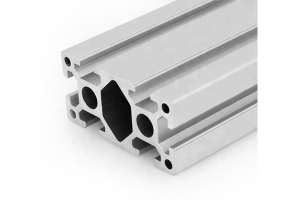 Engineering DesignWhat Is a 4080 Aluminium Profile? (Weight, Slot and Load)
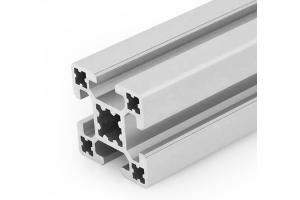 Engineering DesignWhat Is a 4040 Aluminium Profile? (Weight, Slot and Load)
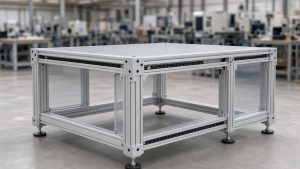 ApplicationsAluminium Profile Applications
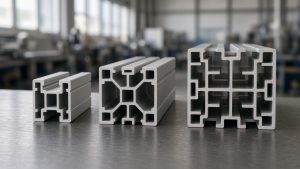 Engineering DesignSlot Dimensions Explained: 6 mm, 8 mm and 10 mm T-Slots
 Engineering DesignT-Slot Cross-Brand Compatibility: Bosch, Item and Generic
 Sourcing and ProcurementAluminium Profile Quote: What Changes the Number by Quantity
 Materials and EngineeringAluminum Extrusion Tolerances: How to Write a Specification Your QC Team Can Actually Inspect
 Sourcing and ProcurementAluminium Profile Shipping: Packing, Container Loading and ISPM 15
 Quality and InspectionAnodising vs Powder Coating: Thickness, Colour, Salt Spray
