Aluminium Profile Shelving: It Buckles and Tips Before It Bends
Shelving is one of the few framing applications where strength is almost never the governing limit. The upright is a slender column, the assembly is tall relative to its depth, and the failure that arrives is a stability one.
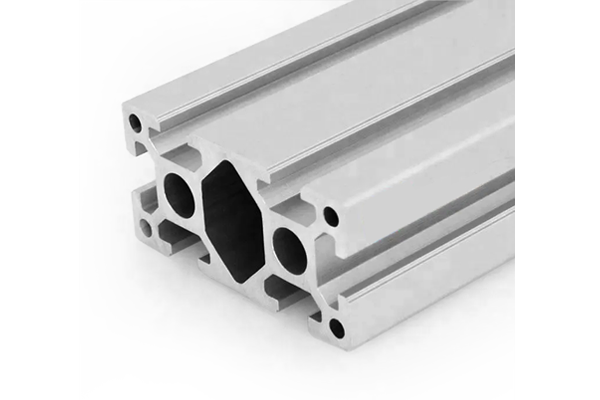
Short answer
Aluminium profile shelving rarely fails because the metal was too weak. It fails in one of three stability modes: the upright buckles as a slender column under load, the shelf deflects visibly between its supports, or the whole unit overturns because it is tall relative to its depth. All three are addressed by geometry and restraint rather than by a heavier section, which is why upgrading the profile is usually the most expensive way to solve a shelving problem.
Three failure modes, none of them about strength
Ask someone why a shelf failed and the answer is usually “it was not strong enough”. Look at the failure and it is almost never a strength failure. The aluminium yielded nowhere; the structure lost stability first.
The first mode is column buckling in the upright. A vertical member loaded in compression does not crush; it bows sideways, and the load at which it bows depends on its slenderness rather than on the material’s yield strength. Using a stronger alloy does very little for buckling, because buckling is governed by stiffness and geometry.
The second is deflection of the shelf itself. A shelf is a beam with a distributed load, and it will visibly sag long before it is anywhere near failing. This is a serviceability limit, not a strength limit, and it is what users actually complain about.
The third is overturning. A shelving unit that is tall and shallow will tip before the frame is anywhere near its capacity, particularly if the load is placed high or if someone pulls on it.
Why a stronger alloy does not help here
Buckling resistance depends on the elastic modulus and the second moment of area. All common aluminium alloys have essentially the same modulus, so moving from 6063 to 6061 changes the yield strength and leaves the buckling load almost untouched.
Slenderness: the number that governs the upright
Slenderness is the ratio of a column’s effective length to its radius of gyration, which is a measure of how far the material sits from the member’s centre. A stocky column has a low ratio and fails by crushing; a slender one has a high ratio and fails by buckling at a much lower load.
For shelving, the practical implication is that the upright’s unbraced length matters enormously. An upright that is braced at every shelf level has a short effective length between braces and a high capacity. The same upright running unbraced from floor to top has a long effective length and a much lower one.
This is why the cheapest capacity increase in shelving is usually another shelf level or a diagonal brace, rather than a larger section. Both shorten the unbraced length, and capacity rises sharply as that length falls.
| Upright condition | Effective length | Capacity trend | Practical note |
|---|---|---|---|
| Braced at every shelf level | Short, shelf to shelf | Highest | Every shelf is also a brace if it is fixed properly |
| Braced at alternate levels | Moderate | Intermediate | Common compromise for tall bays |
| Unbraced floor to top | Full height | Lowest | Avoid; capacity drops sharply with height |
| Braced plus back panel | Short, plus restraint | Highest and stiffest | A back panel braces and prevents racking at once |
Shelf deflection: what users actually see
A shelf may be perfectly safe and still be unacceptable, because people judge a shelf by whether it looks straight. Deflection limits for shelving are therefore a serviceability decision made by the application, not a safety figure from a table.
Three things reduce shelf deflection, and only one of them is the section. Shortening the span is the most effective; supporting the shelf along its length instead of at two points is the second; increasing the section’s second moment of area is the third and usually the most expensive.
Support conditions matter as much as the span. A shelf resting on two brackets at its ends is a simply supported beam. A shelf fixed to uprights at both ends and prevented from rotating is stiffer for the same section, and that difference is often larger than the difference between two section sizes.
FIX 1
Shorten the span. An intermediate upright does more than a larger section.
FIX 2
Support along the length. A continuous rail beats two end brackets.
FIX 3
Restrain the ends. Preventing rotation at the upright stiffens the same shelf.
FIX 4
Then, and only then, the section. Increase the second moment of area last.
Overturning: the one that causes injuries
Buckling and deflection are serviceability problems. Overturning is a safety problem, and it is governed by a ratio that has nothing to do with the profile: the height of the unit relative to its depth, and where the load sits.
A tall, shallow shelving unit with its load on the top shelf is unstable regardless of how strong the aluminium is. The remedies are geometric: increase the depth, lower the load, fix the unit to the floor or to a wall, or tie adjacent units together.
Anchoring is the one that is most often omitted because it is a site work item rather than a supply item. A freestanding unit that is safe in a warehouse with a level floor can be unsafe in a van, on a mezzanine, or in any location where it can be pulled or where the floor is not level.
Four ways shelving gets specified unsafely
What to send with a shelving enquiry
The numbers a supplier needs for shelving are different from those for a machine frame. Load matters, but geometry matters more, and two of the four decisive items are usually missing from an enquiry.
RFQ checklist — shelving
- Bay height, width and depth — depth is the dimension usually omitted, and it governs stability.
- Number of shelf levels and their spacing — each level is a potential brace point for the upright.
- Load per shelf — distributed, and any concentrated load from a heavy item.
- Load height — whether heavy items sit high or low; it governs overturning.
- Fixing condition — freestanding, floor anchored, wall tied, or units tied together.
- Shelf material — panel, slats, or profile frame with an infill; it affects whether shelves can brace.
- Access side — single or double sided; it changes the bracing options and the load path.
- Floor and site conditions — level or not, and whether the unit will ever be moved.
State the deflection limit you will accept. Shelving is judged by appearance, and a shelf that is safe but visibly bowed will be rejected on site.
Checks before loading
- Confirm upright bracing points; every fixed shelf should brace, not just rest.
- Check height to depth and load height against the anchoring decision.
- Anchor or tie tall, shallow units before loading, not after.
- Load heavy items on lower shelves; state this on the unit if it will be used by others.
- Check shelf deflection under load against the stated limit before signing off.
Related on this site
- PG40 80 x 40 six-slot heavy profile— a section with more buckling resistance in the weak axis
- Aluminium angle profiles— shelf edge and upright trim
- Strut profiles category— the upright and beam section range
- Profile sizes 20 x 20 to 100 x 100: what fails first— how the governing limit changes with size
Terms used in this article
- Buckling
- Sudden sideways bowing of a compressed member, governed by stiffness and geometry rather than strength.
- Slenderness
- The ratio of a column’s effective length to its radius of gyration; higher means buckling governs.
- Radius of gyration
- A measure of how far a section’s area sits from its centre; larger means more buckling resistance.
- Effective length
- The unbraced length a column buckles over, shortened by bracing at intermediate points.
- Overturning
- Tipping of a whole unit, governed by height to depth and load height.
Questions buyers ask
Will a bigger profile stop my shelf sagging?
It will help, but it is the most expensive of the four options. Shortening the span, supporting the shelf along its length and restraining its ends all reduce deflection more per unit of cost than increasing the section.
Why does the upright bow when the load is well under the rating?
Because the rating was a strength figure and the failure is buckling. Buckling depends on the unbraced length and the section’s geometry, not on the load at which the metal yields. Brace the upright at more points.
Does 6061 help with buckling?
Barely. All aluminium alloys share essentially the same elastic modulus, so a higher-strength alloy raises the yield point and leaves the buckling load almost unchanged. Fix buckling with geometry.
How tall can a freestanding unit be?
It depends on depth and on where the load sits, not on the section. As height to depth rises and load moves up, anchoring or tying becomes necessary. If in doubt, anchor.
Can shelving be double sided?
Yes, and it improves stability because the unit is deeper relative to its height. It changes the load path and the bracing arrangement, so specify the access side with the enquiry.
Send the height, the depth and the load
Give us the bay geometry and the load per shelf and we will check buckling, deflection and overturning before you commit to a section.
Request a quoteRelated reading
Twelve more engineering notes from this blog, picked for this article — plus every category below.
 Engineering DesignWhat Is a 2020 Aluminium Profile? (Weight, Slot and Load)
 ApplicationsAluminium Profile Applications
 ApplicationsAluminium Workstations: From Fixed Benches to Reconfigurable Cells
 Engineering DesignHow to Choose an Aluminium Extrusion Profile: The Three Decisions That Bind
 Engineering DesignT-Slot vs V-Slot Aluminium Profiles: The V Is a Raceway, Not a Cheaper T
 Engineering DesignAluminium Extrusion Lead Time: New Die vs Existing Die
 ApplicationsAluminium Profiles for Automation Equipment Frames: Design From the Assembly Floor
 Engineering DesignESD Anti-Static Workbench Grounding: The Four Joints That Break the Path
 Materials and EngineeringAnodised vs Powder Coated Aluminium Profiles: A Specification Guide for European Buyers
 Materials and EngineeringIndustrial Aluminium Extrusion: Five Advantages and the Conditions Attached to Each
 Sourcing and ProcurementImporting Aluminum Profiles from China: Nine Failures That Quietly Raise Your Landed Cost
 Quality and InspectionSampling and First Article Approval for Aluminium Extrusion
