Extruded vs Cast Aluminium: Stronger in One Direction, Not in All of Them
The claim that extruded aluminium is stronger than cast is true, and it is true under conditions that a specification usually leaves out. The two processes produce different grain structures, different defect populations and different directional behaviour, and which one wins depends on the load path.
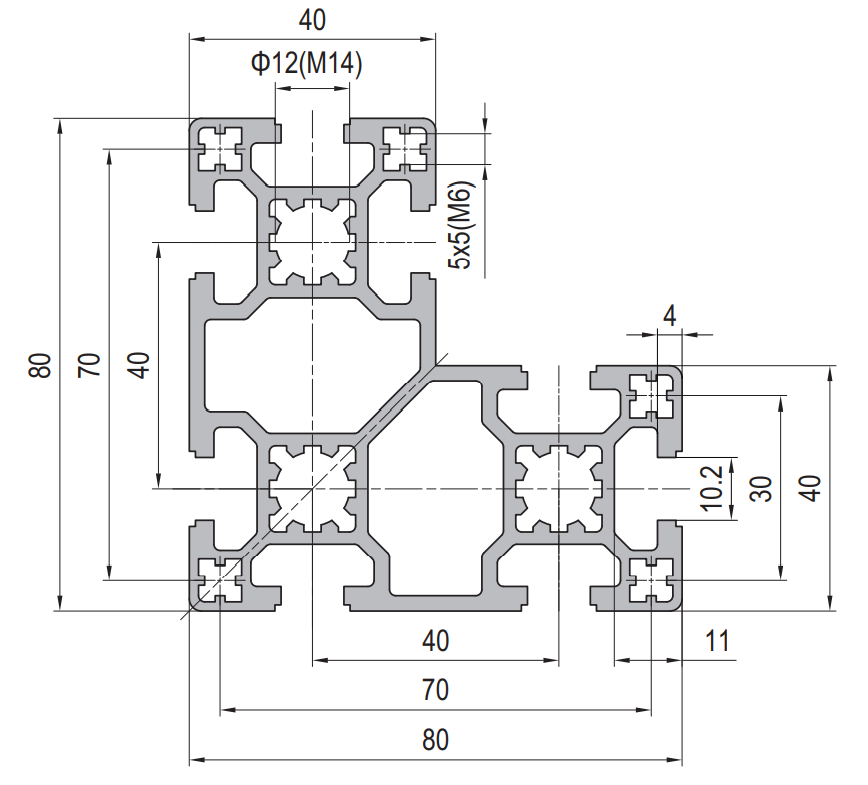
Short answer
Extrusion and casting produce different material, not just different shapes. Extrusion pushes hot metal through a die, so the grains elongate along the extrusion axis and the metal is consolidated under pressure, which leaves no gas porosity. The result is a wrought product with good strength and ductility in the extrusion direction, and properties that are direction-dependent because the grain flow is. Casting pours liquid metal into a mould, so the shape can be far more complex and the material is isotropic, but the process can leave gas porosity and shrinkage, and those defects are where a casting cracks. So the useful statement is: extruded aluminium is stronger along the extrusion axis than a casting of comparable alloy and temper, and it is not automatically stronger across it. A hollow extrusion also contains a weld seam where the metal streams rejoin, and that seam is a real discontinuity that a specification should acknowledge.
The comparison only means something if the alloy and temper match
Most of the confusion in this debate comes from comparing the wrong things. A 6061-T6 extrusion is a heat-treated wrought alloy, and a heat-treated A356 casting is a different alloy system that has also been heat-treated. Comparing a T6 extrusion to an as-cast part is not a comparison of processes; it is a comparison of a heat-treated part with an untreated one, and the heat treatment is doing most of the work.
For reference, 6061-T6 is commonly quoted at an ultimate tensile strength of about 310 MPa and a 0.2 per cent proof stress of about 276 MPa, with good elongation. A well-made, heat-treated casting of a comparable alloy lands in the same order of ultimate strength but typically lower in proof stress and markedly lower in elongation, because the casting still contains the defects that the extrusion process squeezed out.
So the first rule is to compare like with like: same alloy family, same temper, same heat treatment, and the same section. Then the remaining differences are genuinely process differences, and they are the ones worth designing around.
| Property | Extruded | Cast |
|---|---|---|
| Grain structure | Elongated along the extrusion axis | Equiaxed and isotropic |
| Strength direction | Highest along the axis, lower across it | The same in every direction |
| Gas porosity | Consolidated out under pressure | Possible, and it is a crack initiator |
| Shape freedom | Constant section, plus machining | Complex three-dimensional geometry |
| Internal discontinuities | Weld seam in hollow profiles | Shrinkage and oxide films if not controlled |
| Tooling economics | Die cost amortised over length | Pattern and mould cost amortised over pieces |
Extrusion gives grain flow, which makes strength directional
In extrusion, a heated billet is pushed through a die and the metal flows. The grains deform and elongate in the direction of flow, so the finished section has a fibrous grain structure running along its length. That grain flow is why an extruded part is strong in the extrusion direction: a crack that tries to run across the section has to cross the grain boundaries rather than follow them.
The same structure is why the properties are directional. Across the extrusion direction the grain flow gives less benefit, and a load that tries to split the section, or to open a slot, is working against a different material than a load that bends the section along its length. On a T-slot frame the practical case is a slot lip loaded by a bolt: the load is not along the extrusion axis, and the strength there is governed by the lip geometry and the local material rather than by the longitudinal properties quoted in a datasheet.
There is a second microstructural feature worth knowing. The outer skin of an extrusion cools and deforms differently from the core, producing a surface layer with a finer or recrystallised structure. That layer is usually beneficial for surface finish and corrosion, but it is different material from the core, and a machining operation that removes it changes the surface behaviour of the part.
Hollow extrusions have a weld seam, and it is a discontinuity
A solid extrusion is pushed through a simple die. A hollow extrusion needs a die with a mandrel or a bridge, and the metal has to flow around the supports and rejoin on the other side. Where it rejoins, it forms a weld seam running along the length of the profile. A second type, the charge weld, is a transverse joint formed between successive billets in a press run.
These seams are not necessarily defects, and a well-run press produces a seam that is metallurgically sound. But the seam is a place where the structure and the properties differ from the bulk material, and it is a preferred path for certain failure modes. In a pressure-tight application a seam is the first place a leak appears. In a heavily loaded hollow section, the seam is a place to check rather than assume.
The practical consequences are modest but real. A hollow profile that has to be pressure-tight needs a seam-quality requirement rather than a general one. A hollow profile that is machined through should have the seam considered in the machining plan. And a buyer comparing a solid and a hollow section of the same envelope should know that the hollow one is not simply a lighter version of the same material.
Casting trades porosity for shape and isotropy
Casting fills a mould with liquid metal, which means the shape can be complex in three dimensions: ribs, bosses, thick-to-thin transitions and internal passages that no constant-section extrusion can produce. For a part that has to be a housing, a manifold or a bracket with a curved load path, casting is often the only sensible route.
The cost of that freedom is a different defect population. Liquid metal shrinks as it solidifies, and the shrinkage has to be fed; where it is not, the part contains shrinkage porosity. Gas dissolved in the melt can be trapped as gas porosity. Oxide films can be folded into the metal during filling. All of these are internal discontinuities, and all of them concentrate stress. Good foundry practice controls them, but it does not eliminate them, and a casting is therefore specified with a quality level and inspected for internal soundness rather than assumed to be uniform material.
The compensating advantage is isotropy. Because the grains are equiaxed, a casting has essentially the same properties in every direction, so a complex load path does not have to be aligned with a grain flow. That is why castings dominate for housings and manifolds, and why the choice between the two processes is often really a choice between a simple load path and a complex one.
Fatigue is where the two processes separate most clearly
Aluminium has no fatigue limit: unlike steel, there is no stress range below which it can be cycled indefinitely, so the S-N curve keeps falling. That makes every aluminium part a fatigue question, and it makes the defect population decisive, because fatigue cracks start at discontinuities.
An extrusion starts with fewer internal discontinuities than a casting, so for the same nominal stress it usually has the better fatigue performance. But an extrusion has its own initiation sites: the weld seam in a hollow profile, a sharp die line, and any machining mark. A casting starts with porosity and shrinkage, and each pore is a potential initiation site, which is why a casting is more sensitive to the size and distribution of its defects than an extrusion is.
The design consequence is that a fatigue-sensitive part should be specified with its discontinuities in mind. For an extrusion, that means knowing where the seam is and keeping it out of the highest-stress region. For a casting, that means specifying a soundness level and verifying it, and avoiding designs that put the highest stress where the porosity is most likely to be.
Choosing between them on volume, shape and load path
Three questions decide it, and they are usually easy to answer.
The first is shape. If the part is a constant-section member — a beam, a post, a rail, a frame member, a heat sink — extrusion wins, because the die is amortised over length and the section can be optimised for bending. If the part is a three-dimensional housing with internal features, casting wins, because machining an extrusion into that shape wastes material and time.
The second is volume. Extrusion tooling is inexpensive relative to its output, so extrusion is economic from short runs upwards, and a custom die is often justified for a single project. Casting tooling is more expensive, so casting needs volume to amortise it, and a low-volume casting is usually a machined extrusion or a machined billet instead.
The third is the load path. If the load runs along the member, extrusion gives the grain flow for free. If the load path is complex, or if the part has to carry load in several directions at once, the isotropy of a casting is worth paying for. And if the part is fatigue-critical, the defect population matters more than the process name, so specify the soundness or the seam quality and inspect it.
What to send when the process is still open
If the choice between an extrusion and a casting is still open, the enquiry should carry the load case, the load direction relative to the part, the number of parts, the fatigue requirement if any, the tolerances that matter, and the surface finish. With those, a supplier can say honestly which process fits, and whether a hybrid — an extruded section with machined features, or a casting with machined interfaces — is the better answer.
What does not work is to ask for the stronger material. Strength is directional, it depends on the alloy and temper, and on a real part it is usually the joints and the discontinuities that decide the outcome rather than the number in the datasheet.
RFQ checklist — extrusion or casting
- Shape — constant section or three-dimensional; this decides the process before anything else does.
- Volume — annual quantity and whether it justifies casting tooling.
- Load direction — whether the principal load runs along the member or across it.
- Fatigue requirement — the stress range and the cycle count, if the part is cyclically loaded.
- Alloy and temper — stated for both options, so the comparison is like for like.
- Soundness or seam quality — the internal quality level required, and how it will be verified.
- Tolerances — the dimensions that matter, and whether the process can hold them without machining.
- Surface finish — as-extruded, machined, anodised or coated, and the surface that matters.
Ask one question before quoting: which direction carries the load. It decides whether the grain flow of an extrusion is an advantage or an irrelevance on this part.
Four ways the extrusion versus casting decision goes wrong
Related on this site
- Aluminium extrusion: five advantages, five conditions— the same honest-ledger approach applied to the material choice
- Section design and cost— how the section shape drives die cost and metal use
- 6061-T5 vs 6063-T5: alloy and temper guide— why the temper matters as much as the alloy in a comparison
- Aluminium sections category— the standard extruded sections available without tooling
Terms used in this article
- Grain flow
- The elongation of the metal grains along the direction of working, which gives an extrusion its directional strength.
- Isotropic
- Having the same properties in every direction, which is characteristic of an equiaxed cast structure.
- Gas porosity
- Voids left in a casting by gas trapped during solidification, which act as stress concentrators and fatigue initiation sites.
- Seam weld
- The longitudinal joint formed in a hollow extrusion where separate metal streams rejoin behind the die.
- Charge weld
- The transverse joint formed between successive billets in a press run, a discontinuity across the profile.
- Proof stress
- The stress at which a defined small permanent strain remains, used as a practical yield value because aluminium has no sharp yield point.
Questions buyers ask
Is extruded aluminium stronger than cast?
Along the extrusion axis, and for the same alloy and temper, generally yes: the grains run with the load and the metal has been consolidated under pressure. Across the extrusion axis the advantage is much smaller, and a complex three-dimensional load path may suit a casting better.
Why does direction matter if the alloy is the same?
Because extrusion produces a fibrous grain structure along its length. Strength is highest along the grain flow and lower across it, so a load that opens a slot or splits a section is not seeing the longitudinal properties a datasheet quotes.
Are weld seams in extrusions a defect?
Not in themselves. A well-run press produces a sound seam, but the seam is a place where the structure differs from the bulk, so a pressure-tight or highly loaded hollow section should carry a seam-quality requirement rather than an assumption.
Which process is better for a fatigue-loaded part?
Fatigue depends on where a crack starts, so it depends on discontinuities. An extrusion usually starts with fewer internal ones, but it has a seam and die lines. A casting starts with possible porosity. Specify the soundness or seam quality and inspect it rather than relying on the process name.
Can I use an extrusion for a complex part?
Often yes, by extruding a near-net section and machining the features. That is usually cheaper than a casting at low volume, and it keeps the wrought properties. It becomes uneconomic when the shape wastes a lot of metal or when the features are truly three-dimensional.
Send the load direction and the volume
Tell us where the load runs, how many parts you need and which dimensions matter, and we will tell you honestly whether the part should be extruded, cast, or extruded and machined.
Request a quoteRelated reading
Twelve more engineering notes from this blog, picked for this article — plus every category below.
 ApplicationsAluminium Workbench Fit-Out: When the Accessories and the Joints Compete for the Same Slot
 Engineering DesignStandard vs Custom Aluminium Extrusion: The Break-Even Calculation
 ApplicationsAluminium Profiles Across Industries: What Actually Changes From One Sector to the Next
 ApplicationsAluminium Conveyor Frames: Why Belt Tracking Is a Geometry Problem
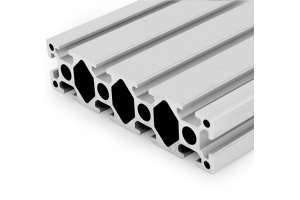 ApplicationsAluminium Partitions: The Three Performance Numbers Behind the Aesthetic
 Materials and EngineeringIndustrial Aluminum Profiles: Alloys, Tempers and How to Select Them
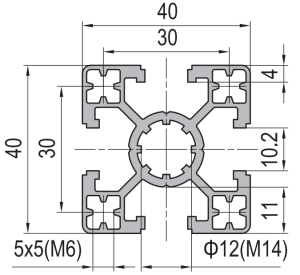 Engineering DesignAluminium Profile Standard Sizes: How the Series Matrix Actually Works
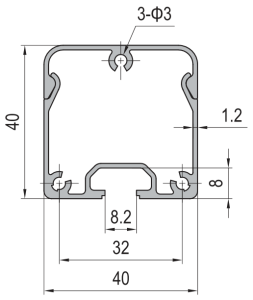 Engineering DesignHow to Choose the Right T-Slot Aluminium Profile for Your Project
 Quality and InspectionT-Slot Aluminium Profiles for Industrial Frames and Automation: A Specification Playbook
 Sourcing and ProcurementDistributor Terms: Territory, Margin and Price Protection
 ApplicationsDesigning Machine Guards and Safety Fences in Aluminium Profile: An ISO 14120 Guide
 ApplicationsAluminium Profile Fish Tank Frames: Glass Load, Salt Water, and the Alloy Question
