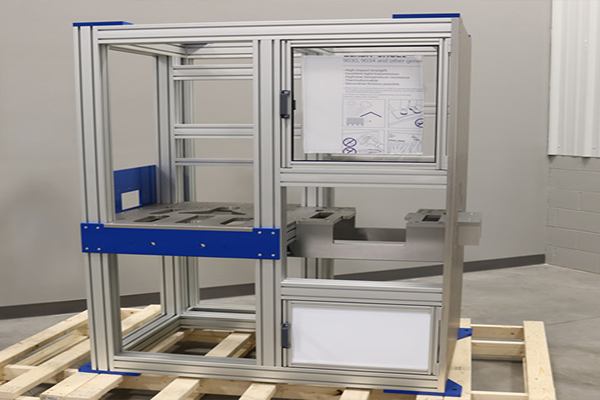
Aluminium Profile Hinge 40 Series 180 Degree for 8 mm Slot Guard Doors
180 degree hinge for 40 series aluminium profile guard doors. Two leaves clamp into the 8 mm slot with M6 T-nuts, in die-cast zinc, polyamide or stainless, with a door stop and backing plate as options.
| Material | Zinc die-cast / polyamide / stainless steel |
|---|---|
| Alloy Grade | Die-cast zinc alloy ZAMAK 3, or PA6, or AISI 304 |
| Temper | custom |
| Section Size | 40 series hinge, fits an 8 mm T-slot, 180 degree opening |
| Slot | M6 T-nut in the 8 mm slot, two fixings per leaf |
| Length | Hinge supplied as a set; door frame cut to the door drawing |
| Tolerance | Hinge leaves fit the 8 mm slot; knuckle clearance is the dominant contributor to door sag |
| Surface | Zinc die-cast as cast or black coated; polyamide in black; stainless passivated |
| MOQ | No fixed minimum; priced per door set |
| Lead Time | Stock hinges ship in about a week; frame kits 2 to 3 weeks plus finish |
| Loading Port | Shanghai / Ningbo |
| Supply Ability | Hinge supply together with profile cut to the door drawing, so the door frame and the hinge arrive as one kit |
| Payment Terms | T/T 30% deposit + 70% before shipment | L/C at sight |
| Trade Terms | FOB | CIF | EXW |
| Certifications | Material declaration and RoHS / REACH on request; the guard as a whole is assessed by the machine builder |
01How many hinges does a guard door need?
Not by rule of thumb alone. A 180 degree aluminium profile hinge on a 40 series frame is a pair of leaves that clamp into the 8 mm slot with M6 T-nuts, and the number you need is set by the moment the door puts on the hinge line, which depends on weight and on how far the centre of gravity sits from the hinge axis.
Work it through on a typical door. A 1000 x 2000 mm guard door framed in 40 x 40 standard wall at about 1.6 kg/m has 6 m of frame, so roughly 9.6 kg of aluminium. A 4 mm polycarbonate panel over 2 m2 at about 4.8 kg/m2 adds 9.6 kg, and handle, latch and hinges add about 2 kg. That is a door of roughly 21 kg, with its centre of gravity about 0.5 m from the hinge axis.
- Door weight (assumed)
- about 21 kg
- Moment about hinge axis
- 21 x 9.81 x 0.5 = about 103 N·m
- Hinges
- two, 1.6 m apart vertically
- Horizontal reaction per hinge
- about 103 / 1.6 = 64 N
- Verdict
- two hinges are adequate in load terms
So load is not what decides the count — stiffness is. Two hinges on a 2 m door hold the load easily, and the door still racks because the door frame itself twists between the hinges. That is why the practical rule is one hinge per 600 to 700 mm of door height, and a third hinge for anything over about 1.8 m or over about 40 kg, not because the hinges are overloaded but because the door needs another point holding it in plane.
All the numbers above are a worked example from stated assumptions, not a rating for this hinge. Substitute your own door weight and geometry — the arithmetic is the same and it takes two minutes.
02Where does sag actually come from?
Three places, and only one of them is the hinge. Knowing which one is failing tells you whether to change the hinge, the fixing or the door.
| Source | What you see | Why it happens | Fix |
|---|---|---|---|
| Pin and knuckle clearance | The door drops at the latch edge as soon as it is hung, and the drop does not grow with load | Angular play in the hinge joint is multiplied by the door width | A hinge with a preloaded or tapered pin; or accept the drop and adjust the latch |
| Slot nut compression | The door drops progressively over weeks, then stops | The T-nut crushes the slot flange under the hinge reaction | Larger washer or a full-length backing plate in the slot, and a third hinge |
| Door frame bow | The latch edge is out of plane and the door will not close flush | The door frame is less stiff than the frame it closes against | Deeper door frame section, or a diagonal brace, or a mid rail |
The first one is worth a number, because it surprises people. A hinge knuckle with 0.1 mm of clearance over a 20 mm knuckle length gives an angular play of about 0.005 radian, and at the far edge of a 1 m door that is about 5 mm of drop. Five millimetres is enough to make a latch misalign and enough to make a safety switch target go out of range. It is also completely invisible when you look at the hinge.
03Slot mounted or face mounted?
Almost every 40 series guard door uses a slot mounted hinge, because the slot is already there and it allows the hinge position to be adjusted after the door is built. The trade-off is that the fixing is only as good as the slot.
Slot mounted
- Position adjustable along the slot after assembly
- No drilling, so no bare aluminium and no swarf
- The T-nut bears on the slot flange, which is the thin part
- Two M6 T-nuts per leaf is normal, four is better on a heavy door
- Adjustment is possible in service, which is often what you want
Face mounted or through bolted
- Load goes through the wall, not the slot flange
- Position is fixed once drilled
- Leaves bare aluminium at the holes unless the part is anodised after drilling
- Needs access to the far side, which a closed frame may not have
- The right answer for doors above roughly 40 kg
The failure mode on slot mounted hinges is specific and recognisable: the door is fine when new, drops over a few weeks, and when you take the hinge off there is a bright mark on the slot flange where the nut has been bearing. That bright mark is the diagnosis. A backing plate that spreads the load along 100 mm of slot fixes it, and it costs less than a third hinge.
04Does the hinge need a door stop?
Yes, and it is the part people leave out. A 180 degree hinge relies on something to stop the door at 180 degrees; without a stop the door keeps going and the load transfers into the hinge leaves and the slot nuts as a peeling force rather than a shear force. That is the load case the fixing is worst at.
- A stop block in the frame slot, positioned so the door lands on it at the open angle you actually want. Cheap, adjustable, and it takes the load in compression.
- A stay or a gas strut if the door must hold position rather than just stop. On a guard door that is opened for maintenance this is often the real requirement.
- A latch or a magnetic catch to hold the door closed. Without one the door rattles against the frame and the hinge sees a fatigue load it was never designed for.
- Do not rely on the hinge itself as the stop. A hinge used as an end stop is being loaded in the direction its pin was not designed for.
05How does a safety switch coexist with a hinge?
This is the question that decides the frame design, and it is worth settling before the door is built. A guard door on a machine almost always needs an interlock, and an interlock needs a target that stays in alignment through the whole life of the door — including the sag.
- Mount the interlock on the frame, not on the hinge. A switch body on the moving door means the cable flexes every cycle and the alignment changes as the door sags.
- Put the target on the door, as close to the hinge axis as the switch allows. The closer to the axis, the less the sag moves it. This single decision removes most alignment callouts.
- Allow adjustment in two axes on the target bracket. A target with slotted holes is worth more than a precise one with round holes.
- Check the switch at the fully open position as well as closed. Some tongue switches will not tolerate the door swinging past the switch body.
- If the door is a hinged guard with a coded or RFID switch, the tolerance is usually generous enough that sag is not an issue. A mechanical tongue switch is the type that punishes sag.
We supply the hinge, the profile and the frame. We do not supply or certify the interlock, and the guard as a whole has to be assessed against the machinery safety standard that applies to your machine.
06Zinc die-cast or polyamide?
Both are common on 40 series doors and they are not interchangeable in behaviour.
| Body | Load behaviour | Noise | Best for | Watch out for |
|---|---|---|---|---|
| Die-cast zinc | Stiff, holds adjustment, takes a heavy door | Metal on metal at the knuckle, audible | Guard doors, doors above about 25 kg | Corrosion in wet or washdown areas |
| Polyamide (PA6) | Slightly compliant, damps vibration | Quiet, no rattle | Inspection doors, laboratory and cleanroom enclosures | Creep under sustained load at elevated temperature |
| Stainless steel | Stiffest, best corrosion resistance | Audible | Washdown, food, pharmaceutical, outdoor | Cost, and a different fixing pattern |
The polyamide option is genuinely better in a cleanroom or a laboratory because a metal hinge on a metal frame transmits every vibration into the enclosure. In a washdown area the polyamide will absorb water and the zinc will corrode, so stainless is the answer despite the cost.
07What to check before ordering
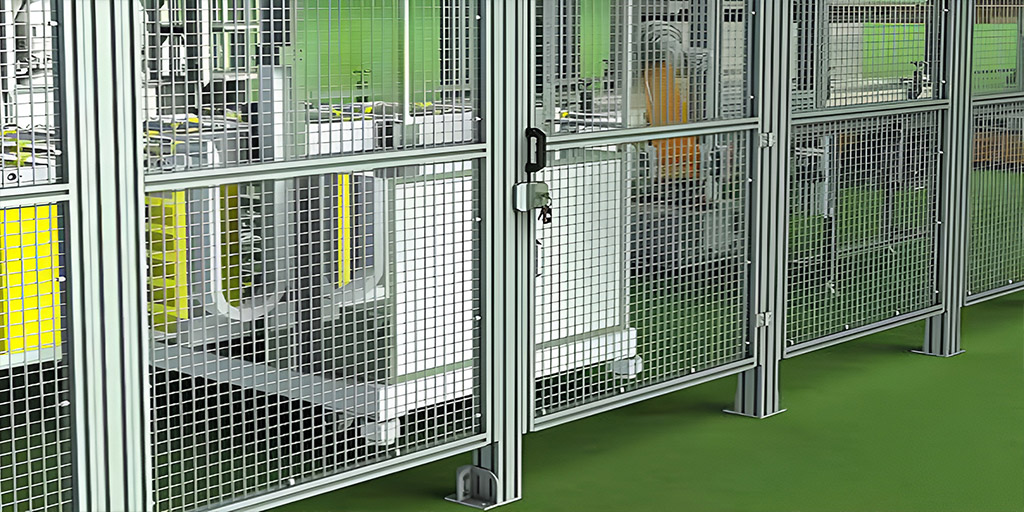
Hinged guard door checklist
- Door weight and where its centre of gravity sits relative to the hinge axis
- Door height, so the hinge count follows the 600 to 700 mm rule
- Slot mounted or through bolted, and whether the far side is accessible
- Backing plate specified if the door is over about 25 kg
- Door stop position, and whether a stay or strut is needed
- Latch or catch type, so the door does not rattle when closed
- Interlock type and where its target sits relative to the hinge axis
- Finish: zinc, polyamide or stainless, matched to the cleaning regime
- Which face of the frame the hinge may mark, if the frame is anodised
08Questions from frame builders
Related sections and categories
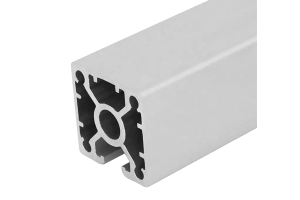
Browse Aluminium Profile Hinges, Door and Window Elements, Connecting Elements, or see the 40 x 40 mm four slot section that this hinge is designed to fit and the machine guard frame page for the frame side of the same door.
How many hinges do I need on a 2 m guard door?
Three, by the 600 to 700 mm rule. Two will carry the load on a door of about 21 kg, but a 2 m door racks between two hinges and the third one is there for stiffness rather than for strength.
Why has my door dropped at the latch edge?
Usually angular play in the hinge knuckle multiplied by the door width: 0.1 mm of clearance over a 20 mm knuckle gives about 5 mm of drop at the far edge of a 1 m door. If the drop is progressive rather than immediate, the slot nut is crushing the slot flange instead.
Can the hinge be adjusted after the frame is built?
Yes, that is the advantage of slot mounting. The hinge slides along the slot and the M6 T-nuts are re-tightened. Position is adjustable in service without drilling.
Do I need a door stop as well as a hinge?
Yes. A 180 degree hinge needs something to stop the door at 180 degrees, otherwise the load becomes a peeling force on the hinge leaves instead of a shear force.
Will the hinge work with a safety interlock?
Yes, if the interlock body is on the frame and the target is on the door close to the hinge axis. That keeps the target within range as the door sags over its life.
Is a polyamide hinge strong enough for a machine guard?
For a light inspection door, yes, and it is quieter. For a guard door over about 25 kg, use die-cast zinc or stainless, because polyamide creeps under sustained load.
What to send for a hinge and door quote
- Door drawing: width, height, frame section and panel material
- Door weight, or the panel material and thickness so we can estimate it
- Opening angle required, and whether the door must hold position
- Hinge count you have assumed, if any
- Slot mounted or through bolted
- Interlock type, and whether the target position is already fixed
- Environment: indoor, washdown, cleanroom or outdoor
- Finish and colour, matched to the frame
- Quantity of doors, and whether the hinges are wanted as part of a frame kit
If you send the door drawing, we will come back with a hinge count and a stop block position rather than just a hinge. The two are a package.
Send the door drawing
Width, height, panel material and opening angle are enough. We will come back with the hinge count, the stop block position and whether the slot needs a backing plate.
Request a quotationRelated Products
 Aluminium Profile Sliding Door 40 Series 8 mm Slot for Machine Enclosures
Sliding door leaves framed in 40 series aluminium profile for machine enclosures. Top hung…
 ESD Aluminium Profile Workbench 40 x 40 mm Anti-Static Assembly Frame
ESD workbench built on a 40 x 40 mm aluminium profile frame, supplied mill…
 120 x 120 mm Aluminium Profile for Automotive Line Tooling
120 x 120 mm twelve-slot aluminium extrusion in 6063-T5 for welding jigs, assembly fixtures…
 40 x 80 mm Aluminium Profile with 80 x 120 mm Beams: A Gantry Combination
Gantry pairing: 40 x 80 mm six-slot columns at 3.60 kg/m with an 80…
 4080 Profile: 40 x 80 mm Aluminium Span and Load Limits
40 x 80 mm six-slot aluminium extrusion in 6063-T5, 3.60 kg/m, with the section…
 40 mm Aluminium Profile Range: Single, Four and Eight Slot Compared
The 40 series aluminium profile range: 40 x 40 in single, four and eight…
 40 x 40 mm Light Aluminium Profile for Mining Equipment
40 x 40 mm four-slot aluminium extrusion in 6063-T5 from 1.30 kg/m, for guards…
 Joining Plate PG40-4040
Joining plate sized for two 40 × 40 mm profiles meeting at 90°, the…
