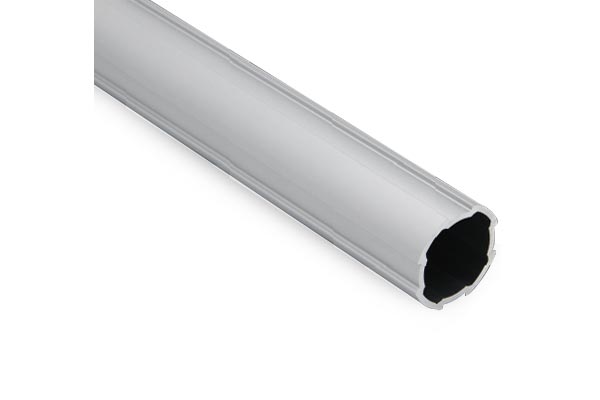
Aluminium Lean Pipe Joint System 28 mm for Kaizen Cart Frames
28 mm lean pipe joint system in aluminium tube with a 1.0 mm wall, about 0.23 kg/m, supplied with clamp-on joints for kaizen carts and workstations that get rebuilt.
| Material | Aluminium |
|---|---|
| Alloy Grade | 6063-T5 |
| Temper | T5 |
| Section Size | 28 mm OD round tube, 1.0 mm wall |
| Slot | No slot; joints clamp on the outside diameter with M6 set screws |
| Length | 6 m stock, cut square to length; bends to about 150 mm radius |
| Tolerance | Cut length +/-0.5 mm, ends square and burr-free so the tube seats fully in the joint |
| Surface | Mill finish / clear anodised / powder coated on request |
| MOQ | 100 m of tube; lower for stock lengths |
| Lead Time | 10 to 20 days for mill finish tube and stock joints; bending adds about a week |
| Loading Port | Shanghai / Ningbo |
| Supply Ability | Tube extrusion and bending in house, joints supplied as part of the frame kit |
| Payment Terms | T/T 30% deposit + 70% before shipment | L/C at sight |
| Trade Terms | FOB | CIF | EXW |
| Certifications | Material declaration, RoHS and REACH on request |
01When is a pipe frame the right answer instead of an aluminium profile?
A 28 mm lean pipe joint system and a T-slot aluminium profile frame solve the same problem — a structure that is built from stock parts — and they are good at opposite things. The pipe system is good at being changed; the profile system is good at staying where you put it.
Lean pipe frame
- Rebuilt in an afternoon with a hex key and a saw
- Joints clamp anywhere on the tube, so there is no drilling
- Tolerant of impact — a cart that gets hit bends rather than shatters
- Rounded surfaces, no sharp slot mouths, no swarf traps
- Low stiffness: it racks, and it will not hold a position accurately
Aluminium profile frame
- Holds geometry, and holds it after a thousand cycles
- Slots take panels, guards, sensors and cable ducts directly
- Stiffer per kilogram than a pipe joint by a wide margin
- Needs cutting to a list and assembling in the right order
- Every joint is a slip plane, so it needs re-tightening in service
The decision is usually made by one question: will this thing be modified? A kaizen cart, a supermarket flow rack, a temporary workstation for a new product line — all of these get changed, and a pipe frame is the cheaper answer over its life even though the parts cost more per metre. A machine frame, a guard, a fixture, a gantry — these are dimensioned once and must not move, and a pipe frame is the wrong tool.
02Aluminium tube or steel-core lean tube? The numbers
Most lean pipe in the market is a steel tube with a plastic coating, and the coating makes it look like plastic. What we supply for this system is an aluminium tube, 28 mm outside diameter with a 1.0 mm wall, and the trade is straightforward once you put the numbers side by side.
- Aluminium 28 x 1.0 mm
- 0.23 kg/m, EI about 5.4 x 10^8 N·mm2
- Steel core 28 x 1.2 mm
- 0.79 kg/m, EI about 1.9 x 10^9 N·mm2
- Ratio, mass
- aluminium is about 71 percent lighter
- Ratio, stiffness
- steel is about 3.5 times as stiff in bending
- Conclusion
- aluminium buys weight and corrosion resistance, steel buys stiffness
Those figures come from the section geometry and the elastic moduli — E of about 70 000 N/mm2 for aluminium and 210 000 N/mm2 for steel — so they are a calculation rather than a rating. Read them honestly: the aluminium tube is not a like-for-like substitute for a steel lean tube. It is a third of the stiffness, for a quarter of the weight.
That makes it right for one job and wrong for another. Right for a cart that is pushed by hand over short spans, where the bending load is small and the weight is felt every time somebody moves it. Wrong for a rack that spans a metre and a half with 200 kg on it, where the steel tube is doing real structural work. The weight saving is only a benefit if the structure still does its job without it.
03Which joint types exist, and what does each cost you?
The joint is where a pipe system’s stiffness actually lives. Every joint type has a different failure mode, and mixing them without thinking produces a frame that racks in one direction only.
| Joint | What it does | Stiffness | Watch out for |
|---|---|---|---|
| Fixed 90 degree | Two tubes at right angles, set screws on both | Highest of the clamp joints | Set screws must be on opposite sides, not in line |
| Swivel | Any angle, locked by a bolt through the joint body | Lower, and it creeps under sustained load | Re-tighten after the first week |
| Cross | Two tubes crossing, one passing in front of the other | Good in plane, poor out of plane | The offset means the frame is not flat |
| Parallel / tee | A tube ending against the side of another | Good | The end tube bears on a single point of the run tube |
| Hinge | A moving joint for a gate or a drop-down shelf | Not a structural joint | Never use it to carry the frame |
| Foot or levelling | Pipe end to floor, adjustable | Depends on the foot, not the joint | A levelling foot is a point load on the floor |
Two practical rules come out of that table. First, a pipe frame is only as square as its diagonals — put a diagonal in the back plane, or the frame will parallelogram the first time it is pushed. Second, do not mix swivel joints into a load path; use them where something has to be adjustable, and fix the geometry with a rigid joint elsewhere.
04What does the set screw actually do to the tube?
It makes a point contact and a local dent, and that is by design — the dent is what stops the joint rotating. The failure is over-tightening: a set screw driven hard into a thin wall deforms the tube enough that the joint body no longer sits square, and the frame goes out of true at that corner.
- Tighten to contact plus a quarter turn, not to a torque figure. The set screw is a position lock, not a preloaded fastener — and on a 1.0 mm wall it will dent, which is how it grips, but also how the tube gets used up.
- Put the set screws on opposite sides of the tube, at 90 degrees to each other in plan, so the tube is held rather than pushed to one side.
- Use a through bolt on any joint that carries load. Drill through both walls and use a bolt with a washer on the far side; that converts a point contact into a bearing contact.
- Do not re-use a joint on a different tube position without checking the old dent. A joint that lands on a previous set screw dent will not sit square.
- On a cart that gets rebuilt, expect to replace joints rather than tubes. The joint body and its set screw are the wear parts.
05Can the tube be bent, and where should it not be?
Yes, with a rotary draw bender, to a centreline radius of about 150 mm minimum for a 28 mm tube — roughly five times the diameter. Tighter than that and the wall thins on the outside of the bend and the tube ovalises, and a joint will no longer clamp on it properly.
Bending is worth it for two cases and not for a third. It is right for handle loops and for guard rails on a cart, where a bend removes two joints and makes the part stronger and safer. It is wrong for structural corners — a bent corner is a cantilever, not a joint, and it cannot be adjusted later. If the corner may ever need to change, use a joint.
Cut tube with a saw that leaves a square end, not a pipe cutter that leaves a raised burr. A burr on the end stops the tube seating fully into the joint, and a tube that is not fully seated is a joint that will move.
06How do you join a pipe frame to an aluminium profile frame?
This is the question that comes up on almost every mixed project, and the answer is that you join them at a plate, not at a joint. There is no standard part that clamps a 28 mm tube to an 8 mm T-slot, and trying to improvise one is where mixed frames get loose.
- Bolt a small plate to the profile slot using two M6 T-nuts, so the plate cannot rotate.
- Fix the pipe joint to the plate, using the joint’s own through-bolt holes rather than a set screw.
- Keep the interface in one plane. A mixed frame that connects in two planes will fight itself as soon as the two materials move differently.
- Put the stiff material where the accuracy is needed. Profile for the machine datum, pipe for the handling and storage around it.
A common and sensible arrangement is a profile machine frame with pipe flow racks feeding it. The profile holds the process, the pipe holds the material, and the interface is a plate at one or two points rather than a continuous connection.
07What to check before ordering
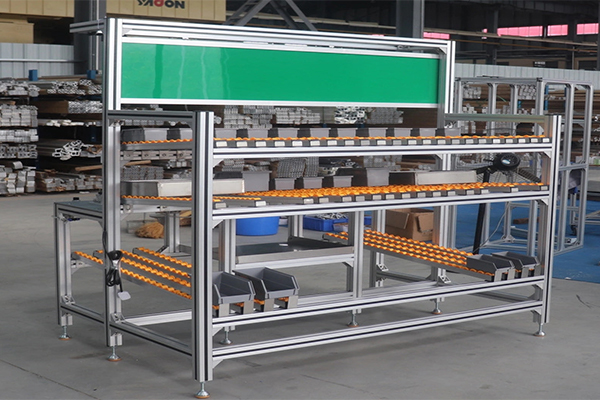
Lean pipe frame checklist
- What the frame carries, and whether the load is a point load or distributed
- Whether the frame will be rebuilt, and how often
- Tube: aluminium for weight and set screw bite, steel core for stiffness
- Wall thickness, and whether any joint needs a through bolt
- Joint types per node, and which nodes are in the load path
- Diagonal bracing in the back plane, or the frame will rack
- Bends required, and whether the radius is above about 150 mm
- Feet: fixed, levelling, or castors, and the floor condition
- Whether any part of the frame interfaces with an aluminium profile structure
08Questions from lean and continuous improvement teams
Related sections and categories
Browse Lean Pipe Profiles, Pipe and Joint Systems, or see the 28 mm aluminium pipe for the tube data, and the 40 x 40 mm four slot section if the same project also needs a rigid machine frame.
What is a lean pipe joint system?
A building system of 28 mm round tube and clamp-on joints, used for kaizen carts, flow racks and workstations. Joints clamp to the outside diameter with set screws, so the tube needs no drilling and can be re-used.
Is a lean pipe frame as stiff as an aluminium profile frame?
No. A pipe joint clamps on a round tube and every joint is a slip plane, so the frame racks. It is chosen for frames that get rebuilt, not for frames that must hold geometry.
Should I use aluminium tube or steel-core lean tube?
Aluminium at 28 x 1.0 mm is about 0.23 kg/m and roughly 29 percent of the bending stiffness of a 28 x 1.2 mm steel tube at 0.79 kg/m. Use aluminium for light hand-pushed carts, steel where the frame spans and carries load.
What is the minimum bend radius for 28 mm lean pipe?
About 150 mm centreline, roughly five times the diameter. Tighter bends thin the wall and ovalise the tube, and a joint will no longer clamp properly.
How tight should the set screws be?
Contact plus about a quarter turn. The set screw is a position lock, not a preloaded fastener, and over-tightening dents the tube enough to put the corner out of square.
Can a pipe frame be connected to an aluminium profile frame?
Yes, through a plate: bolt the plate to the profile slot with two T-nuts, then fix the pipe joint to the plate with a through bolt. There is no standard clamp that joins the two directly.
What to send for a lean pipe frame quote
- Sketch or photo of the frame, with overall dimensions
- What it carries, and the load per level
- Whether the frame will be rebuilt, and roughly how often
- Tube preference, or the load case so we can recommend one
- Joint schedule if you have one, or the sketch is enough for us to build it
- Bends required, with radii
- Feet, castors or levelling, and the floor condition
- Any interface with an existing aluminium profile frame
- Quantity, and whether it is a one-off or a repeatable standard cart
A photo of the existing cart or rack is worth more than a drawing on a first enquiry. Most lean projects are a modification of something that already exists.
Send a photo of the cart
A photo of what you have now, the load per level and how often it gets rebuilt is enough. We will come back with a tube and joint schedule rather than a price per metre.
Request a quotationRelated Products
 ESD Aluminium Profile Workbench 40 x 40 mm Anti-Static Assembly Frame
ESD workbench built on a 40 x 40 mm aluminium profile frame, supplied mill…
 Aluminium Profile Stair Stringer 45 x 90 mm for Access Platforms
45 x 90 mm six slot heavy aluminium profile at about 4.85 kg/m, cut…
 Aluminium Profile CNC Router Gantry 90 x 180 mm Twelve Slot Beam
90 x 180 mm twelve slot aluminium profile at about 9.50 kg/m for a…
 Aluminium Profile Truck Body Frame 50 x 100 mm for Dry Freight Boxes
50 x 100 mm six slot aluminium profile at about 5.40 kg/m for dry…
 Solar Mounting Aluminium Rail 45 x 45 mm for PV Array Frames
45 x 45 mm four slot aluminium profile at about 2.55 kg/m, used as…
 45 x 180 mm Aluminium Extrusion for Typhoon-Zone Frames
45 × 180 mm aluminium extrusion in 6063-T5 for outdoor frames in the Philippine…
 20 x 80 mm Narrow Aluminium Profile for Textile and Diamond Machinery
20 x 80 mm ten slot narrow aluminium profile in 6063-T5 for machinery where…
 45 x 180 mm Aluminium Extrusion: Arrival Inspection for Importers
45 × 180 mm aluminium extrusion in 6063-T5 for importers clearing at Nhava Sheva.…
