What Is a 2020 Aluminium Profile?
A 2020 aluminium profile is a 20 × 20 mm T-slot section. In the grownparts range it runs 0.38–0.62 kg/m depending on wall thickness, with slot variants across the range (table below).
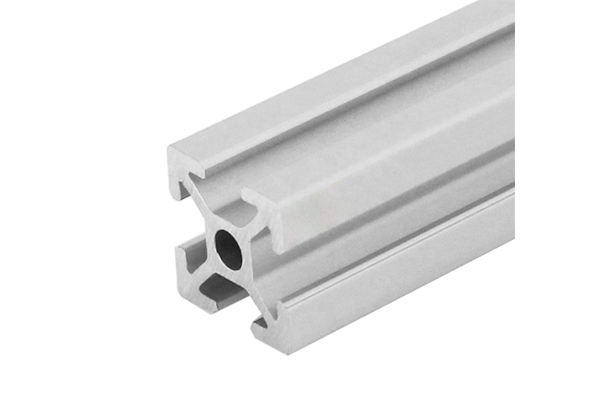
Short answer
2020 names the 20 × 20 mm envelope only. On this site the section ships at 0.38–0.62 kg/m by wall class, with slot variants built around a 6.2 mm groove and 6 mm mouth on a 20 mm pitch (M5 and M6 hardware). Tolerances follow EN 755-9 / GB/T 6892 with wall ±0.15 mm and cut length ±0.5 mm from 6 m stock. Made to order; small trial lengths from stock offcuts. Mill finish typically 2 to 3 weeks, about a week longer for anodising. Reference price band in 2026: $0.42–$1.20 per metre. For how kg/m and Ix sit across the full range, see weight per metre; for what the slot number means, see T-slot dimensions.
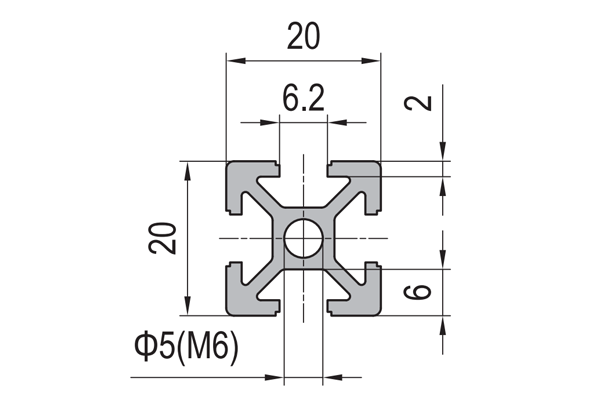
What the numbers mean
“2020” is the outside section in millimetres: 20 mm by 20 mm — not an alloy grade and not a guarantee that every supplier’s slot will take the same nut.
In PG / series naming, the 20 module sets the pitch of faces and connectors. The slot on this site’s 2020 variants uses a 6.2 mm groove with a 6 mm mouth on a 20 mm pitch, taking M5 and M6 T-nuts. Some faces carry one slot; others in the range use multiple grooves on the straight faces. Two 2020 bars that share the outline can still differ in groove depth, lip thickness and core-hole diameter between factories, so hardware fit is a measured slot question, not a name match. Confirm the mouth and groove against slot geometry before mixing brands.
Specification table (by wall thickness)
Six in-range 2020 SKUs collapse into three wall classes; buy against the die kg/m, not the envelope alone.
| Variant | Weight (kg/m) | Slot | Wall | Ix (cm⁰) | Typical use |
|---|---|---|---|---|---|
| Light wall | 0.38–0.45 | 6.2 mm groove, 6 mm mouth; M5/M6 | Light | per die drawing | Instrument ribs, short braces |
| Standard wall | 0.45–0.55 | 6.2 mm groove, 6 mm mouth; 20 mm pitch; M5/M6 | Standard | per die drawing | Lab stands, trial frames |
| Heavy wall | 0.55–0.62 | 6.2 mm groove, 6 mm mouth; 1–4 slots/face class | Heavy | per die drawing | Stiffer short posts, kits |
Mass band for the family is 0.38–0.62 kg/m. Ix scales with wall and web layout; copy the value from the die drawing onto the PO and compare spans on the weight and Ix chart. Slot count per face varies (four-slot square vs fewer grooves on selected faces) inside the same 20 × 20 outline.
What it is typically used for
2020 earns its keep on short, light members where a deeper section would waste mass and cost.
Typical jobs on this site: laboratory instrument stands, spare lengths and offcuts, trial builds, cut-to-size kits, stockholding for maintenance, and optical sub-frames. It also shows up as sensor rails, light panel ribs and adjustable test-rig uprights when spans stay short. Browse live SKUs in the 20 series aluminium profiles category.
Where the limits are
Deflection, not yield, ends the useful life of 2020 as a primary rail once spans and payload leave the light-fixture class.
With Ix on the order of a light 20-series square, a lone 2020 is the wrong primary member for a loaded workbench, machine perimeter, conveyor rail, CNC gantry beam or tall robot-cell fence. Keep unsupported spans short; for bay lengths that matter, step to 3030/4040 or a rectangular beam and check numbers on max span and load. Slot lips sized for M5/M6 are not a substitute for M8 industrial joints on a vibrating base.
Supply facts for RFQs: 6 m stock, cut to list to ±0.5 mm; wall ±0.15 mm under EN 755-9 / GB/T 6892; made to order with small trial lengths from stock offcuts; mill finish typically 2 to 3 weeks, about a week longer for anodising; reference price $0.42–$1.20 (2026).
RFQ checklist — 2020
- Wall class — light / standard / heavy inside 0.38–0.62 kg/m.
- Slot callout — 6.2 mm groove, 6 mm mouth, slot count per face, M5/M6.
- Cut list — lengths to ±0.5 mm from 6 m stock.
- Finish — mill or anodised (add about a week).
- Quantity — production metres vs trial offcuts.
Send the wall class, slot count and cut list. We quote against the die kg/m and EN 755-9 callouts for that 2020 variant.
Related on this site
- Aluminium profile weight per metre — how this section compares across the range
- T-slot dimensions — what the slot number means
- Maximum span and load — the load limit in numbers
- 20 series aluminium profiles — products in this series
Terms used in this article
- 2020
- Nominal 20 × 20 mm T-slot envelope; wall and slot still vary by die.
- kg/m
- Mass per metre; on this site 0.38–0.62 for 2020 by wall class.
- Slot mouth
- Narrow opening of the T-slot; here typically 6 mm on 2020 variants.
- EN 755-9
- Extruded aluminium tolerance standard cited with wall ±0.15 mm on this section.
- Ix
- Second moment of area (cm⁰); take from the die drawing for deflection checks.
Questions buyers ask
Should I use 2020 or a deeper section for a workbench?
Use 2020 only for short braces, panel ribs or light shelves inside a deeper frame. For primary bench rails at about 1 m under useful load, step to 3030 or 4040 — 2020’s low Ix makes flatness the limiter, not yield. See maximum span and load.
Should I use 2020 or a deeper section for a machine frame?
Keep 2020 off the primary machine perimeter. It suits sensor rails, light covers and short ties. Machine uprights and long horizontals need 3030 or 4040 so deflection stays inside L/500 or L/360 under payload.
Should I use 2020 or a deeper section for a robot cell fence?
2020 can work for short panel posts and light mesh frames under about 0.6 m spans. For bay widths near 1 m or where the fence carries doors and cable trays, use 3030 or 4040 as the post and rail.
Should I use 2020 or a deeper section for a conveyor frame?
Not as the main conveyor rail. 2020 is too soft for roller or belt spans that matter; use 4040 or a rectangular 4080 on the strong axis. 2020 remains useful for light side guards and sensor mounts.
Should I use 2020 or a deeper section for a cleanroom equipment frame?
Yes for compact instrument stands and optical sub-frames where spans stay short. For cleanroom benches and taller cabinets, prefer 3030/4040 so the frame stays square under panel and filter mass.
Should I use 2020 or a deeper section for a machine guard?
2020 is acceptable for light local guards and polycarbonate windows on short posts. Full-height perimeter guarding with doors usually needs 3030 or 4040 for post stiffness and M6/M8 hardware capacity.
Should I use 2020 or a deeper section for a CNC router gantry?
Do not use 2020 as the gantry beam. Use a rectangular 4080 (or deeper) with the 80 mm depth in the bending plane. 2020 is fine for light dust covers and cable-chain carriers on the same machine.
Should I use 2020 or a deeper section for a test rig?
Yes for small, hand-movable test fixtures and laboratory instrument stands. When the rig carries actuators or spans past about 0.6–0.8 m under load, move to 3030 so the fixture does not ring or sag.
Open the 20 series range or send a 2020 cut list
Pick the wall class and slot count from the 20 series category, or send lengths and finish for a quote against 0.38–0.62 kg/m.
Request a quoteRelated reading
Twelve more engineering notes from this blog, picked for this article — plus every category below.
 Engineering DesignAluminium Profile Basics: What the Series Numbers and Slot Codes Mean
 Engineering DesignAluminum Corner Brackets for T-Slot Frames: How to Choose by Load Path, Not by Looks
 ApplicationsWhere Modular Aluminium Framing Works: A Load-Tier Map Instead of an Industry List
 Engineering DesignHeavy-Duty T-Slot Hinges and Sliding Door Buffers: Sizing Them with Numbers
 Engineering DesignMetric vs Imperial T-Slot Profiles: How to Test Compatibility Before You Order
 Engineering DesignStandard vs Custom Aluminium Extrusion: The Break-Even Calculation
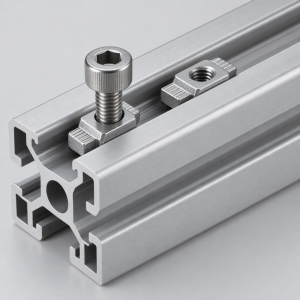 Engineering DesignT-Slot Aluminium: The Slot Mouth Is the Interface Standard, Not the Series Name
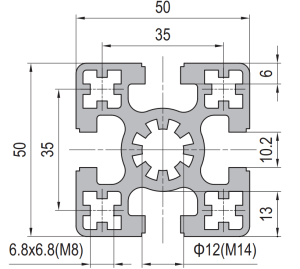 Engineering DesignAluminium Profile Sizes 20 × 20 to 100 × 100: What Fails First
 Quality and InspectionT-Slot Aluminium Profiles for Industrial Frames and Automation: A Specification Playbook
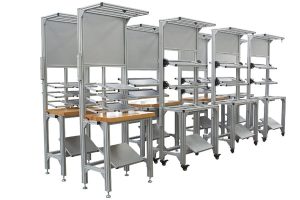 ApplicationsESD-Safe Aluminum Profile Workbenches: Why Anodising Alone Fails the Audit
- Quality and InspectionGlobal Sourcing Excellence: Multi-Category OEM and ODM Manufacturing and Supply Chain Integration
 Quality and InspectionHow to Choose (and Audit) an Aluminium Extrusion Supplier
