Aluminium, Zinc and Nylon Hinges for Machine Doors
A buyer with wide 900 × 1,800 mm machine service doors has a familiar complaint: the standard plastic PA6 hinges flex over time, and the door latch no longer meets the safety switch. They want to standardise on metallic aluminium-profile hinges, and asked three practical questions — extruded or machined aluminium versus die-cast zinc, including radial and axial load per pair on 30, 40 and 45 series; left- and right-hand lift-off hinges so a crew can lift the guard off its pins during a mould change; and whether every hinge includes removable 8 mm and 10 mm anti-rotation slot centering pins, including asymmetric 30-to-40 series pins — then asked us to quote 2,500 pairs.
Short answer
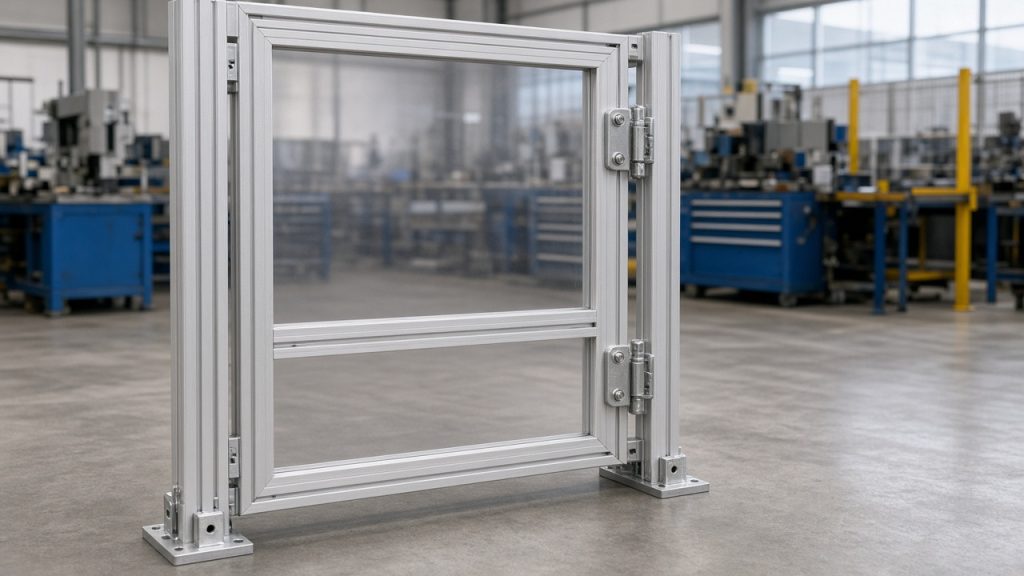
On a 900 × 1,800 mm service door, a PA6 hinge is the wrong body for the long-term load path: the polymer creeps, knuckle clearance adds sag, and the latch misses the interlock. The published metallic options on the 40-series 180° hinge GP-HG-40-180 are die-cast zinc alloy ZAMAK 3 for load — as-cast or black coated — and AISI 304 stainless for washdown; PA6 remains the quiet, lighter-duty body. There is no published extruded or CNC-machined anodised aluminium hinge SKU, and no radial or axial load ratings in kN or N per pair for 30, 40 or 45 series. The listed hinge clamps into the 8 mm slot with M6 T-nuts, two fixings per leaf, adjustable along the slot, without drilling the profile. A backing plate spreads load along 100 mm of slot; a stop block takes the opening load in compression. Hinge count is a stiffness decision, not just a load decision — send the door drawing and we will return a count, a stop-block position and a note on the backing plate. Lift-off left- and right-hand hinges, and removable 8 mm or 10 mm anti-rotation centering pins including asymmetric 30-to-40 pins, are not on that page; they can be quoted to drawing. A 2,500-pair enquiry is priced per body material and per whether the part is the stock 40-series 180° hinge or a custom variant, not as one invented lump sum.
Why PA6 hinges sag on a 900 × 1,800 mm guard door
A 900 × 1,800 mm service door sags on PA6 hinges because the polymer creeps under a sustained moment, and knuckle clearance is the dominant contributor to that sag — not because the M6 bolts were left a turn short.
The mass of the leaf, the panel and any handle sits on a vertical hinge line, and the moment at the knuckles grows with both width and height. PA6 is a viscoelastic polymer: under a constant load it slowly yields, more so in a warm shop or under cyclic opening. The first symptom is rarely a broken leaf. It is a latch that used to hit the safety switch and now sits a few millimetres low or out of line.
A metallic hinge body does not creep in that way. What still matters is play in the knuckle. Our published note on GP-HG-40-180 is direct: knuckle clearance is the dominant contributor to door sag, which is why we check sag on the first assembled door rather than treating a catalogue load figure as a substitute for a built leaf. Guard and interlock assessment remains the machine builder’s scope.
A sliding leaf is a different product. On the 40-series sliding door GP-SD-40, a 40 × 40 rail over 2 m with a 30 kg leaf sags by roughly 9 mm — rail span, not hinge knuckle.
Zinc, stainless, PA6 and machined aluminium: what is listed
The published bodies on GP-HG-40-180 are die-cast zinc alloy ZAMAK 3 for load, PA6 for quiet, and AISI 304 stainless for washdown; there is no published extruded or CNC-machined anodised aluminium hinge SKU.
We die-cast the zinc body, mould the PA6 body, and fabricate the stainless body. The finishes on the page are specific: zinc is as-cast or black coated, PA6 is black, stainless is passivated. None of those is an anodised finish. Anodising belongs on aluminium, and GP-HG-40-180 is not an anodised aluminium extrusion.
A machined aluminium leaf is a reasonable request on a wide door. Aluminium does not exhibit the room-temperature polymer creep that walks a PA6 hinge off line, and a CNC-cut leaf can be made stiff in bending if the drawing calls for it. That is engineering reasoning, not a catalogue claim. If the buyer requires that construction, we will quote an extruded or machined aluminium hinge to the drawing — without inventing a stock code or a kN rating, and without describing the listed zinc or stainless hinge as if it were that part.
| Die-cast zinc, ZAMAK 3 | PA6 polyamide | AISI 304 stainless | Extruded or machined aluminium | |
|---|---|---|---|---|
| Published role | For load | For quiet, lighter-duty leaves | For washdown | Not a listed SKU |
| Finish | As-cast or black coated | Black | Passivated | To-drawing; do not treat GP-HG-40-180 as an anodised extrusion |
| Where it belongs | Wide or heavy 40-series doors | Light, quiet hatches | Washdown cells | Only if a machined aluminium leaf is required |
| Published load rating | None published | None published | None published | None — to-drawing only |
The selection rule
Use PA6 on light, quiet hatches where the leaf is small and the interlock is not fighting millimetres of creep. Use ZAMAK 3 on a wide or heavy 40-series guard door, and AISI 304 where the cell is washed down. A machined aluminium leaf is a to-drawing item, only when that construction is required.
The stiffness path when no load table is published
We publish no radial or axial load ratings in kN or N per pair for 30, 40 or 45 series metallic hinges, so the selection is a stiffness path: body material, hinge count, a backing plate over 100 mm of slot, and a stop block in compression.
We will not invent a load table. Capacity on a T-slot door is limited by the leaf, the knuckle, the T-nuts in the 8 mm slot, and how far the door mass sits from the hinge line. A single number in kN would hide all of that.
Choose zinc or stainless rather than PA6. Treat hinge count as a stiffness decision, not just a load decision — a third hinge on an 1,800 mm leaf is often there to cut deflection, not because two hinges would tear out. A backing plate, where specified, spreads the load along 100 mm of slot. A stop block takes the open door in compression, rather than leaving a bending load on the knuckles at the end of travel. Send the door drawing and we will return a hinge count, a stop-block position, and a note on the backing plate. Sag is checked on the first assembled door.
The listed hinge is 40 series, 8 mm slot, M6 T-nuts only. We do not have a published 30-series or 45-series (10 mm slot) hinge page; those versions are to-drawing, not stock codes. Series and slot conventions for the surrounding frame are covered in the metric T-slot series guide and in building with T-slot aluminium.
How GP-HG-40-180 clamps into the 8 mm slot
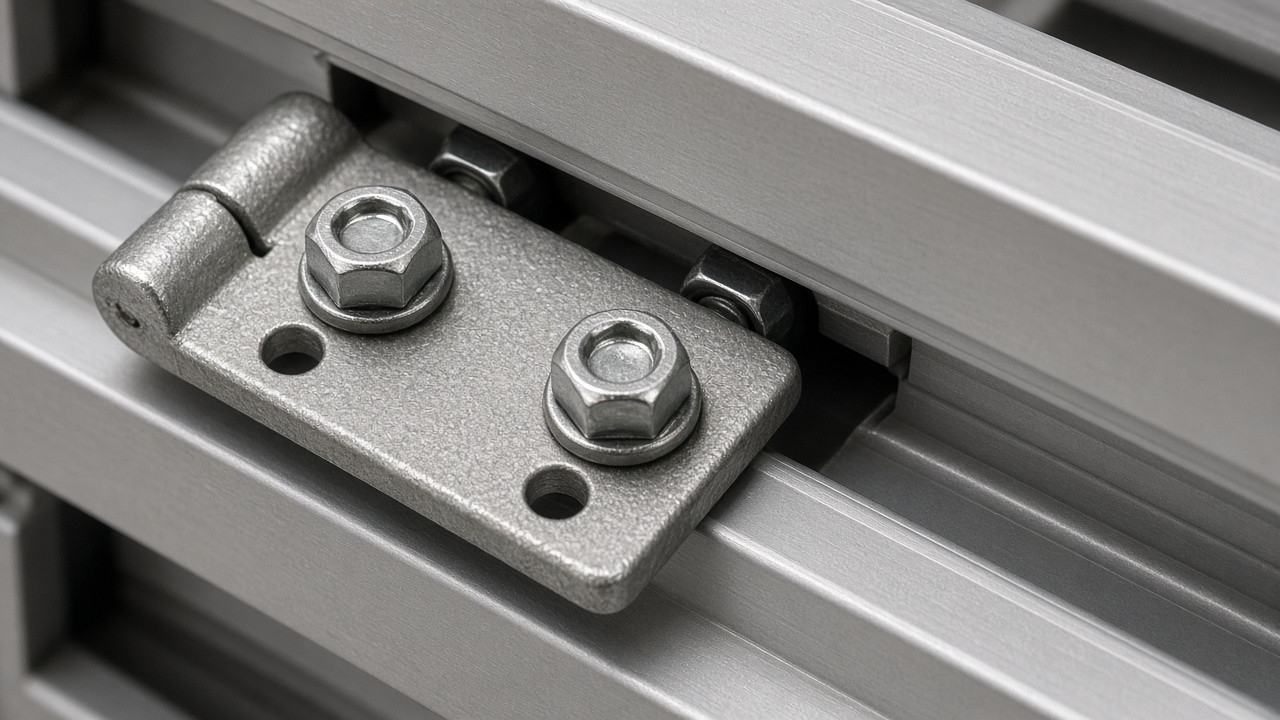
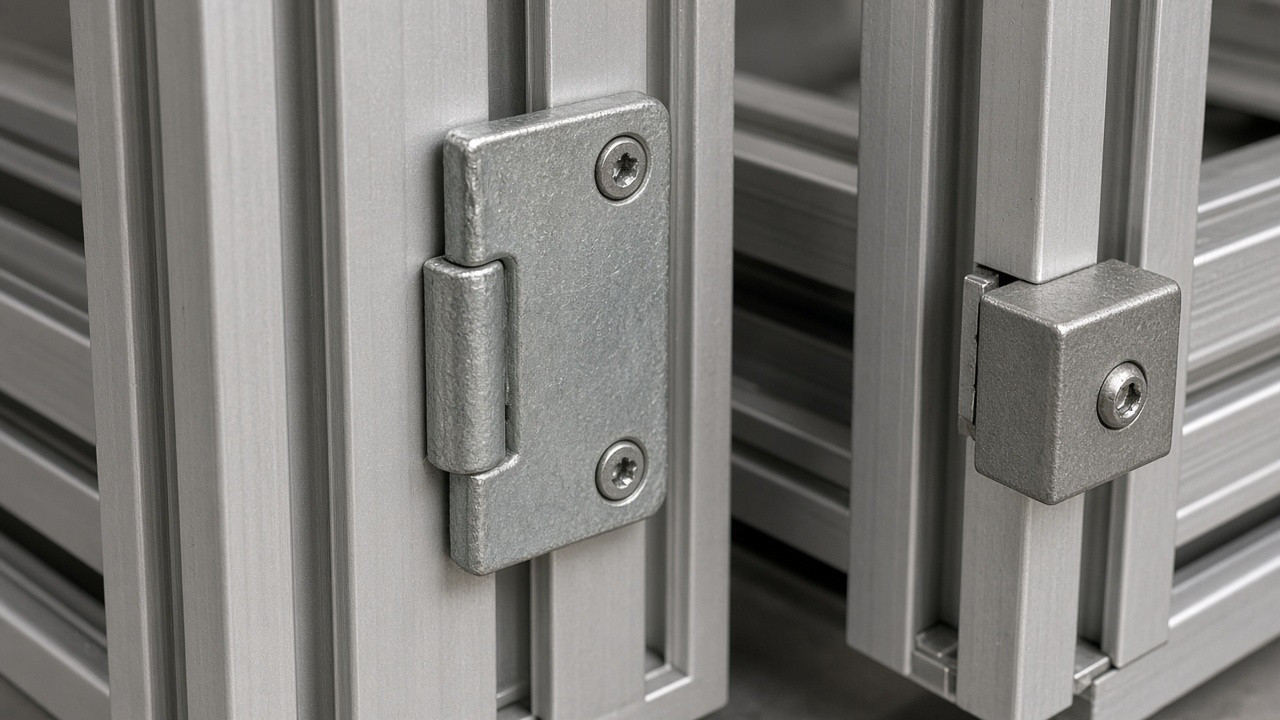
Two leaves clamp into the 40-series 8 mm slot with M6 T-nuts — two fixings per leaf — so the hinge can be adjusted along the slot after assembly and the profile does not need to be drilled.
That is the published location method, and it is the same T-nut logic used when joining aluminium profiles without drilling the extrusion. The opening is 180°, so the door can lie flat against the frame — useful on a service door that has to clear a tool change even when it is not a lift-off design. The zinc die-cast hinge weighs about 0.35 kg each.
We can supply the hinge together with profile cut to the door drawing, so the door frame and the hinge arrive as one kit. Hinges are bagged by door set with the matching fixings. Frame cut length is to ±0.5 mm; hinge position stays adjustable in the slot. Drawings are available as PDF, DWG, DXF, STEP or IGES on request; overview PDFs sit on the downloads page, which is not a public library of unlisted lift-off or pin variants.
When a lift-off hinge is the right geometry
A lift-off, or detachable, hinge is the right geometry when a crew must lift the entire 900 × 1,800 mm guard off its pins during a mould change, but left- and right-hand lift-off aluminium hinges are not listed on the GP-HG-40-180 page and are quoted to drawing.
The industry logic is simple. One half of the hinge — usually the pin — stays on the frame post; the matching half stays on the door. Once the latch is released, the door lifts vertically off the pins and can be carried or crane-lifted clear of the machine. Handing matters: a left-hand and a right-hand pair have to be specified so the pins point the same way and the leaf comes off without binding.
The listed 180° hinge is not that mechanism. We will not invent a pin diameter, a handing SKU or a lift-off load rating. If the enquiry needs a lift-off pair, send the door drawing, the handing, and how the crew intends to lift the leaf. We will quote the detachable hinge to that drawing, in the body material the duty requires, and keep it separate from the stock GP-HG-40-180 line.
Anti-rotation slot centering pins versus M6 T-nuts
Removable 8 mm and 10 mm anti-rotation slot centering pins, including asymmetric 30-to-40 series pins, are not a standard inclusion on the listed hinge; the published location method is two M6 T-nuts per leaf in the 8 mm slot.
A centering pin that drops into the T-slot does two useful jobs. It stops the leaf rotating about a single bolt while the second fixing is tightened, and it locates the hinge so the door edge — and therefore the latch or tongue — repeats in the same place after a removal. On a mixed frame, with one leaf on a 30-series slot and the other on a 40-series slot, an asymmetric pin would also make up the difference in slot or face offset so the knuckles still line up.
Those pins are a to-drawing request, not a feature we list on GP-HG-40-180. We will not invent pin diameters as if they were catalogue dimensions, and we will not say that every hinge ships with them. If the door set needs pins — same-series or mixed-series — say so on the drawing and we will quote them with the hinge. Interlock assessment remains the machine builder’s scope; the pin, like the T-nut and the stop block, only keeps the assembled geometry from walking.
How 2,500 pairs are quoted in 2026
A 2,500-pair enquiry in 2026 is quoted per body material and per whether the part is the 40-series 180° stock hinge or a custom lift-off, pin, 30-series or 45-series variant — not as one invented lump-sum price.
There is no fixed minimum order. Hinges are priced per hinge or per door set against body material and quantity, with steps at sample, door set and production quantity. Stock hinges ship in about a week; frame kits take 2 to 3 weeks plus finish. Material declaration and RoHS or REACH documents are available on request. The guard as a whole is assessed by the machine builder.
Send this and the first quote will be usable
- Door size and mass: the 900 × 1,800 mm leaf, panel material, and any handle or switch weight.
- Profile series and slot. The listed hinge is 40 series, 8 mm slot, M6 T-nuts; 30-series or 45-series / Slot-10 is to-drawing.
- Body: ZAMAK 3 as-cast or black coated, black PA6, or passivated AISI 304. Machined aluminium only if that construction is required.
- Whether the door must lift off its pins during mould changes, and the handing of each leaf.
- Whether anti-rotation centering pins are required, including any mixed 30-to-40 leaves.
- Whether the door frame is kitted with the hinges, and whether a sample door is needed before the 2,500-pair release.
Related on this site
- What is listed on the 40-series 180° aluminium profile hinge?
- When is a 40-series sliding door a better access leaf than a hinged guard?
- How do you join T-slot aluminium profiles without drilling?
- What matters when you build frames and hardware in T-slot aluminium?
- How do the 15- to 60-series metric T-slot profiles differ?
- Which end caps and slot covers finish a T-slot door frame?
- Where are the overview PDFs, and how do I request a STEP or DXF?
Terms used
- Knuckle clearance
- Play in the hinge pivot. On GP-HG-40-180 it is the dominant contributor to door sag, checked on the first assembled door.
- Lift-off hinge
- A detachable hinge whose door half lifts off a pin that stays on the frame, so a crew can remove the guard during a mould change. Not listed on GP-HG-40-180; quoted to drawing.
- ZAMAK 3
- The published die-cast zinc alloy for the load-bearing body of GP-HG-40-180. Finish is as-cast or black coated, not anodised.
- PA6
- Polyamide 6, the published quiet, lighter-duty hinge body, supplied in black. It creeps under a sustained moment on a wide door.
- Backing plate
- An optional plate that spreads the hinge clamp load along 100 mm of slot.
- Door stop block
- An optional block that takes the open door in compression, so the knuckles are not left carrying the leaf in bending at end of travel.
- Anti-rotation centering pin
- A pin that locates a hinge leaf in the T-slot and resists rotation while the fixings are tightened. 8 mm, 10 mm and asymmetric 30-to-40 pins are to-drawing, not standard on the listed hinge.
Questions buyers ask
How do aluminium, PA6 nylon and zinc die-cast hinges compare for load on a wide guard door?
On a 900 × 1,800 mm door, use ZAMAK 3 for load or AISI 304 for washdown, not PA6, which creeps under a sustained moment. There is no published extruded or CNC-machined anodised aluminium hinge SKU; that construction is quoted to drawing if required. We publish no kN or N ratings. Add hinges for stiffness, a backing plate, a stop block in compression, and a sag check on the first door.
When should I use lift-off (detachable) hinges on a T-slot machine-guard door?
When the crew must lift the entire guard off its pins during a mould change. The pin stays on the frame, the door half lifts off, and left- and right-hand parts are specified together. That geometry is not listed on GP-HG-40-180 and is quoted to drawing, without an invented pin diameter, handing SKU or lift-off load rating.
How do anti-rotation slot centering pins keep a hinge aligned with a safety interlock?
A pin in the slot stops the leaf rotating about one bolt and helps the door edge — and the latch or tongue — repeat after a removal. Asymmetric 30-to-40 pins would also line up mixed-series leaves. Pins are not standard on the listed hinge; the published method is two M6 T-nuts per leaf in the 8 mm slot. Interlock assessment remains the machine builder’s scope.
Do you publish radial and axial load ratings per pair for 30, 40 and 45 series hinges?
No, and we will not invent a table in kN or N. The listed hinge is 40 series, 8 mm slot, M6 T-nuts; 30-series and 45-series (10 mm slot) versions are to-drawing. Send the door drawing and we will return a hinge count, a stop-block position and a note on the backing plate.
What is actually listed on GP-HG-40-180, and how is a 2,500-pair order quoted in 2026?
A 180° hinge for 40-series doors: two leaves in the 8 mm slot, M6 T-nuts, two fixings per leaf, no drilling. Bodies are ZAMAK 3, PA6 or AISI 304, about 0.35 kg each in zinc die-cast. A 2,500-pair enquiry is quoted per body material and per whether the part is this stock hinge or a custom lift-off, pin, 30-series or 45-series variant, not as a lump sum. No fixed minimum; stock hinges ship in about a week; frame kits take 2 to 3 weeks plus finish.
Also searched as: aluminium profile hinges, die-cast zinc T-slot hinges, PA6 nylon guard-door hinges, ZAMAK 3 vs PA6 vs AISI 304, 40-series 180 degree hinge, lift-off detachable machine-guard hinges, anti-rotation T-slot hinge pins, 8 mm slot M6 T-nut hinge, 900 × 1,800 mm guard door sag
Send the door drawing, the series and how the leaf must come off
Tell us the door size and mass, the profile series and slot, the body material, whether the crew must lift the door off its pins during a mould change, and whether centering pins or mixed 30-to-40 leaves are required. You will get a written offer on the listed 40-series 180° hinge, or a to-drawing path for a lift-off, pin or other-series variant — with a hinge count, stop-block position and backing-plate note, not an invented load table or lump-sum price.
Request a hinge and door-kit quoteRelated reading
Twelve more engineering notes from this blog, picked for this article — plus every category below.
 Machine SafetyAluminium Profile Machine Guards: Size the Frame from the Energy, Not from the Mesh
 Engineering DesignT-Slot vs V-Slot Aluminium Profiles: The V Is a Raceway, Not a Cheaper T
 Engineering DesignAluminium Profile Sizes 20 × 20 to 100 × 100: What Fails First
 Engineering DesignHeavy-Duty T-Slot Hinges and Sliding Door Buffers: Sizing Them with Numbers
 Engineering DesignCross-Brand T-Slot Compatibility: Interchangeability Is a Hardware Question
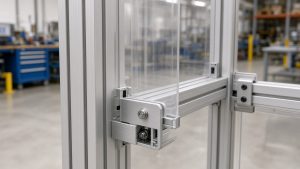 ApplicationsHow to Fix Panels, Guards and Accessories to Aluminium Profiles
 ApplicationsAluminium Partitions: The Three Performance Numbers Behind the Aesthetic
 ApplicationsLean Pipe vs T-Slot Profile: Two Interface Philosophies, Not Two Generations
 Sourcing and ProcurementAuditing an Aluminium Profile Supplier: Factory, Trader, or Something in Between
 Sourcing and ProcurementAluminium Profile MOQ: 150 m Existing Die, 500 m New
 Quality and InspectionHow to Choose (and Audit) an Aluminium Extrusion Supplier
 ApplicationsAluminium Profile for LED Strips: A Heat Sink First, a Housing Second