T-Slot vs V-Slot Aluminium Profiles: The V Is a Raceway, Not a Cheaper T
V-slot profile looks like T-slot profile with a different groove shape. It is not. The V is a running surface for wheels, and a section designed to guide a wheel is making a different set of compromises from one designed to clamp a nut.
Short answer
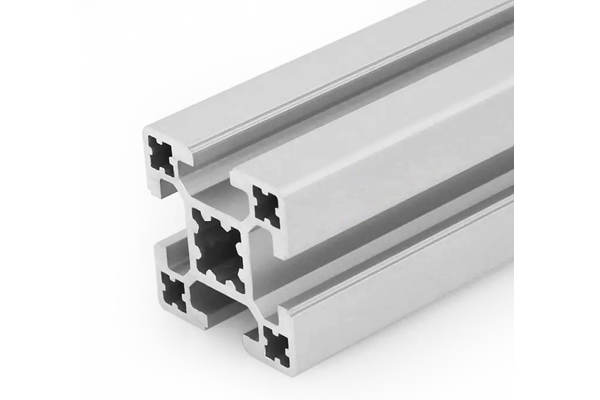
A T-slot groove is a clamping interface: a nut slides in, rotates or seats, and a bolt torques against it to make a rigid joint. A V-slot groove is a bearing race: a polymer or steel wheel with a matching V rides in it and rolls along the length. V-slot is chosen when something has to move along the profile, T-slot when something has to stay put. The load capacity of a V-slot joint is set by the wheel, not by the extrusion, and it is far lower than a bolted T-slot node.
Two geometries doing two jobs
The confusion is understandable because both are aluminium extrusions with a longitudinal groove, both come in 20x20 and 20x40 sizes, and both are sold by the same distributors. The functional difference is where the load goes.
In a T-slot, the load path runs from the member into the groove walls, into the nut, and out through the bolt. The groove walls are in bearing, the nut is in shear, and the bolt is in tension. That is a stiff, high-capacity path, which is why T-slot became the standard for machine frames.
In a V-slot, the load path runs from the member into the angled faces of the V, into a wheel, and out through the wheel’s axle. The contact is a narrow band on each face of the V, the wheel is a bearing with its own load rating, and the assembly is designed to roll. That is a compliant, low-capacity path, and it is exactly what a linear axis needs.
| Aspect | T-slot | V-slot |
|---|---|---|
| Groove shape | Rectangular cavity with a narrower mouth | Open V, typically 90° included angle |
| What fits it | T-nut, sliding nut, T-bolt, hammer nut | V-wheel, typically polymer or steel |
| Joint type | Clamped, rigid, torque-controlled | Rolling, guided, preload-controlled |
| Capacity set by | Bolt size and groove wall | Wheel load rating and preload |
| Typical use | Machine frames, guards, workstations | Linear axes, gantries, printers, light doors |
| Reconfiguration | Unbolt and re-clamp anywhere | Re-tension and re-tram the wheels |
Why a V-slot joint carries less
Three reasons, and all of them are geometric rather than material.
First, the contact area. A T-nut bears on the flat faces of the groove across its full width. A V-wheel contacts two narrow bands on the angled faces. For the same normal force, the contact pressure on the V is far higher, and aluminium under high local contact pressure deforms and then frets.
Second, the load rating moves outside the extrusion. A bolted T-slot node fails in the bolt or in the groove wall, both of which are sized by the designer. A V-wheel node fails in a bearing whose rating was chosen by someone else, and that rating is usually quoted for a very different duty cycle than the one the machine will see.
Third, preload. A T-slot joint is clamped once and stays clamped. A V-wheel carriage has to be preloaded enough to stay on the rail and loose enough to roll, and that window is narrow. Too little preload and the carriage rocks; too much and the wheel wears flat and the aluminium face frets.
The symptom of a V-slot pushed into a T-slot job
Black dust under the wheels. It is aluminium oxide and polymer wear, and it means the contact pressure exceeded what the V face can take. The joint will develop play and the axis will lose repeatability long before anything visibly bends.
Where V-slot is genuinely the right answer
V-slot is not an inferior product. It is the correct answer for a specific and growing set of applications, and in those applications T-slot is the wrong choice.
USE 1
Linear axes and gantries. A carriage that must move along the member, where the profile is both structure and rail.
USE 2
Desktop machines. Printers, small routers and plotters, where loads are low and cost matters.
USE 3
Sliding panels and doors. Light guards and access panels that must slide rather than hinge.
USE 4
Adjustable fixtures. Jigs that are repositioned often, where a wheel beats a wrench.
The common thread is motion along the member. If the requirement includes “and it moves”, V-slot deserves a look. If the requirement is “and it stays exactly there under load”, it does not.
- Something rolls along the profile
- Loads are light and the duty cycle is gentle
- Repositioning happens often and must be tool-free
- Cost and part count matter more than rigidity
- The joint must be rigid and torqued
- The node carries a real moment
- Vibration or shock is present
- Repeatability matters more than repositioning speed
The traps in mixing them
Because the two profiles look similar and are stocked side by side, they end up in the same frame more often than they should. The problems that follow are not dramatic; they are the slow kind that show up as lost accuracy.
The first trap is hardware. A T-nut does not seat in a V; a V-wheel does not run in a T. Anything that has to span between the two sections needs an adapter, and the adapter becomes the least stiff part of the frame.
The second trap is assumed interchangeability of the outer dimension. A 20x40 V-slot and a 20x40 T-slot have the same envelope, so a drawing that says “20x40 extrusion” is ambiguous. Whoever picks up the drawing will pick one, and if they pick the other, half the hardware will not fit.
The third trap is stiffness mismatch. A frame with T-slot uprights and a V-slot cross rail has a rigid leg and a compliant beam. Under load the beam rolls slightly at its carriage, and the deflection appears where nobody calculated it.
Four ways the mix goes wrong
What to specify
Both profile types are specified by the same categories, but the decisive numbers differ. For T-slot it is the groove and mouth width. For V-slot it is the included angle and the wheel that will run in it.
RFQ checklist — state the profile type
Start with the type, then the numbers:
- Profile type — T-slot or V-slot, written next to every section dimension on the drawing.
- For T-slot: groove width, mouth width, groove depth, slot pitch, wall thickness at the groove.
- For V-slot: included angle of the V, groove depth, and the wheel diameter and material it must accept.
- Wheel specification — for V-slot, the load rating and duty cycle the wheel must meet, not just its size.
- Alloy and temper — 6063-T5 is typical; check the wall thickness at the groove for the expected preload.
- Surface treatment — note that hard anodising changes the V face geometry and the wheel fit.
- Duty cycle — for any rolling application, cycles per day and the load during them.
For a moving axis, send the wheel you intend to use. Fit and preload are geometry questions, and a sample settles them faster than a drawing note.
Checks before release
- Every section dimension on the drawing carries the words T-slot or V-slot.
- Wheel load rating checked against the peak load, not the average.
- Wheel material compatible with the surface finish specified.
- Preload method defined and re-checkable after service.
- One hardware inventory, or a documented adapter at every mixed interface.
Related on this site
- 40 x 40 eight-slot strut profile— a high slot-density T-slot section
- T-nut for aluminium profiles— what actually seats in a T groove
- 40 series aluminium profiles— the T-slot series range
- T-slot profiles in automation, and when not to use them— where T-slot framing stops being the answer
Terms used in this article
- Raceway
- A formed surface on which a rolling element runs. In V-slot the V faces are the raceway.
- Included angle
- The angle between the two faces of the V, commonly 90°.
- Preload
- The controlled force pressing a wheel into its race; too little rocks, too much frets.
- Fretting
- Surface damage from small repeated sliding movements, producing oxide debris.
- Duty cycle
- How often and how heavily a moving element is loaded; sets the bearing life.
Questions buyers ask
Is V-slot just a cheaper version of T-slot?
No. It is a different function. V-slot carries a rolling wheel and is used where something moves along the profile; T-slot clamps a nut and is used where a joint must stay rigid. They are not grades of the same product.
Can I put T-nuts in a V-slot profile?
Some V-slot sections have a central T-shaped cavity as well as the external V faces, so it depends on the specific section. Check whether the section has an internal T cavity before assuming hardware compatibility.
How much load can a V-wheel carriage take?
It is set by the wheel bearing rating and the preload, not by the extrusion. Ask for the wheel’s dynamic load rating and check it against your peak load and duty cycle; do not infer it from the profile size.
Why does my V-slot axis lose accuracy over time?
Usually wheel wear or loss of preload. Look for oxide or polymer dust under the wheels. Set the preload to a defined value and re-check it on a service interval.
Can I build a machine frame entirely from V-slot?
You can, and it is done for light machines. But every structural node is then a rolling contact instead of a clamped joint, so rigidity and vibration behaviour will be much worse than a T-slot frame of the same size.
Tell us whether it moves or stays
If something rolls along the member we will quote V-slot with the wheel rating checked. If it must stay rigid we will quote T-slot with the node counted.
Request a quoteRelated reading
Twelve more engineering notes from this blog, picked for this article — plus every category below.
 Engineering DesignT-Slot Aluminum Profile Connectors: What Each Type Is Actually Good At
 Engineering Design4080 vs 4545 Aluminium Profile: Which for Your Frame
 ApplicationsWhy T-Slot Aluminium Profiles Are Used in Automation and When They Are Not
 Engineering Design6061-T5 vs 6063-T5: What the Temper Label Really Decides
 Applications40×40 Aluminium Profile: Where It Works, Where It Fails, and Why
 ApplicationsLean Pipe vs T-Slot Profile: Two Interface Philosophies, Not Two Generations
 Engineering DesignPrecision Cutting and Tapping of Aluminium Profiles: The Tolerance That Actually Matters
 Engineering Design3030 vs 4040 Aluminium Profile: A Decision With Numbers
 Sourcing and ProcurementAluminium Profile MOQ: 150 m Existing Die, 500 m New
 Materials and EngineeringIndustrial Aluminum Profiles: Alloys, Tempers and How to Select Them
 Quality and InspectionHow to Choose (and Audit) an Aluminium Extrusion Supplier
- Materials and Engineering6063-T5 Aluminium Profile: What the Designation Actually Guarantees
