Automation framing · material choice
Why T-Slot Aluminium Profiles Are Used in Automation and When They Are Not
The usual answer is that aluminium is lighter and just as stiff. That is half right, and the half that is wrong is the half that decides projects. Aluminium and steel have almost identical stiffness per kilogram, so what you are actually buying with a T-slot frame is depth and reconfigurability. Here are the numbers, and the four cases where steel still wins.
Quick answer
- The material is a wash. Aluminium has about one third of the modulus of steel and about one third of the density, so stiffness per kilogram comes out at 25.9 against 26.8 kN·m/kg — within 3 per cent.
- So the advantage is not the material, it is the depth. Because stiffness rises with the fourth power of section depth, a 40 × 40 aluminium member matches a 30 × 30 steel one. Aluminium wins when you can afford the depth and steel wins when you cannot.
- The real limit of a T-slot frame is the bolted joint, not the member. A friction grip only resists slip up to the friction coefficient times the clamp load the slot lips can sustain — roughly 0.3 to 0.45 kN per M8 joint in a 40 series slot.
- Four cases where steel is still right: a depth-constrained member, a load that reverses often enough to work a friction joint loose, service above about 150 °C, and a volume high enough that a welded frame is simply cheaper.
- Aluminium moves 1.9 times as much as steel when the temperature changes. 23.1 against 12.0 µm/m·K. Over 3 m and 10 K that is 0.69 mm against 0.36 mm — enough to matter on a measurement frame and irrelevant on a guard.
- The hybrid is usually the best answer: an aluminium superstructure on a steel or concrete base, with isolating washers at every steel-to-aluminium interface.
Also searched as t slot aluminium profiles automation, why use aluminium profiles in automation, aluminium extrusion vs steel frame, t-slot profile machine frame, modular aluminium framing, aluminium profile automation equipment.
The claim that never gets tested
Every guide to aluminium framing in automation repeats the same sentence in some form: aluminium is light, and it has a better strength-to-weight ratio than steel. The first half is unarguable. The second half is where the trouble starts, because the sentence is used to imply something it does not say — that a lighter frame will be as stiff.
It will not. Two properties matter, and they move together.
| Property | 6063-T5 aluminium | Structural steel | Ratio, Al : steel |
|---|---|---|---|
| Young’s modulus E | 70,000 N/mm² | 210,000 N/mm² | 1 : 3.0 |
| Density ρ | 2.70 g/cm³ | 7.85 g/cm³ | 1 : 2.9 |
| Stiffness per unit mass, E/ρ | 25.9 kN·m/kg | 26.8 kN·m/kg | 0.97 : 1 |
| Thermal expansion α | 23.1 µm/m·K | 12.0 µm/m·K | 1.9 : 1 |
| Yield stress, typical section | 110 MPa (T5) | 235 MPa (S235) | 1 : 2.1 |
The third row is the one that matters and it is the one nobody quotes. Aluminium is three times softer and roughly three times lighter, and the two effects cancel almost exactly. A kilogram of aluminium and a kilogram of steel, formed into geometrically similar sections, carry the same load at the same deflection. Aluminium is not a better structural material. It is a different one.
What you are actually buying
When you buy a T-slot aluminium frame you are not buying a superior material. You are buying the ability to put depth where the load is, cheaply and without welding: an extrusion die can produce a 60 × 60 closed section with internal slots and a centre bore at a cost per metre that a fabricated steel box of the same complexity cannot approach. That is the whole advantage, and it is a real one.
What the depth ratio means in practice
For a hollow square section, the second moment of area scales roughly with the fourth power of the depth. Matching a steel section with an aluminium one therefore needs a depth increase of the fourth root of the modulus ratio.
The one ratio worth memorising
a(Al) / a(steel) = (210,000 / 70,000)^(1/4) = 1.32A 40 mm aluminium square is the stiffness equivalent of a 30.4 mm steel square. A 53 mm aluminium square matches a 40 mm steel square. This is why a 40 × 40 T-slot profile feels substantial next to a 30 mm steel box and why a 60 × 60 aluminium member is not an oversized choice for a machine that would otherwise use 45 mm steel.
Two consequences follow, and they pull in opposite directions.
Where aluminium wins: anywhere the member has room to grow. A machine base, a conveyor support, a robot pedestal, a gantry beam, a guard frame — in all of these the depth is available and the aluminium section is lighter at equal stiffness, because a lighter member is also a smaller load to carry, to move and to mount. On a moving axis, that feedback loop is worth more than the raw number suggests: a lighter gantry beam needs a smaller drive, which needs a smaller frame.
Where aluminium loses: anywhere the depth is fixed by something else. A conveyor rail that must fit under a 100 mm product, a low-profile transfer unit, a member that has to pass through an existing opening, a frame whose overall height is set by an operator’s reach envelope. If the depth is capped, the aluminium member is simply three times more flexible than the steel one it replaced, and no amount of engineering around the rest of the frame recovers that.
The joint, not the member, is the limit
This is the part of the aluminium-versus-steel argument that is genuinely under-discussed, and it decides more projects than the modulus does. A welded steel frame is one continuous piece of material. A T-slot frame is a set of members held together by friction, and friction has a limit that is much lower than most people assume.
The clamp load in a T-slot joint is not the bolt’s preload. It is limited by the slot lips the nut head bears on. Our published pull-out figure for an M8 T-nut in a 40 series slot is 1.5 to 2.2 kN per nut. Take the friction available to resist slip as the coefficient of friction times that figure — around 0.15 to 0.2 for aluminium on aluminium — and the working slip resistance of one joint comes out at roughly 0.3 to 0.45 kN.
| Fastener | Slot | Torque ceiling | Pull-out per fastener | Working slip resistance, one joint |
|---|---|---|---|---|
| M6 T-nut, 30 series | 8 mm | approx. 6 N·m | 600 – 900 N | approx. 0.12 – 0.18 kN |
| M8 T-nut, 40 series | 8 mm | approx. 15 N·m | 1.5 – 2.2 kN | approx. 0.30 – 0.45 kN |
| M8 square nut, 40 series | 8 mm | 15 – 20 N·m | not published | Larger bearing face; better for vibration |
| Anchor connector, 40 series | 8 mm | to the bolt class | not published | Load is carried by the connector body, not by friction |
Read the last column and the design rule writes itself. A static load of 400 N in shear on a single M8 joint is fine. The same 400 N reversing ten times a second for a year is not, because the joint sits at its slip threshold and walks. In practice this is why vibration-heavy automation equipment uses square nuts, anti-torsion nuts or anchor connectors rather than relying on a plain T-nut friction joint, and it is why a bolted frame needs a torque re-check after the first week of running.
The mistake that looks like a design success
A frame that passes a static load test and fails after three months of production has almost always failed at the joints, not at the members. If your load reverses, or if the equipment has a reciprocating axis, design the joint for the reversing component separately and use a connector that carries load in bearing rather than in friction.
Four cases where steel is still the right answer
The depth is capped
If the member has to fit inside a fixed envelope, the aluminium section is three times more flexible at the same size. This is common on conveyor rails, low-profile transfer units and anything that has to pass under a product or through an existing opening. The honest answer is a steel member, or a redesign of the envelope.
The load reverses
A friction joint has a slip threshold of a few hundred newtons. A reversing or reciprocating load that exceeds it will move the joint, and a moved joint loses preload and then loosens. Steel with welded or heavily bolted connections handles this without a second thought; a T-slot frame needs square nuts, anti-torsion nuts, thread locking or bearing-type connectors to match.
Service above about 150 °C
6063-T5 is a room-temperature temper. Prolonged exposure above roughly 150 °C causes overageing and a gradual loss of the properties the T5 designation was bought for. Steel does not care. If the frame is near a heat source, a furnace, an oven or a hot process, the temper is a service condition, not a purchase detail.
The volume is high and the design is frozen
Reconfigurability is what you are paying for, and it has no value on a machine that will never be changed. At high volume with a stable design, a welded steel frame is cheaper per unit, and an extrusion die amortised over a few hundred metres of profile is not. Aluminium wins on the first machine and on every change after it; steel wins on the thousandth identical one.
There is a fifth case that is less about structure and more about interfaces: steel structures and aluminium structures joined together in a wet or humid environment. Aluminium is anodic to steel and to stainless steel, so a steel fastener in an aluminium frame with moisture present will drive a galvanic couple and corrode the aluminium. It is manageable — isolating washers, coated fasteners, a dry environment, or a zinc-plated interface — but it has to be designed, not discovered.
What T-slot framing is genuinely unbeatable at
The material argument is a wash, so the case for aluminium framing in automation has to rest on everything else. It does, comfortably, and these are the four reasons it dominates the sector.
Reconfiguration without fabrication
A machine that has to gain a sensor, a safety door, a camera bracket or a new conveyor module next quarter can be modified with a hex key. No cutting, no welding, no repainting, no re-certification of a coating. On a production floor, the value of that is measured in downtime, not in material cost.
No hot work
Welding a frame means spatter, distortion, a heat-affected zone and a finishing operation. In a cleanroom, a food plant, a pharmaceutical suite or a paint shop, hot work is not merely inconvenient, it is often prohibited. A bolted frame arrives clean and stays clean.
No heat-affected zone
Welding 6063-T6 in the heat-affected zone leaves roughly 61 per cent of the parent strength, which is why a welded aluminium frame is not the same structure as a bolted one. Bolted joints keep the temper the extrusion was sold with.
Moving mass, and everything downstream of it
On a gantry, a moving portal or a robot axis, the frame mass is part of the payload. A lighter structure needs a smaller drive, a smaller gearbox and a lighter base, and the saving compounds. This is where aluminium framing is not merely competitive but structurally superior.
Five applications, and what each one actually asks of the frame
The application lists in most guides are interchangeable: machine frames, robot cells, conveyors, guarding, workstations, and the same six bullets under each. The useful version of that list asks a different question — what does this application demand of the structure that the others do not. Answer that and the sizing follows.
| Application | What the frame is really being asked for | The number that decides it |
|---|---|---|
| Machine frames | Damping and thermal stability more than raw stiffness. A bolted frame has many interfaces, and interfaces dissipate energy, which helps with chatter and hurts nothing until a joint creeps. | Cutting force 500 – 2,000 N on a small CNC; the frame has to hold the tool path to the machine’s accuracy spec |
| Robot cells | Rotational stiffness at the base, because a base rotation becomes a positioning error at the tool, multiplied by the reach. | 0.1 mrad of base rotation = 0.1 mm at 1,000 mm reach |
| Conveyor supports | Height consistency along the line and adjustability, not load capacity. A conveyor bed that steps 2 mm between supports will track badly however strong the frame is. | Height tolerance between adjacent supports, typically ±0.5 mm |
| Machine guarding | Panel retention and door alignment. The frame carries the panel’s wind and impact load and the door’s mass, not the machine’s load — so it is usually sized by the panel, not by the process. | Safety distances and impact per ISO 14120 and ISO 13857 |
| Assembly workstations | Ergonomics and reconfiguration. The structural load is small; the requirement is a height range, accessory positions and a surface that can be changed without rebuilding. | Working height range and the accessory load, typically 20 – 50 kg |
Notice how few of those rows are about strength. Only the machine frame and the robot cell are genuinely structural problems, and even there the binding requirement is a stiffness or a stability figure rather than a stress figure. The other three are geometry problems that a T-slot frame solves extremely well, which is a large part of why aluminium framing took over the sector — not because it is stronger, but because most of the applications were never strength-limited in the first place.
The decision table
Five questions, asked in this order, resolve most automation framing choices.
| Question | If yes | If no |
|---|---|---|
| Is the section depth free to grow? | T-slot aluminium is a good fit | Steel, or redesign the envelope |
| Does the design change more than once a year? | T-slot aluminium, decisively | Neither material is favoured by this alone |
| Does the load reverse, or is there a reciprocating axis? | Aluminium is possible, with bearing-type connectors and a torque plan | T-slot aluminium with plain T-nuts is fine |
| Is the service temperature above about 150 °C? | Steel | Aluminium, in 6063-T5 |
| Is the annual volume in the hundreds of identical units? | Steel, or a dedicated aluminium die if the section is worth it | T-slot aluminium from stock |
Hybrid frames, and why they are usually the answer
The question is rarely aluminium or steel. It is which parts of the structure need depth and which parts need mass. A very common and very effective arrangement is an aluminium superstructure — the guard frame, the operator interfaces, the sensor mounting, the cable routing, the panel frames — sitting on a steel or concrete base that provides the mass and the anchorage. The aluminium part gets all the benefits of reconfiguration and no hot work; the base gets the stiffness, the damping and the low centre of gravity.
Two details make the hybrid work. First, put an isolating washer or a coated fastener at every aluminium-to-steel interface, and keep the joint dry, so the galvanic couple has no electrolyte. Second, decide which structure is the datum. Two frames bolted together are one frame, and the alignment of the whole assembly will follow whichever one was built square.
Four numbers on the drawing
Span, load with its position, deflection limit, and the reversing component of the load at the joints. The first three size the member. The fourth decides the connector, and it is the one that is almost never written down.
Frequently asked questions
Are aluminium profiles as strong as steel?
Why is aluminium used so widely in automation frames then?
When should I use a steel frame instead of aluminium?
How much load can a bolted T-slot joint carry in shear?
Does temperature affect an aluminium automation frame?
Can I join aluminium profiles to a steel structure?
Tell us the span, the load and whether it reverses
We extrude the 20 through 60 series and the deep beam sections in 6063-T5 and 6061-T6, and we supply the connectors that carry load in bearing rather than in friction. Send the frame layout and the load case and we will size the members and specify the joints that hold them.
Related reading
Twelve more engineering notes from this blog, picked for this article — plus every category below.
 ApplicationsAluminium Workbench Fit-Out: When the Accessories and the Joints Compete for the Same Slot
 Engineering Design6061-T5 vs 6063-T5: What the Temper Label Really Decides
 ApplicationsAluminium Profile Shelving: It Buckles and Tips Before It Bends
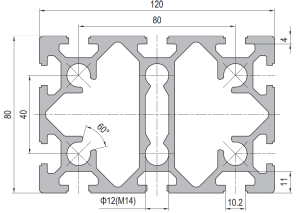
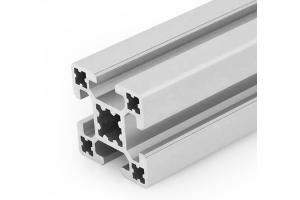 Engineering Design4040 vs 4080 Aluminium Profile: Which for Your Frame
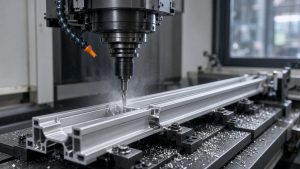 Engineering DesignCut-to-Length, Drilling and Tapping: What Fabrication Adds
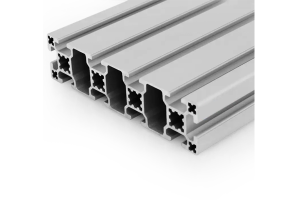
 ApplicationsWhere Modular Aluminium Framing Works: A Load-Tier Map Instead of an Industry List
 ApplicationsAluminium Conveyor Frames: Why Belt Tracking Is a Geometry Problem
 Engineering DesignT-Slot Cross-Brand Compatibility: Bosch, Item and Generic
 Materials and EngineeringIndustrial Aluminium Extrusion: Five Advantages and the Conditions Attached to Each
 Sourcing and ProcurementPayment Terms for Aluminium Profile Orders (T/T, L/C and the Risk)
 Quality and InspectionEuropean Anodised Aluminium Specification: What Should a Purchase Order Contain?
 Quality and InspectionAluminium Profile Finishes: Choose by Failure Mode, Not by Process Name
