Lean Pipe vs T-Slot Profile: Two Interface Philosophies, Not Two Generations
Lean pipe and T-slot framing are often presented as an older and a newer way to do the same thing. They are not. One joins by friction around a round tube and the other by mechanical lock in a slot, and every difference in performance follows from that.
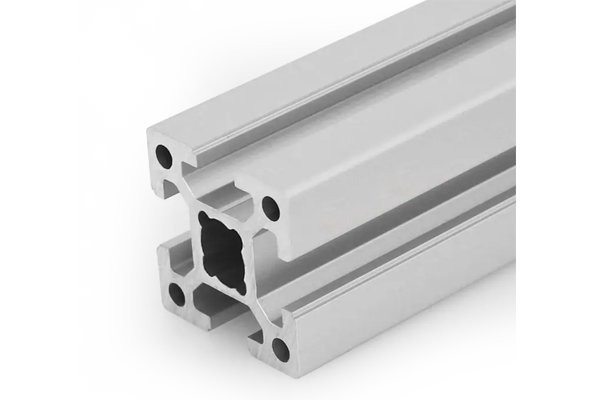
Short answer
A lean pipe system joins round tube with a clamp that grips by friction, so a joint can be repositioned by loosening one fastener and rotating it, and any angle is available without machining. A T-slot system locates a nut or connector in a groove and clamps it, so the joint is stiffer and repeatable but the angles are fixed by the section geometry. Choose lean pipe where layout changes constantly and loads are light; choose T-slot where stiffness, load capacity or dimensional repeatability matter.
The difference is the interface, not the material
Both systems use tube or profile, both are modular, and both are sold for the same applications. Comparing them by material misses the point, because the thing that determines behaviour is how a joint is made.
In a lean pipe system the structural member is a round tube and the joint is a clamp that wraps it. The clamp grips by friction, generated by tightening a fastener. Because the tube is round and the clamp can rotate around it, any angle is achievable without cutting or machining anything, and changing that angle is a matter of slackening one bolt.
In a T-slot system the member has one or more grooves, and the joint is made by a component that sits in the groove and is tightened against it. The groove defines where the joint can be and at what angle, which is a constraint, and in exchange the joint is located positively rather than held by friction.
Everything else follows. Friction joints are fast to change and slow to creep. Positive joints are slower to change and hold their position indefinitely.
| Aspect | Lean pipe system | T-slot profile system |
|---|---|---|
| Joining principle | Friction clamp around a tube | Mechanical lock in a groove |
| Angles available | Any, continuously | Fixed by section geometry, plus brackets |
| Rebuild speed | Very fast; one fastener per joint | Slower; nuts and brackets repositioned |
| Joint stiffness | Lower; joint can rotate under load | Higher; positively located |
| Repeatability | Depends on re-tightening care | High; the groove locates the part |
| Machining required | Normally none | Sometimes end tapping or access holes |
| Directionality | Isotropic; tube is the same all round | Directional; grooves are on specific faces |
What friction costs in stiffness
A friction clamp holds by normal force across a contact area. It resists rotation up to a limit set by that force and the friction coefficient, and beyond that limit it slips. Under a sustained or varying load, that slip shows up as a joint that slowly rotates or settles.
The practical consequence is that a lean pipe structure is compliant at the joints. Members are stiff, because a tube is an efficient structural shape, but the assembly is not, because every node can move a little. Add several nodes in a chain and the accumulated movement is visible.
This is not a defect. It is the price of the capability that makes the system worth having. The failure is to use a lean pipe structure in an application where joint compliance is the governing problem, which is most applications involving significant load or any requirement to hold a dimension.
The symptom
A lean pipe structure that has to be nudged back into square every few weeks is not faulty. It is telling you the joint loads exceed what friction is comfortably holding. Either the structure is under-built for the load, or it should have been a T-slot frame.
Where lean pipe genuinely wins
Set against the stiffness limitation is a set of advantages that are decisive in the right application, and they all come from the same property: the joint can be changed without any preparation.
WIN 1
Continuous adjustment. Any angle, no machining, no new parts.
WIN 2
Rebuild speed. One fastener per joint to release and reset.
WIN 3
Low skill barrier. Teams can reconfigure without drawings or cutting.
WIN 4
Isotropy. A round tube does not care which way round it is fitted.
These matter most where the layout is genuinely fluid: flow racks that are re-balanced as product mix changes, kit carts that get reshaped, and trial fixtures that will be altered several times in a week. In those applications a T-slot frame is objectively better engineered and practically worse, because every change is a small project.
- The layout changes weekly or monthly
- Loads are light and predictable
- No machining capability is available
- Angles that are not 90 degrees are common
- The team rebuilds without engineering support
- Dimensions must be held and repeated
- Loads are significant or off-centre
- Panels, doors or guards must be mounted
- The frame carries equipment or motors
- Joint stiffness is the governing requirement
The hidden running cost
A lean pipe structure has a maintenance item that a T-slot frame mostly does not: clamps need re-tightening. Friction joints relax, particularly where there is vibration or thermal cycling, and a structure that was square at commissioning will work loose over weeks.
That is a manageable cost, but it has to be budgeted. It means a re-tightening interval, an owner for it, and a check that the structure is still square when it is done. On a site with many lean pipe structures this becomes a recurring labour item that does not appear in the purchase comparison.
The second hidden cost is component loss. Clamps are small, removable without tools once slack, and easy to separate from the structure during a rebuild. Sites running large lean pipe installations usually find that spare clamps are needed not because they wear out but because they go missing.
Running costs compared
- Re-tightening intervalRequired for lean pipe; minimal for T-slot
- Spare fastener stockHigher for lean pipe
- Rebuild labour per changeLower for lean pipe
- Rebuild skill requirementLower for lean pipe
What to send with the enquiry
These two systems are quoted quite differently, and the enquiry has to state which one is being considered and why. Five items separate a useful quote from a guess.
RFQ checklist — lean pipe and T-slot
- Which system, and what drove the choice — rebuild frequency or stiffness; it changes the recommendation.
- Load per joint — the number that decides whether friction is adequate.
- Change frequency — per week, month or year; it drives the whole economic case.
- Whether angles other than 90 degrees are needed — lean pipe handles these natively.
- Tube or section material — coated steel tube or aluminium; weight, corrosion and cost differ.
- Environment — washdown, ESD, clean room; it affects both material and finish.
- Whether panels or accessories mount to the frame — a strong argument for T-slot.
- Expected quantity and repeat orders — and whether spare clamps or fasteners are in scope.
If you are unsure which system fits, describe the change frequency and the load. That pair of facts usually settles it faster than a feature comparison.
Four ways the choice goes wrong
Related on this site
- Aluminium pipe for lean pipe systems— round tube profile for pipe-and-joint structures
- PG40 40 x 40 four-slot heavy profile— the T-slot alternative
- Connecting elements category— joints and clamps for both approaches
- Modular components: the real cost structure— where the interface money goes
Terms used in this article
- Lean pipe
- A round tube, usually coated steel or aluminium, joined by friction clamps rather than by fasteners into the tube.
- Friction clamp
- A joint that holds by normal force across a contact surface; adjustable through a full range of angles.
- Positive location
- A joint where the parts are positioned by geometry, not by friction; repeatable.
- Joint compliance
- The small movement in a joint under load; accumulates across a structure.
- Isotropic
- Having the same properties in all directions, as a round tube does.
Questions buyers ask
Is lean pipe strong enough for a workstation?
For light to medium duty with frequent changes, yes. For heavy loads, cantilevered shelves or anything carrying equipment, the joint compliance becomes the limit and a T-slot frame is the better choice.
Why does my lean pipe rack keep going out of square?
Friction joints relax under load and vibration. It is characteristic of the system rather than a fault. Set a re-tightening interval, and if the drift is rapid, check whether the loads exceed what the system should be carrying.
Can I mix the two systems?
Physically yes with adapters, and it is sometimes sensible — a T-slot base with lean pipe upper structure. But it means two component inventories and an adapter at every interface, so it needs a reason.
Which is cheaper?
Per metre, lean pipe is usually cheaper to buy. Over a life with frequent changes it is often cheaper still, because rebuild labour is far lower. Add the re-tightening labour and spares before concluding.
Should the tube be steel or aluminium?
Coated steel tube is common and economical; aluminium tube is lighter, corrosion resistant and suits washdown and clean environments. The choice follows from environment and how often the structure is carried or moved.
Tell us the change frequency and the load
Give us how often the layout changes and what each joint carries, and we will tell you which system fits and quote it with the spares you will actually need.
Request a quoteRelated reading
Twelve more engineering notes from this blog, picked for this article — plus every category below.
 Engineering DesignCross-Brand T-Slot Compatibility: Interchangeability Is a Hardware Question
 Engineering DesignWhat EN 755-9 Allows: Aluminium Extrusion Tolerances
 ApplicationsHow Strong Is an Aluminium Profile? It Depends on How You Fix It
 ApplicationsHow to Fix Panels, Guards and Accessories to Aluminium Profiles
 Engineering DesignHow to Choose an Aluminium Extrusion Profile: The Three Decisions That Bind
 ApplicationsAluminium Conveyor Frames: Why Belt Tracking Is a Geometry Problem
 Engineering Design3030 vs 4040 Aluminium Profile: A Decision With Numbers
 ApplicationsWhy T-Slot Aluminium Profiles Are Used in Automation and When They Are Not
 Quality and InspectionGood vs Bad Aluminium Profiles: What Your Receiving Dock Can and Cannot Check
 Sourcing and ProcurementAluminium Profile Quote: What Changes the Number by Quantity
 Quality and InspectionAluminium Extrusion Certificates and Standards Explained (EN 755, EN 12020, ISPM 15)
 Quality and InspectionEuropean Anodised Aluminium Specification: What Should a Purchase Order Contain?
