30 Series T-Slot Profiles: The Middle That Has to Justify Itself
Between the light 20 series and the standard 40 series sits the 30 series. It is a good system, and it is also the one most often chosen for the wrong reason, because the reason to move up from 20 is rarely the one buyers assume.
Short answer
The 30 series is defined by its slot, and in this system that slot has an 8.2 mm groove with a 6 mm mouth and takes an M6 fastener. That is the same fastener size as the 20 series. So moving from 20 to 30 does not buy a bigger bolt; it buys section depth and a more robust slot lip, and those are the reasons to do it. What the 30 series genuinely offers is a middle position: roughly three centimetres to the fourth in stiffness at about 1.15 kilograms per metre, against about half that stiffness at around 0.62 for a 20 x 20, and around 6.5 to 7.2 on the 40 x 40 sections that keep a solid face at about two kilograms per metre. It wins where a 20 series frame is too flexible but a 40 series frame is heavier and more expensive than the job needs. It loses where the accessory you need simply does not exist in the series.
What the 30 series is, and what it is not
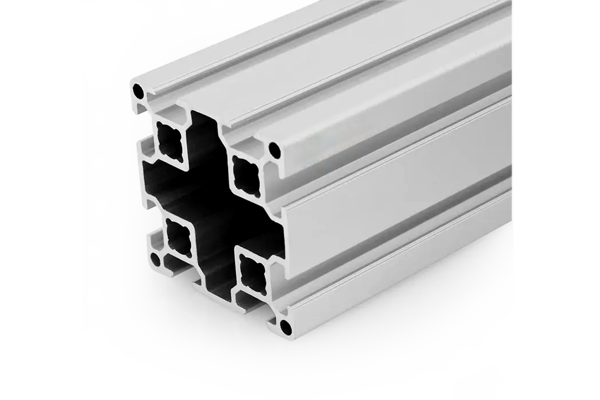
A series number describes a slot family. In this range the 30 series slot is an 8.2 mm groove with a 6 mm mouth, taking M6 slot nuts, and the sections are built on a 30 mm slot pitch with one slot per face on a 30 x 30 square.
The first thing to get right is the fastener. Because the mouth is 6 mm, the fastener that passes through it is M6, exactly as on the 20 series. The 8.2 mm groove is wider than the mouth so that the nut can be captured inside, not so that a larger bolt can pass. The step to an 8 mm mouth, and therefore to M8, happens at the 40 series.
That single fact changes the argument for the series. If the reason for upgrading is a stronger bolt, one step is not enough and the answer is the 40 series. If the reason is a stiffer frame or a slot lip that will not deform under a bracket, the 30 series is exactly the right move.
A quick way to remember the ladder
20 series: 6.2 mm groove, 6 mm mouth, M6. 30 series: 8.2 mm groove, 6 mm mouth, M6. 40 series: 10.2 mm groove, 8 mm mouth, M8. Two steps, not one, if the goal is a larger fastener.
The real reason to move up from the 20 series
On a 20 series section the wall at the slot lip is around 1.5 mm, and that thin wall is what carries any load applied through the slot. It is the part that deforms when a bracket is loaded, and it is why a 20 series joint can loosen without anything having broken.
The 30 series answers that directly. The 30 x 30 four-slot section has a nominal 2.2 mm flange and an 8 mm web, and it carries about 1.15 kilograms per metre against roughly 0.62 for a 20 x 20 four-slot. Nearly twice the material, distributed where the load arrives, with the same fastener and the same accessory philosophy.
The second gain is stiffness, and it is a large one relative to the weight. Published section data for the 30 x 30 four-slot gives approximately 3.0 cm⁴ about both axes. Because the section is square, that stiffness is available in both directions, which a rectangular 20 x 40 cannot offer. For a frame that has to stay square under a panel or carry an occasional load in an unpredictable direction, the square section is the practical answer.
The 30 x 30 four-slot, in numbers
It is worth seeing what the section actually provides, because these are the numbers that decide whether the middle is the right place to be.
| Feature | Value (approx.) | Why it matters |
|---|---|---|
| Envelope | 30 x 30 mm square | Square section: stiffness is available in both planes |
| Slots | 4 x 8.2 mm groove, 6 mm mouth | M6 fastener, one slot per face |
| Slot pitch | 30 mm; 23 mm between centres across a corner | Sets accessory and bracket spacing |
| Wall | 2.2 mm flange, 8 mm web | A substantially thicker lip than the 20 series |
| Corner bores | 4 x 4.5 mm, M6 clearance | Direct end-to-end and bracket fixing without a slot nut |
| Centre bore | Phi 10 mm, tapped M12 at the end | Feet, castors and levellers screw straight in |
| Stiffness | approx. 3.0 cm⁴ | The number to compare against your deflection limit |
| Mass | approx. 1.15 kg/m | The cost and handling consequence |
The centre bore deserves attention because it is often the feature that decides the series on a real project. A tapped end bore means a levelling foot, a castor or a threaded insert attaches without any bracket and without consuming slot. On a 20 series frame the same foot usually needs a plate and slot space, which is where a small frame starts to run out of real estate.
What it buys over the 40 series, and what it gives up
The 40 series is where this system becomes genuinely heavy-duty. Its 10.2 mm groove and 8 mm mouth take M8, its four-slot section runs from about 1.30 kilograms per metre in a light wall to about 2.35 in a heavy wall, and on the configurations that keep a solid face the family is published at roughly 6.5 to 7.2 cm⁴.
So the trade is straightforward: the 40 series roughly doubles the stiffness of the 30 series for roughly 1.7 times the mass, and it brings a larger fastener and a much deeper accessory ecosystem. That is a favourable trade, and it is why the 40 series dominates. The 30 series wins only when the extra stiffness is genuinely not needed, because on a small frame the difference in mass and cost is real and the difference in capability is not.
The less obvious cost of the middle is the ecosystem. A framing system is not a profile; it is a profile plus the brackets, hinges, feet, handles, cable clips and panel fixings that go with it. If the accessory you need exists in the 20 and 40 series and not in the 30, choosing the middle means paying an engineer to design around it, and that cost appears in hours rather than in the material bill. This is a genuine B2B consideration and it is almost never on a data sheet.
The practical rule is to choose the series by the accessory list first and the stiffness second, then check that the stiffness is adequate. Doing it in the other order is how projects end up with a perfectly adequate frame and an awkward build.
Mixing series
Mixing is possible and it should be a decision rather than an accident. A 30 series member and a 40 series member cannot be bolted directly to one another, because the slot geometry and the fastener differ; the joint needs an adapter plate or a bracket designed for the transition.
The real cost of mixing is spares. Two series means two sets of slot nuts, two sets of brackets, two sets of tools and two sets of drawings, and it means that a maintenance technician reaching for a bracket has a fifty per cent chance of picking the wrong one. Where a frame mixes series, the transition points should be few, deliberate, and marked on the drawing.
If a project genuinely needs both, the usual sensible split is a 40 series base and posts with 30 series for the lighter upper structure, rather than an interleaved mix throughout.
Where the 30 series is the right answer
The 30 series earns its place in a fairly narrow band, and it is a large band in practice.
It is right where a 20 series frame is too flexible or its slot lip too easily deformed, but where the load is still modest: light machine enclosures, small carts and trolleys, laboratory benches and instrument frames, guard rails and light safety fencing, display and signage structures, and the upper structure of a machine where the base carries the real load.
It is the wrong answer where a person leans or sits, where the frame carries a heavy panel over a long span, where vibration is significant, or where the design has any chance of growing. In those cases the 40 series costs a little more and removes a whole class of future problems.
What to send with a 30 series enquiry
RFQ checklist — 30 series frames
- Why the 30 series — state whether the driver is stiffness, slot-lip robustness, or an existing build you are matching.
- Load and deflection limit — the limit is what decides the section, and 3.0 cm⁴ is the number to check against it.
- Longest unsupported span — and whether intermediate supports are acceptable.
- Accessory list — hinges, feet, handles, cable management and panel fixings; confirm they exist in the series before committing.
- Feet and mobility — whether levelling feet or castors go into the tapped end bore or need a plate.
- Whether other series are involved — if so, define the transition points and the adapter.
- Environment and finish — anodic class or powder, and whether cut ends are sealed.
- Cut length tolerance — on a frame with real stiffness, a racked rectangle is the most common build defect.
Ask one question before quoting: does every accessory on the list exist in this series. If not, the cheapest series is the one with the parts you need.
Five ways the middle gets chosen badly
Related on this site
- 3030 vs 4040: an engineering comparison— the same decision with numbers
- How the series matrix actually works— why series numbers describe slots, not sizes
- PG30 30 x 30 four-slot profile— the section used as the example here
- The slot mouth is the interface standard— why the 6 mm mouth, not the 8.2 mm groove, sets the fastener
Terms used in this article
- Series
- A slot family defined by its slot geometry and fastener size, not by the outside dimensions of the profile.
- Slot mouth
- The narrow opening at the surface; at 6 mm it passes M6 and no more, whatever the internal groove measures.
- Slot pitch
- The spacing of slot centres, which sets the accessory and bracket spacing.
- Centre bore
- The central hole running the length of the profile, often tapped at the end to accept a foot, castor or insert.
- Second moment of area
- The geometric property governing stiffness in bending; given in centimetres to the fourth.
- Accessory ecosystem
- The range of brackets, fasteners and fittings available in a given slot series; a practical constraint on series choice.
Questions buyers ask
Does the 30 series use M8 bolts?
No. The 30 series slot has an 8.2 mm groove but a 6 mm mouth, so the fastener is M6, the same as the 20 series. M8 arrives with the 40 series, which has an 8 mm mouth.
Is 3030 strong enough for a machine frame?
For a light enclosure or an instrument frame, usually yes. For a frame carrying real machine loads, with long unsupported spans or significant vibration, the 40 series is the safer and usually cheaper answer.
Can I bolt a 30 series profile to a 40 series profile?
Not directly, because the slot geometry and fastener differ. The joint needs an adapter plate or a transition bracket, and the transition points should be defined on the drawing.
What does the tapped centre bore give me?
A threaded attachment at the end of the member, so levelling feet, castors or inserts screw straight in without a bracket and without consuming slot length.
Why is 3030 quoted at different weights by different suppliers?
Because the sections differ. Slot count, slot width and wall thickness vary inside the same nominal envelope, and the difference shows first at the slot lip.
Send the accessory list with the drawing
Give us the frame layout and the fittings you need, and we will tell you whether the 30 series covers them or whether the 40 series is the cheaper route once engineering hours are counted.
Request a quoteRelated reading
Twelve more engineering notes from this blog, picked for this article — plus every category below.
 Engineering DesignT-Slot Cross-Brand Compatibility: Bosch, Item and Generic
 Sourcing and ProcurementAluminium Profile Shipping: Packing, Container Loading and ISPM 15
 Engineering DesignAluminium Extrusion Tolerances: What to Write, and How to Inspect
 Engineering Design6063 vs 6061 vs 6082 and T5 vs T6: What Changes in Practice
 ApplicationsAluminium Conveyor Frames: Why Belt Tracking Is a Geometry Problem
 Engineering DesignHow to Join Aluminium Profiles: Joints, Brackets and Torque
 Engineering DesignAluminium Extrusion Capacity: What a Factory Can Actually Deliver
 Engineering DesignT-Slot vs V-Slot Aluminium Profiles: The V Is a Raceway, Not a Cheaper T
 Quality and InspectionAnodising vs Powder Coating: Thickness, Colour, Salt Spray
 Materials and EngineeringIndustrial Aluminum Profiles: Alloys, Tempers and How to Select Them
 ApplicationsAluminium Profiles in Solar Mounting: Wind Uplift, Corrosion and a 25-Year Life
 ApplicationsAluminium Profiles in Industry and Construction: One Material, Two Acceptance Logics
